Archival Note
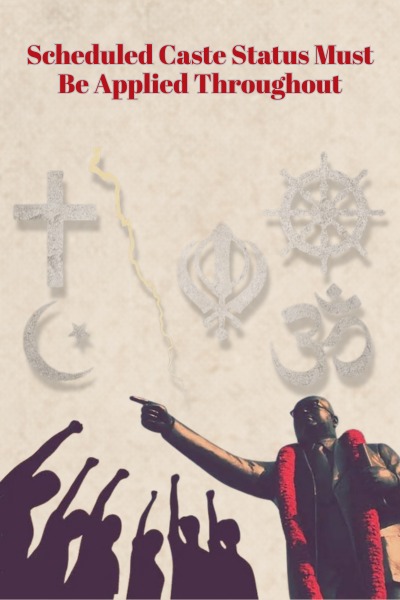
Published in Dalit Voice (Vol. 24, Issue No. 5, 1 March 2005), this essay by V. T. Rajshekar takes up the demand for Scheduled Caste reservations for Dalit Christians. Rajshekar argues that caste is a social identity rooted in birth and historical oppression, and that religious conversion does not erase that identity. He uses the inclusion of Dalit Sikhs and Dalit Buddhists in the Scheduled Caste framework to question why Dalit Christians continue to be excluded.
For Rajshekar, conversion is itself part of the history of resistance to caste. Dalits who converted to Christianity, Islam, Sikhism or Buddhism, he argues, changed their religion without escaping the caste identity imposed on them. The continued exclusion of some converts from Scheduled Caste recognition therefore reproduces the divisions created by the caste order, separating Dalits who share a history of untouchability on the basis of their present religion. His argument makes the recognition of Dalit Christians a question larger than reservation: it concerns whether the Dalit movement understands caste as an identity that can persist across religious boundaries.
The question Rajshekar raised in 2005 remains central to the present dispute over Scheduled Caste status for Dalit Christians and Dalit Muslims. The revived Dalit Voice has returned to the issue in its recent discussion of the Supreme Court’s refusal to grant constitutional protection to Dalits across religions, arguing that caste continues to operate beyond religious boundaries. The archival essay shows that Dalit Voice had identified this problem two decades ago: if caste survives religious conversion, then legal protection against caste discrimination cannot depend on a person’s religion.
Below is an abridged version of the essay. The complete piece can be read in its original context here: [Read the full essay]
Supreme Court Must Keep Off Social Problems
DV supports Dalit Christian quota: Church must force government by mobilising support
In fact, it was the Dalit Voice which first mooted the proposal of reservations to Dalit Christians. We also vigorously campaigned for it all over India.
The underlying principle is caste is our basic identity and this identity can never be destroyed even by conversion to another religion. Every socio-cultural development in this country from time immemorial has taken place by taking into consideration caste, the basic building brick of India.
Hindu gas chamber: The Untouchables, the original inhabitants of this land, became victims of Brahminism and suffered for centuries. To protest against Brahminism, the victims of untouchability crossed over to Christianity, Islam, Sikhism and Buddhism. They only changed their religion (which is like a dress) but not their identity. (V.T. Rajshekar, Caste – A Nation Within the Nation, Books for Change, 2002).
But the Brahminical rulers, to punish the Untouchables getting out of their Hinduism, fearing that their artificially floated “majority religion” would become a micro-minority religion, punished the Untouchables fleeing out of their Hindu gas chamber. But this also did not work.
Racism in India: Religious conversion is one of the powerful socio-cultural weapons of the deprived destitutes to liberate themselves. No power on earth can stop it notwithstanding the ridiculous protests launched by the jealous Hindu nazis against the American Evangelist Benny Hinn visit to Bangalore in Jan. 2005. Dr. Babasaheb Ambedkar himself has recommended the conversion weapon. (Why Go for Conversion? DSA-1987)
The Muslims (15%), Christians and Sikhs (5%) did not come from outside India. At least 90% of its followers are Untouchables, Tribals and Backward Castes. Today, after going over to these egalitarian religions, they say they feel liberated and hence powerful.
It is the Dalit Christians who are mainly responsible for taking the issue of Brahminical racism in India to the United Nations at Durban and making the world aware of the worse-than-Apartheid practices in Hindu India.
Verdict of history: The Brahminical fear is that if the SC/ST reservations are extended to the converts not only the floodgates of conversion will be wide open but more than that the converted Dalits will join hands with the non-converted Dalits and together they will hammer the micro-minority Aryan oppressors, and their empire built on bluffs and blackmail will simply collapse. Every problem of India arises out of this fear.
History is not on the side of the Brahminical Social Order (BSO). Justice and Truth can never be demolished even if the BSO has the support of the Supreme Court.
It is this fear that made the BSO rulers put all sorts of restrictions on SC/ST reservations. Since the higher judiciary is loaded with upper castes, (this judiciary is the main stumbling block to the social and cultural advancement of India’s oppressed majority), the rulers have been mainly seeking the willing help of the judiciary.
Dalit Christian mistake: The simple question is when the Dalit Sikhs and Dalit Buddhists are already included in the SC/ST reservation list why this discrimination only against Dalit Christians? Is not the Brahminical mischief clear?
The Untouchables, whichever be their religion, even the more egalitarian Islam, are all our brothers and the mischievous Brahminical bid to divide Brothers from Brothers must be fought.
To hell with Presidential Order: We are fully aware that the Brahminical rulers are using the state power and the judiciary to divide us and discriminate against us. The BSO must know that it is taking advantage of our goodness and mistaking our peace-loving nature to our docility. They can fool the people for some time. Those days are over.
The Government of India and the Supreme Court should stop taking shelter under the Presidential Order (PO) of 1950. This Order is not part of the Constitution. When this Order was amended many times to include the Sikh and then the Buddhist converts, it can be amended again and again. When the Constitution itself was amended umpteen times, what is big about PO? The government [has to do this] in the interest of the people. Parliament being the highest court of the people can certainly endorse it.
The Supreme Court must note [the] social and cultural problems vexing the people, particularly the oppressed SC/ST/BCs and Muslim/Christian/Sikhs, [and therefore] it should not interfere.
Attorney-General (AG) Milon Banerji said the same thing when the matter came up before the Supreme Court on Feb. 11, 2005. He said he had written a letter to the Government to consider the case of Dalit Christian reservation sympathetically. “It is a matter of policy and legislation and the courts should keep out of it”. Well said.
We don’t know what made today’s Government of India to reject AG’s request. The previous Brahmana Jati Party (BJP)-led Government did reject the demand in 2002 because that Government was led by a set of anti-people Hindu nazi leaders like Vaidik Vajpayee. But that is not the case with the Manmohan Singh Government. Why did it repeat the same old song? Sonia Gandhi must interfere and correct the course.
Upper caste church leadership: The Christian Church leadership is to be partly blamed for not taking genuine interest in the case of Dalit Christian reservation.
Over 75% of the Indian Christians are Dalit. The Indian church itself is a Dalit church. But the leadership of the church is with the upper caste particularly the Syrian Christians.
Now that the Supreme Court has decided to take up the matter after four weeks, the church leadership must prevail upon the Government of India not to oppose the plea of the Dalít Christians. It should also prepare public opinion and produce enough literature so that the Government of India changes its mind and the Supreme Court does not get in the way.
If they refuse to see reason, then the church must get down to mass action. We are here to render any support. Because Dalit Christians are our brothers.