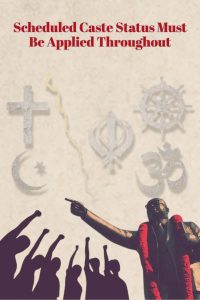
Scheduled Caste Status Must Be Applied Throughout

Archival Note

Published in Dalit Voice (Vol. 24, Issue No. 5, 1 March 2005), this essay by V. T. Rajshekar takes up the demand for Scheduled Caste reservations for Dalit Christians. Rajshekar argues that caste is a social identity rooted in birth and historical oppression, and that religious conversion does not erase that identity. He uses the inclusion of Dalit Sikhs and Dalit Buddhists in the Scheduled Caste framework to question why Dalit Christians continue to be excluded.

For Rajshekar, conversion is itself part of the history of resistance to caste. Dalits who converted to Christianity, Islam, Sikhism or Buddhism, he argues, changed their religion without escaping the caste identity imposed on them. The continued exclusion of some converts from Scheduled Caste recognition therefore reproduces the divisions created by the caste order, separating Dalits who share a history of untouchability on the basis of their present religion. His argument makes the recognition of Dalit Christians a question larger than reservation: it concerns whether the Dalit movement understands caste as an identity that can persist across religious boundaries.

The question Rajshekar raised in 2005 remains central to the present dispute over Scheduled Caste status for Dalit Christians and Dalit Muslims. The revived Dalit Voice has returned to the issue in its recent discussion of the Supreme Court’s refusal to grant constitutional protection to Dalits across religions, arguing that caste continues to operate beyond religious boundaries. The archival essay shows that Dalit Voice had identified this problem two decades ago: if caste survives religious conversion, then legal protection against caste discrimination cannot depend on a person’s religion.

Below is an abridged version of the essay. The complete piece can be read in its original context here: [Read the full essay] 


Supreme Court Must Keep Off Social Problems

DV supports Dalit Christian quota: Church must force government by mobilising support

In fact, it was the Dalit Voice which first mooted the proposal of reservations to Dalit Christians. We also vigorously campaigned for it all over India.

The underlying principle is caste is our basic identity and this identity can never be destroyed even by conversion to another religion. Every socio-cultural development in this country from time immemorial has taken place by taking into consideration caste, the basic building brick of India.

Hindu gas chamber: The Untouchables, the original inhabitants of this land, became victims of Brahminism and suffered for centuries. To protest against Brahminism, the victims of untouchability crossed over to Christianity, Islam, Sikhism and Buddhism. They only changed their religion (which is like a dress) but not their identity. (V.T. Rajshekar, Caste – A Nation Within the Nation, Books for Change, 2002).

But the Brahminical rulers, to punish the Untouchables getting out of their Hinduism, fearing that their artificially floated “majority religion” would become a micro-minority religion, punished the Untouchables fleeing out of their Hindu gas chamber. But this also did not work.

Racism in India: Religious conversion is one of the powerful socio-cultural weapons of the deprived destitutes to liberate themselves. No power on earth can stop it notwithstanding the ridiculous protests launched by the jealous Hindu nazis against the American Evangelist Benny Hinn visit to Bangalore in Jan. 2005. Dr. Babasaheb Ambedkar himself has recommended the conversion weapon. (Why Go for Conversion? DSA-1987)

The Muslims (15%), Christians and Sikhs (5%) did not come from outside India. At least 90% of its followers are Untouchables, Tribals and Backward Castes. Today, after going over to these egalitarian religions, they say they feel liberated and hence powerful.

It is the Dalit Christians who are mainly responsible for taking the issue of Brahminical racism in India to the United Nations at Durban and making the world aware of the worse-than-Apartheid practices in Hindu India.

Verdict of history: The Brahminical fear is that if the SC/ST reservations are extended to the converts not only the floodgates of conversion will be wide open but more than that the converted Dalits will join hands with the non-converted Dalits and together they will hammer the micro-minority Aryan oppressors, and their empire built on bluffs and blackmail will simply collapse. Every problem of India arises out of this fear.

History is not on the side of the Brahminical Social Order (BSO). Justice and Truth can never be demolished even if the BSO has the support of the Supreme Court.

It is this fear that made the BSO rulers put all sorts of restrictions on SC/ST reservations. Since the higher judiciary is loaded with upper castes, (this judiciary is the main stumbling block to the social and cultural advancement of India’s oppressed majority), the rulers have been mainly seeking the willing help of the judiciary.

Dalit Christian mistake: The simple question is when the Dalit Sikhs and Dalit Buddhists are already included in the SC/ST reservation list why this discrimination only against Dalit Christians? Is not the Brahminical mischief clear?

The Untouchables, whichever be their religion, even the more egalitarian Islam, are all our brothers and the mischievous Brahminical bid to divide Brothers from Brothers must be fought.

To hell with Presidential Order: We are fully aware that the Brahminical rulers are using the state power and the judiciary to divide us and discriminate against us. The BSO must know that it is taking advantage of our goodness and mistaking our peace-loving nature to our docility. They can fool the people for some time. Those days are over.

The Government of India and the Supreme Court should stop taking shelter under the Presidential Order (PO) of 1950. This Order is not part of the Constitution. When this Order was amended many times to include the Sikh and then the Buddhist converts, it can be amended again and again. When the Constitution itself was amended umpteen times, what is big about PO? The government [has to do this] in the interest of the people. Parliament being the highest court of the people can certainly endorse it.

The Supreme Court must note [the] social and cultural problems vexing the people, particularly the oppressed SC/ST/BCs and Muslim/Christian/Sikhs, [and therefore] it should not interfere.

Attorney-General (AG) Milon Banerji said the same thing when the matter came up before the Supreme Court on Feb. 11, 2005. He said he had written a letter to the Government to consider the case of Dalit Christian reservation sympathetically. “It is a matter of policy and legislation and the courts should keep out of it”. Well said.

We don’t know what made today’s Government of India to reject AG’s request. The previous Brahmana Jati Party (BJP)-led Government did reject the demand in 2002 because that Government was led by a set of anti-people Hindu nazi leaders like Vaidik Vajpayee. But that is not the case with the Manmohan Singh Government. Why did it repeat the same old song? Sonia Gandhi must interfere and correct the course.

Upper caste church leadership: The Christian Church leadership is to be partly blamed for not taking genuine interest in the case of Dalit Christian reservation.

Over 75% of the Indian Christians are Dalit. The Indian church itself is a Dalit church. But the leadership of the church is with the upper caste particularly the Syrian Christians.

Now that the Supreme Court has decided to take up the matter after four weeks, the church leadership must prevail upon the Government of India not to oppose the plea of the Dalít Christians. It should also prepare public opinion and produce enough literature so that the Government of India changes its mind and the Supreme Court does not get in the way.

If they refuse to see reason, then the church must get down to mass action. We are here to render any support. Because Dalit Christians are our brothers.

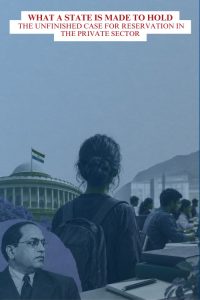
What a State Is Made to Hold: The Unfinished Case for Reservation in the Private Sector

“The purpose of a system is what it does,” Stafford Beer once said: not what its charter claims, not what its founders intended, not what its defenders insist it’s secretly working toward once the numbers look bad. The line comes from Beer’s work in cybernetics and systems theory, but it travels well, because it was really a warning against taking any institution’s word for itself. Apply it to the state and the sentence stops being quippy and starts being uncomfortable. A state does not do what its Constitution’s preamble promises. It does not do what its bare acts say it must. It does what its politicians ignore until an election forces a promise out of them. It does what a police force using violence on citizens with impunity does. It does the slow torture bureaucrats in government offices administer by attrition. It does the routine ignoring of injustice courts specialise in. Everything else is marketing.

A state’s default setting isn’t a neutral one, but it isn’t a fixed conspiracy either: it simply doesn’t move unless it’s made to. Every gain anyone has pulled out of a state came after someone made not conceding more expensive than conceding.

Reservation itself carries the memory of that fact in its own founding story. Ambedkar’s original demand, at the Round Table Conferences, was a separate electorate for the Depressed Classes: our own constituencies, our own voters, our own representatives answerable to no one else’s veto, a political existence independent of Hindu society rather than embedded inside it. The Communal Award of August 1932 granted exactly that. Gandhi, in prison, announced a fast unto death to force its withdrawal, blackmailing the Depressed Classes and its leaders as well as the British rulers, on the ground that a separate electorate would permanently divide Hindu society. Ambedkar held out against a starving man for days before the political pressure, not the argument, became unbearable on practical grounds, and what emerged from the negotiation at Poona was not the separate electorate but reserved seats inside a joint electorate: more seats than the Award had granted, 148 in the provincial legislatures instead of the original allotment, but folded back into the same political body Ambedkar had tried to exit. Reservation was not the original ask. It is what remained after the original mandate was made impossible by someone else’s leverage and the Hindu moral bankruptcy behind it. The instrument defended for ninety years since it has itself been a settlement, arriving at under duress, from a wider claim.

Rahul Sonpimple, founder of the All India Independent Scheduled Castes Association (AIISCA), made a version of this point at a press meeting on private sector reservation in Delhi on 27th September, framing reservation as something closer to a treaty than an entitlement: a thin, fragile thread and the only one tying Dalits, Adivasis and OBCs to the Indian state, functioning not as generosity but as a negotiated peace. It buys the state and the dominant castes who still hold most of the country’s assets a measure of calm from a majority whose rightful share has otherwise been denied, while giving the numerically dominant Bahujan population some working proxy for the democratic weight their numbers should carry. A contract, not a gift. Except a contract is only as good as what a party can be made to perform under it, and a state that already treats its own preamble as marketing will treat a contract no differently.

A contract implies parties, and a state, unlike a private employer, actually has one with its citizens. It demands loyalty, taxation, submission to its law, alongside the monopoly to dictate the political fates of those within its territory, in exchange for a set of standing obligations back. A private firm asks for labour under a contract either side can in principle at least walk from, and owes nothing back to someone who was never bound to it in any comparable way. That asymmetry is a large part of why a claim on the state’s own hiring is different in kind from a claim on a firm’s, not because the state behaves more responsibly in practice, as we are all well-aware, but because it owes something on the terms of the relationship itself. Although an obligation the state owes but doesn’t perform is worth exactly as much as a preamble it doesn’t act on.

A private firm is not identical to the state, and the case for reaching it anyway doesn’t depend on pretending otherwise. It rests on two separate facts. The economy itself has changed since the framers drew the line at public employment, and a social justice framework confined to the public sector now leaves most of economic life untouched, because most of it no longer sits inside the public sector at all, a gap widened further by the same state’s ongoing privatisation of what public capacity remains, shrinking the one terrain where proportional representation currently carries legal force. But the second fact runs deeper and doesn’t depend on how recent liberalisation is: a private sector built on land, credit, licenses and infrastructure the state provides, privatising its profits while routinely and unsparingly socialising its costs through subsidy, tax concession and public investment, has never sat outside the state’s reach in the first place, this was true of Indian capital before 1991 as much as after it. A firm that depends on the state which itself takes from the public commons for that much can never be allowed to answer to nothing beyond its own balance sheet.

Even so, there’s a real limit to what representation alone produces. Elevated individuals from a movement or caste often become instruments of the institution’s own legitimation rather than being accountable to the base that elevated them, and when they try to push further beyond the constraints and the logics of those systems, they get cut down by the sheer weight of social forces unwilling to tolerate the progress already made. Despite that, political reservation has still converted into something more durable than individual token presence, an independent structure of Bahujan power that didn’t exist before it, even as oppressor-caste violence against that rise has grown alongside it. What government service has that the private sector doesn’t is exactly this: decades of organised structure built up around the reserved seat, structure that keeps contesting the ceiling even where it doesn’t break through it. The private sector has never had an equivalent foothold, and no amount of employer voluntarism has ever built one. That’s the case for statutory reservation even in its thinnest form: not that a quota alone delivers equality, especially substantively, but that it’s the minimum legal anchor around which durable, organisable power can be built at all.

Against that backdrop, private sector reservation is not a new demand groping for its first hearing. It has been formally raised for close to two decades. The All India Confederation of SC/ST Organisations was pressing the case as early as 2012, organising a march on Delhi backed by three dozen SC/ST organisations, arguing plainly that no nation stays strong while its economic and social levels remain this split. But even before that, in 2003, then Prime Minister Atal Bihari Vajpayee addressed a meeting of SC and ST MPs and said that the private sector cannot exist in isolation and has to be responsive to the needs of the society, making it essential to have reservation in the private sector. This was followed by a broad consensus among electoral parties across the ideological spectrum on the matter, even though it has not yet been translated into political will or substantive action. One concrete effort came in 2006, under Prime Minister Manmohan Singh, when he appealed directly to Indian industries to become the government’s partner on the question. However, rather than legislate a mandate, the government let industry regulate itself: CII, FICCI and ASSOCHAM each adopted a Voluntary Code of Conduct built around four pillars, Employability, Education, Entrepreneurship Development and Employment. That October, the PMO had already constituted a Coordination Committee on Affirmative Action in the Private Sector, chaired by the Principal Secretary to the Prime Minister, drawing on the Department of Personnel and Training, the Ministry of Social Justice and Empowerment, the Ministry of Tribal Affairs, and serviced by the Department of Industrial Policy and Promotion. The Committee has met nine times since. By 2010, the government’s own review found adoption of the voluntary codes was slow; by 2013, it was still describing the same dialogue as ongoing; by 2015, industry associations were reporting hundreds of member companies signed on. Twenty years of this arrangement has produced a voluntary code without enforceable duties, and industry associations professing over a lakh of beneficiaries with no verifiable representation data to back the figure. Now we cannot sit once again with a renewed appeal for goodwill. What is needed is to go beyond an empty promise and fight for a statutory guarantee: a binding quota, backed by rule of law, not another code any signatory can stop honouring when they feel like it.

On 26 July 2024, that demand reached Parliament directly. Chandrashekhar Azad, MP for Nagina, introduced a private member’s bill titled the Reservation for the Scheduled Castes, the Scheduled Tribes and the Other Backward Classes in Private Sector Act, 2024, one of three private member’s bills he introduced in the Lok Sabha that day. It covers private firms, educational institutions and other establishments employing at least twenty people with no government financial stake. Even this bill stops short of a binding hiring quota: its mechanism is incentive-based, requiring the central government to induce private firms toward reservation through special concessions and lower-interest loans via nationalised banks, with an annual implementation report tabled in both Houses. Structurally, a private member’s bill has almost no chance of becoming law: enactment is the exception, not the rule, and has been for decades. That a bill this cautious, relying on incentives rather than quotas, remains a private member’s bill and is still pending says something about how far Parliament remains from treating this as settled business.

But the case for the demand itself rests on documented discrimination. Sukhadeo Thorat and Paul Attewell’s 2007 correspondence study sent matched applications under upper-caste Hindu, Dalit and Muslim names to private-sector job advertisements in the English dailies and found discrimination operating at the very first screening stage, before any interview, before any assessment of merit beyond a name on a page. Zahra Siddique’s 2011 work went further, quantifying the size of the gap and who was driving it: low-caste applicants had to send 20% more resumes than high-caste applicants to get the same callback rate, with the disparity sharpest when the recruiter was male or Hindu, and more pronounced at smaller firms than larger ones. Axmann, Swanson and Cuspinera Contreras, using Indian Human Development Survey data in 2016, found significant wage discrimination against Dalits and Adivasis specifically inside the private sector. Madheswaran and Singhari, drawing on National Sample Survey employment data the same year, found SC workers earning less than equally qualified forward-caste workers in urban labour markets, with the gap wider in private employment than public, and unequal access to occupations itself doing much of the work in producing the disparity. Pattayat’s 2024 study of rural non-farm workers, using NSSO and PLFS data spanning 2004-05 to 2019-20, found the earnings gap persisting across that entire period and examined how much of it discrimination itself accounted for.

Article 15(5) already gives the state constitutional room to act on half of this. Inserted by the 93rd Amendment in 2005 and in force since January 2006, it permits special provision by law for socially and educationally backward classes, Scheduled Castes and Scheduled Tribes in admission to educational institutions, explicitly including private institutions, aided or unaided, with the sole carve-out for Article 30(1) minority institutions. Because education sits on the Concurrent List, both Parliament and state legislatures can act under it, and several states have already legislated on private educational admissions. Tamil Nadu enacted a 2006 law providing 69% reservation for Backward Classes, Most Backward Classes and Denotified Communities, Scheduled Castes and Scheduled Tribes in private educational institutions. Andhra Pradesh had already applied SC, ST and Backward Class reservations to admissions in private professional institutions through its admission rules. Karnataka’s 2006 Professional Educational Institutions Act provides for 50% reservation for SCs, STs and OBCs in unaided non-minority professional institutions. Maharashtra enacted a 2006 law providing reservation for SCs, STs, Denotified Tribes, Nomadic Tribes and OBCs in private professional educational institutions, while Haryana’s 2016 Backward Classes Act provides reservation for Backward Classes in admissions to educational institutions, including private institutions.

What that record shows is that Article 15(5) has been given statutory effect at the state level, but unevenly and without a nationwide framework. A Parliamentary Standing Committee report presented to the Rajya Sabha in August 2025 said that private educational institutions are currently under no national legal obligation to implement reservation because there is no central statute mandating it. It recommended that Parliament legislate 27%, 15% and 7.5% reservation for OBCs, SCs and STs respectively in private higher educational institutions, with government reimbursement of the associated costs on the model of the Right to Education Act. Although a sincere Caste Census may tell us that the necessary numbers should be much higher, the constitutional ceiling on reservation itself also needs to be revisited.

What Article 15(5) doesn’t reach at all is employment, and that gap isn’t small: education and employment were never separable; a degree that doesn’t convert into a job is a credential, not a livelihood. One state that tried a binding private-sector quota by its own legislation ran straight into that trap. Haryana’s 2020 State Employment of Local Candidates Act mandated 75% reservation for domiciled candidates in private jobs under a salary threshold, with a 10% district sub-cap built in, not a caste quota, a domicile one. The Punjab and Haryana High Court struck it down in 2023 as unconstitutional and violative of Part III of the Constitution; the challenge to that judgment remains pending before the Supreme Court. The deeper problem predates the ruling: the 93rd Amendment gave the state constitutional room to reach private education specifically and never extended that room to private employment. Domicile was the classification that failed here, not caste, but replacing domicile with caste would not by itself resolve the Article 19(1)(g) problem, because no amendment has yet done for employment what the 93rd did for education. That is what this demand still needs and hasn’t gotten: not just a statute, but a constitutional amendment opening the same room for private employment that the 93rd opened for private education, without which any statute meets the wall Haryana did.

Winning that room would still only secure a narrower claim than the one Ambedkar himself eventually made. Private sector reservation, at its most comprehensive, means reservation in private employment, reservation in private educational institutions, and an Equal Employment Opportunity Act as organizations like AIISCA and others have been demanding: legislation with a working complaint mechanism, an investigation process, ongoing monitoring, and real accountability, reaching recruitment, wages, promotion, workplace treatment, termination, occupational allocation, contract employment and professional advancement, not just the moment of hire. That last piece is the one twenty years of voluntary codes never touched, because a Voluntary Code of Conduct had no enforceable complaint mechanism and no statutory consequence for ignoring it. A statute would. But even this full slate, a foothold at every stage of the employment relationship, asks only for fair terms of entry into an economy whose ownership stays exactly where it already is. It is a claim to be treated fairly inside the room. It has never been a claim on who owns the room.

Ambedkar’s own economic writing sits alongside all of this as one part of a longer record, that expands the horizon of economic fight itself. In States and Minorities, the memorandum he prepared for the Constituent Assembly on behalf of the Scheduled Caste Federation, he proposed a state control over economy in which key industries would be owned and run directly by the state and basic industries owned by the state and run through its own corporations, with land held under state ownership and cultivated through cooperative farming, aimed at dismantling landlordism and the agrarian exploitation caste had built itself around. That program was never incorporated into the Constitution in the form Ambedkar proposed. Although a version of that was found in the Nehruvian socialist project, which was itself eventually given up in the face of global neoliberal onslaught. What it shows, regardless of anyone’s own view of state ownership as a remedy, is how early and how directly Ambedkar located the actual target in who owns the economy, not merely who holds a fair position inside it.

Ambedkar’s economic target, and the demand for reservation in the private sector, concern forms of structural injustice that are harder to see than the moments when that injustice erupts into visible violence. That shapes not only who gets to have this conversation and on what terms, but who is willing to listen to it. Oppressor-caste liberals attend to Dalit-Bahujan life most readily through the news cycle of atrocity, because atrocity is visceral and immediately legible, while the guilt of a grieving conscience often springs into action only when Dalit-Bahujan rage forces that attention. A Dalit-Bahujan body demands attention in a way a hiring statistic does not. A wage-discrimination dataset spanning fifteen years, a Coordination Committee that has gone nowhere, a bill pending in Parliament since 2024, none of these produces the same urgency because none offers an easy villain, a headline image or a clean moment of collective horror to perform. Grieving a corpse asks nothing ongoing of anyone. But there is a real villain here, even if it is harder to identify in any single moment: the state, which owes more than what it does and routinely shows where its priorities lie, alongside the structural violence produced through years of oppressor-caste apathy at best and antipathy at worst.

The historical record here is a caution, not a reason to wait. What survived Poona wasn’t Ambedkar’s original demand: it was a narrower settlement that still had to be fought for afterward, seat by seat, for decades, before it was more than ink. The same will be true of a private-sector statute and an Equal Employment Opportunity Act alongside it. Winning them will not finish anything on its own; a seat is captured as often as it’s built on. Beer’s sentence applies once more, now to the law: a statute’s purpose isn’t what its statement of objects and reasons says either. It’s what the Act does. Whether the complaint mechanism gets used, whether a violation carries any real cost, whether the oversight committee holds its next meeting or goes missing in action the way it already has. None of that follows from any bill becoming an act. It follows only if the pressure that forces the act into existence keeps being applied after it exists. Because a state, as established, only holds what it’s made to hold.


Paresh Hate is a Bahujan queer researcher, writer, documenter and activist and the Lead Content Manager at Dalit Voice.

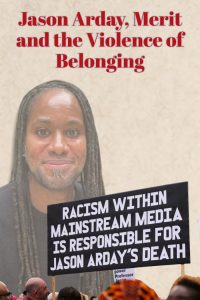
Jason Arday, Merit and the Violence of Belonging

Jason Arday was a sociologist, a teacher, a writer, a son, a partner, a father, a brother and a man whose life had already contained extraordinary difficulties and achievements long before Cambridge made him a symbol. He was 41 when he was found dead at his home in south London on August 14, nine days after resigning from the University of Cambridge amid allegations concerning plagiarism, his academic record and aspects of the life story he had publicly told. The Metropolitan Police said his death was unexpected but not believed to be suspicious. An inquest is to determine the circumstances of his death.

His life was more than his Cambridge appointment, more than the allegations against him and certainly more than the controversy that consumed his final weeks. He had spoken about being diagnosed with autism and other developmental difficulties as a child, about remaining non-verbal until he was 11 and about his difficulties with reading and writing. He nevertheless went on to earn a PhD, teach across several British universities, write about race and education, and become Cambridge’s youngest Black professor in 2023.

The allegations against Arday were presented as a matter of academic misconduct without sufficient scrutiny of their origin and validity. What is disturbing about the Arday affair is the point at which scrutiny of an individual appeared to become a much larger argument about who deserves to occupy an elite institution.

NewsCord’s review counted 249 distinct articles about Arday across 15 British national outlets between July 24 and the evening of August 14. Of these, 188 appeared in the nine days after his resignation. That amounted to an average of 20.9 articles a day after he had already stepped down.

There was plainly a story to investigate. But the coverage did not remain confined to his academic work. His childhood, memoir, personal claims, sporting achievements and biography became subjects of repeated public examination. NewsCord’s account documents coverage that moved into ridicule, speculation and commentary about parts of his life that went far beyond the original academic allegations.

The most troubling context is that some of the controversy was explicitly connected to arguments about race and diversity. The academic who brought the plagiarism allegations to wider attention, Nathan Cofnas, has described himself as a “race realist” and has previously written about racial representation in elite professions in terms that explicitly invoke supposedly innate differences in ability. He has since said that his concern was with diversity, equity and inclusion rather than personal hostility towards Arday. Cofnas, now sacked from his institute, must nonetheless be held accountable for the chain of events he initiated. The positions and politics he espouses form part of the context in which Arday’s case was interpreted and circulated, and of a wider social order in which Black and other oppressed communities are made to experience institutions as spaces of conditional belonging.

What happened to Arday, then, cannot be understood only as a dispute over one academic’s work. The larger question is what happens when the presence of someone from a historically excluded community inside an elite institution is treated as something that must continually be justified.

For many of us in India, there is something painfully familiar in that question.

The specific histories are different. Arday was a Black British academic; caste is a different system from race, with its own history and mechanisms. But the experience of being treated as an exception whose presence requires explanation has recognisable parallels.

Think about the Dalit student who enters an elite university. The Dalit scholar who gets a faculty position. The first-generation student who enters medicine, the civil services or a prestigious professional institution. Their achievement is often not allowed to remain simply an achievement. A question enters the room before they do: Did they actually deserve this?

That question is rarely asked in isolation. It arrives carrying the weight of caste. Reservation makes that question explicit. “Merit” becomes the language through which caste privilege can present itself as a neutral achievement. We are seeing this today in India, where Delhi’s designated protest site has a sit-in by Reservation Hatao Andolan, a group of snowflake oppressor-caste members who cannot ask for structural change from the state and would rather espouse casteist statements of exclusion and degradation on camera while claiming victimhood.

The same logic that asks whether a Black professor really belongs at Cambridge can, in another context, ask whether a Dalit professor really belongs in a university at all. The language changes. The hierarchy does not.

This is why the mythology of merit matters. The mythology of merit depends on forgetting the conditions under which merit is produced. Before a person sits for an examination, submits a PhD application or interviews for an academic job, they have already travelled through a social world. Some people grow up with educated parents, private schooling, books, stable housing, English-language fluency, professional networks and the confidence that elite institutions are places where they naturally belong. Others encounter those institutions after crossing barriers that were never faced by their supposedly more “meritorious” peers.

Yet once the final credential is produced, all of that history disappears behind an apparently objective label: merit. Caste makes this contradiction impossible to ignore.

For generations, education and professional authority were overwhelmingly concentrated among particular castes. Property, literacy, institutional familiarity, social networks and cultural capital accumulated across families and communities. When the descendants of those histories arrive at elite universities, their inherited advantages are rarely described as an intervention into merit. They appear as merit itself. Reservation disrupts that story because it makes social exclusion visible.

That is why the rhetoric around merit can become so vicious. Merit is presented as a timeless measure of individual worth, when in practice institutions decide what counts as merit, how it will be measured and who gets the opportunity to demonstrate it.

The same baton is used to beat affirmative action in different contexts: DEI in the West and reservations in India. In both cases, policies intended to address historical exclusion are recast as threats to a supposedly neutral system that was never neutral to begin with.

Once this idea of merit is entertained, the presence of a Black professor or a Dalit professor can become suspicious before anything about their work is examined. Their success is treated as something requiring an explanation. Their mistakes become evidence of a larger failure. Their credentials become open to a level of scrutiny that their social position was already unlikely to protect them from.

This is what makes the racial invocation against Arday’s career so pernicious. The question moves from a basic inquiry, “Did this individual meet the standards?”, to “Why was someone like this here in the first place?”

The second question may present itself as a defence of objectivity, but it is not really interested in objectivity, real or imagined. It is about belonging. It is about who gets to occupy the public arena without having their presence continually explained, defended or justified.

And that is where Arday’s story speaks beyond itself. Because many people from historically oppressed communities recognise the particular pain of entering spaces that were not built with them in mind and then discovering that their right to be there remains permanently open to question.


Mangesh is a law student from Mumbai, Maharashtra.

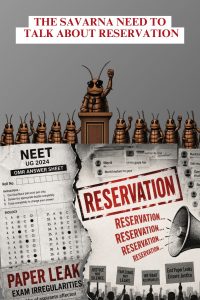
The Savarna Need to Talk About Reservation

Say what you will about the CJP protests against the NEET paper leak, everyone has already said that the immediate demands are not enough to change the education system. Education scholars are more likely to tell you about the 5-point charter submitted by the CJP to the Government of India. But one class of discourse generators is rattled by the protests themselves, or has been looking for an opportunity to vent its pre-existing frustrations or biases and has now found the perfect one . This is the oppressed castes’ general status and their tiresome, repeated, annoying rant against reservation.

This includes someone fabricating a fake post by actor Vijay Varma about his one non-reserved category friend suffering in some educational institution, which the pro-protest actor quickly said he had never posted. His acting in the anti-Mandal movement film Hurdang alongside Sunny Kaushal, however, may not have made his supposed stance difficult to believe had the post been genuine. Whether he posted it or not, and whether he believes the logic underneath that post, are different questions.

Mrunal Thakur, another actor, apparently posted a story on her Instagram account suggesting that the key moment that changed the game for everyone during these protests was NEET aspirant Harsh Dubey questioning the dominant narrative around the protests, arguing that the focus on the paper leak has overshadowed other longstanding issues in medical admissions. This was apparently a clip from a conversation with NDTV’s Shiv Aroor, where Dubey said questions around reservation policy and the difficulties faced by general category students also deserve public attention. Whether Mrunal Thakur will also come out and deny posting this is a matter of no one’s concern. Bollywood celebrities have shown their political illiteracy and general inhumanity more than once.

But this idea that neither the BJP nor the CJP wants to touch reservation, and that this is what led to the compromise, is one of those Savarna delusions burdened with so many argumentative flaws that a sane mind can hardly engage with it. To begin with, despite its classist and meritocratic articulation of the protests, the CJP does not appear to be opposed to reservation, partly reflected in its use of Ambedkarite symbolism, whether sincere or strategic. One also forgets that the BJP is a heterogeneous party with multiple caste groups and not simply Brahmins and other general category persons. There is no consensus on this question even within the Hindutva fold, something evident from the raita vs. trad debates that have long existed within their own ideological circles. To treat a single interview, one that merely regurgitates the most banal opinion circulating on the Savarna reactionary internet, as having played any pivotal role in shaping the protests is fantasy writing in its purest form.

But what is up with the casteist Savarnas? In a protest that brought together people from the non-protesting middle classes and celebrities, wherein status and privilege are also disproportionately held by oppressor castes, what has made the casteist Savarnas launch into their regular rant with great vigour? Are Savarnas simply waiting for any needle to move so they can carry their anti-reservation agenda? Are they simply incapable of shutting up for once?

Why, then, does every major public mobilisation touching education or even employment seem to invite an anti-reservation chorus from casteist Savarnas? The answer is not that reservation is secretly the central issue every time, like the Dubeys make it out to be. It is that reservation has become the preferred language through which sections of the Savarna public interpret almost every institutional crisis. Whenever a crisis emerges in education or public recruitment, reservation is summoned as the familiar explanation, even when it has little to do with the event itself. It is less a response to the facts before them than a political reflex.

This reflex performs an ideological function. It redirects public anger away from institutions and towards beneficiaries of affirmative action. A paper leak points towards failures of governance, regulation, corruption, examination agencies, and political accountability. None of these explanations preserve the moral authority of the existing Brahminical social order. Reservation, on the other hand, offers an already available narrative; and if Savarna public discourse has shown anything, it is that they love readily available labour, intellectual and otherwise. The next generation of casteists also lack imagination and will rely on the intellectual dis-labour of their Savarna forefathers.

These complaints are very vapid. They transform a structural failure into a grievance against redistributive and representational justice. Instead of asking why an examination system repeatedly fails millions of students, they ask who supposedly enjoys unfair advantages, even though the empirical facts reveal it is they who do. The institution escapes scrutiny because caste once again becomes framed as the problem only when it attempts to correct itself.

There is another reason why these moments are politically useful. Large protests produce so much uncertainty. They reopen public debate and create the possibility that questions long considered settled may be discussed again, especially now that social media has permitted everyone to have an opinion, for good and bad alike. For anti-reservation voices, this is an opportunity to attach their long-standing campaign to a movement that was never organised around their demands. They seek legitimacy through proximity of discourse. If enough people begin associating educational injustice with reservation rather than with state failure, the moment gets a new meaning.

This explains why Harsh Dubey’s interview came to acquire symbolic importance far beyond its actual place in the protests. It offered something many casteist Savarnas had been waiting for: an apparently articulate voice on national television through which they could restate arguments that have circulated for decades. Reservation disrupts the comforting belief that educational success reflects individual merit alone. Every conversation about admissions threatens to reopen the history of caste privilege that made merit appear natural in the first place. It is therefore unsurprising that even a movement against examination malpractice becomes, for some, another occasion to defend inherited advantages while presenting themselves as victims of an unjust system. The anti-reservation discourse surrounding the NEET protests tells us less about the movement than about the persistence of Savarna political common sense.


DalitThinkerToday is a Chartered Accountant by profession from Sangli, Maharashtra, who occasionally dabbles in thinking about politics when people in her oppressor-caste-majority office frustrate her. This is her pseudonym.

Good Minorities and Oppressed Persons in Ceremonial Roles

Archival Note

Published in 2006 during A. P. J. Abdul Kalam’s presidency in Vol. 25, Issue No. 24 (16/12/2006), this article is less a profile of Kalam than a reflection on the politics of minority representation. V.T. Rajshekhar asks why some members of historically oppressed groups come to be celebrated by dominant political establishments while others remain excluded or viewed with suspicion. These ideas remain urgent over the last decade with a Dalit and an Adivasi president from the Hindu nationalist party occupying the post.

The article is reproduced here in full. Read today, it can also be situated within a wider discussion about the distinction often drawn between the “good” and the “bad” Muslim—a distinction that is used globally as a liberal strategy to tame minority political power.

The complete, unabridged article is available in the Dalit Voice archives: https://dalitvoice.net/why-upper-castes-are-all-praise-for-abdul-kalam-as-a-good-man/


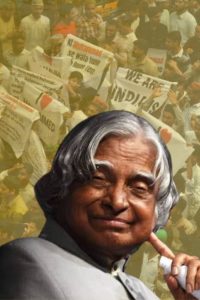
Why Upper Castes Are All Praise For Abdul Kalam As “A Good Man”? 

President Abdul Kalam, the dark-looking, vegetarian Tamil bachelor who is never invited by any Muslim organisation anywhere in India, is called a “good man” by our Brahminical rulers. Maybe he is called good because he has been good to them.

We were all praise for Kalam when he was a scientist in the Defence Department. We then called him “India’s only scientist”. All other upper-caste “scientists” had no achievement to their credit. Collectively, they did a lot of harm to the poor Kalam. Despite all the pinpricks, Kalam went up by his sheer “merit and efficiency”, which no other Brahmin scientist possessed.


MEDIOCRITY GLORIFIED

We have not made any comment on him after he became the President of India. Because, no. 1, we had never heard him speaking face to face. No. 2, out of respect for a Muslim.

But we have read a lot of his speeches, which made no sense. We asked many people their opinion. They gave the same opinion.

Mediocrity is always glorified in this vast intellectual desert called India.

For the first time, we heard him at the Tehelka “Summit of the Powerless”, which he inaugurated in Delhi on Nov. 20, 2006. As usual, the speech made no sense to us or any comrades with us.


HELPED FIGHT PAKISTAN?

His days as a scientist (he was no doubt brilliant) were fully exploited by the upper castes to manufacture rockets, in which he was an expert. Do rockets feed India’s hungry millions? If not, why was he praised and paraded by the fellow scientists, all from the upper castes? Because rockets helped threaten the enemy. Who is India’s enemy? Of course, Pakistan, which is a Muslim country. Did Muslim Kalam help fight Muslims? Was he praised for this?

In other words, the hungry millions did not get any relief from Kalam’s scientific experiments. He catered to the interests of the Brahminical rulers, who considered Pakistan (read Muslim) as their enemy.

In his speech at the Tehelka function, he praised the cock-and-bull story called the Ramayana (Read Dr. Ambedkar’s book Riddle of Rama & Krishna. DSA, 1995) and the Tamil Brahmin religious leader Ramanujacharya. These are music to Brahminical ears.


WHY ALL HIS GRAND “PLANS” IGNORED?

Kalam, as the President, had visited several places and delivered scores of speeches presenting his grand “plans to reduce poverty in 10 years”. The upper castes cheered him but did not implement a single “plan”.

Why did his “plans” always fall on deaf ears? Because these were all economic in content, while the over 85% of India suffered from a disease that was essentially social and cultural in content. That is why Kalam was simply ignored. His most publicised plan was the “PURA Project”. Did anybody implement his project? We have no information.

Brahmins praised him but silently laughed at him. They are not bloody fools to select him as President unless they have made sure that he would serve their interests.

Prime Minister Vajpayee, heading the sworn anti-Muslim party of BJP, wanted an obedient, harmless Muslim as head of state to decorate the Rashtrapati Bhavan.


PRAISE FOR GANDHI KILLERS

How big a simpleton he is could be made out from his profuse praise for a top RSS terrorist leader, Nanaji Deshmukh. He said he had visited Nanaji’s project in MP and was much impressed by the socio-cultural changes it brought about.

How could the RSS be interested in socio-cultural revolution? Maybe Nanaji’s multi-million-rupee experiment converting the MP tribals into good “Hindus”, meaning slaves, impressed him. RSS is doing such socio-cultural experiments in all tribal belts.

Nanaji is senior to Vaidik Vajpayee. He resigned as Union Cabinet Minister to go into the MP forest to continue his “socio-cultural experiment” of enslaving the tribals. How selfless and dedicated he must be. RSS has hundreds of such leaders and workers.

Kalam has been praised for such work. That means even such a brilliant scientist can be taken for a ride by the Brahminical people.

As he was going out after his speech, we caught hold of his hand and questioned his praise of a Hindu terrorist leader.

His answer was: “What if he is an RSS man? He is doing good work.” We said: “RSS killed Gandhi, whom you praised many times in your speech.” He simply walked away without answering.

Brahminical India gets the President it deserves and the Prime Minister it deserves.

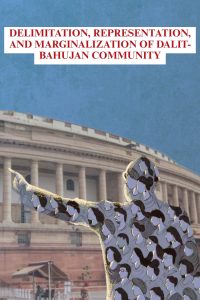
Delimitation, Representation, and Marginalization of Dalit-Bahujan Community

The dubious delimitation attempt under the guise of women’s reservation during the special parliamentary session of April 16–18, 2026, was packaged as a routine constitutional necessity aligned with democratic principles of equal representation. It was rightly defeated in parliament because of its vastly inequitable and politicized approach. Yet, to prevent any future such mischievous exercise, any such lop-sided, ill-defined bill must be examined for its implications for India’s deeply stratified social structure, particularly the realities of Dalits, Adivasis, and OBCs. Doing so raises profound concerns about the future of political representation, social justice, and democratic equity for these sections of society. What was being framed as a neutral, population-based recalibration of parliamentary seats risks entrenching caste inequalities unless it explicitly addresses the historical and ongoing exclusion of these communities from political representation.

Formally, delimitation rests on the principle that each vote should carry equal weight; therefore, constituencies must be periodically redrawn to reflect population changes. India’s last delimitation was based on the 2001 Census, with a freeze on seat redistribution extended until after the first census post-2026. The forthcoming exercise, therefore, is expected to rely on updated demographic data—though notably, the absence of a recent census since 2011 introduces significant ambiguity.

As per the 2011 Census, India’s population was 1.21 billion, but contemporary estimates place it at approximately 1.47 billion, leaving around 250–260 million people outside the ambit of representation – a majority of them from the Dalit Bahujan, Tribal and Adivasi communities. This gap is not merely technical; it has direct implications for communities whose demographic weight is substantial but whose political visibility remains limited.

Dalits (Scheduled Castes) constitute approximately 16.6% of India’s population, while Adivasis (Scheduled Tribes) account for about 8.6%, based on 2011 data. OBCs, though not officially enumerated in that census, were widely estimated by the Mandal Commission and are considered by subsequent studies to comprise between 40% and 52% of the population. Taken together, these groups form an overwhelming majority—often described as the Dalit-Bahujan social bloc. Yet, their numerical strength has not translated into proportional political representation, particularly at the national level. While the Constitution provides for reserved constituencies for SCs and STs in Parliament and state assemblies, these reservations are tied to outdated population data and do not extend to OBCs in Parliament.

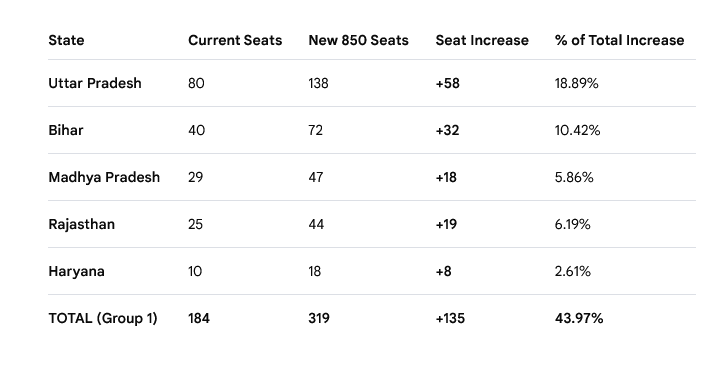
This structural imbalance affecting DBA communities becomes more pronounced in the context of delimitation. A purely population-driven redistribution of seats is expected to increase the parliamentary weight of northern states such as Uttar Pradesh, Bihar, Madhya Pradesh, Haryana and Rajasthan. These states already account for about a 33.89% share of Lok Sabha seats and projections using the 2011 census suggest that their share would rise by approximately 43.97% for a total of 48.97% in an expanded House of around 850 members (see chart 1). These numbers would further increase if the current population estimate of 1.47 billion is considered. Similar rises (see Chart 2) are indicated in states like Jharkhand, Chhattisgarh and Odisha where the combined Dalit and Tribal population exceeds 40%.

Chart 1 - North Indian States
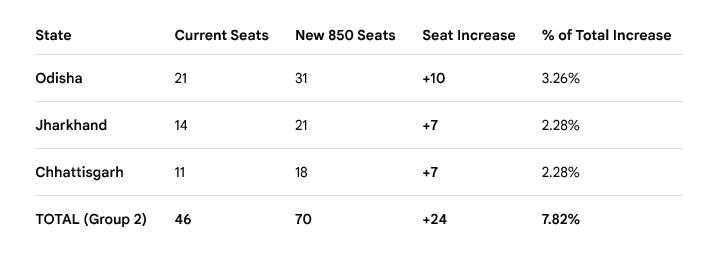
Chart 2 - Tribal Population Dense States
Superficially, these changes might appear beneficial for Dalit-Bahujan communities, given their large presence in these states. Uttar Pradesh, for instance, has one of the highest concentrations of Scheduled Castes in the country, with Dalits comprising over 21% of its population. Bihar’s OBC population is estimated to exceed 50%, while Adivasi populations are significant in states like Madhya Pradesh and Rajasthan.

However, the critical issue is not merely where these populations are concentrated, but how political power is distributed within these regions. Electoral representation and outcomes in these states have historically been shaped by dominant caste coalitions, often marginalizing Dalit-Bahujan voices despite their numerical strength. The expansion of seats, therefore, risks amplifying existing patterns of dominance unless accompanied by structural safeguards ensuring equitable representation.

The absence of political reservation for OBCs in Parliament is particularly significant in this context. Despite constituting nearly half of India’s population, OBCs do not have reserved constituencies at the national level, unlike SCs and STs. This exclusion is compounded by the lack of updated caste data. The Socio-Economic and Caste Census (SECC) conducted in 2011 collected extensive data, but its caste findings have never been fully released or integrated into policymaking. Without a comprehensive caste census, delimitation proceeds in a data vacuum that obscures the actual social composition of constituencies. This effectively perpetuates historical inequalities, allowing representation to be recalibrated based on aggregate population figures while ignoring internal disparities.

For Scheduled Castes and Scheduled Tribes, the situation is equally complex. The number of reserved constituencies is determined by their share in the population, but this share is based on outdated data. If the actual proportion of SCs and STs has changed over the past decade and a half—as is most likely—then the current framework under-represents their presence. Moreover, delimitation could alter the geographical distribution of reserved constituencies in ways that dilute the political influence of these communities.

For example, if SC populations are dispersed across multiple constituencies rather than concentrated in specific areas, the number of reserved seats may not adequately reflect their demographic weight.

Adivasi communities face additional challenges. Concentrated in forested and resource-rich regions, they have long experienced displacement, land alienation, and administrative neglect. While ST-reserved constituencies exist, they do not necessarily guarantee effective representation, particularly when political and economic power remains external to these communities. Delimitation that does not account for the socio-economic vulnerabilities of Adivasis risks reinforcing a pattern in which territorial representation exists without substantive empowerment.

The linkage of delimitation to the implementation of women’s reservation further complicates the picture. The Constitution (106th Amendment) Act, 2023, which mandates 33% reservation for women in Parliament and state assemblies, has been widely celebrated as a landmark reform. However, its implementation is contingent upon the completion of a fresh census and subsequent delimitation. This conditionality effectively delays the realization of women’s representation, potentially by several years.

For Dalit-Bahujan women, who face intersecting forms of marginalization based on caste, class, occupation and gender, this delay is particularly consequential. Without explicit provisions ensuring representation for SC, ST, and OBC women within the broader quota, there is the risk that the benefits of women’s reservation will be disproportionately captured by upper-caste women. At the same time, the government has been noted to ignore calls by Dalit transgender activists for horizontal reservation for transgender persons even as BJP has sought to introduce exclusionary amendments to the existing Transgender Act.

Data from local government institutions, where reservations for women and OBCs are already in place, provides important insights. Studies have shown that while women’s reservation in Panchayati Raj institutions has increased female participation, the distribution of benefits is uneven. In many cases, women from dominant social groups are more likely to occupy leadership positions, while Dalit and Adivasi women continue to face barriers such as social discrimination, limited access to resources, and proxy representation. Extending this pattern to Parliament without corrective measures will reproduce similar inequalities at scale.

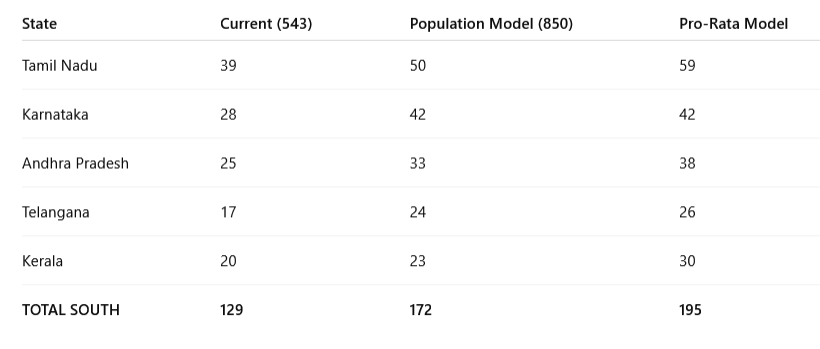
The federal dimension of delimitation has attracted considerable attention, particularly the potential shift in political power from southern and western states to the northern Hindi belt. Southern states such as Tamil Nadu, Kerala, Karnataka, and Andhra Pradesh have achieved population control, higher literacy levels, and better health outcomes compared to many northern states. Consequently, their population growth has stabilized, while their share of parliamentary seats is likely to decline in relative terms—from around 23.8% to approximately 20.2%, even if the absolute number of seats increases from 129 to 172 (see Chart 3) purely on the basis of population.

Chart 3 - South India States

While this shift is framed as a question of regional imbalance, it also has implications for Dalit-Bahujan communities. Southern states have historically implemented more robust social justice policies, including reservations for OBCs in education and employment, welfare schemes targeting marginalized communities, and relatively stronger institutional frameworks for addressing caste discrimination. A reduction in their political influence at the national level could weaken the policy emphasis on social justice, affecting the oppressed caste populations across the region.

At the same time, the expansion of representation in northern states does not automatically translate into improved outcomes for marginalized communities. These regions continue to face significant challenges in terms of poverty, education, healthcare, and social inequality. According to National Family Health Survey (NFHS-5) data, indicators such as child malnutrition, maternal mortality, and access to sanitation remain worse in several northern states compared to the national average, with Dalit-Bahujan communities disproportionately affected. Without targeted interventions, increased political representation at the state level will not lead to substantive improvements in their socio-economic status.

The method by which delimitation is being introduced further raises concerns about social justice and democratic practice. Rather than being debated as an independent issue, it has been embedded within the operational framework of women’s reservation, limiting the scope for independent and broader scrutiny. This approach mirrors a broader pattern of policymaking in which significant structural changes are introduced with limited consultation and legislative debate. For communities that have historically been excluded from decision-making processes, such methods exacerbate existing deficits in representation.

The delay in conducting the census adds another layer of social justice complexity. A census is not merely a statistical exercise; it is the foundation upon which policies related to representation, resource allocation, and social justice are built. The absence of up-to-date data undermines the credibility of the delimitation process and raises questions about its fairness toward oppressed communities. For Dalit-Bahujan communities, whose claims to representation are often contested or minimized, the lack of reliable data is particularly detrimental.

Experts have suggested alternative approaches that incorporate indicators such as fiscal contribution, socio-economic development, and human development outcomes alongside population. Such models could help balance the principle of equal caste representation with the need to ensure equitable participation of Dalit-Bahujans in governance. However, these proposals have not been considered, and the insistence on a purely population-based approach that suggests a preference for a framework that aligns with existing political advantages of dominant communities.

Ultimately, delimitation is not just a technical exercise; it is a reconfiguration of the political landscape that will shape distribution of power for decades. For the broader Dalit-Bahujan population, the stakes are particularly high. Without explicit safeguards, updated data, and inclusive policymaking, the process risks reinforcing the very inequalities it should seek to address.

Democracy, at its core, is about ensuring that those who have historically been excluded are meaningfully included in decision-making. A delimitation process that prioritizes numerical redistribution without addressing structural inequities falls short of this ideal. In its current form, it risks transforming demographic strength into political invisibility, leaving Dalit-Bahujan communities as passive participants in a system that continues to marginalize their voices and political equality.

The question, therefore, is not whether delimitation should occur, but how it should be conducted. A just and equitable process must begin with a comprehensive caste census, ensuring that the social composition of the population is accurately reflected. It must include provisions for OBC political representation, recognizing their demographic significance. It must update and strengthen SC/ST reservations based on current data, ensuring that these communities are neither underrepresented nor misrepresented. It must incorporate intersectional safeguards to ensure that Dalit-Bahujan women are not excluded from the benefits of gender-based reservation. And above all, it must be conducted through a transparent, consultative process that includes the voices of those most affected.

Without these measures, delimitation risks becoming an instrument of consolidation for the dominant castes rather than democratization—a mechanism that redistributes seats while leaving power structures intact. For a country that has long struggled with the legacies of caste and inequality, such an outcome would represent not progress, but regression.


*Data based on analysis merging figures from Census of India 2011, Election Commission of India, Times of India and numbers in the Delimitation proposal of 131st Amendment Bill.


Oliver D’Souza is a former journalist and an author.

A Deep-rooted Post-Independence Conspiracy to Keep Oppressed Castes Oppressed: Anti-Conversion Laws Across Indian States

On 13 March 2026, the Freedom of Religion Bill was tabled in the Maharashtra State Assembly — the eleventh state that may have such legislation since independence. Ten similar laws in the states of Odisha, Madhya Pradesh, Gujarat, Chhattisgarh, Himachal Pradesh, Jharkhand, Uttarakhand, Uttar Pradesh, Karnataka, and Haryana have already been enacted; one in Tamil Nadu has been repealed. Two others in Arunachal Pradesh and Rajasthan were never enacted despite formulation. Home Minister Amit Shah has made an election promise that the law would be enacted in the State of Punjab as well. The stated purpose is a familiar trope: preventing conversions obtained through force, fraud, or inducement. The language is legal and respectable. The real targets are Dalits and other oppressed castes.

These laws have nothing to do with coercive religious practice. They are instruments designed to prevent the emancipation of oppressed castes from dominant castes’ hegemony — and to ensure that the dominant caste establishment’s social, economic, and civilizational hegemony, which that order has sustained for two millennia, remains intact.

Caste is not merely a social phenomenon. It is a religious system of control, encoded in the Manusmriti as a spiritual, social, and economic order and sanctified by Brahminical Hinduism for two millennia. It has structured every material dimension of life: occupation, property, education, marriage, and public space. Spiritual inequality was the foundational condition from which all socio-economic deprivation followed. The Dalit-Bahujan communities did not merely occupy the bottom of a social hierarchy — they were theologically assigned to it. Any faith that rejected that assignment was, therefore, not merely a spiritual alternative. It was a structural threat to those who benefited from the arrangement.

That is the context in which every anti-conversion law, which includes conversion to any faith, must be read.

The legislative history begins not in 1967, when Odisha enacted India’s first anti-conversion law, but in 1950, when the Presidential Order quietly excluded converts to minority faiths from the reservation protections established under Article 341 of the Constitution. The Constitution (Scheduled Castes) Order, 1950, originally limited SC status to those professing Hinduism, and later extended it to Sikhism and Buddhism. Converts to Christianity and Islam, which form the bulk of non-Buddhist converts, lose SC status under this order, as affirmed by recent Supreme Court interpretation citing the 1950 Presidential Order in a case pertaining to Andhra Pradesh, even as a petition concerning reservation benefits for Dalit Muslims and Christians has been pending before a three-member bench of the Supreme Court since January 2011.

In 1950, this was not debated. It was not declared. It was done quietly, and widely attributed to K. M. Munshi, a Constituent Assembly member with known Manuwadi leanings, who openly opposed extending reservations to those who left the Hindu fold. The purpose was malignant.

The most consequential test of that logic came six years later. On 14 October 1956, B. R. Ambedkar — the man who had written the Constitution those same dominant caste legislators are now subverting — converted to Buddhism along with approximately half a million of his followers in Nagpur. Ambedkar had spent decades arguing that caste could not be reformed from within Hinduism because it was not an aberration within Brahminical theology but its direct product. Conversion was not apostasy. It was the exercise of the precise freedom the Constitution guaranteed. The 1950 Presidential Order had already moved to penalise that choice economically. Had these state anti-conversion laws existed in 1956, Ambedkar’s event at Nagpur — the largest mass act of religious self-determination in modern Indian history — would have required prior government approval under the very constitutional order he had designed. The extension of SC status to Navayana Buddhism only happened in 1990 under the V. P. Singh government. That is not an irony, it is the point. These laws are aimed, in their structure and intent, at preventing socio-economic outcomes exactly like what Ambedkar fought for in that spiritual and social context.

Christianity’s presence in India is not a colonial imposition. St. Thomas arrived on the Malabar Coast in the first century AD. Catholicism spread along India’s western coast after the Portuguese conquest of Goa in 1510, and later inland, focusing on the emancipation of oppressed castes, even as they had their own interests in doing so. During colonial rule, Protestant missionaries added to the work Catholics were doing — running schools and hospitals where none existed and agitating against oppressive caste practices, among them the requirement in parts of South India that Dalit women leave their breasts uncovered as a mark of caste subordination. The tangible improvements these missions delivered to Dalits are documented. The Savarna response to those improvements has also been documented, including in the form of every anti-conversion law that followed.

The rhetorical device used to delegitimise this history is the accusation of “ricebag Christians” — the claim that conversions were purchased with food rather than chosen in conscience. When people are starving, providing food alongside a theology that affirms their equality before God is not inducement. It is the practical application of that theology that responds to social reality.

In 1956, the Madhya Pradesh government appointed a committee under Hindu nationalist former judge M. B. Niyogi to examine missionary activities in the state. The Committee was formed in response to the Bharatiya Jana Sangh’s “Anti-Foreign Missionary Week” protest. Set up by a Congress government, it recommended legally prohibiting conversions that were not fully voluntary, but the proposal was not implemented at the time, as it would have been difficult to enforce without violating constitutional religious freedoms. The Niyogi Report was not an inquiry. It was a brief for the prosecution, prepared in advance of charges not yet formally filed. It catalogued missionary schools, hospitals, orphanages, and social service institutions — and then attributed to all of it a calculated programme of conversion through inducement. It did not disprove the emancipatory value of these institutions to oppressed castes. It simply recast that value as evidence of conspiracy. The Niyogi Report provided the ideological and legislative scaffolding for the Odisha anti-conversion law of 1967, and its logic has been reproduced in every state law enacted since.

The constitutional foundation for these laws was established by the Supreme Court’s 1977 ruling in Rev. Stanislaus v. State of Madhya Pradesh, which held that the right to “propagate” religion under Article 25 does not include a right to convert another person. This distinction, applied carefully, is reasonable. Applied as it has been in practice, it is not. The right to convert another person was never what the church claimed.

By constructing its judgment around the prevention of an act that was not in dispute, the Court gave legislative cover to restrict the proclamation of faith itself — and since the state now determined what constitutes illegitimate persuasion, any message compelling enough to move oppressed caste persons toward a different understanding of their own worth can be prosecuted as inducement. The Allahabad High Court has recently reaffirmed the right to propagate and proclaim one’s faith, which amounts to an implicit rebuke of how the Stanislaus judgment has been operationalised.

With the BJP’s rise to national power in 1999 and its consolidation under Narendra Modi in 2014 — whose political formation within the Sangh Parivar is defined by the goal of a Hindu Rashtra, which implicitly requires the maintenance of the caste hierarchy that Brahminical Hinduism produced — seven additional states enacted anti-conversion laws. Each successive iteration grew more elaborate in its administrative requirements.

The most recent versions require prior government approval, inserting a state official between a citizen and a decision of personal conscience in direct tension with Article 21 of the Constitution. An oppressed caste person who wishes to leave the faith that theologically sanctions their subordination must now obtain permission from an apparatus largely controlled by the communities that have historically benefited from that subordination.

The Tamil Nadu precedent is sometimes cited to argue that anti-conversion legislation crosses party lines. In 2002, the AIADMK government enacted a similar law. This requires little explanation: the AIADMK was then a coalition partner in the BJP-led NDA government and enacted the law to sustain that alliance. Tamil Nadu has one of India’s oldest and most rooted Christian populations. The law was repealed in 2004 when the UPA came to power, under pressure from Christian communities — confirming that it had no independent political logic in the state and was adopted purely as a coalition obligation. Nonetheless, this signals the state’s willingness to compromise constitutional freedoms for political expediency.

When the complete sequence is examined together — the 1950 Presidential Order, the Niyogi Report, the Stanislaus judgment, and the cascade of state laws — the pattern is coherent and consistent. The RSS, Jana Sangh, Janata Party, and BJP share an unbroken ideological lineage rooted in a Brahminical Hindu nationalist vision, combining a project of social dominance over internal subaltern communities with a resistance to religious influences perceived as external threats.

Over seventy percent of India’s population — the Scheduled Castes, Scheduled Tribes, and Other Backward Classes combined — belong to communities that Christian social and educational institutions most consistently serve. It is precisely the emancipation of these communities — economic, educational, and spiritual — that strikes at the material interests of the Savarna establishment that has historically thrived on their exploitation. The Mandal Commission’s implementation dismantled the Savarna monopoly over state employment and political power. The Church in India, through civil society institutions, has been eroding their civilisational dominance for far longer. Anti-conversion laws are the establishment’s response to both.

The Church is not above scrutiny in this account. Caste has penetrated Christian institutions in India in ways that contradict the theology that made those institutions work for oppressed caste communities in the first place — separate cemeteries, separate seating, upper-caste dominance of church hierarchies still continue in diminishing measures, with Dalit theology now in vogue in seminaries, gradually dissipating these anomalies. That contradiction is real and must be named.

Yet this does not change the fact that the laws are designed not to reform Christian institutions from within, but to prevent oppressed caste communities from accessing them at all. The internal failures of the Church are a problem the Church must answer for. The anti-conversion laws are a problem the state must answer for. Conflating the two serves only those who drafted the legislation.

There is a reason no central anti-conversion law has been passed at the national level: it would face a full constitutional bench and would not survive the judicial test. The state laws function as instruments of attrition — they harass clerics and communities, deter others from exercising their rights, create a climate of legal uncertainty, and signal to oppressed castes that the price of emancipation will be as high as the state can make it. Their authors are not constitutionally naive. They know better than to invite a definitive national ruling.

The multiplication of these laws since 1999 is evidence that they are not impeding Christian emancipation efforts. If oppressed castes had stopped choosing emancipation, new laws would be unnecessary. If earlier laws had effectively blocked the exit, elaboration would be redundant. The inclusion of administrative approval requirements in the most recent iterations — including the Maharashtra Bill now passed in both the Houses and awaiting Governor Jishnu Dev Varma’s assent — confirms that those prosecuting this project are aware it is failing socially and are escalating in response. Escalation in the face of failure is not a sign of strength. It is a sign that the outcome they feared is continuing regardless.

A nation that directs its legislative energy toward preventing the emancipation of the majority of its population — the Scheduled Castes, Scheduled Tribes, and Other Backward Classes who together constitute over seventy percent of India’s people — in order to protect the privileges of numerically smaller Savarnas at the top cannot expect that arrangement to produce equitable development. The evidence is already visible in the widening gap between India’s claims to being the world’s fifth-largest economy and the material conditions of the oppressed castes whose labour has always underwritten that economy.

The courts will, hopefully, eventually confirm what the constitutional record already shows: these laws were not enacted with confidence in their constitutionality. They were enacted with confidence in political impunity to impede the emancipation of oppressed caste communities. That foundation is far more fragile than it appears.

The emancipation of oppressed castes is not a process that can be permanently arrested by administrative procedure. Ambedkar understood this. The six hundred thousand people who walked with him in Nagpur in 1956 understood it. The millions who have followed in the decades since understand it. History does not offer a single example of a project designed to lock human beings into inherited degradation that finally succeeded. The architects of this one will find no exception to that record.


Oliver D’Souza is a former journalist and an author.