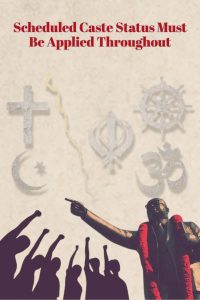
Scheduled Caste Status Must Be Applied Throughout

Archival Note

Published in Dalit Voice (Vol. 24, Issue No. 5, 1 March 2005), this essay by V. T. Rajshekar takes up the demand for Scheduled Caste reservations for Dalit Christians. Rajshekar argues that caste is a social identity rooted in birth and historical oppression, and that religious conversion does not erase that identity. He uses the inclusion of Dalit Sikhs and Dalit Buddhists in the Scheduled Caste framework to question why Dalit Christians continue to be excluded.

For Rajshekar, conversion is itself part of the history of resistance to caste. Dalits who converted to Christianity, Islam, Sikhism or Buddhism, he argues, changed their religion without escaping the caste identity imposed on them. The continued exclusion of some converts from Scheduled Caste recognition therefore reproduces the divisions created by the caste order, separating Dalits who share a history of untouchability on the basis of their present religion. His argument makes the recognition of Dalit Christians a question larger than reservation: it concerns whether the Dalit movement understands caste as an identity that can persist across religious boundaries.

The question Rajshekar raised in 2005 remains central to the present dispute over Scheduled Caste status for Dalit Christians and Dalit Muslims. The revived Dalit Voice has returned to the issue in its recent discussion of the Supreme Court’s refusal to grant constitutional protection to Dalits across religions, arguing that caste continues to operate beyond religious boundaries. The archival essay shows that Dalit Voice had identified this problem two decades ago: if caste survives religious conversion, then legal protection against caste discrimination cannot depend on a person’s religion.

Below is an abridged version of the essay. The complete piece can be read in its original context here: [Read the full essay] 


Supreme Court Must Keep Off Social Problems

DV supports Dalit Christian quota: Church must force government by mobilising support

In fact, it was the Dalit Voice which first mooted the proposal of reservations to Dalit Christians. We also vigorously campaigned for it all over India.

The underlying principle is caste is our basic identity and this identity can never be destroyed even by conversion to another religion. Every socio-cultural development in this country from time immemorial has taken place by taking into consideration caste, the basic building brick of India.

Hindu gas chamber: The Untouchables, the original inhabitants of this land, became victims of Brahminism and suffered for centuries. To protest against Brahminism, the victims of untouchability crossed over to Christianity, Islam, Sikhism and Buddhism. They only changed their religion (which is like a dress) but not their identity. (V.T. Rajshekar, Caste – A Nation Within the Nation, Books for Change, 2002).

But the Brahminical rulers, to punish the Untouchables getting out of their Hinduism, fearing that their artificially floated “majority religion” would become a micro-minority religion, punished the Untouchables fleeing out of their Hindu gas chamber. But this also did not work.

Racism in India: Religious conversion is one of the powerful socio-cultural weapons of the deprived destitutes to liberate themselves. No power on earth can stop it notwithstanding the ridiculous protests launched by the jealous Hindu nazis against the American Evangelist Benny Hinn visit to Bangalore in Jan. 2005. Dr. Babasaheb Ambedkar himself has recommended the conversion weapon. (Why Go for Conversion? DSA-1987)

The Muslims (15%), Christians and Sikhs (5%) did not come from outside India. At least 90% of its followers are Untouchables, Tribals and Backward Castes. Today, after going over to these egalitarian religions, they say they feel liberated and hence powerful.

It is the Dalit Christians who are mainly responsible for taking the issue of Brahminical racism in India to the United Nations at Durban and making the world aware of the worse-than-Apartheid practices in Hindu India.

Verdict of history: The Brahminical fear is that if the SC/ST reservations are extended to the converts not only the floodgates of conversion will be wide open but more than that the converted Dalits will join hands with the non-converted Dalits and together they will hammer the micro-minority Aryan oppressors, and their empire built on bluffs and blackmail will simply collapse. Every problem of India arises out of this fear.

History is not on the side of the Brahminical Social Order (BSO). Justice and Truth can never be demolished even if the BSO has the support of the Supreme Court.

It is this fear that made the BSO rulers put all sorts of restrictions on SC/ST reservations. Since the higher judiciary is loaded with upper castes, (this judiciary is the main stumbling block to the social and cultural advancement of India’s oppressed majority), the rulers have been mainly seeking the willing help of the judiciary.

Dalit Christian mistake: The simple question is when the Dalit Sikhs and Dalit Buddhists are already included in the SC/ST reservation list why this discrimination only against Dalit Christians? Is not the Brahminical mischief clear?

The Untouchables, whichever be their religion, even the more egalitarian Islam, are all our brothers and the mischievous Brahminical bid to divide Brothers from Brothers must be fought.

To hell with Presidential Order: We are fully aware that the Brahminical rulers are using the state power and the judiciary to divide us and discriminate against us. The BSO must know that it is taking advantage of our goodness and mistaking our peace-loving nature to our docility. They can fool the people for some time. Those days are over.

The Government of India and the Supreme Court should stop taking shelter under the Presidential Order (PO) of 1950. This Order is not part of the Constitution. When this Order was amended many times to include the Sikh and then the Buddhist converts, it can be amended again and again. When the Constitution itself was amended umpteen times, what is big about PO? The government [has to do this] in the interest of the people. Parliament being the highest court of the people can certainly endorse it.

The Supreme Court must note [the] social and cultural problems vexing the people, particularly the oppressed SC/ST/BCs and Muslim/Christian/Sikhs, [and therefore] it should not interfere.

Attorney-General (AG) Milon Banerji said the same thing when the matter came up before the Supreme Court on Feb. 11, 2005. He said he had written a letter to the Government to consider the case of Dalit Christian reservation sympathetically. “It is a matter of policy and legislation and the courts should keep out of it”. Well said.

We don’t know what made today’s Government of India to reject AG’s request. The previous Brahmana Jati Party (BJP)-led Government did reject the demand in 2002 because that Government was led by a set of anti-people Hindu nazi leaders like Vaidik Vajpayee. But that is not the case with the Manmohan Singh Government. Why did it repeat the same old song? Sonia Gandhi must interfere and correct the course.

Upper caste church leadership: The Christian Church leadership is to be partly blamed for not taking genuine interest in the case of Dalit Christian reservation.

Over 75% of the Indian Christians are Dalit. The Indian church itself is a Dalit church. But the leadership of the church is with the upper caste particularly the Syrian Christians.

Now that the Supreme Court has decided to take up the matter after four weeks, the church leadership must prevail upon the Government of India not to oppose the plea of the Dalít Christians. It should also prepare public opinion and produce enough literature so that the Government of India changes its mind and the Supreme Court does not get in the way.

If they refuse to see reason, then the church must get down to mass action. We are here to render any support. Because Dalit Christians are our brothers.

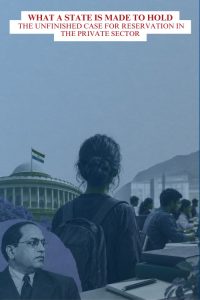
What a State Is Made to Hold: The Unfinished Case for Reservation in the Private Sector

“The purpose of a system is what it does,” Stafford Beer once said: not what its charter claims, not what its founders intended, not what its defenders insist it’s secretly working toward once the numbers look bad. The line comes from Beer’s work in cybernetics and systems theory, but it travels well, because it was really a warning against taking any institution’s word for itself. Apply it to the state and the sentence stops being quippy and starts being uncomfortable. A state does not do what its Constitution’s preamble promises. It does not do what its bare acts say it must. It does what its politicians ignore until an election forces a promise out of them. It does what a police force using violence on citizens with impunity does. It does the slow torture bureaucrats in government offices administer by attrition. It does the routine ignoring of injustice courts specialise in. Everything else is marketing.

A state’s default setting isn’t a neutral one, but it isn’t a fixed conspiracy either: it simply doesn’t move unless it’s made to. Every gain anyone has pulled out of a state came after someone made not conceding more expensive than conceding.

Reservation itself carries the memory of that fact in its own founding story. Ambedkar’s original demand, at the Round Table Conferences, was a separate electorate for the Depressed Classes: our own constituencies, our own voters, our own representatives answerable to no one else’s veto, a political existence independent of Hindu society rather than embedded inside it. The Communal Award of August 1932 granted exactly that. Gandhi, in prison, announced a fast unto death to force its withdrawal, blackmailing the Depressed Classes and its leaders as well as the British rulers, on the ground that a separate electorate would permanently divide Hindu society. Ambedkar held out against a starving man for days before the political pressure, not the argument, became unbearable on practical grounds, and what emerged from the negotiation at Poona was not the separate electorate but reserved seats inside a joint electorate: more seats than the Award had granted, 148 in the provincial legislatures instead of the original allotment, but folded back into the same political body Ambedkar had tried to exit. Reservation was not the original ask. It is what remained after the original mandate was made impossible by someone else’s leverage and the Hindu moral bankruptcy behind it. The instrument defended for ninety years since it has itself been a settlement, arriving at under duress, from a wider claim.

Rahul Sonpimple, founder of the All India Independent Scheduled Castes Association (AIISCA), made a version of this point at a press meeting on private sector reservation in Delhi on 27th September, framing reservation as something closer to a treaty than an entitlement: a thin, fragile thread and the only one tying Dalits, Adivasis and OBCs to the Indian state, functioning not as generosity but as a negotiated peace. It buys the state and the dominant castes who still hold most of the country’s assets a measure of calm from a majority whose rightful share has otherwise been denied, while giving the numerically dominant Bahujan population some working proxy for the democratic weight their numbers should carry. A contract, not a gift. Except a contract is only as good as what a party can be made to perform under it, and a state that already treats its own preamble as marketing will treat a contract no differently.

A contract implies parties, and a state, unlike a private employer, actually has one with its citizens. It demands loyalty, taxation, submission to its law, alongside the monopoly to dictate the political fates of those within its territory, in exchange for a set of standing obligations back. A private firm asks for labour under a contract either side can in principle at least walk from, and owes nothing back to someone who was never bound to it in any comparable way. That asymmetry is a large part of why a claim on the state’s own hiring is different in kind from a claim on a firm’s, not because the state behaves more responsibly in practice, as we are all well-aware, but because it owes something on the terms of the relationship itself. Although an obligation the state owes but doesn’t perform is worth exactly as much as a preamble it doesn’t act on.

A private firm is not identical to the state, and the case for reaching it anyway doesn’t depend on pretending otherwise. It rests on two separate facts. The economy itself has changed since the framers drew the line at public employment, and a social justice framework confined to the public sector now leaves most of economic life untouched, because most of it no longer sits inside the public sector at all, a gap widened further by the same state’s ongoing privatisation of what public capacity remains, shrinking the one terrain where proportional representation currently carries legal force. But the second fact runs deeper and doesn’t depend on how recent liberalisation is: a private sector built on land, credit, licenses and infrastructure the state provides, privatising its profits while routinely and unsparingly socialising its costs through subsidy, tax concession and public investment, has never sat outside the state’s reach in the first place, this was true of Indian capital before 1991 as much as after it. A firm that depends on the state which itself takes from the public commons for that much can never be allowed to answer to nothing beyond its own balance sheet.

Even so, there’s a real limit to what representation alone produces. Elevated individuals from a movement or caste often become instruments of the institution’s own legitimation rather than being accountable to the base that elevated them, and when they try to push further beyond the constraints and the logics of those systems, they get cut down by the sheer weight of social forces unwilling to tolerate the progress already made. Despite that, political reservation has still converted into something more durable than individual token presence, an independent structure of Bahujan power that didn’t exist before it, even as oppressor-caste violence against that rise has grown alongside it. What government service has that the private sector doesn’t is exactly this: decades of organised structure built up around the reserved seat, structure that keeps contesting the ceiling even where it doesn’t break through it. The private sector has never had an equivalent foothold, and no amount of employer voluntarism has ever built one. That’s the case for statutory reservation even in its thinnest form: not that a quota alone delivers equality, especially substantively, but that it’s the minimum legal anchor around which durable, organisable power can be built at all.

Against that backdrop, private sector reservation is not a new demand groping for its first hearing. It has been formally raised for close to two decades. The All India Confederation of SC/ST Organisations was pressing the case as early as 2012, organising a march on Delhi backed by three dozen SC/ST organisations, arguing plainly that no nation stays strong while its economic and social levels remain this split. But even before that, in 2003, then Prime Minister Atal Bihari Vajpayee addressed a meeting of SC and ST MPs and said that the private sector cannot exist in isolation and has to be responsive to the needs of the society, making it essential to have reservation in the private sector. This was followed by a broad consensus among electoral parties across the ideological spectrum on the matter, even though it has not yet been translated into political will or substantive action. One concrete effort came in 2006, under Prime Minister Manmohan Singh, when he appealed directly to Indian industries to become the government’s partner on the question. However, rather than legislate a mandate, the government let industry regulate itself: CII, FICCI and ASSOCHAM each adopted a Voluntary Code of Conduct built around four pillars, Employability, Education, Entrepreneurship Development and Employment. That October, the PMO had already constituted a Coordination Committee on Affirmative Action in the Private Sector, chaired by the Principal Secretary to the Prime Minister, drawing on the Department of Personnel and Training, the Ministry of Social Justice and Empowerment, the Ministry of Tribal Affairs, and serviced by the Department of Industrial Policy and Promotion. The Committee has met nine times since. By 2010, the government’s own review found adoption of the voluntary codes was slow; by 2013, it was still describing the same dialogue as ongoing; by 2015, industry associations were reporting hundreds of member companies signed on. Twenty years of this arrangement has produced a voluntary code without enforceable duties, and industry associations professing over a lakh of beneficiaries with no verifiable representation data to back the figure. Now we cannot sit once again with a renewed appeal for goodwill. What is needed is to go beyond an empty promise and fight for a statutory guarantee: a binding quota, backed by rule of law, not another code any signatory can stop honouring when they feel like it.

On 26 July 2024, that demand reached Parliament directly. Chandrashekhar Azad, MP for Nagina, introduced a private member’s bill titled the Reservation for the Scheduled Castes, the Scheduled Tribes and the Other Backward Classes in Private Sector Act, 2024, one of three private member’s bills he introduced in the Lok Sabha that day. It covers private firms, educational institutions and other establishments employing at least twenty people with no government financial stake. Even this bill stops short of a binding hiring quota: its mechanism is incentive-based, requiring the central government to induce private firms toward reservation through special concessions and lower-interest loans via nationalised banks, with an annual implementation report tabled in both Houses. Structurally, a private member’s bill has almost no chance of becoming law: enactment is the exception, not the rule, and has been for decades. That a bill this cautious, relying on incentives rather than quotas, remains a private member’s bill and is still pending says something about how far Parliament remains from treating this as settled business.

But the case for the demand itself rests on documented discrimination. Sukhadeo Thorat and Paul Attewell’s 2007 correspondence study sent matched applications under upper-caste Hindu, Dalit and Muslim names to private-sector job advertisements in the English dailies and found discrimination operating at the very first screening stage, before any interview, before any assessment of merit beyond a name on a page. Zahra Siddique’s 2011 work went further, quantifying the size of the gap and who was driving it: low-caste applicants had to send 20% more resumes than high-caste applicants to get the same callback rate, with the disparity sharpest when the recruiter was male or Hindu, and more pronounced at smaller firms than larger ones. Axmann, Swanson and Cuspinera Contreras, using Indian Human Development Survey data in 2016, found significant wage discrimination against Dalits and Adivasis specifically inside the private sector. Madheswaran and Singhari, drawing on National Sample Survey employment data the same year, found SC workers earning less than equally qualified forward-caste workers in urban labour markets, with the gap wider in private employment than public, and unequal access to occupations itself doing much of the work in producing the disparity. Pattayat’s 2024 study of rural non-farm workers, using NSSO and PLFS data spanning 2004-05 to 2019-20, found the earnings gap persisting across that entire period and examined how much of it discrimination itself accounted for.

Article 15(5) already gives the state constitutional room to act on half of this. Inserted by the 93rd Amendment in 2005 and in force since January 2006, it permits special provision by law for socially and educationally backward classes, Scheduled Castes and Scheduled Tribes in admission to educational institutions, explicitly including private institutions, aided or unaided, with the sole carve-out for Article 30(1) minority institutions. Because education sits on the Concurrent List, both Parliament and state legislatures can act under it, and several states have already legislated on private educational admissions. Tamil Nadu enacted a 2006 law providing 69% reservation for Backward Classes, Most Backward Classes and Denotified Communities, Scheduled Castes and Scheduled Tribes in private educational institutions. Andhra Pradesh had already applied SC, ST and Backward Class reservations to admissions in private professional institutions through its admission rules. Karnataka’s 2006 Professional Educational Institutions Act provides for 50% reservation for SCs, STs and OBCs in unaided non-minority professional institutions. Maharashtra enacted a 2006 law providing reservation for SCs, STs, Denotified Tribes, Nomadic Tribes and OBCs in private professional educational institutions, while Haryana’s 2016 Backward Classes Act provides reservation for Backward Classes in admissions to educational institutions, including private institutions.

What that record shows is that Article 15(5) has been given statutory effect at the state level, but unevenly and without a nationwide framework. A Parliamentary Standing Committee report presented to the Rajya Sabha in August 2025 said that private educational institutions are currently under no national legal obligation to implement reservation because there is no central statute mandating it. It recommended that Parliament legislate 27%, 15% and 7.5% reservation for OBCs, SCs and STs respectively in private higher educational institutions, with government reimbursement of the associated costs on the model of the Right to Education Act. Although a sincere Caste Census may tell us that the necessary numbers should be much higher, the constitutional ceiling on reservation itself also needs to be revisited.

What Article 15(5) doesn’t reach at all is employment, and that gap isn’t small: education and employment were never separable; a degree that doesn’t convert into a job is a credential, not a livelihood. One state that tried a binding private-sector quota by its own legislation ran straight into that trap. Haryana’s 2020 State Employment of Local Candidates Act mandated 75% reservation for domiciled candidates in private jobs under a salary threshold, with a 10% district sub-cap built in, not a caste quota, a domicile one. The Punjab and Haryana High Court struck it down in 2023 as unconstitutional and violative of Part III of the Constitution; the challenge to that judgment remains pending before the Supreme Court. The deeper problem predates the ruling: the 93rd Amendment gave the state constitutional room to reach private education specifically and never extended that room to private employment. Domicile was the classification that failed here, not caste, but replacing domicile with caste would not by itself resolve the Article 19(1)(g) problem, because no amendment has yet done for employment what the 93rd did for education. That is what this demand still needs and hasn’t gotten: not just a statute, but a constitutional amendment opening the same room for private employment that the 93rd opened for private education, without which any statute meets the wall Haryana did.

Winning that room would still only secure a narrower claim than the one Ambedkar himself eventually made. Private sector reservation, at its most comprehensive, means reservation in private employment, reservation in private educational institutions, and an Equal Employment Opportunity Act as organizations like AIISCA and others have been demanding: legislation with a working complaint mechanism, an investigation process, ongoing monitoring, and real accountability, reaching recruitment, wages, promotion, workplace treatment, termination, occupational allocation, contract employment and professional advancement, not just the moment of hire. That last piece is the one twenty years of voluntary codes never touched, because a Voluntary Code of Conduct had no enforceable complaint mechanism and no statutory consequence for ignoring it. A statute would. But even this full slate, a foothold at every stage of the employment relationship, asks only for fair terms of entry into an economy whose ownership stays exactly where it already is. It is a claim to be treated fairly inside the room. It has never been a claim on who owns the room.

Ambedkar’s own economic writing sits alongside all of this as one part of a longer record, that expands the horizon of economic fight itself. In States and Minorities, the memorandum he prepared for the Constituent Assembly on behalf of the Scheduled Caste Federation, he proposed a state control over economy in which key industries would be owned and run directly by the state and basic industries owned by the state and run through its own corporations, with land held under state ownership and cultivated through cooperative farming, aimed at dismantling landlordism and the agrarian exploitation caste had built itself around. That program was never incorporated into the Constitution in the form Ambedkar proposed. Although a version of that was found in the Nehruvian socialist project, which was itself eventually given up in the face of global neoliberal onslaught. What it shows, regardless of anyone’s own view of state ownership as a remedy, is how early and how directly Ambedkar located the actual target in who owns the economy, not merely who holds a fair position inside it.

Ambedkar’s economic target, and the demand for reservation in the private sector, concern forms of structural injustice that are harder to see than the moments when that injustice erupts into visible violence. That shapes not only who gets to have this conversation and on what terms, but who is willing to listen to it. Oppressor-caste liberals attend to Dalit-Bahujan life most readily through the news cycle of atrocity, because atrocity is visceral and immediately legible, while the guilt of a grieving conscience often springs into action only when Dalit-Bahujan rage forces that attention. A Dalit-Bahujan body demands attention in a way a hiring statistic does not. A wage-discrimination dataset spanning fifteen years, a Coordination Committee that has gone nowhere, a bill pending in Parliament since 2024, none of these produces the same urgency because none offers an easy villain, a headline image or a clean moment of collective horror to perform. Grieving a corpse asks nothing ongoing of anyone. But there is a real villain here, even if it is harder to identify in any single moment: the state, which owes more than what it does and routinely shows where its priorities lie, alongside the structural violence produced through years of oppressor-caste apathy at best and antipathy at worst.

The historical record here is a caution, not a reason to wait. What survived Poona wasn’t Ambedkar’s original demand: it was a narrower settlement that still had to be fought for afterward, seat by seat, for decades, before it was more than ink. The same will be true of a private-sector statute and an Equal Employment Opportunity Act alongside it. Winning them will not finish anything on its own; a seat is captured as often as it’s built on. Beer’s sentence applies once more, now to the law: a statute’s purpose isn’t what its statement of objects and reasons says either. It’s what the Act does. Whether the complaint mechanism gets used, whether a violation carries any real cost, whether the oversight committee holds its next meeting or goes missing in action the way it already has. None of that follows from any bill becoming an act. It follows only if the pressure that forces the act into existence keeps being applied after it exists. Because a state, as established, only holds what it’s made to hold.


Paresh Hate is a Bahujan queer researcher, writer, documenter and activist and the Lead Content Manager at Dalit Voice.

The Right Not to Sing

Nationalist Demands in the New Law

The Prevention of Insults to National Honour (Amendment) Bill, 2026 was introduced by Amit Shah in the Rajya Sabha on 24 July 2026. Its Statement of Objects and Reasons recalls that Rajendra Prasad, as President of the Constituent Assembly, said on 24 January 1950 that Vande Mataram would be “honoured equally” with Jana Gana Mana. It notes that no legal provision existed to prevent interference with the singing of the National Song and proposes to address this by amending Section 3 of the 1971 Act, which already made intentionally preventing the singing of the National Anthem, or disturbing an assembly engaged in singing it, punishable with imprisonment of up to three years, a fine, or both, with a mandatory minimum of one year for a second and subsequent conviction. The amendment extends that same offence, and the same penalties, to the National Song. Article 51A(a) names the Constitution, the national flag and the national anthem as objects of citizens’ respect; it has never named the National Song.

The amendment arrived alongside a separate, longer-running push to change what gets sung. Vande Mataram has six stanzas; since 1937, only the first two have been used at national gatherings, a convention set by the Congress Working Committee. The Ministry of Home Affairs had already moved to reverse that convention on its own, issuing a protocol on 28 January 2026 requiring the full six-stanza version at government, ceremonial and cultural events, well before this amendment existed. That protocol was advisory and, as the courts would go on to hold twice over the following months, carried no penalty of its own. Only after those two challenges failed did the government tighten the position twice more: a July 9 MHA letter to all states specifying that only the official six-stanza version could be recited whenever the song was sung in mass singing, and then, on 24 July, the amendment itself. Where both the song and the anthem are performed at one event, Vande Mataram now goes first. Schools are directed to open assemblies with it, although many schools already practiced this of their own volition. It is to be played at state functions, civilian award ceremonies, flag-hoisting events, and the arrivals and departures of the President and Governors.


The Political Fight Over the Song
The push for the full six-stanza version followed a ten-hour special discussion in the Lok Sabha in December 2025 marking the song’s 150th anniversary, in which the Prime Minister accused the Congress of having “sowed the seeds of division” by trimming the song. In 1937, the Congress Working Committee, after consultation with Mohandas Gandhi, Jawaharlal Nehru, Rabindranath Tagore, Subhas Chandra Bose, Rajendra Prasad and Vallabhbhai Patel, decided that only the first two stanzas would be used at national gatherings because of objections to the religious imagery in the later verses. Tagore had written to Nehru that the first two stanzas had “acquired a separate individuality and an inspiring significance of its own,” while the later verses, read in context, “[are] liable to be interpreted in ways that might wound [Muslim] susceptibilities.” Congress rejected the Prime Minister’s charge, pointing to this 1937 decision and Tagore’s letter and accusing the government of manufacturing the controversy for present gain in the context of then upcoming elections, a charge Priyanka Gandhi Vadra made directly. The Congress Working Committee has since reaffirmed the two-stanza position for its own party programmes.

The dispute has now also moved into a question of federal authority after the Karnataka government ordered on 8 September that only the first two stanzas be sung at state government programmes, except when the President, Vice-President, Prime Minister or Governor is present. Within days, advocate Girish Bharadwaj filed a PIL challenging the state’s authority to prescribe a shorter version, arguing that the matter falls within Parliament’s residuary legislative powers and that the state order conflicts with the 2026 amendment to the Prevention of Insults to National Honour Act. The petition also challenged the procedure by which the Karnataka Cabinet took the decision, alleging that it was approved as an “Informal Discussion” without a Cabinet Note or Law Department advice. Governor Thaawarchand Gehlot then wrote to Chief Minister D.K. Shivakumar, invoking Articles 162, 256 and 257(1) and asking the government to reconsider its order on the ground that it conflicted with the Union’s statutory and executive framework. On 16 September, BJP MLA S.N. Channabasappa walked out of a government programme in Shivamogga after only the first two stanzas were sung.

The opposition, however, has also been weak in resisting the Centre’s position. In Kerala, the Congress-led UDF government initially circulated the Centre’s instruction that Vande Mataram be sung in full during the Har Ghar Tiranga campaign from 9 to 17 August. This put a Congress-led government in the position of appearing to implement the same six-stanza version promoted by the BJP-led Union government, despite Congress’s objections to treating the full version, with its references to Hindu deities, as a compulsory expression of national identity. The CPI(M) criticised the UDF’s position, with Leader of the Opposition Pinarayi Vijayan arguing that the song “in its entirety is not compatible with secularism” and that “there is nothing wrong with reciting the opening stanzas”, and accusing the UDF of surrendering to an RSS agenda. The UDF subsequently clarified that it would not follow the full version, and the state government ultimately omitted Vande Mataram from its official Independence Day function.

The song’s meaning has remained contested within the communities whose religious commitments are most directly implicated by it, a history the government’s “everybody knows what is national song” formulation simply passes over. The distinction made in 1937 remains central to the dispute: the Congress Working Committee accepted the first two stanzas for national gatherings while recognising objections to the later verses and their religious imagery. Muslim religious authorities have continued to make this distinction. Darul Uloom Deoband and Maulana Mahmood Madani have objected to the later verses on the grounds that their depiction of the motherland as divine conflicts with the Islamic doctrine of tawhid, while the All India Sunni Ulema Board ruled in 2006 that Muslims could sing the first two stanzas.

The dispute, however, has not been confined to Muslim objections. During the 2006 centenary controversy, the Shiromani Gurdwara Parbandhak Committee initially instructed its schools not to sing Vande Mataram, with its president arguing that it promoted a particular religion and did not fulfil the aspirations of minorities, before subsequently backing away from that position. In 2026, the Andhra Pradesh Christian Leaders Forum objected to the newly mandated full version, specifically citing its references to Durga and their implications for Christian beliefs. The question is therefore not simply whether Vande Mataram is the national song, but what religious content the state is asking people to affirm when it mandates the complete text. The Home Ministry’s circular treats that underlying question as though it had never been contested. Where it does allude to the religious objection, it reduces it to a question of Muslim reluctance, allowing a disagreement over religious belief to be recast as a question of patriotism.


The Text Behind the Mandate
The distinction between the first two stanzas and the later verses can be traced to how the song was written. Bankim Chandra Chattopadhyay had written the first two stanzas in the 1870s, describing a land of rivers, fruit and gentle winds. He added four more when he incorporated the song into his 1882 novel Anandamath, and those later stanzas carry the divine imagery: the third stanza calls the motherland “protector of millions and destroyer of enemies,” the fourth names her Durga, Lakshmi and Saraswati outright, while the fifth and sixth complete the poem as a vow of devotion.

Anandamath provides the setting in which those later stanzas acquire their political and religious meaning. Bankim Chandra Chattopadhyay is one of the key figures of proto-Hindutva politics in British India, and the novel is set during the Sannyasi Rebellion. Its protagonist, Mahendra, a zamindar separated from his family amid famine and unrest, falls in with the Santans, a band of ascetic soldiers who have taken up arms to liberate the motherland from Muslim rule, with the British entering the story only later. One of Satyananda’s disciples wants to “pull down the city of the renegades” and “throw it into the river.” Bhavananda, inducting Mahendra into the cause, tells him “unless we drive these tipsy long-beards away, a Hindu can no longer hope to save his religion,” and answers the question of method with “we will beat them.” He then leads Mahendra to the order’s temple, where, standing before the idols of Durga and Kali, he tries to fill him with religious fervor for the fight ahead. Elsewhere in the novel, the Santans send emissaries into villages to gather bands of Hindus, then raid Muslim settlements, which are burned “to ashes.” Characters imagine the day a mosque will be razed to build a temple to Radha-Madhava in its place. The four later stanzas of Vande Mataram were written for, and inside, this story. This is the context of the text now mandated by law.


The Limits of the Law’s Imagination
That January 28 protocol was challenged twice. In February, Muhammed Sayeed Noori approached the Supreme Court, arguing that requiring the complete version raised questions of religious freedom and conscience. On 25 March, the Court declined to entertain the petition, holding that the protocol was advisory and carried no penalty for those who chose not to sing, while leaving open the possibility of intervention if the advisory hardened into actual discrimination or coercion. A parallel challenge in the Karnataka High Court, filed by Bengaluru-based advocate Somashekhar Rajavamshi, objected specifically to the inclusion of stanzas three through six and their references to Durga, Saraswati and Lakshmi; the High Court dismissed it on 9 April on the same ground, that the protocol did not make singing the full version mandatory.

The 2026 amendment changes that position. The January protocol could prescribe the full version’s use; it could not, on its own, criminalise a refusal to sing it. The amendment extends the National Song to the Section 3 offence applicable to the National Anthem since 1971: intentionally preventing its singing, or disturbing an assembly engaged in singing it.

On 22 September 2026, the Supreme Court heard a petition by T. M. Krishna, with senior advocate S. Muralidhar appearing for him. The petition challenges the 2026 amendment insofar as it extends the existing criminal provision to the National Song. It also challenges the Home Ministry’s directions requiring the complete six-stanza version at official functions. The petition argues that the amended provision and the directions violate Articles 14 (equality before the law), 15(1) (prohibition of discrimination on specified grounds), 19(1)(a) (freedom of speech and expression), 21 (protection of life and personal liberty) and 25(1) (freedom of conscience and the right to profess, practise and propagate religion).

The Court refused to decide whether the National Song should consist of two stanzas or six, indicating that this was for the democratically elected state to determine rather than for the Court to prescribe. Justice Bagchi also questioned the suggestion that religious references in all six stanzas are, by themselves, incompatible with the Constitution’s secular character, pointing to the reference to God in the US national anthem. That another country’s anthem contains a religious line does not make it a benchmark for what India’s Constitution should tolerate; it only shows that one other state has also let religious language sit inside a national symbol. Whether a lingering religious motif of that kind is compatible with secularism is exactly the question in front of the Court, and pointing to a second, unexamined instance of the same thing does not answer it. The Centre has two weeks to respond, and the Court has not yet ruled on the constitutional validity of the amendment or the six-stanza directions.

At the hearing, however, the Court drew a distinction between the State’s choice of a national symbol and the use of criminal law in relation to participation in it. Nothing in the amendment says that simply refusing to sing Vande Mataram is itself an offence; the crime, as under the original Section 3, is preventing others from singing or disturbing an assembly engaged in it. The question before the Court is therefore whether the protection recognised in Bijoe Emmanuel, which concerned refusal to sing the National Anthem under that same original section, also protects a person who refuses to sing the National Song on grounds of conscience or religion while leaving others free to do so.

That leaves an odd gap. If the amendment truly does not touch a refusal that neither prevents others from singing nor disturbs an assembly, the state loses nothing by saying so outright, and Krishna’s petition should fall outside the law’s reach without a fight. The Centre resisted even the issuing of notice, and Solicitor General Mehta pressed the Court not to entertain the petition at all. That resistance points to a state interest that Section 3’s text does not itself supply: the discretion to withhold, for as long as possible, any confirmation that non-participation is safe.

Bijoe Emmanuel v. State of Kerala, which the Court said still governs the field and has never been challenged, is the case that established that refusal to sing the National Anthem, where the person neither prevents others from singing nor disturbs the assembly, does not constitute an offence under Section 3. In 1986, the Court considered three schoolchildren in Kerala who belonged to the Jehovah’s Witnesses faith. They believed that singing the National Anthem was incompatible with their religious convictions, although they had no objection to the words or sentiments of Jana Gana Mana. During their school’s morning assembly, they stood silently while the anthem was sung. After the issue was raised, they were expelled from school, despite an inquiry finding that they were law-abiding and had shown no disrespect. The Supreme Court held that their expulsion violated their fundamental rights. It also held that there was no law obliging anyone to sing the National Anthem and that their standing silently while it was sung did not constitute an offence under Section 3 because it neither prevented the singing nor disturbed the assembly.

The Court in Bijoe Emmanuel answered for the facts it had: the children stood, in silence, while others sang, and that was respect enough. Whether sitting, or some other form of non-participation, would count the same way was never argued before it, and the judgment does not say. The Court’s later National Anthem jurisprudence went further than Bijoe Emmanuel by imposing a general requirement to stand, but went no further in deciding whether an able-bodied person who chose not to comply had thereby committed an act of disrespect. In Shyam Narayan Chouksey v. Union of India, the Court initially ordered, in 2016, that the National Anthem be played before every feature film and that everyone present stand. It subsequently recognised exceptions for people unable to stand and for occasions when the anthem appeared within a film, newsreel or documentary. In 2018, it made the playing of the anthem before films optional and handed the wider question of its regulation to the government. What remained unresolved was whether an able-bodied person who deliberately remained seated when the National Anthem was played had thereby shown disrespect.

Article 51A(a) requires citizens to respect the Constitution, the national flag and the national anthem. That language concerns respect for specified national symbols, while Section 3 concerns conduct that interferes with their public performance. The Constitution speaks of an attitude of respect; Section 3 defines specific acts that the law prohibits. Bijoe Emmanuel is the only case here that actually examined a specific act of non-participation and ruled on whether it counted as respectful: the children stood silently while others sang. Chouksey, by contrast, imposed a general rule about what everyone present in a cinema hall had to do when the anthem was played, and later withdrew the requirement that the anthem be played there at all. The distinction between respectful and disrespectful non-participation has therefore never actually been adjudicated on its own terms. That leaves the discretion to decide sitting with whoever is enforcing the law in the moment, not with any settled rule a citizen could rely on in advance. And even supposing that gap could be closed, and the state produced a clean definition of respectful non-participation tomorrow, a further question is why a person should have to demonstrate respect for a national symbol through participation of any kind, rather than simply being left alone by the law altogether.

Article 51A(a) itself answers none of this. The Fundamental Duties, inserted into the Constitution by the 42nd Amendment in 1976, are not enforceable in court. No citizen has ever been prosecuted for an abstract failure to respect the Constitution, the flag or the anthem. Section 3 punishes specific conduct: preventing a performance, disturbing an assembly, even though the boundaries of that conduct can still be interpreted and policed according to the discretion of whoever is enforcing the law. Article 51A(a) supplies the word “respect” and nothing else. It does not say what respect consists of, and it does not say respect must be shown rather than merely left unviolated. The state has built a criminal statute that reaches only interference, and rested it on a duty clause that was written to describe an attitude, not to compel an act.


The Right Not to Sing
The present controversy asks a larger question about the limits of state power over national rituals. A person may have a religious objection to the text, reject the use of a national symbol altogether, or simply choose not to participate. If that refusal does not prevent anyone else from singing, what is the state entitled to demand from the person who refuses? Even as the space for conscientious objection shrinks in the shadow of ultranationalism, we must continue to ask: why should the state require that refusal to take a prescribed form of respect, and why can it not leave room for people to decline participation altogether?

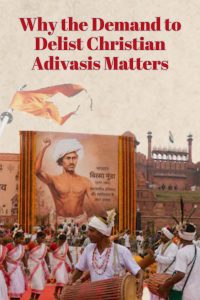
Why the Demand to Delist Christian Adivasis Matters

The demand to remove Christian Adivasis from the Scheduled Tribe list has moved from the margins of Hindutva advocacy toward the centre of national politics. On May 24, around 50,000 tribal persons gathered at Delhi’s Red Fort for a rally organised by the RSS-linked Janjati Suraksha Manch (JSM), where speakers called for the de-listing of Christian Adivasis from the Scheduled Tribe category. The presence of Union Home Minister Amit Shah transformed the event from an organisational mobilisation into a signal of political endorsement.

What was presented as a defence of tribal culture carries wider political implications. The campaign serves two connected functions. It assists the incorporation of tribal populations into a Hindutva political framework by constructing Christianity as a threat to tribal identity. At the same time, it weakens forms of Adivasi politics that have historically centred on land, forests, resources, self-governance and autonomy. The controversy over de-listing therefore reaches far beyond reservations. It concerns who gets to define Adivasi identity and what kinds of political claims can be made in its name.

This is not a new conflict. For decades, organisations associated with the Sangh Parivar have attempted to reshape the political vocabulary through which tribal communities are understood. The preference for the term “Vanvasi” over “Adivasi” is part of that project. Naming is never a neutral exercise. The term “Adivasi” became associated with political movements that understood tribal communities as possessing distinct histories, social formations and relationships to territory that cannot be reduced to the categories of the postcolonial Indian state. It also came to be linked with struggles over land, autonomy, self-representation and cultural rights. “Vanvasi,” by contrast, has been promoted by RSS-affiliated organisations as part of an effort to situate tribal communities within a broader Hindu civilisational framework. The dispute over terminology concerns who has the authority to define tribal identity and whether tribal politics will be articulated through its own historical experiences and political demands or incorporated into a larger majoritarian narrative.

The de-listing campaign emerges from this history. It seeks to make religious affiliation increasingly central to the way tribal identity is understood and recognised. Its supporters argue that conversion to Christianity severs individuals from tribal traditions and therefore undermines the basis on which constitutional protections were granted. Yet once religious affiliation becomes the basis for determining who is a legitimate member of the political community, the implications extend well beyond Christianity.

Across central and eastern India, the strongest currents within Adivasi politics have historically developed around struggles over land, displacement, mining, forests and self-governance. Whether in Jharkhand, Chhattisgarh, Odisha or Maharashtra, tribal movements have repeatedly confronted state institutions, extractive industries and dominant social groups over control of territory and resources. Opposition to mining projects and industrial land acquisition, struggles over the implementation of the Forest Rights Act and PESA, demands for a separate Sarna religious code, and movements against displacement have all shaped contemporary Adivasi politics. These mobilisations have generally been organised around questions of land, governance, cultural recognition and collective rights. The Fifth Schedule, PESA, forest rights legislation and movements against displacement emerged from these material struggles. They did not emerge from divisions between Christian and non-Christian Adivasis.

That is precisely what makes the current campaign politically consequential. It redirects attention away from conflicts over land, extraction and governance and toward conflicts within Adivasi communities themselves. Christian Adivasis become a separate political category whose claims can be isolated from those of the wider community. Such divisions weaken collective mobilisation against displacement, mining expansion, land alienation and other forms of dispossession. They also benefit those who have long sought a more fragmented and manageable Adivasi politics, whether in the service of electoral consolidation or the continued extraction of resources from tribal regions.

These concerns have been repeatedly voiced by Adivasi organisations across Jharkhand. More than one hundred tribal leaders, academics, activists and community organisations called for a boycott of the Delhi conclave before it took place. Their objections reflected a broader pattern. Campaigns around de-listing receive substantial organisational energy and political support, while struggles over land alienation, mining expansion, displacement and forest rights rarely attract comparable urgency from the same actors. That contrast raises an obvious question: why are religious differences within Adivasi communities relevant at all while ongoing conflicts over land, forests and resources are not?

The campaign also seeks to alter the constitutional terms through which tribal identity is recognised. Scheduled Tribe recognition was never designed as a reward for adherence to a particular religion. Article 342 contains no religious qualification, and Adivasi status does not disappear because an individual changes faith.

The constitutional histories of Scheduled Castes and Scheduled Tribes are different, but neither category was originally conceived as contingent on religious affiliation. Dalit Christians and Dalit Muslims continue to challenge their exclusion from Scheduled Caste status on the grounds that caste oppression survives conversion. Rather than correcting that injustice, the demand to de-list Christian Adivasis seeks to extend a similar logic of religious exclusion into a constitutional category where it has historically had no place. Recent judicial and political developments have made such efforts appear increasingly plausible, contributing to a broader perception that protections available to historically oppressed communities are open to reinterpretation through the language of religious belonging.

The de-listing campaign also reveals the conditions under which Hindutva is prepared to recognise tribal distinctiveness. Organisations associated with the Sangh Parivar have long sought to incorporate Adivasi communities into a broader Hindu civilisational framework while simultaneously acknowledging them as culturally distinct. The demand to remove Christian Adivasis from the Scheduled Tribe list narrows the space for that distinctiveness. Tribal identity remains legitimate so long as it can be accommodated within a majoritarian political project; conversion is treated as a point at which recognition becomes conditional.

Christianity has undoubtedly transformed many tribal societies over the past century, as have education, migration, urbanisation and countless other social processes. Those transformations do not erase histories of marginalisation, nor do they justify making religious affiliation the basis of constitutional recognition.

At stake in the controversy is more than the status of Christian Adivasis alone. The demand seeks to normalise the idea that constitutional protections can be conditioned by religious affiliation and that communities historically recognised because of marginalisation can be reorganised through the language of religious belonging. The immediate target may be Christian Adivasis, but the wider effect is the weakening of political traditions organised around land, resources, self-governance and collective rights. In regions where Adivasi communities continue to confront displacement, mining expansion and the erosion of democratic control over local resources, such fragmentation serves interests far more powerful than the communities being asked to embrace it.


Paresh Hate is a Bahujan queer researcher, writer, documenter and activist and the Lead Content Manager at Dalit Voice.
Buddhist, Dalit, Constitutionalist, Hindu Nationalist?

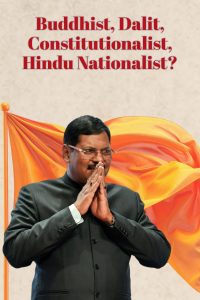
The first Buddhist—and only the second Dalit—to serve as Chief Justice of India, B. R. Gavai held office from 14 May to 23 November 2025. On 20 April 2026, he was seen inside Bageshwar Dham. He offered prayers before Balaji, then sat down with Dhirendra Krishna Shastri. A photograph of the deity was presented to him. The meeting ran for roughly half an hour, touching—at least on the surface—on spirituality, social work, and the Gurukulam project. It was not his first visit.

But neither the setting nor the company was neutral.

In early November 2025, the same figure he met had led a travelling mobilisation across Delhi, Uttar Pradesh, and Haryana. It was introduced as a padyatra for unity: a call to end caste divisions, a call for Hindu consolidation. It also demanded that India be declared a Hindu Rashtra. Over hundreds of stops, the rhetoric sharpened. “Love jihad.” “Land jihad.” Warnings of demographic collapse. Calls for economic boycott, for expulsion. Violence, reframed as vigilance. This was not Dhirendra Shastri’s first stint at genocidal bigotry and hate speech. He is popular across the internet for precisely this.

The distance between a constitutional court and such mobilisation is supposed to be absolute. Not only in law, but in conduct. When that distance contracts into a ritual visit—followed by an easy, cordial exchange—the issue is no longer personal belief. It is alignment, made visible.

The speeches delivered during that padyatra did not stay within the realm of faith. Minorities were named as demographic threats. There were suggestions that property would be taken over. Warnings that unless Hindus united, violence would spread “in every gali.” Questions about why “these people” become terrorists. Partition invoked to justify future consolidation. The idea that dissenters should leave the country was normalised. Economic segregation was not just implied; it was openly urged. Citizenship itself was recast in religious terms.

This is where context begins to matter. Because the visit does not stand alone. During his tenure, the former Chief Justice spoke of a “swadeshi” jurisprudence—one that consciously stepped away from foreign precedent. Around the same time, the Prime Minister called for India to shed its colonial mindset. Right-wing decolonization is in fashion these days, applied to laws across the board and the former Chief Justice did not want to be clearly left behind.

For many Ambedkarite and anti-caste activists, none of this comes as a surprise. The criticism did not begin with this visit; it has a longer lineage. Figures like R. S. Gavai, the former Chief Justice’s father, have often been criticised for moving away from grassroots mobilisation, for aligning too closely with dominant political formations, and for reducing anti-caste politics to symbolic presence within state structures. The outcome, critics argue, is not transformation but accommodation. Similar apprehensions resurfaced when his son assumed the office of Chief Justice.

The six-month tenure of Gavai itself offers a broader frame. Established conventions were set aside. The power of the roster was used not merely to assign cases but, at times, to shape outcomes. Precedents were revisited—sometimes sidestepped—through procedural manoeuvre. The boundary between administrative authority and judicial intervention grew less distinct. What emerged was a concentration of power in the office of the Chief Justice, with fewer visible constraints. Again and again, institutional limits appeared negotiable, with outcomes that often aligned with what the central executive stood to gain.

The consequences were uneven but telling. Constitutional challenges to executive action lingered, sometimes until they lost relevance altogether. At the same time, other matters moved with striking urgency. The pattern is familiar: delay in one direction, speed in another. The effect is anything but neutral. It stabilises certain outcomes while postponing others. Alongside this, opacity deepened. The collegium drifted further from public scrutiny, decisions were issued without recorded reasons, and even internal dissent rarely surfaced.

There were also moments when the Court’s interventions more directly expanded executive advantage. The creation of a pathway through Presidential Reference effectively offered the central executive a second chance to revisit decisions it found unfavourable. It was not framed as a privilege. In practice, it functioned as one.

Taken together, these are not isolated developments. They trace a pattern of judiciary’s growing subservience to a Hindu nationalist government. Seen against that background, the visit to Bageshwar Dham acquires a different meaning. It stops looking like a personal act. It begins to read as part of a larger alignment between institutional conduct and an expanding ideological environment. It does not matter that Gavai no longer holds the office. Like many ex-CJIs, he too will continue to dazzle in the limelight for a while, especially due to the hanging out in the corridors of this government.

The meeting itself was small. Thirty minutes. A ritual, a conversation, a photograph. But politics doesn’t always depend on scale. It also moves through signals. And this one was unmistakable.


Paresh Hate is a Bahujan queer researcher, writer, documenter and activist and the Lead Content Manager at Dalit Voice.

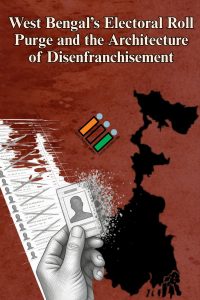
West Bengal’s Electoral Roll Purge and the Architecture of Disenfranchisement

In the run-up to polling, West Bengal isn’t just approaching an election. It is also seeing a redrawing of who gets to participate. Voting is set for April 23 and April 29, yet for millions the right to vote has already been taken away through administrative action. The Special Intensive Revision (SIR) of electoral rolls has operated in much the same way as its precursor in Bihar and its antecedent, the National Register of Citizens in Assam: as a tool of exclusion shaped by bureaucratic force, opaque technology, and nationalist ideological direction.

Between 9 and 9.1 million names, close to 12 percent of the electorate, have been removed ahead of the 2026 Assembly elections. Over 6 million were categorised as absent, shifted, deceased, or duplicate. The deeper problem sits with the remaining 2.7 million people whose status is still unresolved. Many of them submitted documents, established links to earlier rolls including the 2002 list, and yet found their voting rights in suspension. The election is proceeding even as their claims remain undecided.

The exercise has been presented as an attempt to produce a “pure electoral roll.” In practice, it signals a move away from inclusion towards filtration. An AI-assisted system has been used to identify what are described as “logical discrepancies” in voter data: minor spelling differences in names, age gaps within families, or several individuals linked to a single parent. In a context where documentation is often uneven and shaped by linguistic and clerical variation, these benchmarks turn ordinary inconsistencies into reasons for exclusion.

The pattern becomes clearer in the numbers. Muslims, who make up about 27 percent of West Bengal’s population, account for roughly 34 percent of those removed, around 3.11 million people. Districts such as Murshidabad and Malda have seen particularly high levels of deletion. Dalit Hindu communities, especially those with histories of migration like the Matua community, have also been heavily affected in districts such as North 24-Parganas and Nadia. The impact is spread across groups, but it consistently bears down on those who are already vulnerable, dependent on documents, and politically marginal.

In border districts adjoining Bangladesh, where narratives of migration and infiltration have long circulated, deletions are especially high. North 24-Parganas alone has lost more than 1.26 million voters. In parts of Kolkata, close to 30 percent of voters in certain constituencies have been removed. Some polling booths have seen more than half their electorate disappear from the rolls. Entire neighbourhoods have effectively been thinned out in the days before voting.

The process has moved quickly, concentrated in the immediate lead-up to the election. While appeal mechanisms exist on paper, they are limited in practice. Nineteen appellate tribunals were established to hear challenges, but access has been restricted, hearings limited, and even legal representation reportedly curtailed. Deadlines for inclusion in supplementary rolls leave little room for proper adjudication. The rolls were frozen on April 9, excluding those whose cases are still pending.

What emerges is a system in which rights are not formally denied but held in suspension. Voters are asked to appeal, yet the process does not conclude in time to restore their participation. Disenfranchisement takes shape through delay and procedure rather than through an explicit refusal.

The Election Commission has carried out the revision using methods that remain difficult to scrutinise. The algorithm used to identify discrepancies has not been fully explained, and the criteria themselves differ from earlier exercises at this scale. A process once associated with expanding the franchise now casts large numbers of voters as suspect. In both its design and its execution, the approach sits closer to a broader political direction than to an independent constitutional role.

On the ground, the disruption is uneven and immediate. Within the same household, some names remain while others are missing, often without explanation. Individuals with long-established records, including presence in earlier electoral rolls, have been excluded due to clerical inconsistencies that frequently originate in state documentation itself. Differences in dates of birth, variations in spelling, or changes over time are enough to trigger doubt. The burden of proof rests entirely on the individual, even when the discrepancy is administrative.

This is how bureaucratic violence works. It does not rely on overt force. Instead, it imposes procedural demands that many cannot meet within the time and access available to them. It requires documents, verification, and compliance under compressed timelines. The outcome may appear technical, but its consequences are clearly political.

West Bengal remains a central electoral focus for the Bharatiya Janata Party, which has sought to expand its presence in the state. Campaign language around “infiltrators” overlaps with the categories produced through the SIR process. Administrative labels such as “doubtful” voters sit alongside political claims about illegal migration, often directed at Muslims. In this alignment, the revision of electoral rolls becomes part of a wider effort to reshape the electorate before voting takes place.

What is being reshaped is not only a voter list. It is the basis on which political participation is granted. The right to vote is becoming conditional, dependent on continuous verification and open to withdrawal through processes that lack transparency and accountability. The creation of large categories of “doubtful” voters embeds that uncertainty.

This is not an abstract question of representation. It reflects a further narrowing of an already constrained democratic space. When millions are excluded from the electoral process through procedural means, the issue extends beyond electoral outcomes. It concerns who is recognised as part of the political community, and who can be removed from it without consequence.


Paresh Hate is a Bahujan queer researcher, writer, documenter and activist and the Lead Content Manager at Dalit Voice.
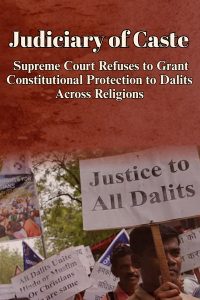
Judiciary of Caste: Supreme Court Refuses to Grant Constitutional Protection to Dalits Across Religions

On 24 March 2026, the Supreme Court of India delivered a judgment that appears, at first glance, to simply restate settled constitutional law. Scheduled Caste status, it held, is limited to Hindus, Sikhs, and Buddhists, and conversion to any other religion results in its “immediate and complete loss.” In doing so, the Court upheld an earlier Andhra Pradesh High Court ruling that denied a Christian pastor protection under the Scheduled Castes and Scheduled Tribes (Prevention of Atrocities) Act after he alleged caste abuse and threats to his life. The reasoning was categorical. Caste, for the purposes of constitutional protection, cannot survive religious conversion. Christianity, the Court asserted, does not recognise caste. The legal consequence is stark. A person born into caste oppression can lose the law’s recognition of that oppression simply by changing faith.

This judgment is not merely a technical reiteration of Clause 3 of the Constitution (Scheduled Castes) Order, 1950. It is a political act that redefines the relationship between caste, religion, and the state. It insists that caste is a bounded, religion-specific phenomenon rather than a pervasive social structure. It collapses the distinction between theology and lived reality, and in doing so, it weakens one of the most significant legal architectures available to confront caste violence in India.

Pastor Chintada Anand Paul approached the courts alleging casteist abuse and threats under the SC/ST (Prevention of Atrocities) Act. His argument was simple and empirically grounded. Caste is a matter of birth, social location, and historical disadvantage. Conversion does not erase stigma, occupation, or the violence that structures everyday life. The Court rejected this claim. It held that one cannot simultaneously profess Christianity and claim Scheduled Caste status, as the two are “mutually exclusive.” It further imposed a stringent burden on those who seek reconversion, demanding proof not just of religious change but of total dissociation from the prior faith and acceptance by the original caste community. The effect is to transform caste from a lived structure of oppression into a matter of formal religious identity. This move is conceptually flawed and politically dangerous.

Caste in India has never been reducible to theology. It is a system that organises labour, space, marriage, and dignity across centuries. It determines who cleans, who owns land, who is touched, who is excluded, and who is killed. Conversion may alter belief, but it does not alter these material conditions. A person who has historically been forced into sanitation work does not cease to be socially marked because they now pray in a church or a mosque. Their neighbours do not forget. Their employers do not forget. The state itself does not forget, as evidenced by the continued concentration of Dalit-origin communities, including Muslim and Christian groups, in sanitation labour.

We need a clearer understanding of what conversion has meant in anti-caste politics, particularly keeping in mind the legacy of B. R. Ambedkar, whose political choices have defined anti-caste possibilities for many of us. Conversion was never a naive belief that caste would simply disappear with a change of religion. It was a political act, a refusal of graded inequality, and an assertion of dignity against a system that denied it. What the present judgment reveals is not the failure of that strategy, but the persistence of caste as a social structure that exceeds religious boundaries, and the state’s refusal to recognise that persistence.

Empirical evidence across regions confirms this persistence. Studies of Muslim and Christian communities show entrenched hierarchies, occupational segregation, endogamy, and practices analogous to untouchability. Dalit Muslims report being denied access to shared burial grounds, segregated in schools, and excluded from social interaction by both Hindus and upper caste Muslims. Rural poverty and landlessness among these communities are significantly higher than among upper caste Muslims, placing them at the bottom of an already marginalised population. Similar patterns exist among Dalit Christians. The continuity is not accidental.

The Court’s assertion that Christianity does not recognise caste is therefore beside the point. The question is not whether religious texts endorse caste, but whether social life reproduces it. By privileging theology over sociology, the judgment adopts an abstract view of religion while ignoring empirical reality. It mistakes doctrine for practice and, in doing so, denies protection to those who continue to experience caste violence.

This denial has deep historical roots. The Constitution (Scheduled Castes) Order, 1950 restricted SC status to Hindus, later expanded in 1956 to include Sikhs and in 1990, under the V. P. Singh government, to include Navayana Buddhists. Muslims and Christians had been excluded since the beginning, with a petition seeking reservation benefits for Dalit Muslims and Christians pending before a three-judge bench of the Supreme Court since January 2011. This exclusion was not a neutral reflection of social reality, but a product of political choices that sought to contain caste within a “Hindu” frame. It allowed the state to acknowledge caste where it was unavoidable while maintaining the fiction of a casteless modernity elsewhere. The result has been a long-standing invisibilisation of caste among religious minorities.

This invisibilisation has served multiple purposes. It has enabled upper caste dominance within minority communities by suppressing internal hierarchies. It has allowed the state to deny the universality of caste oppression. And it has fractured anti-caste politics by creating differential access to legal recognition and protection.

A troubling dimension of this moment is the relative silence, and at times loud opposition, from sections of anti-caste movements themselves. This hesitation is often rooted in a politics of scarcity, where access to reservations and legal protections is treated as a finite resource to be defended rather than expanded. In this frame, the inclusion of Dalit Muslims and Dalit Christians is seen not as a necessary correction of historical injustice, but as a potential dilution of already inadequate entitlements. This logic mirrors, in unsettling ways, the very arguments long deployed by upper caste groups against reservations, where claims of merit, competition, and limited opportunity are mobilised to resist redistribution. When anti-caste politics adopts this grammar, it risks reproducing the exclusions it seeks to dismantle. Instead of challenging the state to expand its commitment to justice, it internalises constraint and turns marginalised communities into competitors, when the demands of justice should be deployed toward the state, which fails to adequately provide mechanisms of dignity for all. The consequence is a fragmented politics that weakens the collective force required to confront caste as a structural system, allowing decisions like this judgment to stand with far less resistance than they should provoke.

The present judgment intensifies this fragmentation. By insisting that caste is only related to Indic religions, it effectively tells Dalit Christians and Dalit Muslims that their oppression is either illusory or legally irrelevant. By denying them access to the SC/ST (Prevention of Atrocities) Act, it removes a crucial mechanism for addressing violence that is explicitly caste-based in nature.

This has serious consequences for anti-caste politics. The SC category has historically functioned as more than a system of reservations. It has been a framework through which the state acknowledges caste as a structural injustice. It provides what has been described as a minimum moral and legal vocabulary to name oppression. To restrict this framework along religious lines is to weaken its conceptual foundation. It suggests that caste is not a pervasive social system, but a bounded religious phenomenon. This undermines the possibility of building solidarities across communities that experience similar forms of violence.

The judgment also produces perverse incentives. It penalises those who sought escape from caste through conversion by stripping them of legal protections. It creates a situation where individuals must choose between religious freedom and access to justice. This is in direct tension with the constitutional guarantees of equality and freedom of religion. It also ignores the historical reality that many conversions were attempts to escape caste oppression, not evidence of its disappearance.

Further, the Court’s approach to Scheduled Tribes reveals the inconsistency of its reasoning. While SC status is treated as rigidly tied to religion, ST status is assessed through social and cultural criteria, including community recognition and continuity of practices. This distinction implicitly acknowledges that identity is not reducible to formal religious affiliation. Yet the same logic is denied to Scheduled Castes. The result is an incoherent framework that treats similar questions differently without sufficient justification.

The requirement of “unimpeachable proof” for reconversion further entrenches exclusion. It places an onerous burden on individuals to demonstrate not only a change in faith, but acceptance by caste communities that have historically excluded them. It effectively grants caste groups the power to determine who can re-enter, reinforcing the very hierarchies the law is supposed to dismantle.

At a broader level, the judgment reflects a deeper anxiety within the Indian state, which has more and more started resembling the ‘Republic of Caste’. Recognising caste across religions would require acknowledging its totalising presence in society. It would necessitate expanding the scope of affirmative action and anti-discrimination measures beyond what has been available since Ambedkar’s time. By maintaining the current framework, the state, lazily at best and maliciously at worst, avoids these challenges.

Caste is a system of graded inequality that structures life chances across communities. To deny its existence in certain contexts is to deny the experiences of those who live it daily. The Supreme Court had an opportunity to move beyond the limitations of a 1950 framework and align constitutional interpretation with these realities. Instead, it has reaffirmed a restrictive reading that privileges formal categories.

If anti-caste politics is to remain meaningful, it must resist this narrowing. We must insist that caste is a shared structure of oppression that cuts across religious boundaries. We must demand that legal frameworks reflect this reality. And we must challenge the idea that dignity and protection can be contingent on faith. The question, ultimately, is not whether caste exists within a particular religion. It is whether the state is willing to recognise and confront caste wherever it operates.


Paresh Hate is a Bahujan queer researcher, writer, documenter and activist and the Lead Content Manager at Dalit Voice.
The Irony of Belonging to the Republic of India

On 26 January 2026, the Indian republic marks its seventy-seventh year. The arithmetic is neat; the history is not. For Dalit-Bahujans, and all those made disposable by caste, faith, gender, sexuality, and labor, Republic Day has long arrived with a knot in the stomach. It asks us to celebrate a promise that has been delivered unevenly, deferred habitually, and in moments like the present, openly betrayed.

The constitutional protections that exist did not arrive as gifts. They were carved out against a deeply hostile social order. Babasaheb Ambedkar understood this with singular clarity. He knew that a constitution could not annihilate caste, but he insisted that institutional safeguards were necessary to slow its violence, to widen the space for political contestation, and to make survival possible. The decades of Dalit-Bahujan political, cultural, and intellectual assertion that followed have done more to democratize this country than any ceremonial invocation of liberal democratic virtues. If the republic has endured for those it otherwise sought to exclude, it is because of this pressure from below. Not because the state became ethical overnight, but because it was compelled to respond.

To celebrate Republic Day uncritically at this juncture, amid the consolidation of ultranationalism, deepening hierarchies across axes of oppression, and a narrowing tolerance for dissent, would therefore be a profound irony. The language of constitutionalism circulates widely, but increasingly as performance. “Constitutional morality” is invoked with reverence, even as the social conditions that give substance to its values are steadily eroded.

The postcolonial Indian state has perfected a very particular politics of recognition. Unlike many liberal democracies, it has acknowledged historic injustice in ways that have been formally democratizing. Yet this recognition has always been carefully managed, its scope narrowly policed, its consequences contained. When those most affected demand more, land, safety, representation, or even the right to speak, they are reminded to be patient, procedural, and grateful.

This tension is not accidental. Constitutionalism in India has never operated evenly across the terrain it claims. In parts of the country governed through emergency, militarization, and administrative exception, it has often functioned as a mediator rather than a constraint on state violence. Rights there are experienced as permissions rather than guarantees. Legality bends easily to necessity. What is tested in these regions rarely remains contained. For those already positioned at the bottom of social hierarchies, this produces a familiar condition. We are all too familiar with the oppression of those in power. The present moment has only sharpened these long-standing contradictions.

None of this diminishes Babasaheb’s legacy. It demands renewed fidelity to it. Ambedkar warned that political democracy without social democracy would remain fragile and hollow. He insisted that liberty, equality, and fraternity were not ornamental ideals but material conditions that had to be continuously produced through struggle. To invoke his name on the occasion of Republic Day while draining those principles of substance is to hollow out the tradition itself.

The horizon that continues to animate Dalit-Bahujan political imagination lies elsewhere. It lies in the promise of Begumpura, a society without fear, without hierarchy, without the everyday violence of graded worth. Begumpura is not a distant utopia. It is a measure against which the present is judged and found wanting. It refuses the narrowness of a politics that asks the oppressed to accept managed inequality and symbolic inclusion. It insists that freedom cannot be segmented, rationed, or indefinitely deferred.

On this Republic Day, the task before us is not celebration but reckoning. Seventy-seven years after its founding, the question is not whether Dalit-Bahujans belong to the republic. We have built it, sustained it, and borne its costs. The question is whether the republic is willing to be transformed, structurally, materially, ethically, into something worthy of that labor.