Scheduled Caste Status Must Be Applied Throughout

Archival Note

Published in Dalit Voice (Vol. 24, Issue No. 5, 1 March 2005), this essay by V. T. Rajshekar takes up the demand for Scheduled Caste reservations for Dalit Christians. Rajshekar argues that caste is a social identity rooted in birth and historical oppression, and that religious conversion does not erase that identity. He uses the inclusion of Dalit Sikhs and Dalit Buddhists in the Scheduled Caste framework to question why Dalit Christians continue to be excluded.

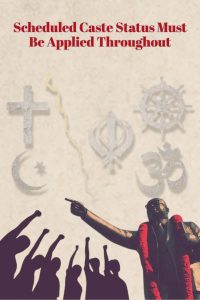
For Rajshekar, conversion is itself part of the history of resistance to caste. Dalits who converted to Christianity, Islam, Sikhism or Buddhism, he argues, changed their religion without escaping the caste identity imposed on them. The continued exclusion of some converts from Scheduled Caste recognition therefore reproduces the divisions created by the caste order, separating Dalits who share a history of untouchability on the basis of their present religion. His argument makes the recognition of Dalit Christians a question larger than reservation: it concerns whether the Dalit movement understands caste as an identity that can persist across religious boundaries.

The question Rajshekar raised in 2005 remains central to the present dispute over Scheduled Caste status for Dalit Christians and Dalit Muslims. The revived Dalit Voice has returned to the issue in its recent discussion of the Supreme Court’s refusal to grant constitutional protection to Dalits across religions, arguing that caste continues to operate beyond religious boundaries. The archival essay shows that Dalit Voice had identified this problem two decades ago: if caste survives religious conversion, then legal protection against caste discrimination cannot depend on a person’s religion.

Below is an abridged version of the essay. The complete piece can be read in its original context here: [Read the full essay] 


Supreme Court Must Keep Off Social Problems

DV supports Dalit Christian quota: Church must force government by mobilising support

In fact, it was the Dalit Voice which first mooted the proposal of reservations to Dalit Christians. We also vigorously campaigned for it all over India.

The underlying principle is caste is our basic identity and this identity can never be destroyed even by conversion to another religion. Every socio-cultural development in this country from time immemorial has taken place by taking into consideration caste, the basic building brick of India.

Hindu gas chamber: The Untouchables, the original inhabitants of this land, became victims of Brahminism and suffered for centuries. To protest against Brahminism, the victims of untouchability crossed over to Christianity, Islam, Sikhism and Buddhism. They only changed their religion (which is like a dress) but not their identity. (V.T. Rajshekar, Caste – A Nation Within the Nation, Books for Change, 2002).

But the Brahminical rulers, to punish the Untouchables getting out of their Hinduism, fearing that their artificially floated “majority religion” would become a micro-minority religion, punished the Untouchables fleeing out of their Hindu gas chamber. But this also did not work.

Racism in India: Religious conversion is one of the powerful socio-cultural weapons of the deprived destitutes to liberate themselves. No power on earth can stop it notwithstanding the ridiculous protests launched by the jealous Hindu nazis against the American Evangelist Benny Hinn visit to Bangalore in Jan. 2005. Dr. Babasaheb Ambedkar himself has recommended the conversion weapon. (Why Go for Conversion? DSA-1987)

The Muslims (15%), Christians and Sikhs (5%) did not come from outside India. At least 90% of its followers are Untouchables, Tribals and Backward Castes. Today, after going over to these egalitarian religions, they say they feel liberated and hence powerful.

It is the Dalit Christians who are mainly responsible for taking the issue of Brahminical racism in India to the United Nations at Durban and making the world aware of the worse-than-Apartheid practices in Hindu India.

Verdict of history: The Brahminical fear is that if the SC/ST reservations are extended to the converts not only the floodgates of conversion will be wide open but more than that the converted Dalits will join hands with the non-converted Dalits and together they will hammer the micro-minority Aryan oppressors, and their empire built on bluffs and blackmail will simply collapse. Every problem of India arises out of this fear.

History is not on the side of the Brahminical Social Order (BSO). Justice and Truth can never be demolished even if the BSO has the support of the Supreme Court.

It is this fear that made the BSO rulers put all sorts of restrictions on SC/ST reservations. Since the higher judiciary is loaded with upper castes, (this judiciary is the main stumbling block to the social and cultural advancement of India’s oppressed majority), the rulers have been mainly seeking the willing help of the judiciary.

Dalit Christian mistake: The simple question is when the Dalit Sikhs and Dalit Buddhists are already included in the SC/ST reservation list why this discrimination only against Dalit Christians? Is not the Brahminical mischief clear?

The Untouchables, whichever be their religion, even the more egalitarian Islam, are all our brothers and the mischievous Brahminical bid to divide Brothers from Brothers must be fought.

To hell with Presidential Order: We are fully aware that the Brahminical rulers are using the state power and the judiciary to divide us and discriminate against us. The BSO must know that it is taking advantage of our goodness and mistaking our peace-loving nature to our docility. They can fool the people for some time. Those days are over.

The Government of India and the Supreme Court should stop taking shelter under the Presidential Order (PO) of 1950. This Order is not part of the Constitution. When this Order was amended many times to include the Sikh and then the Buddhist converts, it can be amended again and again. When the Constitution itself was amended umpteen times, what is big about PO? The government [has to do this] in the interest of the people. Parliament being the highest court of the people can certainly endorse it.

The Supreme Court must note [the] social and cultural problems vexing the people, particularly the oppressed SC/ST/BCs and Muslim/Christian/Sikhs, [and therefore] it should not interfere.

Attorney-General (AG) Milon Banerji said the same thing when the matter came up before the Supreme Court on Feb. 11, 2005. He said he had written a letter to the Government to consider the case of Dalit Christian reservation sympathetically. “It is a matter of policy and legislation and the courts should keep out of it”. Well said.

We don’t know what made today’s Government of India to reject AG’s request. The previous Brahmana Jati Party (BJP)-led Government did reject the demand in 2002 because that Government was led by a set of anti-people Hindu nazi leaders like Vaidik Vajpayee. But that is not the case with the Manmohan Singh Government. Why did it repeat the same old song? Sonia Gandhi must interfere and correct the course.

Upper caste church leadership: The Christian Church leadership is to be partly blamed for not taking genuine interest in the case of Dalit Christian reservation.

Over 75% of the Indian Christians are Dalit. The Indian church itself is a Dalit church. But the leadership of the church is with the upper caste particularly the Syrian Christians.

Now that the Supreme Court has decided to take up the matter after four weeks, the church leadership must prevail upon the Government of India not to oppose the plea of the Dalít Christians. It should also prepare public opinion and produce enough literature so that the Government of India changes its mind and the Supreme Court does not get in the way.

If they refuse to see reason, then the church must get down to mass action. We are here to render any support. Because Dalit Christians are our brothers.
CERD Flags State Violence and Systemic Discrimination Across India

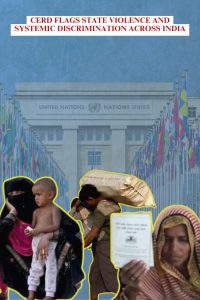
The UN Committee on the Elimination of Racial Discrimination (CERD) has raised serious concerns over the treatment of some of India’s most marginalised communities, including Dalits, Adivasi and tribal peoples, Rohingya, Bengali-speaking Muslims, migrants and asylum-seekers. Its findings follow the first review of India by the Committee since 2007 and examine the country’s combined 20th and 21st periodic reports under the International Convention on the Elimination of All Forms of Racial Discrimination.

The findings were issued after CERD’s 118th session, which also examined Finland, Honduras and Kuwait. This was part of the Committee’s regular review of states that have signed the Convention. CERD’s concluding observations are not court judgments and do not have the force of law. They assess how governments are implementing their obligations under the Convention and identify areas where the Committee finds serious problems.

In India’s case, CERD raised concerns spanning caste, ethnicity, religion, citizenship and policing. One of its gravest concerns was the alleged conduct of law-enforcement agencies towards Indigenous and Tribal Peoples, Scheduled Tribes, Scheduled Castes, particularly Dalits, ethnic and ethno-religious groups and non-citizens. CERD recorded reports of excessive force, racially motivated violence, extrajudicial killings, arbitrary and prolonged detention, torture, ill-treatment and sexual violence. It called for prompt, thorough and impartial investigations, with accountability where violations are established.

The reference to Dalits and Scheduled Castes also brings an older disagreement into the review. The Indian government maintains that caste should not be treated as equivalent to race or “descent” for the purposes of CERD. Its submissions nevertheless contain information on Scheduled Castes and Scheduled Tribes and measures intended to address their disadvantages. CERD’s treatment of caste within its examination of descent and discrimination places caste exclusion within the scope of the Committee’s scrutiny, even as the Indian state rejects that equivalence.

CERD also drew particular attention to Rohingya, Bengali-speaking Muslims, migrants and asylum-seekers. It noted an increase in law-enforcement operations involving these groups, particularly after a 2017 Home Affairs order and the April 2025 Pahalgam attack. Reports of police stops and identity checks based on racial profiling allegedly resulted in arbitrary arrests and detention, torture and other mistreatment. The Committee also raised concerns about deportations and forcible returns involving people who may require international protection.

During the review, CERD Country Rapporteur Stamatia Stavrinaki referred to independent monitoring that recorded more than 1,300 anti-Muslim hate-speech incidents in 2025, including recurring rhetoric attributed to senior officials. India’s delegation responded that legislation enacted in 2023 criminalises acts amounting to hate speech and hate crimes, with additional protections applying when offences target Scheduled Castes and Scheduled Tribes. It also pointed to freedom of religion as a constitutional guarantee.

But CERD’s observations focused on what these protections mean in practice. Alongside the government’s account of its legal safeguards, the Committee recorded concerns about discrimination, hate speech, violence and the conduct of law-enforcement agencies. It called on India to address hate crimes against Rohingya, Bengali-speaking Muslims, migrants and asylum-seekers, refrain from collective expulsions and ensure access to international protection. This includes respecting non-refoulement, the principle that people should not be returned to a place where they face a serious risk of persecution or other grave harm.

The findings also address citizenship and documentation. CERD noted the absence of adequate disaggregated data on Indigenous and Tribal Peoples, ethnic and ethno-religious groups, migrants, refugees, asylum-seekers and stateless people. It highlighted the categorisation of Bengali-speaking Muslims as “non-original inhabitants” and reports that they face more stringent scrutiny during National Register of Citizens verification. The Committee also noted that much of India’s available data on Scheduled Castes, Scheduled Tribes and refugees still derives from the 2011 Census, while acknowledging the delayed 2026 Census and its proposed collection of caste data through self-identification.

The treatment of Bengali-speaking Muslims in the NRC process raises a broader question about how citizenship is administered. CERD’s concern is not simply that documentation is required, but that particular ethnic and religious groups are reportedly subjected to different levels of scrutiny. In a political environment where Muslims are repeatedly cast as outsiders or demographic threats, administrative categories such as “non-original inhabitants” can acquire consequences beyond paperwork. The NRC thus becomes part of a wider system in which belonging is subjected to heightened state verification.

The concerns around Rohingya also sit within a longer history of UN scrutiny. A 2025 communication by UN Special Procedures carried allegations that deportation operations against Muslims, including Rohingya, intensified after the Pahalgam attack, involving raids, arrests, ill-treatment and forcible returns. Those allegations came through a separate UN process and were not findings by CERD or a judicial determination.

India is not a party to the 1951 Refugee Convention or its 1967 Protocol and has no comprehensive national refugee law. UNHCR therefore carries out protection-related functions for refugees and asylum-seekers in the country. This absence has become more significant alongside changes to India’s citizenship and immigration regime.

The Citizenship (Amendment) Act, 2019 was defended by BJP ministers as addressing the unfinished business or “wrongs” of Partition. Yet the CAA was not a refugee law. It created a religion-based route to accelerated citizenship for specified non-Muslim communities from Pakistan, Bangladesh and Afghanistan. It did not establish a general system of refugee protection based on persecution or the risk of serious harm.

And in 2025, Parliament enacted the Immigration and Foreigners Act, replacing four earlier laws governing the entry and treatment of foreign nationals. The new law consolidated the state’s immigration powers without creating a corresponding refugee protection framework. CERD’s call for protection against collective expulsions and respect for non-refoulement therefore comes alongside a strengthened legal machinery for controlling and removing foreign nationals, while India still lacks a dedicated process for determining who requires refugee protection. For Rohingya and other asylum-seekers, that leaves a basic question: what domestic procedure requires the danger they may face after removal to be considered before the state deports them?

India’s delegation, led by Solicitor General Tushar Mehta, defended the country’s legal framework and its claims of pluralism and equality. The government reiterated its position that caste should not be equated with race or “descent” under the Convention and pointed to legislation addressing hate speech and protections for Scheduled Castes and Scheduled Tribes.

CERD’s findings place those claims alongside reports of how state institutions operate on the ground. The Committee’s concerns cover law-enforcement violence against Dalits and Adivasi and tribal communities, anti-Muslim hate speech, racial profiling of Bengali-speaking Muslims and Rohingya, and the treatment of people whose citizenship or immigration status is under scrutiny.

For Dalit and Adivasi communities, and for Muslims and other minorities whose belonging is increasingly subjected to state scrutiny, the findings also expose how Hindu nationalism operates through state power. Caste discrimination, communal targeting, citizenship enforcement and policing are often treated as separate questions, even as they converge in the lives of communities whose relationship with the state is shaped by unequal power. CERD’s observations bring these questions into the same examination of discrimination and direct attention towards the institutions through which unequal treatment is carried out.

Who Gets to Roar Like a Tigress? Neoliberalism, Marketised Education and Caste Inequality

India has expanded education as a formal right while simultaneously allowing the conditions under which that right is exercised to become increasingly differentiated by market capacity. Because market capacity is structured by caste and class, the marketisation of education can undermine the equalising function that constitutional education rights were intended to serve.


Article 21A, inserted through the Constitution (Eighty-Sixth Amendment) Act, 2002, establishes free and compulsory education as a fundamental right for all children between six and fourteen years of age. The Right of Children to Free and Compulsory Education Act, 2009, provides the statutory framework for implementing this constitutional guarantee. This places an obligation on the government to ensure that free and compulsory education reaches children across the most disadvantaged sections of society.

However, there is an evident gap between what the Constitution proclaims education must be, namely, not a private commodity, and what is happening under a neoliberal economic structure. While the right to education is formally universal, as it should be, the quality and conditions under which that right is delivered remain deeply unequal, disproportionately affecting the most vulnerable sections of society, particularly students from SC/ST communities.

In India, there are broadly two types of institutional spaces that provide education and shape the kind of education, exposure, infrastructure, and social networks available to a child: private schools and public schools. Private schools operate through fees and market demand, with annual fees ranging from thousands to several lakhs of rupees, and reaching as high as ₹28–30 lakh in some elite schools. Their appeal is often associated not only with classroom teaching but also with advanced infrastructure, English-language education, extracurricular opportunities, technology, and claims of global exposure. Government schools, by contrast, depend substantially on public expenditure and government provision. A 2025 national survey indicates that average annual household expenditure per child in non-government schools was ₹25,002, compared with ₹2,863 in government schools, making household expenditure on non-government schooling nearly nine times higher.

The government budget for School Education and Literacy, as per the latest available Union Budget 2026–27, is ₹83,562 crore, of which around 70–80% goes towards salaries and administrative costs, leaving substantially less budget for infrastructure, school advancements, and labs. This substantially impacts the passing rate of students and the quality of education they receive.

When a private-educated student and a public-educated student enter a university, the field becomes unequal and highly disadvantageous for public-school students. It is within this unequal field that the neoliberal commodification of education becomes particularly important, as access to better educational opportunities increasingly depends on one’s ability to pay.

Neoliberalism places considerable emphasis on markets, competition, individual choice, and the withdrawal or restructuring of direct state provision. When applied to education, these principles can transform education from a predominantly public responsibility into a service increasingly mediated by market mechanisms. It drives the privatisation of government schools, turning education into a marketable commodity driven by competition, choice, and profit. This is what can be seen in the Indian education system.

Rather than increasing funding and upgrading public schools, the right-wing government has used policies to systematically transfer school ownership, management, or funding to private entities. This has resulted in the closure or merger of 94,000 government schools since 2014, as per a NITI Aayog report. That is 25 public schools per day. On the other hand, private unaided schools grew from 2.88 lakh to roughly 3.39 lakh.

This systematic institutional mobility of schools has resulted in two major shifts. First, the migration of public-school students towards private schools, numbering around 86 lakh. Second, those unable to transfer to or pay for private schools were denied their fundamental right to education.

Such consequences of this marketisation cannot be separated from India’s existing social structure. The ability to choose between schools is itself socially differentiated in India, as income, wealth, social capital, geography, and caste are already unequally distributed.

According to the UDISE+ (Unified District Information System for Education) school database system, around 68.7% of ST students and 62.4% of SC students rely on government schools. For them, public schools continue to function as a major educational lifeline.

A wealthy household facing declining public provision can respond by purchasing private education. A poor household may not have that option. The same policy therefore produces different consequences for different social groups. And therefore, when public education is weakened and monetised, the consequences are not distributed evenly across society, with SC and ST communities bearing a disproportionate share of the impediment.

Furthermore, the incumbent government has allocated just 4% of its GDP to education instead of the 6% recommended by NEP 2020. This gap in allocation, combined with the residual income gap among people, inadequate facilities, and caste domination in government schooling, provides a stark contrast between the constitutional right to formal educational inclusion and substantive equality in education.

In this class and caste divide, SC and ST students are among the most vulnerable. The inequality that begins with access to education continues into the opportunities available to students, eventually contributing to economic inequality. This creates a vicious circular system of unequal education.

unequal schooling → unequal educational attainment → unequal skills and credentials → unequal employment opportunities → reproduction of economic inequality.

Public schooling in India is not simply about education; it is also a political question. In India, neoliberal governance and right-wing politics are lovers, bound together in the making and remaking of the state’s approach to public education. Here, neoliberal restructuring can generate social and economic crises that produce grievances and uncertainty, which right-wing populism can then mobilise politically. In turn, right-wing populism can reinforce the same neoliberal restructuring by redirecting these grievances, generating doubt and distrust towards alternative political and economic narratives, and weakening challenges to the prevailing order.

The recent “School Thik Karo” movement by CJP provides a contemporary illustration of such a love story. The campaign involved visits to government schools, interaction with students, and demands for improvements in educational infrastructure and facilities. What government should fear a demand for better schools? However, rather than being understood simply as a demand for better schools, the campaign encountered political resistance, including restrictions on access to schools in Rajasthan and an FIR in Maharashtra.

This points to a broader tension: government schools are public institutions intended to deliver a constitutional right, yet demands for better infrastructure and greater accountability can become politically contentious. And once again, the consequences fall most heavily on those who have the fewest alternatives: SC and ST students.

Their inability to purchase education, or their household’s lack of the resources necessary to exercise that choice, is a systemic failure of neoliberalism. As neoliberal marketisation increasingly determines who can access quality education, the danger is that education itself, which is intended to enable social mobility, may instead reproduce the inequalities it was expected to overcome.

Dr. Babasaheb Ambedkar said, “Education is the milk of a tigress, and he who drinks it will not fail to roar.”

But what happens when that milk is filtered by income, caste, and market access? The milk is no longer the same for everyone. Some receive it diluted and adulterated, while others receive what allows them to roar. Who gets which kind of milk, and who decides?


Mrunal Madhuri Milind Dupte is a development economics researcher, anti-caste writer and public speaker working on inequality, Dalit and Buddhist economics.

The Savarna Need to Talk About Reservation

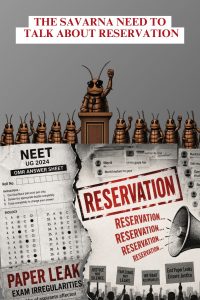
Say what you will about the CJP protests against the NEET paper leak, everyone has already said that the immediate demands are not enough to change the education system. Education scholars are more likely to tell you about the 5-point charter submitted by the CJP to the Government of India. But one class of discourse generators is rattled by the protests themselves, or has been looking for an opportunity to vent its pre-existing frustrations or biases and has now found the perfect one . This is the oppressed castes’ general status and their tiresome, repeated, annoying rant against reservation.

This includes someone fabricating a fake post by actor Vijay Varma about his one non-reserved category friend suffering in some educational institution, which the pro-protest actor quickly said he had never posted. His acting in the anti-Mandal movement film Hurdang alongside Sunny Kaushal, however, may not have made his supposed stance difficult to believe had the post been genuine. Whether he posted it or not, and whether he believes the logic underneath that post, are different questions.

Mrunal Thakur, another actor, apparently posted a story on her Instagram account suggesting that the key moment that changed the game for everyone during these protests was NEET aspirant Harsh Dubey questioning the dominant narrative around the protests, arguing that the focus on the paper leak has overshadowed other longstanding issues in medical admissions. This was apparently a clip from a conversation with NDTV’s Shiv Aroor, where Dubey said questions around reservation policy and the difficulties faced by general category students also deserve public attention. Whether Mrunal Thakur will also come out and deny posting this is a matter of no one’s concern. Bollywood celebrities have shown their political illiteracy and general inhumanity more than once.

But this idea that neither the BJP nor the CJP wants to touch reservation, and that this is what led to the compromise, is one of those Savarna delusions burdened with so many argumentative flaws that a sane mind can hardly engage with it. To begin with, despite its classist and meritocratic articulation of the protests, the CJP does not appear to be opposed to reservation, partly reflected in its use of Ambedkarite symbolism, whether sincere or strategic. One also forgets that the BJP is a heterogeneous party with multiple caste groups and not simply Brahmins and other general category persons. There is no consensus on this question even within the Hindutva fold, something evident from the raita vs. trad debates that have long existed within their own ideological circles. To treat a single interview, one that merely regurgitates the most banal opinion circulating on the Savarna reactionary internet, as having played any pivotal role in shaping the protests is fantasy writing in its purest form.

But what is up with the casteist Savarnas? In a protest that brought together people from the non-protesting middle classes and celebrities, wherein status and privilege are also disproportionately held by oppressor castes, what has made the casteist Savarnas launch into their regular rant with great vigour? Are Savarnas simply waiting for any needle to move so they can carry their anti-reservation agenda? Are they simply incapable of shutting up for once?

Why, then, does every major public mobilisation touching education or even employment seem to invite an anti-reservation chorus from casteist Savarnas? The answer is not that reservation is secretly the central issue every time, like the Dubeys make it out to be. It is that reservation has become the preferred language through which sections of the Savarna public interpret almost every institutional crisis. Whenever a crisis emerges in education or public recruitment, reservation is summoned as the familiar explanation, even when it has little to do with the event itself. It is less a response to the facts before them than a political reflex.

This reflex performs an ideological function. It redirects public anger away from institutions and towards beneficiaries of affirmative action. A paper leak points towards failures of governance, regulation, corruption, examination agencies, and political accountability. None of these explanations preserve the moral authority of the existing Brahminical social order. Reservation, on the other hand, offers an already available narrative; and if Savarna public discourse has shown anything, it is that they love readily available labour, intellectual and otherwise. The next generation of casteists also lack imagination and will rely on the intellectual dis-labour of their Savarna forefathers.

These complaints are very vapid. They transform a structural failure into a grievance against redistributive and representational justice. Instead of asking why an examination system repeatedly fails millions of students, they ask who supposedly enjoys unfair advantages, even though the empirical facts reveal it is they who do. The institution escapes scrutiny because caste once again becomes framed as the problem only when it attempts to correct itself.

There is another reason why these moments are politically useful. Large protests produce so much uncertainty. They reopen public debate and create the possibility that questions long considered settled may be discussed again, especially now that social media has permitted everyone to have an opinion, for good and bad alike. For anti-reservation voices, this is an opportunity to attach their long-standing campaign to a movement that was never organised around their demands. They seek legitimacy through proximity of discourse. If enough people begin associating educational injustice with reservation rather than with state failure, the moment gets a new meaning.

This explains why Harsh Dubey’s interview came to acquire symbolic importance far beyond its actual place in the protests. It offered something many casteist Savarnas had been waiting for: an apparently articulate voice on national television through which they could restate arguments that have circulated for decades. Reservation disrupts the comforting belief that educational success reflects individual merit alone. Every conversation about admissions threatens to reopen the history of caste privilege that made merit appear natural in the first place. It is therefore unsurprising that even a movement against examination malpractice becomes, for some, another occasion to defend inherited advantages while presenting themselves as victims of an unjust system. The anti-reservation discourse surrounding the NEET protests tells us less about the movement than about the persistence of Savarna political common sense.


DalitThinkerToday is a Chartered Accountant by profession from Sangli, Maharashtra, who occasionally dabbles in thinking about politics when people in her oppressor-caste-majority office frustrate her. This is her pseudonym.