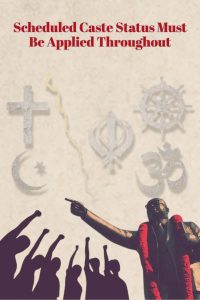
Scheduled Caste Status Must Be Applied Throughout

Archival Note

Published in Dalit Voice (Vol. 24, Issue No. 5, 1 March 2005), this essay by V. T. Rajshekar takes up the demand for Scheduled Caste reservations for Dalit Christians. Rajshekar argues that caste is a social identity rooted in birth and historical oppression, and that religious conversion does not erase that identity. He uses the inclusion of Dalit Sikhs and Dalit Buddhists in the Scheduled Caste framework to question why Dalit Christians continue to be excluded.

For Rajshekar, conversion is itself part of the history of resistance to caste. Dalits who converted to Christianity, Islam, Sikhism or Buddhism, he argues, changed their religion without escaping the caste identity imposed on them. The continued exclusion of some converts from Scheduled Caste recognition therefore reproduces the divisions created by the caste order, separating Dalits who share a history of untouchability on the basis of their present religion. His argument makes the recognition of Dalit Christians a question larger than reservation: it concerns whether the Dalit movement understands caste as an identity that can persist across religious boundaries.

The question Rajshekar raised in 2005 remains central to the present dispute over Scheduled Caste status for Dalit Christians and Dalit Muslims. The revived Dalit Voice has returned to the issue in its recent discussion of the Supreme Court’s refusal to grant constitutional protection to Dalits across religions, arguing that caste continues to operate beyond religious boundaries. The archival essay shows that Dalit Voice had identified this problem two decades ago: if caste survives religious conversion, then legal protection against caste discrimination cannot depend on a person’s religion.

Below is an abridged version of the essay. The complete piece can be read in its original context here: [Read the full essay] 


Supreme Court Must Keep Off Social Problems

DV supports Dalit Christian quota: Church must force government by mobilising support

In fact, it was the Dalit Voice which first mooted the proposal of reservations to Dalit Christians. We also vigorously campaigned for it all over India.

The underlying principle is caste is our basic identity and this identity can never be destroyed even by conversion to another religion. Every socio-cultural development in this country from time immemorial has taken place by taking into consideration caste, the basic building brick of India.

Hindu gas chamber: The Untouchables, the original inhabitants of this land, became victims of Brahminism and suffered for centuries. To protest against Brahminism, the victims of untouchability crossed over to Christianity, Islam, Sikhism and Buddhism. They only changed their religion (which is like a dress) but not their identity. (V.T. Rajshekar, Caste – A Nation Within the Nation, Books for Change, 2002).

But the Brahminical rulers, to punish the Untouchables getting out of their Hinduism, fearing that their artificially floated “majority religion” would become a micro-minority religion, punished the Untouchables fleeing out of their Hindu gas chamber. But this also did not work.

Racism in India: Religious conversion is one of the powerful socio-cultural weapons of the deprived destitutes to liberate themselves. No power on earth can stop it notwithstanding the ridiculous protests launched by the jealous Hindu nazis against the American Evangelist Benny Hinn visit to Bangalore in Jan. 2005. Dr. Babasaheb Ambedkar himself has recommended the conversion weapon. (Why Go for Conversion? DSA-1987)

The Muslims (15%), Christians and Sikhs (5%) did not come from outside India. At least 90% of its followers are Untouchables, Tribals and Backward Castes. Today, after going over to these egalitarian religions, they say they feel liberated and hence powerful.

It is the Dalit Christians who are mainly responsible for taking the issue of Brahminical racism in India to the United Nations at Durban and making the world aware of the worse-than-Apartheid practices in Hindu India.

Verdict of history: The Brahminical fear is that if the SC/ST reservations are extended to the converts not only the floodgates of conversion will be wide open but more than that the converted Dalits will join hands with the non-converted Dalits and together they will hammer the micro-minority Aryan oppressors, and their empire built on bluffs and blackmail will simply collapse. Every problem of India arises out of this fear.

History is not on the side of the Brahminical Social Order (BSO). Justice and Truth can never be demolished even if the BSO has the support of the Supreme Court.

It is this fear that made the BSO rulers put all sorts of restrictions on SC/ST reservations. Since the higher judiciary is loaded with upper castes, (this judiciary is the main stumbling block to the social and cultural advancement of India’s oppressed majority), the rulers have been mainly seeking the willing help of the judiciary.

Dalit Christian mistake: The simple question is when the Dalit Sikhs and Dalit Buddhists are already included in the SC/ST reservation list why this discrimination only against Dalit Christians? Is not the Brahminical mischief clear?

The Untouchables, whichever be their religion, even the more egalitarian Islam, are all our brothers and the mischievous Brahminical bid to divide Brothers from Brothers must be fought.

To hell with Presidential Order: We are fully aware that the Brahminical rulers are using the state power and the judiciary to divide us and discriminate against us. The BSO must know that it is taking advantage of our goodness and mistaking our peace-loving nature to our docility. They can fool the people for some time. Those days are over.

The Government of India and the Supreme Court should stop taking shelter under the Presidential Order (PO) of 1950. This Order is not part of the Constitution. When this Order was amended many times to include the Sikh and then the Buddhist converts, it can be amended again and again. When the Constitution itself was amended umpteen times, what is big about PO? The government [has to do this] in the interest of the people. Parliament being the highest court of the people can certainly endorse it.

The Supreme Court must note [the] social and cultural problems vexing the people, particularly the oppressed SC/ST/BCs and Muslim/Christian/Sikhs, [and therefore] it should not interfere.

Attorney-General (AG) Milon Banerji said the same thing when the matter came up before the Supreme Court on Feb. 11, 2005. He said he had written a letter to the Government to consider the case of Dalit Christian reservation sympathetically. “It is a matter of policy and legislation and the courts should keep out of it”. Well said.

We don’t know what made today’s Government of India to reject AG’s request. The previous Brahmana Jati Party (BJP)-led Government did reject the demand in 2002 because that Government was led by a set of anti-people Hindu nazi leaders like Vaidik Vajpayee. But that is not the case with the Manmohan Singh Government. Why did it repeat the same old song? Sonia Gandhi must interfere and correct the course.

Upper caste church leadership: The Christian Church leadership is to be partly blamed for not taking genuine interest in the case of Dalit Christian reservation.

Over 75% of the Indian Christians are Dalit. The Indian church itself is a Dalit church. But the leadership of the church is with the upper caste particularly the Syrian Christians.

Now that the Supreme Court has decided to take up the matter after four weeks, the church leadership must prevail upon the Government of India not to oppose the plea of the Dalít Christians. It should also prepare public opinion and produce enough literature so that the Government of India changes its mind and the Supreme Court does not get in the way.

If they refuse to see reason, then the church must get down to mass action. We are here to render any support. Because Dalit Christians are our brothers.

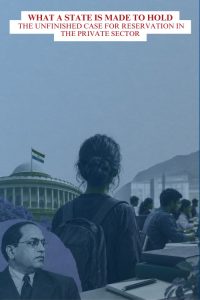
What a State Is Made to Hold: The Unfinished Case for Reservation in the Private Sector

“The purpose of a system is what it does,” Stafford Beer once said: not what its charter claims, not what its founders intended, not what its defenders insist it’s secretly working toward once the numbers look bad. The line comes from Beer’s work in cybernetics and systems theory, but it travels well, because it was really a warning against taking any institution’s word for itself. Apply it to the state and the sentence stops being quippy and starts being uncomfortable. A state does not do what its Constitution’s preamble promises. It does not do what its bare acts say it must. It does what its politicians ignore until an election forces a promise out of them. It does what a police force using violence on citizens with impunity does. It does the slow torture bureaucrats in government offices administer by attrition. It does the routine ignoring of injustice courts specialise in. Everything else is marketing.

A state’s default setting isn’t a neutral one, but it isn’t a fixed conspiracy either: it simply doesn’t move unless it’s made to. Every gain anyone has pulled out of a state came after someone made not conceding more expensive than conceding.

Reservation itself carries the memory of that fact in its own founding story. Ambedkar’s original demand, at the Round Table Conferences, was a separate electorate for the Depressed Classes: our own constituencies, our own voters, our own representatives answerable to no one else’s veto, a political existence independent of Hindu society rather than embedded inside it. The Communal Award of August 1932 granted exactly that. Gandhi, in prison, announced a fast unto death to force its withdrawal, blackmailing the Depressed Classes and its leaders as well as the British rulers, on the ground that a separate electorate would permanently divide Hindu society. Ambedkar held out against a starving man for days before the political pressure, not the argument, became unbearable on practical grounds, and what emerged from the negotiation at Poona was not the separate electorate but reserved seats inside a joint electorate: more seats than the Award had granted, 148 in the provincial legislatures instead of the original allotment, but folded back into the same political body Ambedkar had tried to exit. Reservation was not the original ask. It is what remained after the original mandate was made impossible by someone else’s leverage and the Hindu moral bankruptcy behind it. The instrument defended for ninety years since it has itself been a settlement, arriving at under duress, from a wider claim.

Rahul Sonpimple, founder of the All India Independent Scheduled Castes Association (AIISCA), made a version of this point at a press meeting on private sector reservation in Delhi on 27th September, framing reservation as something closer to a treaty than an entitlement: a thin, fragile thread and the only one tying Dalits, Adivasis and OBCs to the Indian state, functioning not as generosity but as a negotiated peace. It buys the state and the dominant castes who still hold most of the country’s assets a measure of calm from a majority whose rightful share has otherwise been denied, while giving the numerically dominant Bahujan population some working proxy for the democratic weight their numbers should carry. A contract, not a gift. Except a contract is only as good as what a party can be made to perform under it, and a state that already treats its own preamble as marketing will treat a contract no differently.

A contract implies parties, and a state, unlike a private employer, actually has one with its citizens. It demands loyalty, taxation, submission to its law, alongside the monopoly to dictate the political fates of those within its territory, in exchange for a set of standing obligations back. A private firm asks for labour under a contract either side can in principle at least walk from, and owes nothing back to someone who was never bound to it in any comparable way. That asymmetry is a large part of why a claim on the state’s own hiring is different in kind from a claim on a firm’s, not because the state behaves more responsibly in practice, as we are all well-aware, but because it owes something on the terms of the relationship itself. Although an obligation the state owes but doesn’t perform is worth exactly as much as a preamble it doesn’t act on.

A private firm is not identical to the state, and the case for reaching it anyway doesn’t depend on pretending otherwise. It rests on two separate facts. The economy itself has changed since the framers drew the line at public employment, and a social justice framework confined to the public sector now leaves most of economic life untouched, because most of it no longer sits inside the public sector at all, a gap widened further by the same state’s ongoing privatisation of what public capacity remains, shrinking the one terrain where proportional representation currently carries legal force. But the second fact runs deeper and doesn’t depend on how recent liberalisation is: a private sector built on land, credit, licenses and infrastructure the state provides, privatising its profits while routinely and unsparingly socialising its costs through subsidy, tax concession and public investment, has never sat outside the state’s reach in the first place, this was true of Indian capital before 1991 as much as after it. A firm that depends on the state which itself takes from the public commons for that much can never be allowed to answer to nothing beyond its own balance sheet.

Even so, there’s a real limit to what representation alone produces. Elevated individuals from a movement or caste often become instruments of the institution’s own legitimation rather than being accountable to the base that elevated them, and when they try to push further beyond the constraints and the logics of those systems, they get cut down by the sheer weight of social forces unwilling to tolerate the progress already made. Despite that, political reservation has still converted into something more durable than individual token presence, an independent structure of Bahujan power that didn’t exist before it, even as oppressor-caste violence against that rise has grown alongside it. What government service has that the private sector doesn’t is exactly this: decades of organised structure built up around the reserved seat, structure that keeps contesting the ceiling even where it doesn’t break through it. The private sector has never had an equivalent foothold, and no amount of employer voluntarism has ever built one. That’s the case for statutory reservation even in its thinnest form: not that a quota alone delivers equality, especially substantively, but that it’s the minimum legal anchor around which durable, organisable power can be built at all.

Against that backdrop, private sector reservation is not a new demand groping for its first hearing. It has been formally raised for close to two decades. The All India Confederation of SC/ST Organisations was pressing the case as early as 2012, organising a march on Delhi backed by three dozen SC/ST organisations, arguing plainly that no nation stays strong while its economic and social levels remain this split. But even before that, in 2003, then Prime Minister Atal Bihari Vajpayee addressed a meeting of SC and ST MPs and said that the private sector cannot exist in isolation and has to be responsive to the needs of the society, making it essential to have reservation in the private sector. This was followed by a broad consensus among electoral parties across the ideological spectrum on the matter, even though it has not yet been translated into political will or substantive action. One concrete effort came in 2006, under Prime Minister Manmohan Singh, when he appealed directly to Indian industries to become the government’s partner on the question. However, rather than legislate a mandate, the government let industry regulate itself: CII, FICCI and ASSOCHAM each adopted a Voluntary Code of Conduct built around four pillars, Employability, Education, Entrepreneurship Development and Employment. That October, the PMO had already constituted a Coordination Committee on Affirmative Action in the Private Sector, chaired by the Principal Secretary to the Prime Minister, drawing on the Department of Personnel and Training, the Ministry of Social Justice and Empowerment, the Ministry of Tribal Affairs, and serviced by the Department of Industrial Policy and Promotion. The Committee has met nine times since. By 2010, the government’s own review found adoption of the voluntary codes was slow; by 2013, it was still describing the same dialogue as ongoing; by 2015, industry associations were reporting hundreds of member companies signed on. Twenty years of this arrangement has produced a voluntary code without enforceable duties, and industry associations professing over a lakh of beneficiaries with no verifiable representation data to back the figure. Now we cannot sit once again with a renewed appeal for goodwill. What is needed is to go beyond an empty promise and fight for a statutory guarantee: a binding quota, backed by rule of law, not another code any signatory can stop honouring when they feel like it.

On 26 July 2024, that demand reached Parliament directly. Chandrashekhar Azad, MP for Nagina, introduced a private member’s bill titled the Reservation for the Scheduled Castes, the Scheduled Tribes and the Other Backward Classes in Private Sector Act, 2024, one of three private member’s bills he introduced in the Lok Sabha that day. It covers private firms, educational institutions and other establishments employing at least twenty people with no government financial stake. Even this bill stops short of a binding hiring quota: its mechanism is incentive-based, requiring the central government to induce private firms toward reservation through special concessions and lower-interest loans via nationalised banks, with an annual implementation report tabled in both Houses. Structurally, a private member’s bill has almost no chance of becoming law: enactment is the exception, not the rule, and has been for decades. That a bill this cautious, relying on incentives rather than quotas, remains a private member’s bill and is still pending says something about how far Parliament remains from treating this as settled business.

But the case for the demand itself rests on documented discrimination. Sukhadeo Thorat and Paul Attewell’s 2007 correspondence study sent matched applications under upper-caste Hindu, Dalit and Muslim names to private-sector job advertisements in the English dailies and found discrimination operating at the very first screening stage, before any interview, before any assessment of merit beyond a name on a page. Zahra Siddique’s 2011 work went further, quantifying the size of the gap and who was driving it: low-caste applicants had to send 20% more resumes than high-caste applicants to get the same callback rate, with the disparity sharpest when the recruiter was male or Hindu, and more pronounced at smaller firms than larger ones. Axmann, Swanson and Cuspinera Contreras, using Indian Human Development Survey data in 2016, found significant wage discrimination against Dalits and Adivasis specifically inside the private sector. Madheswaran and Singhari, drawing on National Sample Survey employment data the same year, found SC workers earning less than equally qualified forward-caste workers in urban labour markets, with the gap wider in private employment than public, and unequal access to occupations itself doing much of the work in producing the disparity. Pattayat’s 2024 study of rural non-farm workers, using NSSO and PLFS data spanning 2004-05 to 2019-20, found the earnings gap persisting across that entire period and examined how much of it discrimination itself accounted for.

Article 15(5) already gives the state constitutional room to act on half of this. Inserted by the 93rd Amendment in 2005 and in force since January 2006, it permits special provision by law for socially and educationally backward classes, Scheduled Castes and Scheduled Tribes in admission to educational institutions, explicitly including private institutions, aided or unaided, with the sole carve-out for Article 30(1) minority institutions. Because education sits on the Concurrent List, both Parliament and state legislatures can act under it, and several states have already legislated on private educational admissions. Tamil Nadu enacted a 2006 law providing 69% reservation for Backward Classes, Most Backward Classes and Denotified Communities, Scheduled Castes and Scheduled Tribes in private educational institutions. Andhra Pradesh had already applied SC, ST and Backward Class reservations to admissions in private professional institutions through its admission rules. Karnataka’s 2006 Professional Educational Institutions Act provides for 50% reservation for SCs, STs and OBCs in unaided non-minority professional institutions. Maharashtra enacted a 2006 law providing reservation for SCs, STs, Denotified Tribes, Nomadic Tribes and OBCs in private professional educational institutions, while Haryana’s 2016 Backward Classes Act provides reservation for Backward Classes in admissions to educational institutions, including private institutions.

What that record shows is that Article 15(5) has been given statutory effect at the state level, but unevenly and without a nationwide framework. A Parliamentary Standing Committee report presented to the Rajya Sabha in August 2025 said that private educational institutions are currently under no national legal obligation to implement reservation because there is no central statute mandating it. It recommended that Parliament legislate 27%, 15% and 7.5% reservation for OBCs, SCs and STs respectively in private higher educational institutions, with government reimbursement of the associated costs on the model of the Right to Education Act. Although a sincere Caste Census may tell us that the necessary numbers should be much higher, the constitutional ceiling on reservation itself also needs to be revisited.

What Article 15(5) doesn’t reach at all is employment, and that gap isn’t small: education and employment were never separable; a degree that doesn’t convert into a job is a credential, not a livelihood. One state that tried a binding private-sector quota by its own legislation ran straight into that trap. Haryana’s 2020 State Employment of Local Candidates Act mandated 75% reservation for domiciled candidates in private jobs under a salary threshold, with a 10% district sub-cap built in, not a caste quota, a domicile one. The Punjab and Haryana High Court struck it down in 2023 as unconstitutional and violative of Part III of the Constitution; the challenge to that judgment remains pending before the Supreme Court. The deeper problem predates the ruling: the 93rd Amendment gave the state constitutional room to reach private education specifically and never extended that room to private employment. Domicile was the classification that failed here, not caste, but replacing domicile with caste would not by itself resolve the Article 19(1)(g) problem, because no amendment has yet done for employment what the 93rd did for education. That is what this demand still needs and hasn’t gotten: not just a statute, but a constitutional amendment opening the same room for private employment that the 93rd opened for private education, without which any statute meets the wall Haryana did.

Winning that room would still only secure a narrower claim than the one Ambedkar himself eventually made. Private sector reservation, at its most comprehensive, means reservation in private employment, reservation in private educational institutions, and an Equal Employment Opportunity Act as organizations like AIISCA and others have been demanding: legislation with a working complaint mechanism, an investigation process, ongoing monitoring, and real accountability, reaching recruitment, wages, promotion, workplace treatment, termination, occupational allocation, contract employment and professional advancement, not just the moment of hire. That last piece is the one twenty years of voluntary codes never touched, because a Voluntary Code of Conduct had no enforceable complaint mechanism and no statutory consequence for ignoring it. A statute would. But even this full slate, a foothold at every stage of the employment relationship, asks only for fair terms of entry into an economy whose ownership stays exactly where it already is. It is a claim to be treated fairly inside the room. It has never been a claim on who owns the room.

Ambedkar’s own economic writing sits alongside all of this as one part of a longer record, that expands the horizon of economic fight itself. In States and Minorities, the memorandum he prepared for the Constituent Assembly on behalf of the Scheduled Caste Federation, he proposed a state control over economy in which key industries would be owned and run directly by the state and basic industries owned by the state and run through its own corporations, with land held under state ownership and cultivated through cooperative farming, aimed at dismantling landlordism and the agrarian exploitation caste had built itself around. That program was never incorporated into the Constitution in the form Ambedkar proposed. Although a version of that was found in the Nehruvian socialist project, which was itself eventually given up in the face of global neoliberal onslaught. What it shows, regardless of anyone’s own view of state ownership as a remedy, is how early and how directly Ambedkar located the actual target in who owns the economy, not merely who holds a fair position inside it.

Ambedkar’s economic target, and the demand for reservation in the private sector, concern forms of structural injustice that are harder to see than the moments when that injustice erupts into visible violence. That shapes not only who gets to have this conversation and on what terms, but who is willing to listen to it. Oppressor-caste liberals attend to Dalit-Bahujan life most readily through the news cycle of atrocity, because atrocity is visceral and immediately legible, while the guilt of a grieving conscience often springs into action only when Dalit-Bahujan rage forces that attention. A Dalit-Bahujan body demands attention in a way a hiring statistic does not. A wage-discrimination dataset spanning fifteen years, a Coordination Committee that has gone nowhere, a bill pending in Parliament since 2024, none of these produces the same urgency because none offers an easy villain, a headline image or a clean moment of collective horror to perform. Grieving a corpse asks nothing ongoing of anyone. But there is a real villain here, even if it is harder to identify in any single moment: the state, which owes more than what it does and routinely shows where its priorities lie, alongside the structural violence produced through years of oppressor-caste apathy at best and antipathy at worst.

The historical record here is a caution, not a reason to wait. What survived Poona wasn’t Ambedkar’s original demand: it was a narrower settlement that still had to be fought for afterward, seat by seat, for decades, before it was more than ink. The same will be true of a private-sector statute and an Equal Employment Opportunity Act alongside it. Winning them will not finish anything on its own; a seat is captured as often as it’s built on. Beer’s sentence applies once more, now to the law: a statute’s purpose isn’t what its statement of objects and reasons says either. It’s what the Act does. Whether the complaint mechanism gets used, whether a violation carries any real cost, whether the oversight committee holds its next meeting or goes missing in action the way it already has. None of that follows from any bill becoming an act. It follows only if the pressure that forces the act into existence keeps being applied after it exists. Because a state, as established, only holds what it’s made to hold.


Paresh Hate is a Bahujan queer researcher, writer, documenter and activist and the Lead Content Manager at Dalit Voice.

The Right Not to Sing

Nationalist Demands in the New Law

The Prevention of Insults to National Honour (Amendment) Bill, 2026 was introduced by Amit Shah in the Rajya Sabha on 24 July 2026. Its Statement of Objects and Reasons recalls that Rajendra Prasad, as President of the Constituent Assembly, said on 24 January 1950 that Vande Mataram would be “honoured equally” with Jana Gana Mana. It notes that no legal provision existed to prevent interference with the singing of the National Song and proposes to address this by amending Section 3 of the 1971 Act, which already made intentionally preventing the singing of the National Anthem, or disturbing an assembly engaged in singing it, punishable with imprisonment of up to three years, a fine, or both, with a mandatory minimum of one year for a second and subsequent conviction. The amendment extends that same offence, and the same penalties, to the National Song. Article 51A(a) names the Constitution, the national flag and the national anthem as objects of citizens’ respect; it has never named the National Song.

The amendment arrived alongside a separate, longer-running push to change what gets sung. Vande Mataram has six stanzas; since 1937, only the first two have been used at national gatherings, a convention set by the Congress Working Committee. The Ministry of Home Affairs had already moved to reverse that convention on its own, issuing a protocol on 28 January 2026 requiring the full six-stanza version at government, ceremonial and cultural events, well before this amendment existed. That protocol was advisory and, as the courts would go on to hold twice over the following months, carried no penalty of its own. Only after those two challenges failed did the government tighten the position twice more: a July 9 MHA letter to all states specifying that only the official six-stanza version could be recited whenever the song was sung in mass singing, and then, on 24 July, the amendment itself. Where both the song and the anthem are performed at one event, Vande Mataram now goes first. Schools are directed to open assemblies with it, although many schools already practiced this of their own volition. It is to be played at state functions, civilian award ceremonies, flag-hoisting events, and the arrivals and departures of the President and Governors.


The Political Fight Over the Song
The push for the full six-stanza version followed a ten-hour special discussion in the Lok Sabha in December 2025 marking the song’s 150th anniversary, in which the Prime Minister accused the Congress of having “sowed the seeds of division” by trimming the song. In 1937, the Congress Working Committee, after consultation with Mohandas Gandhi, Jawaharlal Nehru, Rabindranath Tagore, Subhas Chandra Bose, Rajendra Prasad and Vallabhbhai Patel, decided that only the first two stanzas would be used at national gatherings because of objections to the religious imagery in the later verses. Tagore had written to Nehru that the first two stanzas had “acquired a separate individuality and an inspiring significance of its own,” while the later verses, read in context, “[are] liable to be interpreted in ways that might wound [Muslim] susceptibilities.” Congress rejected the Prime Minister’s charge, pointing to this 1937 decision and Tagore’s letter and accusing the government of manufacturing the controversy for present gain in the context of then upcoming elections, a charge Priyanka Gandhi Vadra made directly. The Congress Working Committee has since reaffirmed the two-stanza position for its own party programmes.

The dispute has now also moved into a question of federal authority after the Karnataka government ordered on 8 September that only the first two stanzas be sung at state government programmes, except when the President, Vice-President, Prime Minister or Governor is present. Within days, advocate Girish Bharadwaj filed a PIL challenging the state’s authority to prescribe a shorter version, arguing that the matter falls within Parliament’s residuary legislative powers and that the state order conflicts with the 2026 amendment to the Prevention of Insults to National Honour Act. The petition also challenged the procedure by which the Karnataka Cabinet took the decision, alleging that it was approved as an “Informal Discussion” without a Cabinet Note or Law Department advice. Governor Thaawarchand Gehlot then wrote to Chief Minister D.K. Shivakumar, invoking Articles 162, 256 and 257(1) and asking the government to reconsider its order on the ground that it conflicted with the Union’s statutory and executive framework. On 16 September, BJP MLA S.N. Channabasappa walked out of a government programme in Shivamogga after only the first two stanzas were sung.

The opposition, however, has also been weak in resisting the Centre’s position. In Kerala, the Congress-led UDF government initially circulated the Centre’s instruction that Vande Mataram be sung in full during the Har Ghar Tiranga campaign from 9 to 17 August. This put a Congress-led government in the position of appearing to implement the same six-stanza version promoted by the BJP-led Union government, despite Congress’s objections to treating the full version, with its references to Hindu deities, as a compulsory expression of national identity. The CPI(M) criticised the UDF’s position, with Leader of the Opposition Pinarayi Vijayan arguing that the song “in its entirety is not compatible with secularism” and that “there is nothing wrong with reciting the opening stanzas”, and accusing the UDF of surrendering to an RSS agenda. The UDF subsequently clarified that it would not follow the full version, and the state government ultimately omitted Vande Mataram from its official Independence Day function.

The song’s meaning has remained contested within the communities whose religious commitments are most directly implicated by it, a history the government’s “everybody knows what is national song” formulation simply passes over. The distinction made in 1937 remains central to the dispute: the Congress Working Committee accepted the first two stanzas for national gatherings while recognising objections to the later verses and their religious imagery. Muslim religious authorities have continued to make this distinction. Darul Uloom Deoband and Maulana Mahmood Madani have objected to the later verses on the grounds that their depiction of the motherland as divine conflicts with the Islamic doctrine of tawhid, while the All India Sunni Ulema Board ruled in 2006 that Muslims could sing the first two stanzas.

The dispute, however, has not been confined to Muslim objections. During the 2006 centenary controversy, the Shiromani Gurdwara Parbandhak Committee initially instructed its schools not to sing Vande Mataram, with its president arguing that it promoted a particular religion and did not fulfil the aspirations of minorities, before subsequently backing away from that position. In 2026, the Andhra Pradesh Christian Leaders Forum objected to the newly mandated full version, specifically citing its references to Durga and their implications for Christian beliefs. The question is therefore not simply whether Vande Mataram is the national song, but what religious content the state is asking people to affirm when it mandates the complete text. The Home Ministry’s circular treats that underlying question as though it had never been contested. Where it does allude to the religious objection, it reduces it to a question of Muslim reluctance, allowing a disagreement over religious belief to be recast as a question of patriotism.


The Text Behind the Mandate
The distinction between the first two stanzas and the later verses can be traced to how the song was written. Bankim Chandra Chattopadhyay had written the first two stanzas in the 1870s, describing a land of rivers, fruit and gentle winds. He added four more when he incorporated the song into his 1882 novel Anandamath, and those later stanzas carry the divine imagery: the third stanza calls the motherland “protector of millions and destroyer of enemies,” the fourth names her Durga, Lakshmi and Saraswati outright, while the fifth and sixth complete the poem as a vow of devotion.

Anandamath provides the setting in which those later stanzas acquire their political and religious meaning. Bankim Chandra Chattopadhyay is one of the key figures of proto-Hindutva politics in British India, and the novel is set during the Sannyasi Rebellion. Its protagonist, Mahendra, a zamindar separated from his family amid famine and unrest, falls in with the Santans, a band of ascetic soldiers who have taken up arms to liberate the motherland from Muslim rule, with the British entering the story only later. One of Satyananda’s disciples wants to “pull down the city of the renegades” and “throw it into the river.” Bhavananda, inducting Mahendra into the cause, tells him “unless we drive these tipsy long-beards away, a Hindu can no longer hope to save his religion,” and answers the question of method with “we will beat them.” He then leads Mahendra to the order’s temple, where, standing before the idols of Durga and Kali, he tries to fill him with religious fervor for the fight ahead. Elsewhere in the novel, the Santans send emissaries into villages to gather bands of Hindus, then raid Muslim settlements, which are burned “to ashes.” Characters imagine the day a mosque will be razed to build a temple to Radha-Madhava in its place. The four later stanzas of Vande Mataram were written for, and inside, this story. This is the context of the text now mandated by law.


The Limits of the Law’s Imagination
That January 28 protocol was challenged twice. In February, Muhammed Sayeed Noori approached the Supreme Court, arguing that requiring the complete version raised questions of religious freedom and conscience. On 25 March, the Court declined to entertain the petition, holding that the protocol was advisory and carried no penalty for those who chose not to sing, while leaving open the possibility of intervention if the advisory hardened into actual discrimination or coercion. A parallel challenge in the Karnataka High Court, filed by Bengaluru-based advocate Somashekhar Rajavamshi, objected specifically to the inclusion of stanzas three through six and their references to Durga, Saraswati and Lakshmi; the High Court dismissed it on 9 April on the same ground, that the protocol did not make singing the full version mandatory.

The 2026 amendment changes that position. The January protocol could prescribe the full version’s use; it could not, on its own, criminalise a refusal to sing it. The amendment extends the National Song to the Section 3 offence applicable to the National Anthem since 1971: intentionally preventing its singing, or disturbing an assembly engaged in singing it.

On 22 September 2026, the Supreme Court heard a petition by T. M. Krishna, with senior advocate S. Muralidhar appearing for him. The petition challenges the 2026 amendment insofar as it extends the existing criminal provision to the National Song. It also challenges the Home Ministry’s directions requiring the complete six-stanza version at official functions. The petition argues that the amended provision and the directions violate Articles 14 (equality before the law), 15(1) (prohibition of discrimination on specified grounds), 19(1)(a) (freedom of speech and expression), 21 (protection of life and personal liberty) and 25(1) (freedom of conscience and the right to profess, practise and propagate religion).

The Court refused to decide whether the National Song should consist of two stanzas or six, indicating that this was for the democratically elected state to determine rather than for the Court to prescribe. Justice Bagchi also questioned the suggestion that religious references in all six stanzas are, by themselves, incompatible with the Constitution’s secular character, pointing to the reference to God in the US national anthem. That another country’s anthem contains a religious line does not make it a benchmark for what India’s Constitution should tolerate; it only shows that one other state has also let religious language sit inside a national symbol. Whether a lingering religious motif of that kind is compatible with secularism is exactly the question in front of the Court, and pointing to a second, unexamined instance of the same thing does not answer it. The Centre has two weeks to respond, and the Court has not yet ruled on the constitutional validity of the amendment or the six-stanza directions.

At the hearing, however, the Court drew a distinction between the State’s choice of a national symbol and the use of criminal law in relation to participation in it. Nothing in the amendment says that simply refusing to sing Vande Mataram is itself an offence; the crime, as under the original Section 3, is preventing others from singing or disturbing an assembly engaged in it. The question before the Court is therefore whether the protection recognised in Bijoe Emmanuel, which concerned refusal to sing the National Anthem under that same original section, also protects a person who refuses to sing the National Song on grounds of conscience or religion while leaving others free to do so.

That leaves an odd gap. If the amendment truly does not touch a refusal that neither prevents others from singing nor disturbs an assembly, the state loses nothing by saying so outright, and Krishna’s petition should fall outside the law’s reach without a fight. The Centre resisted even the issuing of notice, and Solicitor General Mehta pressed the Court not to entertain the petition at all. That resistance points to a state interest that Section 3’s text does not itself supply: the discretion to withhold, for as long as possible, any confirmation that non-participation is safe.

Bijoe Emmanuel v. State of Kerala, which the Court said still governs the field and has never been challenged, is the case that established that refusal to sing the National Anthem, where the person neither prevents others from singing nor disturbs the assembly, does not constitute an offence under Section 3. In 1986, the Court considered three schoolchildren in Kerala who belonged to the Jehovah’s Witnesses faith. They believed that singing the National Anthem was incompatible with their religious convictions, although they had no objection to the words or sentiments of Jana Gana Mana. During their school’s morning assembly, they stood silently while the anthem was sung. After the issue was raised, they were expelled from school, despite an inquiry finding that they were law-abiding and had shown no disrespect. The Supreme Court held that their expulsion violated their fundamental rights. It also held that there was no law obliging anyone to sing the National Anthem and that their standing silently while it was sung did not constitute an offence under Section 3 because it neither prevented the singing nor disturbed the assembly.

The Court in Bijoe Emmanuel answered for the facts it had: the children stood, in silence, while others sang, and that was respect enough. Whether sitting, or some other form of non-participation, would count the same way was never argued before it, and the judgment does not say. The Court’s later National Anthem jurisprudence went further than Bijoe Emmanuel by imposing a general requirement to stand, but went no further in deciding whether an able-bodied person who chose not to comply had thereby committed an act of disrespect. In Shyam Narayan Chouksey v. Union of India, the Court initially ordered, in 2016, that the National Anthem be played before every feature film and that everyone present stand. It subsequently recognised exceptions for people unable to stand and for occasions when the anthem appeared within a film, newsreel or documentary. In 2018, it made the playing of the anthem before films optional and handed the wider question of its regulation to the government. What remained unresolved was whether an able-bodied person who deliberately remained seated when the National Anthem was played had thereby shown disrespect.

Article 51A(a) requires citizens to respect the Constitution, the national flag and the national anthem. That language concerns respect for specified national symbols, while Section 3 concerns conduct that interferes with their public performance. The Constitution speaks of an attitude of respect; Section 3 defines specific acts that the law prohibits. Bijoe Emmanuel is the only case here that actually examined a specific act of non-participation and ruled on whether it counted as respectful: the children stood silently while others sang. Chouksey, by contrast, imposed a general rule about what everyone present in a cinema hall had to do when the anthem was played, and later withdrew the requirement that the anthem be played there at all. The distinction between respectful and disrespectful non-participation has therefore never actually been adjudicated on its own terms. That leaves the discretion to decide sitting with whoever is enforcing the law in the moment, not with any settled rule a citizen could rely on in advance. And even supposing that gap could be closed, and the state produced a clean definition of respectful non-participation tomorrow, a further question is why a person should have to demonstrate respect for a national symbol through participation of any kind, rather than simply being left alone by the law altogether.

Article 51A(a) itself answers none of this. The Fundamental Duties, inserted into the Constitution by the 42nd Amendment in 1976, are not enforceable in court. No citizen has ever been prosecuted for an abstract failure to respect the Constitution, the flag or the anthem. Section 3 punishes specific conduct: preventing a performance, disturbing an assembly, even though the boundaries of that conduct can still be interpreted and policed according to the discretion of whoever is enforcing the law. Article 51A(a) supplies the word “respect” and nothing else. It does not say what respect consists of, and it does not say respect must be shown rather than merely left unviolated. The state has built a criminal statute that reaches only interference, and rested it on a duty clause that was written to describe an attitude, not to compel an act.


The Right Not to Sing
The present controversy asks a larger question about the limits of state power over national rituals. A person may have a religious objection to the text, reject the use of a national symbol altogether, or simply choose not to participate. If that refusal does not prevent anyone else from singing, what is the state entitled to demand from the person who refuses? Even as the space for conscientious objection shrinks in the shadow of ultranationalism, we must continue to ask: why should the state require that refusal to take a prescribed form of respect, and why can it not leave room for people to decline participation altogether?

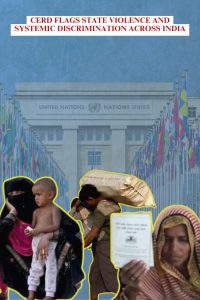
CERD Flags State Violence and Systemic Discrimination Across India

The UN Committee on the Elimination of Racial Discrimination (CERD) has raised serious concerns over the treatment of some of India’s most marginalised communities, including Dalits, Adivasi and tribal peoples, Rohingya, Bengali-speaking Muslims, migrants and asylum-seekers. Its findings follow the first review of India by the Committee since 2007 and examine the country’s combined 20th and 21st periodic reports under the International Convention on the Elimination of All Forms of Racial Discrimination.

The findings were issued after CERD’s 118th session, which also examined Finland, Honduras and Kuwait. This was part of the Committee’s regular review of states that have signed the Convention. CERD’s concluding observations are not court judgments and do not have the force of law. They assess how governments are implementing their obligations under the Convention and identify areas where the Committee finds serious problems.

In India’s case, CERD raised concerns spanning caste, ethnicity, religion, citizenship and policing. One of its gravest concerns was the alleged conduct of law-enforcement agencies towards Indigenous and Tribal Peoples, Scheduled Tribes, Scheduled Castes, particularly Dalits, ethnic and ethno-religious groups and non-citizens. CERD recorded reports of excessive force, racially motivated violence, extrajudicial killings, arbitrary and prolonged detention, torture, ill-treatment and sexual violence. It called for prompt, thorough and impartial investigations, with accountability where violations are established.

The reference to Dalits and Scheduled Castes also brings an older disagreement into the review. The Indian government maintains that caste should not be treated as equivalent to race or “descent” for the purposes of CERD. Its submissions nevertheless contain information on Scheduled Castes and Scheduled Tribes and measures intended to address their disadvantages. CERD’s treatment of caste within its examination of descent and discrimination places caste exclusion within the scope of the Committee’s scrutiny, even as the Indian state rejects that equivalence.

CERD also drew particular attention to Rohingya, Bengali-speaking Muslims, migrants and asylum-seekers. It noted an increase in law-enforcement operations involving these groups, particularly after a 2017 Home Affairs order and the April 2025 Pahalgam attack. Reports of police stops and identity checks based on racial profiling allegedly resulted in arbitrary arrests and detention, torture and other mistreatment. The Committee also raised concerns about deportations and forcible returns involving people who may require international protection.

During the review, CERD Country Rapporteur Stamatia Stavrinaki referred to independent monitoring that recorded more than 1,300 anti-Muslim hate-speech incidents in 2025, including recurring rhetoric attributed to senior officials. India’s delegation responded that legislation enacted in 2023 criminalises acts amounting to hate speech and hate crimes, with additional protections applying when offences target Scheduled Castes and Scheduled Tribes. It also pointed to freedom of religion as a constitutional guarantee.

But CERD’s observations focused on what these protections mean in practice. Alongside the government’s account of its legal safeguards, the Committee recorded concerns about discrimination, hate speech, violence and the conduct of law-enforcement agencies. It called on India to address hate crimes against Rohingya, Bengali-speaking Muslims, migrants and asylum-seekers, refrain from collective expulsions and ensure access to international protection. This includes respecting non-refoulement, the principle that people should not be returned to a place where they face a serious risk of persecution or other grave harm.

The findings also address citizenship and documentation. CERD noted the absence of adequate disaggregated data on Indigenous and Tribal Peoples, ethnic and ethno-religious groups, migrants, refugees, asylum-seekers and stateless people. It highlighted the categorisation of Bengali-speaking Muslims as “non-original inhabitants” and reports that they face more stringent scrutiny during National Register of Citizens verification. The Committee also noted that much of India’s available data on Scheduled Castes, Scheduled Tribes and refugees still derives from the 2011 Census, while acknowledging the delayed 2026 Census and its proposed collection of caste data through self-identification.

The treatment of Bengali-speaking Muslims in the NRC process raises a broader question about how citizenship is administered. CERD’s concern is not simply that documentation is required, but that particular ethnic and religious groups are reportedly subjected to different levels of scrutiny. In a political environment where Muslims are repeatedly cast as outsiders or demographic threats, administrative categories such as “non-original inhabitants” can acquire consequences beyond paperwork. The NRC thus becomes part of a wider system in which belonging is subjected to heightened state verification.

The concerns around Rohingya also sit within a longer history of UN scrutiny. A 2025 communication by UN Special Procedures carried allegations that deportation operations against Muslims, including Rohingya, intensified after the Pahalgam attack, involving raids, arrests, ill-treatment and forcible returns. Those allegations came through a separate UN process and were not findings by CERD or a judicial determination.

India is not a party to the 1951 Refugee Convention or its 1967 Protocol and has no comprehensive national refugee law. UNHCR therefore carries out protection-related functions for refugees and asylum-seekers in the country. This absence has become more significant alongside changes to India’s citizenship and immigration regime.

The Citizenship (Amendment) Act, 2019 was defended by BJP ministers as addressing the unfinished business or “wrongs” of Partition. Yet the CAA was not a refugee law. It created a religion-based route to accelerated citizenship for specified non-Muslim communities from Pakistan, Bangladesh and Afghanistan. It did not establish a general system of refugee protection based on persecution or the risk of serious harm.

And in 2025, Parliament enacted the Immigration and Foreigners Act, replacing four earlier laws governing the entry and treatment of foreign nationals. The new law consolidated the state’s immigration powers without creating a corresponding refugee protection framework. CERD’s call for protection against collective expulsions and respect for non-refoulement therefore comes alongside a strengthened legal machinery for controlling and removing foreign nationals, while India still lacks a dedicated process for determining who requires refugee protection. For Rohingya and other asylum-seekers, that leaves a basic question: what domestic procedure requires the danger they may face after removal to be considered before the state deports them?

India’s delegation, led by Solicitor General Tushar Mehta, defended the country’s legal framework and its claims of pluralism and equality. The government reiterated its position that caste should not be equated with race or “descent” under the Convention and pointed to legislation addressing hate speech and protections for Scheduled Castes and Scheduled Tribes.

CERD’s findings place those claims alongside reports of how state institutions operate on the ground. The Committee’s concerns cover law-enforcement violence against Dalits and Adivasi and tribal communities, anti-Muslim hate speech, racial profiling of Bengali-speaking Muslims and Rohingya, and the treatment of people whose citizenship or immigration status is under scrutiny.

For Dalit and Adivasi communities, and for Muslims and other minorities whose belonging is increasingly subjected to state scrutiny, the findings also expose how Hindu nationalism operates through state power. Caste discrimination, communal targeting, citizenship enforcement and policing are often treated as separate questions, even as they converge in the lives of communities whose relationship with the state is shaped by unequal power. CERD’s observations bring these questions into the same examination of discrimination and direct attention towards the institutions through which unequal treatment is carried out.

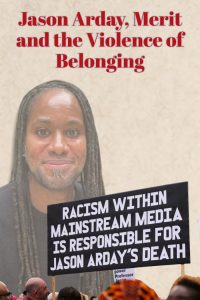
Jason Arday, Merit and the Violence of Belonging

Jason Arday was a sociologist, a teacher, a writer, a son, a partner, a father, a brother and a man whose life had already contained extraordinary difficulties and achievements long before Cambridge made him a symbol. He was 41 when he was found dead at his home in south London on August 14, nine days after resigning from the University of Cambridge amid allegations concerning plagiarism, his academic record and aspects of the life story he had publicly told. The Metropolitan Police said his death was unexpected but not believed to be suspicious. An inquest is to determine the circumstances of his death.

His life was more than his Cambridge appointment, more than the allegations against him and certainly more than the controversy that consumed his final weeks. He had spoken about being diagnosed with autism and other developmental difficulties as a child, about remaining non-verbal until he was 11 and about his difficulties with reading and writing. He nevertheless went on to earn a PhD, teach across several British universities, write about race and education, and become Cambridge’s youngest Black professor in 2023.

The allegations against Arday were presented as a matter of academic misconduct without sufficient scrutiny of their origin and validity. What is disturbing about the Arday affair is the point at which scrutiny of an individual appeared to become a much larger argument about who deserves to occupy an elite institution.

NewsCord’s review counted 249 distinct articles about Arday across 15 British national outlets between July 24 and the evening of August 14. Of these, 188 appeared in the nine days after his resignation. That amounted to an average of 20.9 articles a day after he had already stepped down.

There was plainly a story to investigate. But the coverage did not remain confined to his academic work. His childhood, memoir, personal claims, sporting achievements and biography became subjects of repeated public examination. NewsCord’s account documents coverage that moved into ridicule, speculation and commentary about parts of his life that went far beyond the original academic allegations.

The most troubling context is that some of the controversy was explicitly connected to arguments about race and diversity. The academic who brought the plagiarism allegations to wider attention, Nathan Cofnas, has described himself as a “race realist” and has previously written about racial representation in elite professions in terms that explicitly invoke supposedly innate differences in ability. He has since said that his concern was with diversity, equity and inclusion rather than personal hostility towards Arday. Cofnas, now sacked from his institute, must nonetheless be held accountable for the chain of events he initiated. The positions and politics he espouses form part of the context in which Arday’s case was interpreted and circulated, and of a wider social order in which Black and other oppressed communities are made to experience institutions as spaces of conditional belonging.

What happened to Arday, then, cannot be understood only as a dispute over one academic’s work. The larger question is what happens when the presence of someone from a historically excluded community inside an elite institution is treated as something that must continually be justified.

For many of us in India, there is something painfully familiar in that question.

The specific histories are different. Arday was a Black British academic; caste is a different system from race, with its own history and mechanisms. But the experience of being treated as an exception whose presence requires explanation has recognisable parallels.

Think about the Dalit student who enters an elite university. The Dalit scholar who gets a faculty position. The first-generation student who enters medicine, the civil services or a prestigious professional institution. Their achievement is often not allowed to remain simply an achievement. A question enters the room before they do: Did they actually deserve this?

That question is rarely asked in isolation. It arrives carrying the weight of caste. Reservation makes that question explicit. “Merit” becomes the language through which caste privilege can present itself as a neutral achievement. We are seeing this today in India, where Delhi’s designated protest site has a sit-in by Reservation Hatao Andolan, a group of snowflake oppressor-caste members who cannot ask for structural change from the state and would rather espouse casteist statements of exclusion and degradation on camera while claiming victimhood.

The same logic that asks whether a Black professor really belongs at Cambridge can, in another context, ask whether a Dalit professor really belongs in a university at all. The language changes. The hierarchy does not.

This is why the mythology of merit matters. The mythology of merit depends on forgetting the conditions under which merit is produced. Before a person sits for an examination, submits a PhD application or interviews for an academic job, they have already travelled through a social world. Some people grow up with educated parents, private schooling, books, stable housing, English-language fluency, professional networks and the confidence that elite institutions are places where they naturally belong. Others encounter those institutions after crossing barriers that were never faced by their supposedly more “meritorious” peers.

Yet once the final credential is produced, all of that history disappears behind an apparently objective label: merit. Caste makes this contradiction impossible to ignore.

For generations, education and professional authority were overwhelmingly concentrated among particular castes. Property, literacy, institutional familiarity, social networks and cultural capital accumulated across families and communities. When the descendants of those histories arrive at elite universities, their inherited advantages are rarely described as an intervention into merit. They appear as merit itself. Reservation disrupts that story because it makes social exclusion visible.

That is why the rhetoric around merit can become so vicious. Merit is presented as a timeless measure of individual worth, when in practice institutions decide what counts as merit, how it will be measured and who gets the opportunity to demonstrate it.

The same baton is used to beat affirmative action in different contexts: DEI in the West and reservations in India. In both cases, policies intended to address historical exclusion are recast as threats to a supposedly neutral system that was never neutral to begin with.

Once this idea of merit is entertained, the presence of a Black professor or a Dalit professor can become suspicious before anything about their work is examined. Their success is treated as something requiring an explanation. Their mistakes become evidence of a larger failure. Their credentials become open to a level of scrutiny that their social position was already unlikely to protect them from.

This is what makes the racial invocation against Arday’s career so pernicious. The question moves from a basic inquiry, “Did this individual meet the standards?”, to “Why was someone like this here in the first place?”

The second question may present itself as a defence of objectivity, but it is not really interested in objectivity, real or imagined. It is about belonging. It is about who gets to occupy the public arena without having their presence continually explained, defended or justified.

And that is where Arday’s story speaks beyond itself. Because many people from historically oppressed communities recognise the particular pain of entering spaces that were not built with them in mind and then discovering that their right to be there remains permanently open to question.


Mangesh is a law student from Mumbai, Maharashtra.

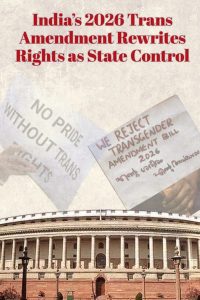
India’s 2026 Trans Amendment Rewrites Rights as State Control

On March 25, 2026, the Rajya Sabha cleared the Transgender Persons (Protection of Rights) Amendment Bill, 2026, completing its swift passage through Parliament a day after it had been pushed through the Lok Sabha by voice vote amid an Opposition walkout. Introduced by Virendra Kumar and framed as a technical correction to an existing law, the legislation has in effect been rushed into force with extraordinary haste, amounting not merely to a statutory revision but to a profound and troubling reordering of how the Indian state understands gender, identity, and the limits of personal autonomy: a process that, in both its substance and its passage, underscores the travesty at the heart of this exercise.

To understand the scale of this shift, it is necessary to return to the constitutional baseline established in National Legal Services Authority v. Union of India. That judgment recognised gender identity as intrinsic to personhood and held that self-identification was not merely permissible but fundamental. It explicitly rejected any requirement that transgender persons undergo medical procedures in order to be legally recognised. The Transgender Persons (Protection of Rights) Act, 2019, imperfect as its scope and implementation have been, attempted to incorporate this principle by recognising self-perceived gender identity and providing a route to legal recognition without mandatory medicalisation.

The 2026 amendment dismantles that framework at every level. It does not merely adjust procedures. It replaces the underlying philosophy of the law. Where the earlier regime was premised, at least formally, on autonomy and self-identification, the new one is built on verification, restriction, and suspicion.

The most immediate transformation lies in the definition of who counts as a transgender person. The 2019 Act adopted a broad and inclusive definition. It explicitly included trans men, trans women irrespective of surgical status, genderqueer persons, and persons with intersex variations, alongside socio-cultural identities such as hijra, kinner, aravani, and jogti. The amendment replaces this with a sharply narrowed category. Recognition is now effectively limited to those who can be placed within specific socio-cultural identities (even as some identities such as nupi manbi, nupa manba, thirunangai, thirunambi, thirunar, khwaja sira, kothi, jenana, dhurani, etc. remain excluded) or those who can be medically classified under intersex variations, thereby strengthening models of cultural identity and pathologisation, both of which queer and trans activists have tirelessly fought against becoming dominant scripts. Trans men, many trans women, and non-binary or genderqueer persons disappear from the statutory language. This is not an omission that can be read down or interpreted away. It is an act of legislative exclusion.

This narrowing is reinforced by an explicit rejection of self-perceived identity as a basis for rights. The amendment deletes Section 4(2) of the 2019 Act, the provision that guaranteed the right to self-identified gender. In its place, the law constructs a system where identity must be externally validated. The shift is conceptual as much as legal. Gender is no longer treated as something one knows about oneself. It becomes something the state must confirm.

This transformation is institutionalised through the introduction of a medical “authority”. The amendment inserts a new definition that creates a medical board, headed by a Chief Medical Officer or equivalent, as a central actor in the recognition process. There was no such requirement in the 2019 Act. The Supreme Court in NALSA had explicitly rejected the idea that medical evaluation could be made a condition for recognition. The amendment not only introduces such a requirement but places it at the heart of the system.

The process that follows from this is deliberately layered and restrictive. To obtain a certificate of identity, an individual must first navigate medical certification, then approach the District Magistrate, who retains the discretion to seek further expert opinion. The structure distributes decision-making power across multiple institutions, each of which can act as a gatekeeper. The earlier framework, which at least formally relied on self-declaration, is replaced by a multi-stage system that is bureaucratic, discretionary, and exclusionary.

This is not merely a procedural inconvenience. It is a stark reconfiguration of power. Identity recognition is no longer an act of self-assertion but a negotiated outcome within state institutions. Access to recognition becomes contingent on the ability to navigate medical systems, administrative offices, and discretionary authority, without much room for autonomous choices. In a country where access to public healthcare is uneven and often inaccessible, this introduces class and geography as decisive factors in determining who can be legally recognised.

The amendment deepens this shift through changes to Section 7, now part of the new Section 5, which governs change of gender. What was previously optional is now mandatory. Any person who undergoes gender-affirming surgery must apply for a revised certificate. Medical institutions are required to report such procedures to the District Magistrate and the medical authority. At the same time, the law removes the earlier provision that protected the continuity of a person’s rights after such a change. The combination of mandatory reporting and removal of rights protection creates a regime where deeply personal medical decisions are subjected to state visibility while legal certainty is diminished.

The implications for privacy are immediate and profound. The reporting requirement effectively creates a database of gender-affirming procedures accessible to administrative authorities. This sits uneasily with the right to privacy recognised in K. S. Puttaswamy v. Union of India, which affirmed informational privacy and bodily autonomy as core constitutional values. The amendment does not attempt to reconcile this tension. It proceeds as if such concerns do not arise or exist.

This constitutional rupture is not merely a matter of activist critique; it has also been formally recognised within the judicial ecosystem. A Supreme Court-appointed Advisory Committee, led by former Delhi High Court judge Justice Asha Menon, has urged the Union government to withdraw the Transgender Persons (Protection of Rights) Amendment Bill, 2026, on the grounds that it undermines the principles laid down in the NALSA judgment, particularly the right to self-identify one’s gender. In its communication to Social Justice Minister Virendra Kumar, the panel flagged the removal of self-identification, the redefinition of “transgender person,” and the introduction of mandatory medical certification as measures that could reverse the limited progress made in integrating transgender persons into legal and social frameworks. It also raised concerns about privacy violations arising from provisions that require medical institutions to report gender-affirming procedures to state authorities, and noted that several of the Bill’s new criminal provisions overlap with existing laws such as the Bharatiya Nyaya Sanhita and the Juvenile Justice Act, 2015, without establishing a clear legislative necessity. The Committee has recommended that the Bill be withdrawn and subjected to wider stakeholder consultation before any further action.

Equally significant is the way the amendment restructures criminal law. The 2019 Act criminalised discrimination and violence against transgender persons but prescribed relatively low penalties. The amendment retains these provisions without strengthening them. At the same time, it introduces a new set of offences centred on the idea of “forced transgender identity”. These include kidnapping, abduction, and bodily harm with the intent to compel a person to assume or present a transgender identity, with punishments ranging from several years to life imprisonment.

On its face, this appears to address serious harms. In substance, it is built on a deeply problematic premise. It constructs transgender identity as something that can be imposed through coercion. It embeds within the law the suspicion that gender variance is not self-generated but externally induced, going back to suspicion of trans communities based in colonial governance. Neither are these speculations supported by available crime data. Existing offences such as kidnapping and trafficking are already comprehensively covered under the Bharatiya Nyaya Sanhita, so the amendment does not fill a clear legal gap. It only creates a new category that aligns with longstanding stereotypes about transgender communities, while adding more criminalisation in the law.

The consequences of this framing extend beyond criminal law. By centering coercion, the amendment places community structures under suspicion. Traditional kinship systems such as hijra households, as well as informal support networks and shelters, become vulnerable to being recast as sites of coercion. In a context where many transgender persons rely on such networks after being rejected by their families and without substantive protection of welfare, the law risks dismantling the very systems that sustain them.

Another critical dimension of the amendment is its treatment of intersex persons. The 2019 Act defined intersex variations separately. The amendment removes that definition and subsumes intersex persons within the definition of “transgender person”. This conflation collapses two distinct categories. Intersex variations relate to biological sex characteristics, while transgender identity concerns gender identity. By merging them, the law obscures the specific needs and rights of intersex persons, while simultaneously using biological variation as a basis to restrict transgender recognition. The result is conceptual confusion with material consequences.

All of these changes are not incidental. They are explicitly justified in the Statement of Objects and Reasons accompanying the Bill. That document lays out the government’s position with clarity. It states that the law is intended to protect only those who face severe social exclusion due to biological reasons beyond their control. It rejects the idea that rights should extend to all forms of gender identity, particularly those based on self-perception. It argues that the earlier definition was too broad and made it difficult to identify “genuine” beneficiaries. It insists that legal status cannot be based on characteristics that are “acquirable” or rooted in personal choice. The cis-sexual law introduces external gatekeeping of trans communities, which it neither has any business interfering in nor has the adequate understanding of.

This is the ideological core of the amendment. It replaces a framework based on autonomy with one based on eligibility. It introduces a hierarchy in which only those whose identities can be framed as biologically determined and involuntary are considered deserving of protection. It treats self-identification not as a right but as a problem to be managed. Precision, in this framework, is achieved through exclusion.

The Statement also attempts to justify the new penal provisions by asserting the existence of practices involving abduction, bodily harm, and forced gender transition. It claims that existing laws do not adequately address these harms in combination. Yet it does not provide empirical evidence demonstrating a gap that necessitates new offences. The effect is to legitimise a narrative that casts transgender identity as suspect, while expanding the reach of criminal law into community spaces.

The amendment includes a few procedural changes that appear positive on the surface, such as allowing name changes in official documents and adjusting the composition of the National Council for Transgender Persons. These are marginal improvements that operate within a framework that has already been fundamentally restricted. Access to these benefits is contingent on passing through the newly tightened certification process. They do not alter the underlying shift toward control.

The political response reflected broad-based opposition across the parliamentary spectrum. Parties including the Indian National Congress, the Dravida Munnetra Kazhagam, the Nationalist Congress Party (Sharad Pawar faction), the Samajwadi Party, the Trinamool Congress, Shiv Sena (UBT), the Vanchit Bahujan Aghadi, and Left formations such as the Communist Party of India (Marxist) opposed the Bill, collectively characterising it as regressive, violative of constitutional guarantees, and enacted without meaningful consultation. In contrast, the ruling Bharatiya Janata Party secured the support of key allies, including the Telugu Desam Party (TDP) and the Janata Dal (United), enabling the Bill’s smooth passage through Parliament.

These objections converge on a common understanding. The Bill does not simply fail to advance rights. It actively restructures them in a way that privileges state control over individual autonomy. It does not strengthen protections against violence. It expands mechanisms of surveillance and verification. It does not recognise the diversity of transgender experiences. It narrows them into administratively convenient categories.

What emerges, taken together, is a legal regime that transforms identity into a site of governance. This is why the amendment cannot be understood as a technical reform and must be opposed in toto. It is a redefinition of the relationship between the individual and the state. It signals a move away from the idea that rights attach to persons by virtue of their humanity, and toward the idea that rights are granted to those who can be classified, verified, and controlled.

The consequences of such a shift are not abstract. They will be felt in who is recognised and who is erased, in who can access documents and who is denied, in who can seek care without fear and who is exposed to scrutiny, which communities survive and which are dismantled. Legislative mandates already draw lines that are arbitrary and violent. This amendment redraws further in that direction, in ways that shrink the space for autonomy and expand the reach of the state toward a model of gender that is premised on cultural identity and pathology, sites that have been used to maim queer and trans lives across history.

At stake is not only the future of a single statute. It is the question of whether the principle established in NALSA, that identity is intrinsic and self-determined, will continue to shape our lives, or whether it will be replaced by a framework in which identity must be proven, approved, and constantly subject to review.

This is a line that cannot be crossed. A law that takes away the right of trans people to define themselves, that puts their identities under state control, is not reform, it is erasure. Trans lives are not conditional.


Paresh Hate is a Bahujan queer researcher, writer, documenter and activist and the Lead Content Manager at Dalit Voice.
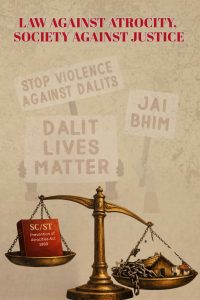
Law Against Atrocity, Society Against Justice

When Parliament passed the Scheduled Castes and Scheduled Tribes (Prevention of Atrocities) Act in 1989, it was acknowledging a basic truth: caste violence was not an aberration but a structure. Ordinary criminal law had proven incapable of addressing it. Atrocities were not simply crimes between individuals. They were acts meant to discipline entire communities. The Act attempted to name that reality and create stronger legal consequences for it.

More than three decades later, the Act remains one of the most powerful legal instruments available to Dalit and Adivasi communities. Yet it also exists within a criminal justice system that often neutralizes its force. This contradiction sits at the heart of the law’s history. The Atrocities Act represents both a recognition of caste violence and a reminder of how limited legal remedies are in a society structured by caste power.


Upward mobility and backlash

The sociologist Dag-Erik Berg offers a useful way of thinking about the relationship between law and caste violence. He describes the Dalit experience in modern India through what he calls a recurring pattern: upward mobility coexisting with enduring atrocity.

The expansion of education, reservation policies, and political representation has enabled sections of Dalits to challenge older hierarchies. Yet each moment of assertion has also produced violent backlash. Many of the most brutal caste massacres in recent decades have targeted communities that were asserting new social or economic claims.

The Atrocities Act emerged from this historical dynamic. It was not simply the product of humanitarian concern but the outcome of decades of Dalit struggles that forced the state to acknowledge caste violence as a structural problem. Earlier laws, such as the Protection of Civil Rights Act, focused mainly on untouchability practices like temple entry. They proved inadequate for addressing organized violence, social boycotts, and collective punishment. The 1989 law attempted to respond to these realities. It listed specific offences tied to caste domination and created special procedures for investigation and prosecution. In doing so, it brought caste explicitly into the framework of criminal law.

But as Berg points out, the presence of such legislation does not automatically transform the social structures that generate violence. Reservation policies and atrocity laws operate within domains visible to the state, such as education, employment, and criminal punishment. Meanwhile, the deeper mechanisms through which caste reproduces itself remain largely untouched. Marriage practices continue to enforce caste boundaries. Land ownership remains deeply unequal across caste lines. Economic and social power in villages often rests with dominant castes. The law intervenes after violence occurs, but the social order that makes violence possible remains largely intact. This gap between structural inequality and legal remedy explains why atrocities continue even in a constitutional democracy that formally prohibits caste discrimination.


The everyday obstacles of justice

If the Atrocities Act represents recognition of caste violence, its implementation reveals how difficult it is to translate that recognition into justice.

Anthropologist Sandhya Fuchs traces what happens when survivors attempt to turn experiences of violence into legal cases. The journey often begins at the police station, where complaints must first be recorded. Here, the law encounters the everyday functioning of the criminal justice system. Police officers frequently reinterpret or dilute complaints in ways that prevent cases from being registered under the Atrocities Act. Acts of violence are reframed as ordinary disputes, family conflicts, or property disagreements.

Survivors may be pressured to withdraw complaints or accept informal settlements. Sometimes cases never reach the courts at all. Even when cases move forward, survivors must navigate a complex field of actors, including activists, lawyers, community leaders, and political intermediaries. Each of these groups may have their own ideas about how the law should be used.

Fuchs describes how atrocity cases can become sites where competing visions of justice, honor, and political strategy collide. Survivors themselves often make pragmatic choices within these constraints. Out-of-court compromises are common, even though many activists criticize them as evidence that the law is failing. For some families, however, the threat of legal action becomes a bargaining tool to secure compensation, protection, or a measure of dignity in hostile local environments.

These negotiations reveal something important about the law’s role. The Atrocities Act is not simply a legal instrument. It has also become a symbolic resource that marginalized communities use to challenge dominant caste power, sometimes inside the courts and sometimes outside them. Yet the same processes that allow creative uses of the law also expose its fragility. Police bias, political pressure, and social intimidation constantly shape whether justice is possible.


Evidence, memory, and the burden of proof

The obstacles do not end once a case reaches court. Legal procedures themselves often place heavy burdens on survivors and witnesses.

Legal scholar Achintya Anita Gurumurthy highlights this problem through the example of the Test Identification Parade, a procedure used during criminal investigations to confirm whether eyewitnesses can identify suspects. In theory, such procedures are meant to strengthen evidence. In practice, they can be used to discredit survivors. Courts sometimes treat minor inconsistencies in witness testimonies as signs of unreliability. Delays in conducting identification parades or technical procedural lapses can weaken cases, even when violence is widely known within local communities. In atrocity cases, this evidentiary framework often collides with the realities of trauma, fear, and social pressure faced by Dalit witnesses.

The result is a pattern in which the credibility of survivors becomes the central issue, while the broader structure of caste power fades into the background. The legal process turns into an examination of memory rather than an inquiry into domination.

Gurumurthy argues that evidentiary practices cannot be treated as neutral procedures. They operate within social hierarchies. When police investigators, prosecutors, and judges overwhelmingly come from dominant castes, the interpretation of testimony inevitably reflects those power relations.

Recent legal developments have not fundamentally altered this situation. The Bharatiya Sakshya Adhiniyam, which replaced the colonial-era Evidence Act in 2023, largely preserves existing evidentiary structures, including the continued reliance on identification procedures like the Test Identification Parade. The formal language of reform has therefore not significantly transformed how evidence functions in caste atrocity cases.

For survivors, this means that the struggle for justice often involves confronting not only perpetrators but also the institutional habits of the legal system itself. Despite sensitive case law in Malkhansingh v. State of Madhya Pradesh and Kulwinder v. State (NCT of Delhi), which reflects the work of Dalit lawyers and activists, much more remains to be done in criminal justice reform if the goals of the Atrocities Act are to be realised.


Contestation and dilution

The Atrocities Act has always faced political resistance. Dominant caste organizations have repeatedly portrayed it as a law prone to misuse. This narrative gained national attention during the controversy surrounding a 2018 Supreme Court judgment that introduced restrictions on arrests under the Act, citing concerns about false cases. Dalit protests across the country forced Parliament to amend the law and restore its original provisions. The episode demonstrated both the vulnerability of the Act and the power of collective mobilization.

Such struggles are part of a longer history. Every expansion of legal protection for marginalized groups has been accompanied by attempts to dilute it, delay its implementation, or reinterpret it in ways that limit its reach. The Atrocities Act is no exception.

At the same time, the law has become deeply embedded in Dalit political consciousness. Activists, lawyers, and community organizations have built networks around it. Survivors often approach the law not simply as a technical instrument but as a statement that their suffering deserves recognition.

This dual character explains why the Act can appear both powerful and fragile, as Fuchs calls it. It is powerful because it names caste violence explicitly and creates legal consequences for it. It is fragile because its effectiveness depends on institutions that remain shaped by the very hierarchies the law seeks to challenge.


What law can and cannot do

For many survivors of atrocities, the most painful realization is that law alone cannot transform social relations. As Fuchs shows through her study of rural Rajasthan, families affected by brutal violence sometimes describe the law as something distant. Court cases may continue for years without changing the attitudes of the communities that carried out the violence.

This does not mean the law is meaningless. Legal action can bring compensation, punishment, or recognition. It can create new networks of solidarity and political mobilization. It can signal that caste violence is not a private dispute but a public injustice.

But law operates within a society where caste remains deeply embedded in everyday life. Courts cannot reorganize land ownership. Police procedures cannot dismantle endogamous marriage networks. Criminal punishment cannot eliminate the desire for status that sustains graded inequality. The persistence of caste therefore exposes the limits of relying solely on legal remedies.


Beyond the courtroom

The history of the Atrocities Act makes one thing clear: law has rarely initiated social transformation in India. More often, it has been forced into existence by movements that refused silence. Dalit and Adivasi struggles compelled the state to recognise caste violence, defend the law when it was diluted, and push institutions to act when they would rather look away.

Seen from this perspective, the Atrocities Act is not the source of justice but one instrument within a larger political struggle. It provides language, leverage, and sometimes protection. But the force that gives the law meaning lies outside the courtroom.

The fight against caste atrocities has never been won by statutes alone. It has been sustained by collective resistance, by communities that organise, testify, and refuse the social order that treats their lives as expendable. When the law works at all, it is usually because those struggles have compelled it to.


Paresh Hate is a Bahujan queer researcher, writer, documenter and activist and the Lead Content Manager at Dalit Voice.

Breaking the Silence on Caste in Universities: A Critical Reading of the UGC 2026 Regulations and the Karnataka Rohith Vemula Bill

In January 2026, the University Grants Commission released its new regulations aimed at creating a more inclusive academic environment and providing a structure to challenge discriminatory practices within higher education institutions. Unlike the largely advisory 2012 regulations, these rules mark a significant shift by placing formal responsibility for compliance squarely on institutional leadership—Vice Chancellors, Registrars, Principals—rather than treating discrimination as a peripheral problem to be handled through token grievance mechanisms. Predictably, this development has been welcomed by many as evidence of progress.

But these regulations are not being read in a political vacuum. They arrive in the month of Rohith Vemula’s Shahadat Diwas—a reminder that caste annihilation in universities has never been a question of administrative intent, but of institutional violence, denial, and impunity. It is in this charged moment that the Campaign for the Rohith Act has also released its draft legislation: the Karnataka Rohith Vemula (Prevention of Exclusion and Injustice in Higher Education Institutions) Bill, 2025. This draft, developed by anti-caste practitioners with sustained inputs from lawyers, academicians, researchers, student activists, and social justice organizations, is not merely a response to episodic discrimination but a political intervention into the Brahminical structure of Indian academia itself.

Both the Karnataka and Telangana governments have indicated their intent to adapt and table versions of this draft in their respective state legislatures. This makes a comparative reading urgent—not to ask which framework is more administratively efficient, but to examine how these two instruments—one regulatory and national, the other legislative and explicitly anti-caste—understand discrimination, justice, institutional power, and accountability. What follows is an attempt to read them against each other, to foreground the strengths of comprehensive anti-caste frameworks, and to assess what it means to legislate equality in spaces historically organized to deny it.

The University Grants Commission (Promotion of Equity in Higher Education Institutions) Regulations, 2026

The University Grants Commission (Promotion of Equity in Higher Education Institutions) Regulations, 2026, effective from January 13, 2026, supersede the 2012 regulations and aim to eradicate discrimination in all higher education institutions across India based on religion, race, caste, gender, place of birth, or disability. The regulations mandate every HEI to establish an Equal Opportunity Centre overseen by an Equity Committee, which must include representation from faculty, staff, civil society, and students, with mandatory representation of Other Backward Classes, Persons with Disabilities, Scheduled Castes, Scheduled Tribes, and women. The Centre is responsible for implementing policies for disadvantaged groups, providing guidance and counselling, maintaining an online portal for reporting discrimination incidents, publishing bi-annual reports, and coordinating with civil society, legal services authorities, and government agencies. HEIs must also operate round-the-clock Equity Helplines, designate Equity Ambassadors across campus units, and deploy mobile Equity Squads to monitor vulnerable areas.

The regulations establish comprehensive procedures for handling discrimination complaints, requiring the Equity Committee to meet within 24 hours of receiving a report and submit findings to the Head of the Institution within 15 working days, who must then take action within 7 working days. Aggrieved persons can appeal to the Ombudsperson within 30 days if dissatisfied with the Equity Committee’s report. All stakeholders must sign undertakings to promote equity and refrain from discrimination, and HEIs must conduct orientation programmes, display awareness materials, and ensure transparent, non-discriminatory practices in admissions, hostel allocations, and classroom arrangements. The UGC will establish a national-level monitoring committee to oversee implementation and may visit campuses to review progress. Non-compliance can result in severe consequences, including debarment from UGC schemes, prohibition from offering degree programmes or ODL/online courses, removal from the UGC’s recognized institutions list under Sections 2(f) and 12B, or additional punitive actions determined on a case-by-case basis.

The regulations place significant operational responsibility on smaller institutions, particularly colleges, which may lack the faculty strength to independently establish Equal Opportunity Centres and must therefore rely on their affiliating universities’ infrastructure. Confidentiality protections run throughout the framework, allowing complainants and witnesses to request anonymity while reporting incidents, and the regulations explicitly provide protection against retaliation for those who report discrimination. These provisions apply uniformly across all modes of higher education delivery, encompassing traditional classroom-based learning as well as Open and Distance Learning and online programmes, thereby extending the equity mandate across India’s diverse higher education landscape.

The Karnataka Rohith Vemula (Prevention of Exclusion and Injustice in Higher Education Institutions) Bill, 2025

The Karnataka Rohith Vemula (Prevention of Exclusion and Injustice in Higher Education Institutions) Bill, 2025, is a proposed state legislation drafted by anti-caste activists aimed at comprehensively addressing caste-based discrimination and harassment against Scheduled Caste and Scheduled Tribe students, faculty, and staff in all higher educational institutions across Karnataka, whether public, private, or charitable. The Bill defines discrimination to include both direct and indirect discrimination, where actions appear neutral but have adverse effects on SC/ST individuals, and institutional discrimination embedded in the structures, policies, and governing bodies of educational institutions. It recognizes caste-based harassment as any hostile behavior expressed verbally, non-verbally, or digitally that humiliates or demeans individuals due to their SC/ST status, and importantly establishes a constitutional “right to overcome caste prejudice” grounded in Article 21, allowing SC/ST individuals to organize collectively, refuse participation in caste-reinforcing activities, exercise informational autonomy over their caste identity, and maintain confidentiality regarding their SC/ST status without facing penalties or negative appraisals.

The Bill mandates the establishment of Equity Committees in every higher educational institution, with a unique composition requirement that at least 80 percent of members must be from SC/ST communities, including a Presiding Officer from SC/ST backgrounds above the rank of Assistant Professor, faculty and staff members, NGO representatives experienced in anti-caste work, and two SC/ST student representatives, with at least one woman. These committees are empowered with civil court–like powers to summon witnesses, require document production, and conduct inquiries that must be completed within ninety days of receiving a complaint. The Bill establishes a dual-track system where aggrieved persons can approach the Equity Committee within three months of an incident, with provisions for conciliation if requested, or directly approach the High Court in cases of institutional discrimination. An appellate body consisting of a member qualified to be a judge and a member with educational or social work experience from SC/ST communities hears appeals within ninety days, with possible extensions not exceeding six months in total. Notably, the Bill requires that if prima facie evidence of an atrocity under the SC/ST Prevention of Atrocities Act or other penal laws emerges, the Equity Committee or appropriate authority must assist in filing a police complaint within seven days, while maintaining that inquiry and remedies under this Act proceed independently of criminal proceedings.

The Bill prescribes detailed remedies and penalties proportionate to the severity of violations, offering aggrieved persons administrative interventions to nullify adverse effects, reasonable accommodations, monetary compensation determined based on mental trauma and loss of opportunity, and counselling support. For respondents found guilty of harassment, penalties range from written warnings and mandatory caste-sensitization workshops to severe consequences, including suspension during inquiry, debarment from supervisory duties, denial of contract renewal, stopping of increments, demotion, dismissal, and salary deductions payable to the aggrieved person, with provisions for recovery as land revenue arrears if unpaid. Student respondents face penalties including hostel debarment, exam withholding, suspension, and expulsion, while higher educational institutions violating the Act face fines up to ten lakh rupees and potential withdrawal of state financial aid. The Bill imposes comprehensive institutional duties requiring HEIs to adopt caste-blind admission processes where feasible, provide reasonable accommodations and structured academic support for SC/ST students, conduct mandatory diversity workshops, avoid delays in scholarship disbursement, reduce arbitrariness in policies, ensure SC/ST students are informed of all opportunities, not perpetuate stereotypes through syllabi or customs, and pay compensation to legal heirs if an SC/ST individual from the institution dies by suicide. Schedule I of the Bill enumerates thirty specific discriminatory actions, including probing family occupation during admissions in ways that humiliate SC/ST candidates, segregating SC/ST individuals in classrooms, excluding them from extracurricular activities or academic engagements, applying biased assessment practices, arbitrarily changing rules to their disadvantage, and occupational steering toward fields deemed “suitable” for them.

The Bill establishes a multi-layered enforcement architecture involving institutional Equity Committees, a specialized appellate body with quasi-judicial powers, District Officers to monitor implementation and maintain data, and appropriate state government authorities to publicize the Act and conduct training programs for committee members, demonstrating a comprehensive regulatory framework that extends beyond complaint redressal to encompass preventive measures, awareness generation, structural reform of institutional practices, confidentiality protections against retaliation, legal aid provisions for students unable to afford counsel, and explicit recognition that overcoming caste prejudice is a constitutionally protected right integral to dignity and personal development in educational spaces.

Reading the Two Frameworks Against Each Other: Spirit, Power, and Consequence

At a surface level, both the UGC Regulations and the Rohith Vemula Bill appear to share a commitment to equity, institutional responsibility, and procedural responsiveness. But this apparent convergence quickly collapses under closer scrutiny. What separates them is not drafting technique but political imagination: how caste is understood, how harm is conceptualized, and how justice is meant to be delivered in spaces historically structured by Brahminical power.

The UGC Regulations operate within a liberal-universalist framework. Caste appears as one category among many—religion, gender, disability—flattened into a general language of inclusion. This in itself is not a problem, since there are intersectional structures that affect members of the academic community. However, given the history of caste-blindness specifically in these spaces, there is something to be said about the specificity of caste focus in the Rohith Vemula Bill, which anti-caste activists have attempted to install. The bigger problem lies in how the UGC treats discrimination as a deviation from institutional norms, something to be corrected through better procedures, faster timelines, and visible compliance structures. The emphasis is on management: committees, portals, helplines, ambassadors, squads. Even the strongest sanctions—derecognition, withdrawal of funding—remain exceptional and remote, deployed rarely and at the discretion of the same state apparatus that has historically shielded universities from accountability.

The Rohith Vemula Bill begins from an entirely different premise. It treats caste not as an identity-based vulnerability but as a historically entrenched system of power that organizes academic life itself—who teaches, who evaluates, who is believed, who is dispensable. By explicitly naming institutional discrimination and indirect discrimination, the Bill refuses the fiction of neutrality that universities so often invoke. It recognizes that exclusion is not always spectacular or abusive, but routine, procedural, and normalized through rules that appear fair while producing casted outcomes.

This divergence is most evident in how representation is imagined. The UGC mandates diversity within committees, presuming that proportional presence will yield fairness. The Bill mandates SC/ST decisional dominance. This is not symbolism; it is an acknowledgement of how consensus is manufactured in academic spaces, and how “balanced” committees routinely reproduce upper-caste common sense under the guise of neutrality. The Bill does not seek representation within Brahminical structures—it seeks to interrupt them.

Similarly, the two frameworks differ sharply in their understanding of justice. Under the UGC Regulations, justice is largely procedural: complaints are to be acknowledged, inquiries completed, reports submitted, actions taken. What remains unaddressed is whether the harm has been meaningfully repaired. The Rohith Vemula Bill, by contrast, centers material consequences. It authorizes compensation for mental trauma and loss of opportunity, salary recovery from perpetrators, institutional fines, suspension during inquiry, and the stripping of supervisory power. Discrimination here is not merely a violation of conduct; it is a redistributive question, requiring correction in material and institutional terms.

Perhaps the most radical departure lies in the Bill’s articulation of a constitutional right to overcome caste prejudice. Grounded in Article 21, this formulation reframes caste discrimination as an assault on dignity, autonomy, and the very possibility of self-making within educational spaces. It recognizes the right to refuse caste-reinforcing practices, to control the disclosure of caste identity, and to organize collectively without reprisal. Nothing in the UGC Regulations approaches this depth of constitutional engagement. Where the UGC seeks compliance, the Bill asserts freedom. The Bill is here able both to draw on the constitutional legacy of social justice and to expand its scope in articulation.

The handling of extreme harm further exposes this gap. The UGC Regulations remain silent on institutional liability in cases of student death by suicide, maintaining the familiar posture of tragedy without causation. The Rohith Vemula Bill explicitly rejects this narrative. By mandating compensation to legal heirs, it refuses to allow institutions to disavow responsibility and insists that caste violence, even when slow and bureaucratic, is still violence.

Taken together, the contrast is stark. The UGC Regulations represent an administrative liberalism—well-intentioned, procedurally elaborate, but politically cautious and structurally non-confrontational. The Rohith Vemula Bill represents anti-caste constitutionalism: unapologetically specific, materially enforceable, and grounded in the historical truth that Indian universities have never been neutral spaces of knowledge, but sites of graded exclusion.

This is not a question of one instrument replacing the other. But if the goal is to meaningfully transform academic spaces rather than merely regulate them, it is the Rohith Vemula Bill that confronts caste where it actually lives—in evaluation, authority, silence, and impunity—rather than where it is easiest to administratively acknowledge. The argument, of course, is not that a regulatory body that caters to different axes of power is not necessary, but that perhaps more such Bills that tackle different structures of oppression are necessary at similar levels. Drawing from the legislative activist history of feminist politics, especially the Sexual Harassment of Women at Workplace (Prevention, Prohibition and Redressal) Act, 2013, the Bill also provides a map for more intervention-focused possibilities.

The draft could be further strengthened by explicitly naming and regulating caste–precarity linkages, recognising how contractual faculty positions, ad hoc appointments, fellowships, and project-based employment have become key sites where caste exclusion is reproduced under the language of flexibility and merit. It would also benefit from treating data as an instrument of accountability rather than mere monitoring, by mandating publicly accessible, anonymised caste-disaggregated data on admissions, evaluations, fellowships, dropouts, and disciplinary actions, and recognising opacity and non-disclosure as forms of institutional discrimination. Finally, the Bill could more clearly foreclose institutional retaliation by design, through an explicit bar on counter-litigation, parallel disciplinary proceedings, or academic reprisals against complainants and witnesses during the pendency of inquiries—one of the most common tactics through which universities neutralise anti-caste claims without ever addressing them.

Disproportionate SC/ST student suicides and mass dropouts across higher education institutions reveal caste discrimination not as an aberration but as a pervasive social problem rooted in historical exclusion and sustained by contemporary institutional practices. These outcomes emerge from everyday academic processes—evaluation, notions of merit, access to resources, representation, and belonging—where caste operates through routine, normalized, and often covert forms of exclusion rather than only through overt acts of violence. Existing frameworks such as affirmative action, criminal law, and earlier UGC regulations have proven inadequate to address this structural harm, making a civil, preventive, and remedial legal intervention necessary.

Seen in this light, the Bill constitutes a significant and overdue political step: it translates decades of lived experience, constitutional commitment, and movement knowledge into a legal architecture that locates caste violence within the institution itself and demands accountability from universities not as neutral spaces of learning, but as sites where dignity, fraternity, and equality must be actively produced. The UGC would benefit from reading this draft carefully if it actually wishes to create more substantial equality on campuses.

Anti-Caste Legislation under State Power

It is also important to situate these developments within the present political moment. With the Congress in opposition at the national level, its governments in Karnataka and Telangana have strong political incentives to endorse and foreground anti-caste articulations that distinguish them from the ruling dispensation. Supporting an anti-caste legislative framework allows the party to consolidate its Bahujan base in South India, draw upon its historical association with social justice politics in the region, and align with the broader narrative of constitutional equality and inclusion that it is presently seeking to reclaim as a national counterpoint. In this sense, the willingness to table such legislation is both politically expedient and ideologically legible within the Congress’s regional history and current commitments.

Yet acknowledging this conjuncture should not slide into political naïveté about the nature of law or the state itself. Endorsement from a party in power at the state level, even one invoking social justice, does not automatically resolve deeper questions about how such laws function once absorbed into bureaucratic and administrative systems. The machinery of the state has its own logics—of delay, dilution, and depoliticization—that often blunt the transformative potential of radical demands, even when those demands are momentarily taken up by sympathetic governments.

It is from this awareness that a more difficult set of questions must be held open. The first concerns implementation. Indian universities have perfected the art of procedural compliance without structural change: committees are constituted, reports are generated, training is conducted, while caste power quietly migrates to less visible sites of authority and discretion. In such a context, even a carefully drafted law risks being reduced to symbolic adherence unless it is accompanied by sustained pressure from students, teachers, staff, and movements operating both within and beyond institutional frameworks.

A second concern follows closely. Expanding the regulatory and quasi-judicial reach of the state within campuses also concentrates power in an apparatus that has historically—and especially currently—been ambivalent, and at times actively hostile, to anti-caste and dissenting student politics. Administrative tools designed to secure equity can, under different political conditions, be repurposed to surveil, discipline, or manage unrest rather than dismantle hierarchy. Naming this tension does not weaken the case for such legislation; it sharpens it. While the law can disrupt impunity and open space, it cannot be mistaken for the horizon of justice itself—and every expansion of state power, even in the language of social justice, must be met with vigilance rather than trust alone.

Ultimately, the question before us is not whether universities will speak the language of equity, but whether they will be forced to surrender the power that caste has long exercised within them. The UGC regulations offer administrative reassurance; the Rohith Vemula Bill issues a political challenge. One manages discrimination, the other names it as violence; one promises better procedures, the other demands consequences. To read these interventions in the shadow of Rohith Vemula’s institutional murder is to be reminded that confronting caste is not a question of intent or timing, but of urgency—and that the struggle to dismantle it in the academy has already been delayed for far too long.


Paresh Hate is a Bahujan queer researcher, writer, documenter and activist and the Lead Content Manager at Dalit Voice.