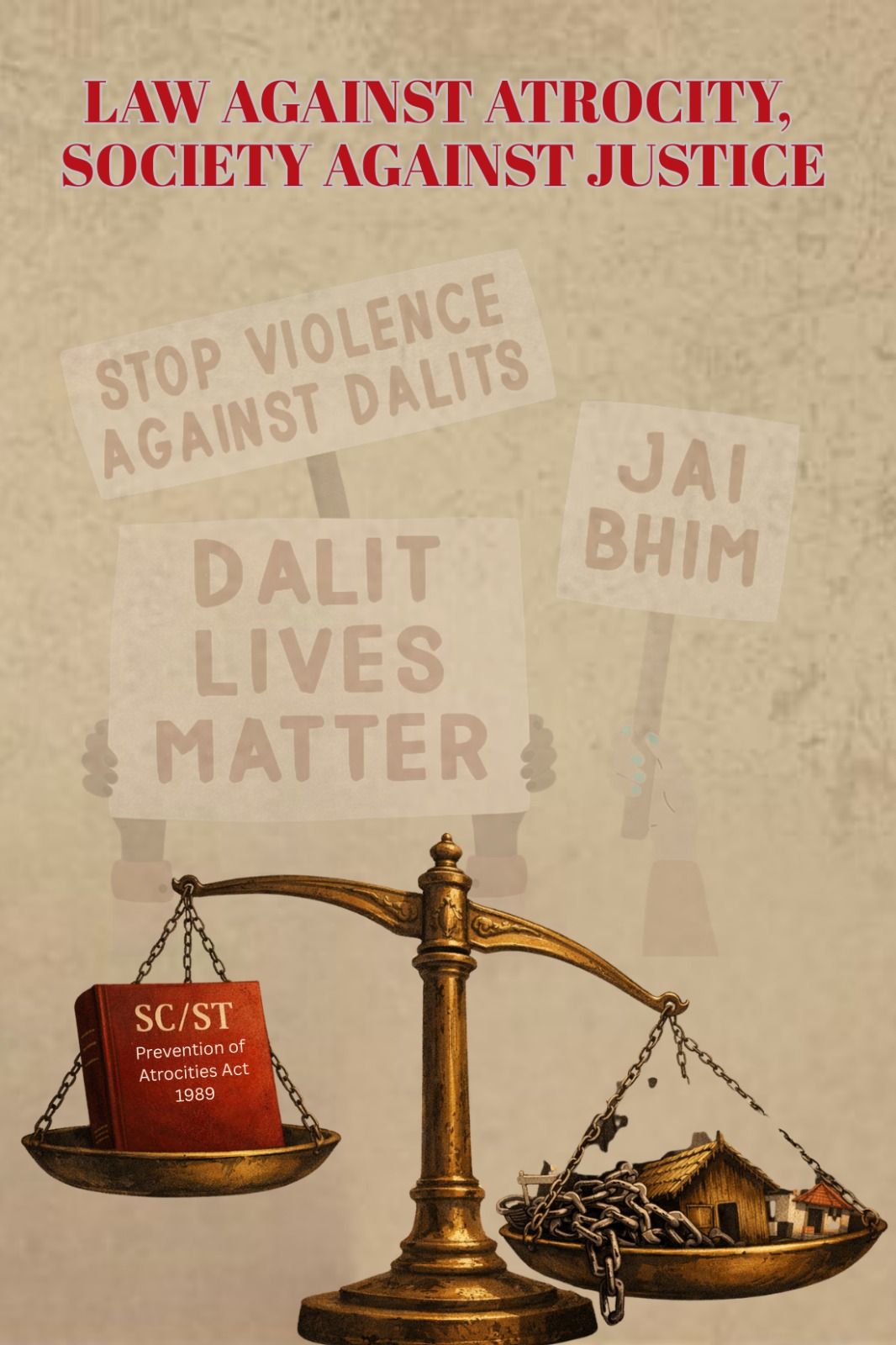
When Parliament passed the Scheduled Castes and Scheduled Tribes (Prevention of Atrocities) Act in 1989, it was acknowledging a basic truth: caste violence was not an aberration but a structure. Ordinary criminal law had proven incapable of addressing it. Atrocities were not simply crimes between individuals. They were acts meant to discipline entire communities. The Act attempted to name that reality and create stronger legal consequences for it.
More than three decades later, the Act remains one of the most powerful legal instruments available to Dalit and Adivasi communities. Yet it also exists within a criminal justice system that often neutralizes its force. This contradiction sits at the heart of the law’s history. The Atrocities Act represents both a recognition of caste violence and a reminder of how limited legal remedies are in a society structured by caste power.
Upward mobility and backlash
The sociologist Dag-Erik Berg offers a useful way of thinking about the relationship between law and caste violence. He describes the Dalit experience in modern India through what he calls a recurring pattern: upward mobility coexisting with enduring atrocity.
The expansion of education, reservation policies, and political representation has enabled sections of Dalits to challenge older hierarchies. Yet each moment of assertion has also produced violent backlash. Many of the most brutal caste massacres in recent decades have targeted communities that were asserting new social or economic claims.
The Atrocities Act emerged from this historical dynamic. It was not simply the product of humanitarian concern but the outcome of decades of Dalit struggles that forced the state to acknowledge caste violence as a structural problem. Earlier laws, such as the Protection of Civil Rights Act, focused mainly on untouchability practices like temple entry. They proved inadequate for addressing organized violence, social boycotts, and collective punishment. The 1989 law attempted to respond to these realities. It listed specific offences tied to caste domination and created special procedures for investigation and prosecution. In doing so, it brought caste explicitly into the framework of criminal law.
But as Berg points out, the presence of such legislation does not automatically transform the social structures that generate violence. Reservation policies and atrocity laws operate within domains visible to the state, such as education, employment, and criminal punishment. Meanwhile, the deeper mechanisms through which caste reproduces itself remain largely untouched. Marriage practices continue to enforce caste boundaries. Land ownership remains deeply unequal across caste lines. Economic and social power in villages often rests with dominant castes. The law intervenes after violence occurs, but the social order that makes violence possible remains largely intact. This gap between structural inequality and legal remedy explains why atrocities continue even in a constitutional democracy that formally prohibits caste discrimination.
The everyday obstacles of justice
If the Atrocities Act represents recognition of caste violence, its implementation reveals how difficult it is to translate that recognition into justice.
Anthropologist Sandhya Fuchs traces what happens when survivors attempt to turn experiences of violence into legal cases. The journey often begins at the police station, where complaints must first be recorded. Here, the law encounters the everyday functioning of the criminal justice system. Police officers frequently reinterpret or dilute complaints in ways that prevent cases from being registered under the Atrocities Act. Acts of violence are reframed as ordinary disputes, family conflicts, or property disagreements.
Survivors may be pressured to withdraw complaints or accept informal settlements. Sometimes cases never reach the courts at all. Even when cases move forward, survivors must navigate a complex field of actors, including activists, lawyers, community leaders, and political intermediaries. Each of these groups may have their own ideas about how the law should be used.
Fuchs describes how atrocity cases can become sites where competing visions of justice, honor, and political strategy collide. Survivors themselves often make pragmatic choices within these constraints. Out-of-court compromises are common, even though many activists criticize them as evidence that the law is failing. For some families, however, the threat of legal action becomes a bargaining tool to secure compensation, protection, or a measure of dignity in hostile local environments.
These negotiations reveal something important about the law’s role. The Atrocities Act is not simply a legal instrument. It has also become a symbolic resource that marginalized communities use to challenge dominant caste power, sometimes inside the courts and sometimes outside them. Yet the same processes that allow creative uses of the law also expose its fragility. Police bias, political pressure, and social intimidation constantly shape whether justice is possible.
Evidence, memory, and the burden of proof
The obstacles do not end once a case reaches court. Legal procedures themselves often place heavy burdens on survivors and witnesses.
Legal scholar Achintya Anita Gurumurthy highlights this problem through the example of the Test Identification Parade, a procedure used during criminal investigations to confirm whether eyewitnesses can identify suspects. In theory, such procedures are meant to strengthen evidence. In practice, they can be used to discredit survivors. Courts sometimes treat minor inconsistencies in witness testimonies as signs of unreliability. Delays in conducting identification parades or technical procedural lapses can weaken cases, even when violence is widely known within local communities. In atrocity cases, this evidentiary framework often collides with the realities of trauma, fear, and social pressure faced by Dalit witnesses.
The result is a pattern in which the credibility of survivors becomes the central issue, while the broader structure of caste power fades into the background. The legal process turns into an examination of memory rather than an inquiry into domination.
Gurumurthy argues that evidentiary practices cannot be treated as neutral procedures. They operate within social hierarchies. When police investigators, prosecutors, and judges overwhelmingly come from dominant castes, the interpretation of testimony inevitably reflects those power relations.
Recent legal developments have not fundamentally altered this situation. The Bharatiya Sakshya Adhiniyam, which replaced the colonial-era Evidence Act in 2023, largely preserves existing evidentiary structures, including the continued reliance on identification procedures like the Test Identification Parade. The formal language of reform has therefore not significantly transformed how evidence functions in caste atrocity cases.
For survivors, this means that the struggle for justice often involves confronting not only perpetrators but also the institutional habits of the legal system itself. Despite sensitive case law in Malkhansingh v. State of Madhya Pradesh and Kulwinder v. State (NCT of Delhi), which reflects the work of Dalit lawyers and activists, much more remains to be done in criminal justice reform if the goals of the Atrocities Act are to be realised.
Contestation and dilution
The Atrocities Act has always faced political resistance. Dominant caste organizations have repeatedly portrayed it as a law prone to misuse. This narrative gained national attention during the controversy surrounding a 2018 Supreme Court judgment that introduced restrictions on arrests under the Act, citing concerns about false cases. Dalit protests across the country forced Parliament to amend the law and restore its original provisions. The episode demonstrated both the vulnerability of the Act and the power of collective mobilization.
Such struggles are part of a longer history. Every expansion of legal protection for marginalized groups has been accompanied by attempts to dilute it, delay its implementation, or reinterpret it in ways that limit its reach. The Atrocities Act is no exception.
At the same time, the law has become deeply embedded in Dalit political consciousness. Activists, lawyers, and community organizations have built networks around it. Survivors often approach the law not simply as a technical instrument but as a statement that their suffering deserves recognition.
This dual character explains why the Act can appear both powerful and fragile, as Fuchs calls it. It is powerful because it names caste violence explicitly and creates legal consequences for it. It is fragile because its effectiveness depends on institutions that remain shaped by the very hierarchies the law seeks to challenge.
What law can and cannot do
For many survivors of atrocities, the most painful realization is that law alone cannot transform social relations. As Fuchs shows through her study of rural Rajasthan, families affected by brutal violence sometimes describe the law as something distant. Court cases may continue for years without changing the attitudes of the communities that carried out the violence.
This does not mean the law is meaningless. Legal action can bring compensation, punishment, or recognition. It can create new networks of solidarity and political mobilization. It can signal that caste violence is not a private dispute but a public injustice.
But law operates within a society where caste remains deeply embedded in everyday life. Courts cannot reorganize land ownership. Police procedures cannot dismantle endogamous marriage networks. Criminal punishment cannot eliminate the desire for status that sustains graded inequality. The persistence of caste therefore exposes the limits of relying solely on legal remedies.
Beyond the courtroom
The history of the Atrocities Act makes one thing clear: law has rarely initiated social transformation in India. More often, it has been forced into existence by movements that refused silence. Dalit and Adivasi struggles compelled the state to recognise caste violence, defend the law when it was diluted, and push institutions to act when they would rather look away.
Seen from this perspective, the Atrocities Act is not the source of justice but one instrument within a larger political struggle. It provides language, leverage, and sometimes protection. But the force that gives the law meaning lies outside the courtroom.
The fight against caste atrocities has never been won by statutes alone. It has been sustained by collective resistance, by communities that organise, testify, and refuse the social order that treats their lives as expendable. When the law works at all, it is usually because those struggles have compelled it to.
Paresh Hate is a Bahujan queer researcher, writer, documenter and activist and the Lead Content Manager at Dalit Voice.