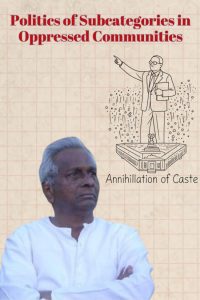
Politics of Subcategories in Oppressed Communities

Archival Note

Published in Dalit Voice (Vol. 17, Issue No. 11, 16 April 1998), this essay enters debates over whether oppressed communities should relinquish their jati identities as part of the struggle against caste. Rajshekar argues that such demands misunderstand the relationship between caste hierarchy and the identities of historically oppressed communities, and questions whether calls for caste abolition are being applied equally across society.

Building his argument through a close reading of Dr. B.R. Ambedkar’s discussion of subcastes in Annihilation of Caste, Rajshekar contends that abolishing subcastes without dismantling the caste order would strengthen existing hierarchies. He therefore defends jati identity as a political question rather than treating it as an obstacle to emancipation.

The latter part of the essay draws on examples from Kerala to argue for separate representation within the Scheduled Castes and questions the classification of some communities under the reservation system. These assertions reflect Rajshekar’s interpretation and should not be read as established historical or legal fact.


Debate On “Jati” Identity


Subcaste abolition will strengthen Hindus & their caste system: Dr. Ambedkar

Our fake democrats, socialists, and other savarna outfits say: “Don’t ask about caste, don’t think about caste, and don’t talk about caste.” They repeat this mantra through their media, so much so that our innocent Dalits and BCs, who are the original victims of the caste system, have also started repeating this very same mantra. As they are the original victims of the caste system, they want to annihilate this devilish system. That is why, when the savarnas just whisper about destroying caste, the Dalits and BCs shout and scream. But why are the savarnas (Hindus), who are the beneficiaries of the caste system, advising only Dalits not to ask about caste, not to think about caste, and not to talk about caste? Are the Hindus willing to surrender the benefits of their caste system? Will they lead a movement, the ultimate result of which will destroy the power and prestige of the savarnas? This is a serious question that we Dalits and BCs have to answer.

CALL TO ELAVAS

No Pope can be a revolutionary. Similarly, no upper-caste man can be a revolutionary. The source of his income, power, prestige, and property is his caste system. So, can he think sincerely of destroying caste? Still, he talks about destroying caste. Why? This is where we become suspicious of his motive. While they call upon us to destroy our caste, what they actually mean is to destroy our ethnic identities, but not their caste system. When they say yes, they actually mean no, and vice versa.

Sree Narayana Guru, the liberator of the Elavas of Kerala, once said:

“Don’t ask about caste, don’t think about caste, and don’t talk about caste,” but his disciple, Sahodharan Ayyappan, the most revolutionary among the disciples of Sree Narayana Guru, reversed the statement and said: “We must always ask, think, and talk about caste.”

USE THORN TO REMOVE THORN

Caste is a thorn in the body of our society. So, we have to use another thorn to remove this thorn. After its removal, we will discard both the thorns. We have lost all human rights due to the caste system. So, we must use the very caste to regain our human rights. Only after we regain all human rights can we think of the removal of caste.

The fact is, we (SC/ST/BCs) have no caste because we are not Hindus. As the original inhabitants of India, what we have are our ethnic identities, which are not caste. Our Editor is right. We are not Hindus. So, destroying caste is not our duty. It is the duty of Hindus.

While they go on strengthening their own evil caste, why are they interested in destroying our ethnic identities like the Pulaya (Pariah), Elava, etc.? This is the puzzle. The fear of the upper castes is that our caste consciousness may help us regain our lost human rights. That is why they advise us to destroy our caste (ethnic identities). For this, they want to destroy our “subcastes” first, which are our ethnic identities. When they use the word “subcaste,” they make us think that we are a part of the Hindu caste system. They know that when we destroy our “subcaste,” we will lose our identity, join the Hindu caste system, and become their most obedient slaves.

INNOCENT DALITS MISLED

Some innocent Dalits also join this Hindu anti-caste campaign. For this, they want us to give up our “sub-caste” first and unite all subcastes in the name of “Dalit.” But can they destroy our identity? Never. Is it a true solution to get our human rights? No. Babasaheb says:

“But assuming that the fusion of subcastes is possible, what guarantee is there that the abolition of subcastes will necessarily lead to the abolition of castes? On the contrary, it may happen that process may stop with the abolition of subcastes. In that case, the abolition of subcastes will only help to strengthen the castes and make them more powerful and therefore far more mischievous. This remedy is, therefore, neither practicable nor effective and may easily prove to be a wrong remedy.” (W&S Vol. 1, p. 67).

Here Babasaheb says that if we abolish the subcastes, it will only help to strengthen the caste system and make the Hindus more powerful.

That means, when we strengthen the subcastes, the Hindu caste system will be destroyed and Hinduism itself will be abolished. That is why the savarnas call upon us to destroy our caste, meaning our ethnic identity, so that enslaving the entire indigenous Dalits and BCs becomes easy.

Some Dalits may have a genuine doubt that when we strengthen our subcaste identity, our people may get divided and fight, which in turn may destroy the very “Dalit concept” and “Dalit unity.” If our people are fighting each other even now on the basis of subcastes, it is not because of these subcastes but because they are Hinduised. They also think that they are Hindus. That is why each subcaste thinks that it is “superior” to other subcastes.

The fighting is not because of our subcastes but because of this wrong notion of superiority or inferiority that they copied from Hindus.

When we educate our people on Ambedkarism and Buddhism, remove the “Hindu mind” from their brains, they will know that we are all different but equal. Each community should recognise the human rights of other communities.

Strengthening the “caste identity,” without proper education, will be a dangerous thing for the Dalits and BCs.

KERALA SCENE

How do we ensure the human rights of each and every subcaste? The good old democratic principle is by giving adequate representation to every subcaste in every field. Otherwise, only the powerful subcaste will gain everything at the cost of other weaker subcastes.

In Kerala, the Pulaya subcaste is the biggest of all other Dalit subcastes. The word “Pulayan” means the owner of the land, peasant, intellectual, etc. Now, as they have lost all their lands, the meaning of the word Pulaya is landless people. They have become the most depressed class in Kerala. The Paraya (Pariah) subcaste is also depressed and landless. They were scavengers in Kerala. Pulaya, Paraya, Valluva, Nayadi, and Chakliyas are the most depressed classes in Kerala. All these subcastes have no adequate representation in the governance of the state.

In Kerala, there are 68 subcastes in the list of Scheduled Castes.

In this list, there are so many subcastes that should actually have been included in the BC list because they are socially and economically forward.

K.R. NARAYANAN IS FORWARD

Recently, I examined the reservation list of some educational institutions, especially in MBBS and Engineering. I could find hardly two or three SC candidates who actually hail from the most downtrodden people of Kerala, i.e., Pulaya, Paraya, Chakliya, etc. Even the MLAs and MPs from reserved constituencies are actually from the forward communities but included in the SC list. This is a serious injustice to the SCs.

President K.R. Narayanan belongs to the Parava community (not Pariah). This community should have been included in the BC list. The Paravas were not unseeables but only Untouchables like the Elavas of Kerala. The hereditary occupation of the Parava women was washing, and hence they were not Untouchables.

In my area, the Paravas behave like the savarnas and discriminate against the Pulayas, Parayas (Pariah), and other Untouchables. They will not even invite these communities to their marriages. There are so many communities in the SC list who behave like the savarnas. They treat the SC people with contempt. In a fight between an SC and a savarna, they side with the savarnas. And yet, they are having all facilities, including reservations, in the name of SC. But at the same time, they will not join us in our struggle for our human rights. The original SC people are fighting and fighting without gaining anything. The benefit goes to other people who oppose and insult them in society. I have no doubt that if the original SC people understand these facts, they will demand adequate representation for each subcaste.

I can tell you that among those who are in the forefront of the “caste annihilation campaign,” we can find many such touchable SC castes. Hindus use these touchable SC subcastes to criticise our Editor’s “caste identity” thesis.

So, to end these problems, each and every subcaste must get proportional representation in every field according to its population in the governance of the country.

On May 31, 1936, Babasaheb organised a Mahar conference in Bombay. Does it mean that he hated other subcastes? What we should build between different subcastes is fraternity (brotherhood). When we fight for our human rights, we cannot oppose the human rights of other communities. This is what our Editor means when he advocates “caste identity.”

All over the world, we can see thousands of ethnic identities. None is interested in destroying its identity. Then, why should we alone destroy our identity?

However, our ethnic identities are not jati or caste. Our people are imitating the Hindus, thinking that they are Hindus. That is why some innocent, unthinking Dalits demand the destruction of our caste.

CASTE SYMBOLISES IDENTITY

What we want to destroy is the casteism of Aryans and also non-Aryans. Destroying our identity means destroying our soul. So, we must think and talk about caste, whether it is Aryan or non-Aryan.

If the upper-caste people do not use their caste identity, how can we identify them, whether it is a cobra or a rat snake? Without identifying our Enemy first, we cannot fight the Enemy.

So, ask, think, and talk about caste for liberation. Remember, as we strengthen our identity, we should also enlighten our people on Ambedkarism and Buddhism.

Our upper-caste rulers acquired everything by their communal thinking. We also can have everything in the same way. So, we too must be communalists.

That means we must love our people.

The savarnas advise us to love the enemy. We must know the trap behind this advice. They know very well that we consider them our Enemy. That is why they ask us to love the enemy. How can we fight our enemy when we don’t hate this Enemy? If we don’t hate the Enemy, we cannot fight and secure our liberation. So, we must hate our Enemy. It is our right to hate and fight our enemy to win our liberation.

What the enemy hates, we must love, and what the enemy loves, we must hate.

Then only will we get a clear picture of the Enemy’s mind. That is why, when they ask us to destroy our caste, we say no. That is why, when they ask us to love our enemy, we oppose it.
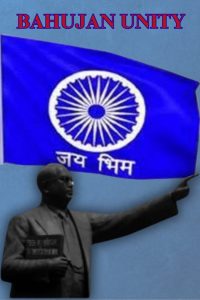
Bahujan Unity

Archival Note

Published in Dalit Voice (Vol. 22, Issue No. 20, 16 October 2003), this essay by V. T. Rajshekar intervenes in debates over the social and political composition of the anti-caste movement at a time when questions of Bahujan unity and electoral realignments were reshaping Indian politics.

Rajshekar argues that the Brahminical Social Order, rather than the Backward Classes (BCs), is the principal adversary of Dalits. He contends that excluding BCs from the Ambedkarite movement weakens the struggle against Brahminism and calls for a renewed Bahujan alliance grounded in the shared emancipatory vision of Phule, Shahu, Periyar, and Ambedkar.

More than two decades later, the essay remains relevant as anti-caste politics continues to grapple with questions of coalition-building, social solidarity, and the relationship between caste oppression and political strategy.


Dalit movement will suffer if BCs are excluded


The one-line answer to the question, “Who is the enemy of Dalits?” is the Brahmins, not BCs, who are the natural allies of Dalits.

Both the Dalits and BCs are the victims of the Brahminical Social Order. The historical truth also must be considered that the BCs and Dalits are from the same stock. Of course, we cannot ignore the involvement of forward BCs in the atrocities against Dalits. Persons enacting the rule seem to be cruel because they are in direct touch, but the actual cruelty lies in the rule and the frames of the rule. The same thing is with BCs and the BSO.

So, I suggest establishing a positive relationship between Dalits and BCs because the root cause of the problem is not the BCs but the Brahminical system.

Dalits alone can save BCs: We have to remove the false Kshatriyatva from the minds of BCs. Of course, Dalits cannot say that it is not their duty. It is their duty because they are the pillars of the Ambedkarite movement. The Dalits, as leaders of the Indian revolution, must lead the BCs also.

Our duty is to generate attachment of BCs with the ideology of Phule-Shahu-Ambedkar. The first step for this is the detachment of BCs from the Brahminical fold. Of course, BCs cannot detach themselves. It is the Dalits who have to do this job.

Restricting the movement to Dalits will not only not help our movement, but it will take the movement backward. On the contrary, we will help the BSO only. Our movement is to abolish the BSO. One of the purposes of our struggle is this. Our target should not be any individual but the culture which creates individuals like Mulayam, Kalyan, Katiyar, and even Paswan. If you want to abolish the BSO, a major part of this system should get out from the BSO, and that major part is the BCs. By avoiding the relationship between Dalits and BCs, we cannot run the Ambedkarite movement. On the contrary, we put a question mark on Phule-Shahu-Periyar-Ambedkar’s mission.

Mulayam is a Hindu: It is a misconception that BCs cannot accept Dalit leadership. Jagjivan Ram did not accept the leadership of Dr. Ambedkar. That does not mean that Dalits did not accept the leadership of Babasaheb. Today, the movement is identified with the name of Babasaheb, not Babuji. So, you cannot generalize the relationship between Dalits and BCs by citing the example of Mulayam and Kalyan (both BCs), but we must understand that they are not accepted by all the BCs. Mulayam, Kalyan, and Paswan are driven by the Brahminical force. Mulayam and Kalyan do not accept the leadership of Kanshi Ram not because of their BC origin but because of their “Hindu mentality.”

Thakur-Brahmin alliance: A leader having the Indian Constitution in one hand and the Manusmruti in another must not be tolerated, even if he is a Dalit.

When Thakurs and Brahmins can join hands to save their BSO, why not Dalits join with BCs? Look how BC MLAs in the BSP have shown their loyalty to the BSP. None of the BC MLAs other than 3 Yadavs left the party (still there are 2 Yadav MLAs with the BSP). While 1 Nishad (ST) and 1 Khatik (SC) have left the BSP, BC MLAs like Rajbhar and Maurya are still with the BSP. Who says that BCs cannot accept Dalit leadership? In UP, Swamiprasad Maurya, BSP legislature party leader, and Sukhdev Rajbhar (chief whip of the BSP) are BCs. In UP, 90% of the Rajbhars vote for the BSP. Similarly, the Maurya and Nonia (BC) castes also cast over 70% of their votes for the BSP.

We cannot put a line between Dalits and BCs because such a division will be a division of ourselves only. Koli is a caste whose subcastes are in different categories: SC, ST, BC, and outside these categories, i.e., general. Where will such castes stand? A caste like Bhar is BC in UP, SC in MP, and ST in Maharashtra.

Psychological violence: We must understand the fact that the BCs are not oppressors. Rather, they are an instrument in the hands of the oppressive forces, the BSO. We must understand that psychological violence is more injurious than physical violence. We should learn something from dogs. If somebody throws a stone at a dog, it does not run after the stone but after the hand that throws the stone. BCs are like stones that are being thrown by the BSO mind. If we do not make them (BCs) part of our struggle, they will go more and more into the BSO camp. We must develop the culture of Bahujan Samaj instead of Dalit Samaj. We should learn a lesson from the collapse of the RPI. Without the BCs, Dalits cannot capture power in the true sense. The true sense means to capture power, retain it, and use it to preserve and propagate the ideology set by our forefathers.

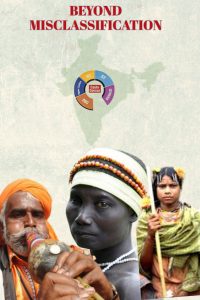
Beyond Misclassification: Why Denotified Tribes Need a Separate Constitutional Schedule

In 2027, India will undertake a caste enumeration for the first time since 1931. For Denotified, Nomadic, and Semi Nomadic Tribes, this moment carries a weight that goes far beyond bureaucratic exercise. Community leaders have secured an assurance from the Union government that these groups will be enumerated in the upcoming Census. Yet there is no clarity on how this enumeration will occur, and no commitment to a separate column in the Census form. For communities whose very history is one of erasure and stigma, the difference between being vaguely “included” and being specifically counted is the difference between visibility and continued disappearance.

Denotified Tribes, commonly referred to as DNTs, are communities that were once branded as “criminal tribes” under the colonial Criminal Tribes Act of 1871. That law empowered the state to register, surveil, and control entire communities on the presumption that criminality was hereditary. The Act was amended in 1924 and finally repealed in 1952. With repeal came “denotification”, but not dignity. The label changed, the suspicion remained. Soon after independence, many States enacted Habitual Offenders laws, which enabled continued police targeting of members of these communities. The colonial imagination of the “born criminal” quietly survived inside the postcolonial state.

Enumeration has always been central to their oppression and their exclusion. From 1911 onwards, colonial Census reports explicitly counted “criminal tribes”. The 1931 Census was the last time these communities were distinctly enumerated. After independence, the Republic chose not to enumerate castes beyond Scheduled Castes and Scheduled Tribes. In principle this was framed as a break from colonial caste fixation. In practice, it meant that communities who had been stigmatized as criminals vanished statistically. A people once over counted for surveillance became under counted for justice.

Over the decades, most DNT communities were absorbed into the categories of Scheduled Castes, Scheduled Tribes, or Other Backward Classes. The most recent National Commission for Denotified, Nomadic, and Semi Nomadic Tribes, headed by Bhiku Ramji Idate, identified nearly 1,200 such communities. It also found that around 268 DNT communities had not been classified in any of these categories. The Commission made clear that without an accurate enumeration, policy would continue to operate in the dark. It was not the first to say so. Successive commissions, including the earlier Renke Commission, began with the same problem: before welfare, there must be identification.

The current demand for a separate Census column arises from lived experience of what community leaders describe as political misclassification. When DNTs are folded into the SC, ST, or OBC lists, they are forced to compete with larger and often more politically organized communities within those categories. In many regions, denotified and nomadic jatis remain among the most educationally and economically deprived, yet they are statistically indistinguishable from groups with far greater access to resources and representation. Leaders from north India point to villages where not a single member of certain denotified communities has completed secondary education, despite being listed as SC for decades. Formal inclusion has not translated into substantive equality.

The argument now being made is not simply for recognition, but for graded recognition. Community leaders have begun to invoke the Supreme Court’s 2024 judgment permitting sub classification within SC and ST categories. They argue that even if sub classification is operationalized within existing lists, it will not address the specific stigma of denotification. The demand is for a separate Constitutional Schedule for DNTs, on par with the existing SC and ST Schedules, along with internal sub classification to account for graded backwardness between settled and nomadic denotified communities. The point is not symbolic parity but structural correction.

The distinction between settled and nomadic DNT communities is not trivial. According to accounts presented before commissions, until the 1960s most denotified communities were similarly placed in conditions of deprivation. Over time, some settled groups were able to leverage land, local networks, or small enterprises to improve their situation marginally. Nomadic and semi nomadic communities, lacking fixed residence, documentation, and access to schooling, were left further behind. Without internal differentiation, a uniform policy risks reproducing internal hierarchies within the DNT category itself.

The state’s existing welfare approach has demonstrated the limits of piecemeal intervention. The Social Justice Ministry’s SEED scheme was designed to support DNTs in education, health, housing, and livelihood. Yet in the last five years, only a fraction of the planned expenditure has been utilized. As is increasingly visible across affirmative action and social justice programmes, the egalitarian edge of such schemes has been administratively diluted. However, a principal reason for this failure is bureaucratic paralysis around certification. To access benefits, individuals must possess a DNT certificate, even if they are already classified as SC, ST, or OBC. Many States simply do not issue such certificates. In effect, the state announces schemes for a category it refuses to formally recognize. The result is predictable. Benefits reach a minuscule fraction of those intended.

This administrative failure is not accidental. Without a clear Constitutional status or a separate Census code, DNTs exist in a grey zone. They are recognized enough to be invoked in speeches, but not recognized enough to command uniform policy implementation. Associations such as the All India Denotified Nomadic Tribes Development Council have repeatedly emphasized that wherever they approach courts or governments, the first question posed is numerical strength: How many are you? In the absence of official data, estimates vary wildly. Some leaders claim crores in a single State. The truth is that no one knows properly. In a democracy that allocates representation and resources through numbers, ignorance is exclusion.

The moral and political stakes are higher than administrative design. The original branding of these communities as criminal was not an incidental error. It was a tool of governance rooted in caste ideology and colonial control. To be marked as criminal by birth is to be denied the presumption of innocence that underpins modern citizenship. Denotification in 1952 did not come with an institutional apology, reparations, or structural safeguards against continued profiling. Instead, Habitual Offenders laws and everyday policing practices reproduce suspicion that continue till date across judicial and policing contexts. The stigma has seeped into schooling, employment, and housing. It has hardened into social fact.

Against this history, the promise of enumeration without clarity is inadequate, a familiar strategy through which governments acknowledge caste without confronting its structural consequences. If DNTs are merely to be counted under pre existing SC, ST, or OBC headings, their specific trajectory of criminalization and denotification will once again dissolve into larger aggregates. Critics may argue that creating a separate Schedule risks proliferating categories which often is worrying because of the expanding powers allowed to the state to regulate. But according to the DNT activists, a separate column in the Census is not an exercise in identity fragmentation. It is a demand for empirical truth. It is a claim that policy must correspond to history. Without distinct data, there can be no targeted allocation, no evaluation of outcomes, no accountability.

What stands before the government is a simple choice. It can treat the 2027 Census as a technical formality and subsume DNTs within existing codes. Or it can confront a century and a half of stigmatization by ensuring that these communities are distinctly counted and constitutionally recognized. In a republic that claims to have broken with colonial injustice, it is indefensible that the descendants of those once branded hereditary criminals must still beg to be seen as a category of citizens. With so many anti-caste hopes pinned onto the upcoming Census, this is not a minor technical demand. It is a test of whether the Republic is prepared to reckon with the communities it once marked as criminal and then has forgotten. If counting determines power in a broken democracy, then refusing to count is continuing violence.


Paresh Hate is a Bahujan queer researcher, writer, documenter and activist and the Lead Content Manager at Dalit Voice.