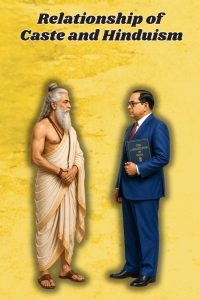
Relationship of Caste and Hinduism

Archival Note

Published in Dalit Voice (Vol. 29, Issue No. 03, 01/02/2010), this essay by V. T. Rajshekar examines Hinduism through the question of caste. He traces caste divisions to the Purusha Sukta and the Bhagavad Gita, then turns to the Manusmriti and its treatment of Brahmins, Sudras and women.

Rajshekar connects these religious texts to the oppression of Dalits and cites accounts of violence against Untouchables alongside condemnations of caste from writers and public figures. His argument leads to a direct question: if caste is part of the religious order Rajshekar identifies as Hinduism, can Hinduism exist without caste?

The essay closes by putting that question to the Hindu believer featured in the film that prompted Rajshekar’s article. How can Hindu faith be reconciled with the caste system? And if caste is rejected, what does that mean for the religious traditions that Rajshekar argues have sustained it?

Read the full piece here


British Anthropologist Details Barbarity of Hinduism

“Revelations: How do you know god exists”, is a film by Anthony Thomas (Channel 4). I saw this film on Aug. 16, 2009. I was particularly interested in what the Hindus had to say. I lived in India for 15 years and found their belief system very confusing. The Hindus as well as the others interviewed failed to show us how he knew god exists.

PART-1

The caste system & origins of Hinduism:

Hinduism is based on myth. Seven rishis overheard “wisdom” being spoken by the gods. This wisdom they passed on to mankind as the four Vedas:

  1. Rig Veda
  2. Yajur Veda
  3. Sama Veda
  4. Atharva Veda

The Rig Veda is our principal concern. It is a composition of 1,028 poems. But more of this later.

HINDU & GREEK GODS

33 crore gods:

According to Lord Winstone (April 17, 2006), the Hindus have about 330,000,000 gods. Shiva, one of the main gods, has 1,008 epithets. Most deities have consorts: Shiva’s wife is Parvati, Vishnu’s wife is Lakshmi and Brahma’s wife is Sarasvati. Mention must be made of two other important gods: Durga and Kali. Sitala is the goddess of smallpox. And the Hindu deity Devagana, it is believed, lives in the anus. And so on.

The Greeks also believed in gods and goddesses. The Greek philosophers found that the gods and goddesses resembled mortals too much and the “myths were nothing but human notions”.

Xenophanes who lived about the year 570 BC was the exponent of this view. There followed developments from a mythological mode to one based on experience and reason. The aim of Greek philosophy was to find natural rather than supernatural explanations for natural processes. The Greek gods and goddesses were then relegated to the realms of fiction.

But the Hindus, on the other hand, continue to believe in their gods and goddesses to this day. The Hindu belief that human beings are born unequal is based on a Vedic hymn called Purusha Sukta found in the fourth veda, the Rig Veda.

According to the Purusha Sukta, the social divisions into which all human beings fall are:

(1) Brahmins, the highest caste, (2) Kshatriyas, the warrior caste, (3) Vaisyas, the merchant caste and (4) Sudras, the working caste.

GOD CREATED CASTE SYSTEM

Outside this demarcation based on strict hereditary lines are the outcastes or Untouchables, who do not belong to any caste at all. They are called Dalits today. It was further confirmed by God Krishna in the Bhagavad Gita (4.13):

The fourfold caste was created by me by the different distribution of guna and karma.

It was finally codified by someone called Manu, the greatest lawgiver.

Who was this Manu?

Manu was born directly of the god Brahma and was hermaphrodite. The human race began from Manu and his family. (Romila Thaper: A History of India, p. 28).

HINDU LAWS OF MANU

Gidoomal and Thomson on p. 17 of their book, A Way of Life, say:

Manu represents the beginning. A semi-divine mythical creature; he is the first man, the first king of India, the first to light the sacrificial fire and the first and the greatest lawgiver.

Every Hindu man and woman is expected to follow the laws of Manu which came to be called Varnashrama Dharma or Manusmriti. They were written down about 200 BC. Hindus follow the laws of Manu to the letter even to this day. And what are some of the laws set by Manu for Hindus to follow?

Here are some taken at random:

(1) The Brahmins are the highest caste. They are the gods among humans.

(2) The drum, the illiterate, the low caste, animals and women must be beaten to make them fit.

(3) A woman must never be independent.

(4) The Brahmin is holy and has a claim to veneration even if he commits shameful deeds.

(5) A Brahmin is born as the highest on earth, the lord of all created things. Whatever exists in the world is the property of the Brahmin on account of the excellence of his origin. The Brahmin is indeed entitled to it all.

(6) The lord has prescribed only one occupation for Sudras (the lowest caste). They must perform service without malice to the other three castes.

(7) Those who educate Sudras will go to hell. A Sudra is unfit to receive education. The upper varnas or castes should not impart education or give advice to a Sudra. Violators will go to hell, called Asamvritta.

(8) If a Sudra (low caste) listens to a recitation of the Vedas (Hindu holy books), his ears shall be filled with tin or lac. If he recites Vedic texts, his tongue shall be cut. Only the Brahmins are entitled to receive the teachings imparted in the Vedas.

ATROCITIES AGAINST DALITS

It is difficult to credit the misanthropic effusions as law to this man who, it is said, was the son of Brahma, the supreme god. No wonder Indian women in 2000 AD

“publicly burned copies of the Manusmriti declaring that the text was misogynistic” (Introducing Hinduism, Lall & Von Lodon, p. 30).

Then there are millions and millions of people in India who have no caste at all. They are without caste because of sins committed by them in a previous incarnation. They are called outcastes or Untouchables. Today they are referred to as Dalits.

The effect of Manu on the outcastes has been devastating. From the time they are born till they die they suffer discrimination and humiliation at every turn of their lives.

GOD ORDERED HINDUS TO KILL DALITS

They have no redress. Here are a few examples of atrocities chosen at random which are committed against the Untouchables:

(1) 1969: India: A Million Mutinies Now by V. S. Naipaul (Viking): “In 1969, 40 Untouchables (Harijans) were burnt alive in a hut.”

(2) April 14, 1992: Commemorating the birthday of Dr. Ambedkar: “20 houses belonging to Untouchables were burnt at Kadalur village (80 km from Madras).” Reported by Henry Thiagaraj in The Wounded Society.

(3) June 18, 2000: The London Observer. “A picture showing a village of low castes (Untouchables) being massacred by high caste thugs in Bihar, India.”

(4) March 30, 2003: The Guardian: “A young lower caste woman was set on fire and burned to death yesterday by the upper caste father of the man she accused of raping her.”

(5) Dec. 16, 2005: Dalit Voice (magazine, p. 9). Gohana (Haryana) incident in Aug. 2005 when 60 Untouchable houses were burnt with police looking on.

(6) 2006: Indian National Bureau of Crime report. 27,007 crimes had been committed against Dalits. Many go unreported (See box):

In 1999, William Dalrymple, reviewing Robert Deliege’s book, The Untouchables of India, says in the London Sunday Times:

“Hindus actually believe god has authorised atrocities to be committed against these Untouchables.”

UNIVERSALLY CONDEMNED

Never in any part of this wide, wide world, whether savage or civilised, is systematic murder of human beings given such divine approval, except in India. Dalrymple goes on to say in the same review:

“In many high caste-dominated villages no Untouchable is allowed to ride a bicycle, sit down or even wear shoes in the presence of a high caste Hindu… Reported incidents of serious violence against Untouchables run at about 9,000 cases annually and this is the tip of the iceberg”.

The caste system of which untouchability is the indispensable part is integral to Hinduism.

‘….those whose conduct has been evil will quickly attain evil birth, the birth of a dog, the birth of a hog, or the birth of a Chandala (Untouchable).

Chandogya, translated by Dr. S. Radhakrishnan and quoted by Pratima Bowes in her The Hindu Religious Tradition (p. 57).

The caste system and especially untouchability is universally condemned.

(1) Dr. Karan Singh, a leading Hindu thinker, in his Essays on Hinduism, quoted by Gidoomal & Thomson (p. 9), described the ill-treatment of Untouchables “over the centuries as a standing disgrace”.

(2) Pratima Bowes, The Hindu Religious Tradition (p. 17): The opinion (is) often expressed that the caste system is the centre of the Hindu religion and that the breakdown of this system means the end of this religion.

(3) Caspar Melville, editor of the New Humanist, Nov. 2005 (p. 19), is “against the caste system, the subordination of women and the invested power of the Brahmin”.

(4) Buddha to Manmohan Singh: The caste system has been condemned by writers and reformers from Buddha, Akbar, Mahatma Phule, Periyar, Gora, Tilak, Guru Nanak, Mahavira, Tukaram, Ram Mohan Roy, the Bhakti movement of Southern India to Manmohan Singh, the Prime Minister of India, and countless others.

(5) Jawaharlal Nehru in Glimpses of World History (p. 112) says: “The caste system had the seeds of decay in it. It was based on perpetuating inequality and injustice and any such attempt was bound to fail in the end. No sound and stable society can be built upon the basis of inequality and injustice or on the exploitation of one class or group by another.”

BLEAK FUTURE OF HINDUISM

I give you three sources:

(1) Loon and Lall: Introducing Hinduism (p. 127):

As knowledge of India grows around the world: Bollywood, Indian fashions, Indian classical music, tandoori cooking and India’s famed gurus Hinduism will come under increasing scrutiny.

On p. 161, they go on to say:

Secular Indians and many others with a humanist vision think of the future of India as bleak.

(2) Ram Gidoomal & Robin Thomson in A Way of Life, (p. 150) say:

Whoever is in power, the tensions over caste and class will continue.

(3) Nirad Chaudry in his Preface to Hinduism (p. XI) says:

I have lost faith in the tenets of Hinduism, indeed in all established religions long ago.

CONCLUSION

Hinduism without the caste system is like Hamlet without the Prince.

I would like to ask the Hindu believer in the film wrapped in saffron robes and daubed in symbols of Hindu piety how he could reconcile his Hindu faith without the caste system.
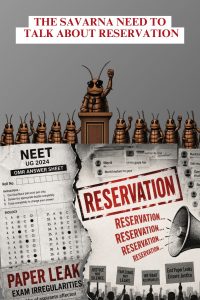
The Savarna Need to Talk About Reservation

Say what you will about the CJP protests against the NEET paper leak, everyone has already said that the immediate demands are not enough to change the education system. Education scholars are more likely to tell you about the 5-point charter submitted by the CJP to the Government of India. But one class of discourse generators is rattled by the protests themselves, or has been looking for an opportunity to vent its pre-existing frustrations or biases and has now found the perfect one . This is the oppressed castes’ general status and their tiresome, repeated, annoying rant against reservation.

This includes someone fabricating a fake post by actor Vijay Varma about his one non-reserved category friend suffering in some educational institution, which the pro-protest actor quickly said he had never posted. His acting in the anti-Mandal movement film Hurdang alongside Sunny Kaushal, however, may not have made his supposed stance difficult to believe had the post been genuine. Whether he posted it or not, and whether he believes the logic underneath that post, are different questions.

Mrunal Thakur, another actor, apparently posted a story on her Instagram account suggesting that the key moment that changed the game for everyone during these protests was NEET aspirant Harsh Dubey questioning the dominant narrative around the protests, arguing that the focus on the paper leak has overshadowed other longstanding issues in medical admissions. This was apparently a clip from a conversation with NDTV’s Shiv Aroor, where Dubey said questions around reservation policy and the difficulties faced by general category students also deserve public attention. Whether Mrunal Thakur will also come out and deny posting this is a matter of no one’s concern. Bollywood celebrities have shown their political illiteracy and general inhumanity more than once.

But this idea that neither the BJP nor the CJP wants to touch reservation, and that this is what led to the compromise, is one of those Savarna delusions burdened with so many argumentative flaws that a sane mind can hardly engage with it. To begin with, despite its classist and meritocratic articulation of the protests, the CJP does not appear to be opposed to reservation, partly reflected in its use of Ambedkarite symbolism, whether sincere or strategic. One also forgets that the BJP is a heterogeneous party with multiple caste groups and not simply Brahmins and other general category persons. There is no consensus on this question even within the Hindutva fold, something evident from the raita vs. trad debates that have long existed within their own ideological circles. To treat a single interview, one that merely regurgitates the most banal opinion circulating on the Savarna reactionary internet, as having played any pivotal role in shaping the protests is fantasy writing in its purest form.

But what is up with the casteist Savarnas? In a protest that brought together people from the non-protesting middle classes and celebrities, wherein status and privilege are also disproportionately held by oppressor castes, what has made the casteist Savarnas launch into their regular rant with great vigour? Are Savarnas simply waiting for any needle to move so they can carry their anti-reservation agenda? Are they simply incapable of shutting up for once?

Why, then, does every major public mobilisation touching education or even employment seem to invite an anti-reservation chorus from casteist Savarnas? The answer is not that reservation is secretly the central issue every time, like the Dubeys make it out to be. It is that reservation has become the preferred language through which sections of the Savarna public interpret almost every institutional crisis. Whenever a crisis emerges in education or public recruitment, reservation is summoned as the familiar explanation, even when it has little to do with the event itself. It is less a response to the facts before them than a political reflex.

This reflex performs an ideological function. It redirects public anger away from institutions and towards beneficiaries of affirmative action. A paper leak points towards failures of governance, regulation, corruption, examination agencies, and political accountability. None of these explanations preserve the moral authority of the existing Brahminical social order. Reservation, on the other hand, offers an already available narrative; and if Savarna public discourse has shown anything, it is that they love readily available labour, intellectual and otherwise. The next generation of casteists also lack imagination and will rely on the intellectual dis-labour of their Savarna forefathers.

These complaints are very vapid. They transform a structural failure into a grievance against redistributive and representational justice. Instead of asking why an examination system repeatedly fails millions of students, they ask who supposedly enjoys unfair advantages, even though the empirical facts reveal it is they who do. The institution escapes scrutiny because caste once again becomes framed as the problem only when it attempts to correct itself.

There is another reason why these moments are politically useful. Large protests produce so much uncertainty. They reopen public debate and create the possibility that questions long considered settled may be discussed again, especially now that social media has permitted everyone to have an opinion, for good and bad alike. For anti-reservation voices, this is an opportunity to attach their long-standing campaign to a movement that was never organised around their demands. They seek legitimacy through proximity of discourse. If enough people begin associating educational injustice with reservation rather than with state failure, the moment gets a new meaning.

This explains why Harsh Dubey’s interview came to acquire symbolic importance far beyond its actual place in the protests. It offered something many casteist Savarnas had been waiting for: an apparently articulate voice on national television through which they could restate arguments that have circulated for decades. Reservation disrupts the comforting belief that educational success reflects individual merit alone. Every conversation about admissions threatens to reopen the history of caste privilege that made merit appear natural in the first place. It is therefore unsurprising that even a movement against examination malpractice becomes, for some, another occasion to defend inherited advantages while presenting themselves as victims of an unjust system. The anti-reservation discourse surrounding the NEET protests tells us less about the movement than about the persistence of Savarna political common sense.


DalitThinkerToday is a Chartered Accountant by profession from Sangli, Maharashtra, who occasionally dabbles in thinking about politics when people in her oppressor-caste-majority office frustrate her. This is her pseudonym.

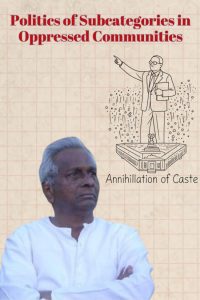
Politics of Subcategories in Oppressed Communities

Archival Note

Published in Dalit Voice (Vol. 17, Issue No. 11, 16 April 1998), this essay enters debates over whether oppressed communities should relinquish their jati identities as part of the struggle against caste. Rajshekar argues that such demands misunderstand the relationship between caste hierarchy and the identities of historically oppressed communities, and questions whether calls for caste abolition are being applied equally across society.

Building his argument through a close reading of Dr. B.R. Ambedkar’s discussion of subcastes in Annihilation of Caste, Rajshekar contends that abolishing subcastes without dismantling the caste order would strengthen existing hierarchies. He therefore defends jati identity as a political question rather than treating it as an obstacle to emancipation.

The latter part of the essay draws on examples from Kerala to argue for separate representation within the Scheduled Castes and questions the classification of some communities under the reservation system. These assertions reflect Rajshekar’s interpretation and should not be read as established historical or legal fact.


Debate On “Jati” Identity


Subcaste abolition will strengthen Hindus & their caste system: Dr. Ambedkar

Our fake democrats, socialists, and other savarna outfits say: “Don’t ask about caste, don’t think about caste, and don’t talk about caste.” They repeat this mantra through their media, so much so that our innocent Dalits and BCs, who are the original victims of the caste system, have also started repeating this very same mantra. As they are the original victims of the caste system, they want to annihilate this devilish system. That is why, when the savarnas just whisper about destroying caste, the Dalits and BCs shout and scream. But why are the savarnas (Hindus), who are the beneficiaries of the caste system, advising only Dalits not to ask about caste, not to think about caste, and not to talk about caste? Are the Hindus willing to surrender the benefits of their caste system? Will they lead a movement, the ultimate result of which will destroy the power and prestige of the savarnas? This is a serious question that we Dalits and BCs have to answer.

CALL TO ELAVAS

No Pope can be a revolutionary. Similarly, no upper-caste man can be a revolutionary. The source of his income, power, prestige, and property is his caste system. So, can he think sincerely of destroying caste? Still, he talks about destroying caste. Why? This is where we become suspicious of his motive. While they call upon us to destroy our caste, what they actually mean is to destroy our ethnic identities, but not their caste system. When they say yes, they actually mean no, and vice versa.

Sree Narayana Guru, the liberator of the Elavas of Kerala, once said:

“Don’t ask about caste, don’t think about caste, and don’t talk about caste,” but his disciple, Sahodharan Ayyappan, the most revolutionary among the disciples of Sree Narayana Guru, reversed the statement and said: “We must always ask, think, and talk about caste.”

USE THORN TO REMOVE THORN

Caste is a thorn in the body of our society. So, we have to use another thorn to remove this thorn. After its removal, we will discard both the thorns. We have lost all human rights due to the caste system. So, we must use the very caste to regain our human rights. Only after we regain all human rights can we think of the removal of caste.

The fact is, we (SC/ST/BCs) have no caste because we are not Hindus. As the original inhabitants of India, what we have are our ethnic identities, which are not caste. Our Editor is right. We are not Hindus. So, destroying caste is not our duty. It is the duty of Hindus.

While they go on strengthening their own evil caste, why are they interested in destroying our ethnic identities like the Pulaya (Pariah), Elava, etc.? This is the puzzle. The fear of the upper castes is that our caste consciousness may help us regain our lost human rights. That is why they advise us to destroy our caste (ethnic identities). For this, they want to destroy our “subcastes” first, which are our ethnic identities. When they use the word “subcaste,” they make us think that we are a part of the Hindu caste system. They know that when we destroy our “subcaste,” we will lose our identity, join the Hindu caste system, and become their most obedient slaves.

INNOCENT DALITS MISLED

Some innocent Dalits also join this Hindu anti-caste campaign. For this, they want us to give up our “sub-caste” first and unite all subcastes in the name of “Dalit.” But can they destroy our identity? Never. Is it a true solution to get our human rights? No. Babasaheb says:

“But assuming that the fusion of subcastes is possible, what guarantee is there that the abolition of subcastes will necessarily lead to the abolition of castes? On the contrary, it may happen that process may stop with the abolition of subcastes. In that case, the abolition of subcastes will only help to strengthen the castes and make them more powerful and therefore far more mischievous. This remedy is, therefore, neither practicable nor effective and may easily prove to be a wrong remedy.” (W&S Vol. 1, p. 67).

Here Babasaheb says that if we abolish the subcastes, it will only help to strengthen the caste system and make the Hindus more powerful.

That means, when we strengthen the subcastes, the Hindu caste system will be destroyed and Hinduism itself will be abolished. That is why the savarnas call upon us to destroy our caste, meaning our ethnic identity, so that enslaving the entire indigenous Dalits and BCs becomes easy.

Some Dalits may have a genuine doubt that when we strengthen our subcaste identity, our people may get divided and fight, which in turn may destroy the very “Dalit concept” and “Dalit unity.” If our people are fighting each other even now on the basis of subcastes, it is not because of these subcastes but because they are Hinduised. They also think that they are Hindus. That is why each subcaste thinks that it is “superior” to other subcastes.

The fighting is not because of our subcastes but because of this wrong notion of superiority or inferiority that they copied from Hindus.

When we educate our people on Ambedkarism and Buddhism, remove the “Hindu mind” from their brains, they will know that we are all different but equal. Each community should recognise the human rights of other communities.

Strengthening the “caste identity,” without proper education, will be a dangerous thing for the Dalits and BCs.

KERALA SCENE

How do we ensure the human rights of each and every subcaste? The good old democratic principle is by giving adequate representation to every subcaste in every field. Otherwise, only the powerful subcaste will gain everything at the cost of other weaker subcastes.

In Kerala, the Pulaya subcaste is the biggest of all other Dalit subcastes. The word “Pulayan” means the owner of the land, peasant, intellectual, etc. Now, as they have lost all their lands, the meaning of the word Pulaya is landless people. They have become the most depressed class in Kerala. The Paraya (Pariah) subcaste is also depressed and landless. They were scavengers in Kerala. Pulaya, Paraya, Valluva, Nayadi, and Chakliyas are the most depressed classes in Kerala. All these subcastes have no adequate representation in the governance of the state.

In Kerala, there are 68 subcastes in the list of Scheduled Castes.

In this list, there are so many subcastes that should actually have been included in the BC list because they are socially and economically forward.

K.R. NARAYANAN IS FORWARD

Recently, I examined the reservation list of some educational institutions, especially in MBBS and Engineering. I could find hardly two or three SC candidates who actually hail from the most downtrodden people of Kerala, i.e., Pulaya, Paraya, Chakliya, etc. Even the MLAs and MPs from reserved constituencies are actually from the forward communities but included in the SC list. This is a serious injustice to the SCs.

President K.R. Narayanan belongs to the Parava community (not Pariah). This community should have been included in the BC list. The Paravas were not unseeables but only Untouchables like the Elavas of Kerala. The hereditary occupation of the Parava women was washing, and hence they were not Untouchables.

In my area, the Paravas behave like the savarnas and discriminate against the Pulayas, Parayas (Pariah), and other Untouchables. They will not even invite these communities to their marriages. There are so many communities in the SC list who behave like the savarnas. They treat the SC people with contempt. In a fight between an SC and a savarna, they side with the savarnas. And yet, they are having all facilities, including reservations, in the name of SC. But at the same time, they will not join us in our struggle for our human rights. The original SC people are fighting and fighting without gaining anything. The benefit goes to other people who oppose and insult them in society. I have no doubt that if the original SC people understand these facts, they will demand adequate representation for each subcaste.

I can tell you that among those who are in the forefront of the “caste annihilation campaign,” we can find many such touchable SC castes. Hindus use these touchable SC subcastes to criticise our Editor’s “caste identity” thesis.

So, to end these problems, each and every subcaste must get proportional representation in every field according to its population in the governance of the country.

On May 31, 1936, Babasaheb organised a Mahar conference in Bombay. Does it mean that he hated other subcastes? What we should build between different subcastes is fraternity (brotherhood). When we fight for our human rights, we cannot oppose the human rights of other communities. This is what our Editor means when he advocates “caste identity.”

All over the world, we can see thousands of ethnic identities. None is interested in destroying its identity. Then, why should we alone destroy our identity?

However, our ethnic identities are not jati or caste. Our people are imitating the Hindus, thinking that they are Hindus. That is why some innocent, unthinking Dalits demand the destruction of our caste.

CASTE SYMBOLISES IDENTITY

What we want to destroy is the casteism of Aryans and also non-Aryans. Destroying our identity means destroying our soul. So, we must think and talk about caste, whether it is Aryan or non-Aryan.

If the upper-caste people do not use their caste identity, how can we identify them, whether it is a cobra or a rat snake? Without identifying our Enemy first, we cannot fight the Enemy.

So, ask, think, and talk about caste for liberation. Remember, as we strengthen our identity, we should also enlighten our people on Ambedkarism and Buddhism.

Our upper-caste rulers acquired everything by their communal thinking. We also can have everything in the same way. So, we too must be communalists.

That means we must love our people.

The savarnas advise us to love the enemy. We must know the trap behind this advice. They know very well that we consider them our Enemy. That is why they ask us to love the enemy. How can we fight our enemy when we don’t hate this Enemy? If we don’t hate the Enemy, we cannot fight and secure our liberation. So, we must hate our Enemy. It is our right to hate and fight our enemy to win our liberation.

What the enemy hates, we must love, and what the enemy loves, we must hate.

Then only will we get a clear picture of the Enemy’s mind. That is why, when they ask us to destroy our caste, we say no. That is why, when they ask us to love our enemy, we oppose it.

Bahujan Unity

Archival Note

Published in Dalit Voice (Vol. 22, Issue No. 20, 16 October 2003), this essay by V. T. Rajshekar intervenes in debates over the social and political composition of the anti-caste movement at a time when questions of Bahujan unity and electoral realignments were reshaping Indian politics.

Rajshekar argues that the Brahminical Social Order, rather than the Backward Classes (BCs), is the principal adversary of Dalits. He contends that excluding BCs from the Ambedkarite movement weakens the struggle against Brahminism and calls for a renewed Bahujan alliance grounded in the shared emancipatory vision of Phule, Shahu, Periyar, and Ambedkar.

More than two decades later, the essay remains relevant as anti-caste politics continues to grapple with questions of coalition-building, social solidarity, and the relationship between caste oppression and political strategy.


Dalit movement will suffer if BCs are excluded


The one-line answer to the question, “Who is the enemy of Dalits?” is the Brahmins, not BCs, who are the natural allies of Dalits.

Both the Dalits and BCs are the victims of the Brahminical Social Order. The historical truth also must be considered that the BCs and Dalits are from the same stock. Of course, we cannot ignore the involvement of forward BCs in the atrocities against Dalits. Persons enacting the rule seem to be cruel because they are in direct touch, but the actual cruelty lies in the rule and the frames of the rule. The same thing is with BCs and the BSO.

So, I suggest establishing a positive relationship between Dalits and BCs because the root cause of the problem is not the BCs but the Brahminical system.

Dalits alone can save BCs: We have to remove the false Kshatriyatva from the minds of BCs. Of course, Dalits cannot say that it is not their duty. It is their duty because they are the pillars of the Ambedkarite movement. The Dalits, as leaders of the Indian revolution, must lead the BCs also.

Our duty is to generate attachment of BCs with the ideology of Phule-Shahu-Ambedkar. The first step for this is the detachment of BCs from the Brahminical fold. Of course, BCs cannot detach themselves. It is the Dalits who have to do this job.

Restricting the movement to Dalits will not only not help our movement, but it will take the movement backward. On the contrary, we will help the BSO only. Our movement is to abolish the BSO. One of the purposes of our struggle is this. Our target should not be any individual but the culture which creates individuals like Mulayam, Kalyan, Katiyar, and even Paswan. If you want to abolish the BSO, a major part of this system should get out from the BSO, and that major part is the BCs. By avoiding the relationship between Dalits and BCs, we cannot run the Ambedkarite movement. On the contrary, we put a question mark on Phule-Shahu-Periyar-Ambedkar’s mission.

Mulayam is a Hindu: It is a misconception that BCs cannot accept Dalit leadership. Jagjivan Ram did not accept the leadership of Dr. Ambedkar. That does not mean that Dalits did not accept the leadership of Babasaheb. Today, the movement is identified with the name of Babasaheb, not Babuji. So, you cannot generalize the relationship between Dalits and BCs by citing the example of Mulayam and Kalyan (both BCs), but we must understand that they are not accepted by all the BCs. Mulayam, Kalyan, and Paswan are driven by the Brahminical force. Mulayam and Kalyan do not accept the leadership of Kanshi Ram not because of their BC origin but because of their “Hindu mentality.”

Thakur-Brahmin alliance: A leader having the Indian Constitution in one hand and the Manusmruti in another must not be tolerated, even if he is a Dalit.

When Thakurs and Brahmins can join hands to save their BSO, why not Dalits join with BCs? Look how BC MLAs in the BSP have shown their loyalty to the BSP. None of the BC MLAs other than 3 Yadavs left the party (still there are 2 Yadav MLAs with the BSP). While 1 Nishad (ST) and 1 Khatik (SC) have left the BSP, BC MLAs like Rajbhar and Maurya are still with the BSP. Who says that BCs cannot accept Dalit leadership? In UP, Swamiprasad Maurya, BSP legislature party leader, and Sukhdev Rajbhar (chief whip of the BSP) are BCs. In UP, 90% of the Rajbhars vote for the BSP. Similarly, the Maurya and Nonia (BC) castes also cast over 70% of their votes for the BSP.

We cannot put a line between Dalits and BCs because such a division will be a division of ourselves only. Koli is a caste whose subcastes are in different categories: SC, ST, BC, and outside these categories, i.e., general. Where will such castes stand? A caste like Bhar is BC in UP, SC in MP, and ST in Maharashtra.

Psychological violence: We must understand the fact that the BCs are not oppressors. Rather, they are an instrument in the hands of the oppressive forces, the BSO. We must understand that psychological violence is more injurious than physical violence. We should learn something from dogs. If somebody throws a stone at a dog, it does not run after the stone but after the hand that throws the stone. BCs are like stones that are being thrown by the BSO mind. If we do not make them (BCs) part of our struggle, they will go more and more into the BSO camp. We must develop the culture of Bahujan Samaj instead of Dalit Samaj. We should learn a lesson from the collapse of the RPI. Without the BCs, Dalits cannot capture power in the true sense. The true sense means to capture power, retain it, and use it to preserve and propagate the ideology set by our forefathers.

A Brahmin Viewpoint 

Sir, 

The cartoon in the Indian Express of July 9 [by Abu Abraham] is in a deplorably low taste. Is it necessary for a principled and sober newspaper to sink so low and indulge in casteism by publishing a cartoon which shows a Brahmin, lathi in hand and a policeman in close support? At this stage of our national evolution, it is just as well to remind the reading public that any number of Brahmins fought for freedom and it was certainly due to the efforts of stalwarts like Rajaji, Satyamurthy, and very many others [including of course the Brahmin Jawaharlal Nehru] that we won freedom. Brahmins are being decried and hounded by some political parties for perpetuating their own pernicious regime no holds barred.  

Is there any justification for this Brahmin-baiting? True when the caste system was born, the Brahmin was the preceptor.  

It might be said that he practiced untouchability. Yes, he really does, even when he begets a son. He treats himself as an untouchable and does not even go to a temple for a certain number of days – a practice being followed to this day. This ‘untouchability’ descends on him even even when his brother begets a child. The basis of this is ‘tantric’ and only the sastras can give the reason, perhaps bordering on the occult.  

The Brahmin has been guilty of untouchability. The British who ruled us have perpetrated greater atrocities on Indians. For that reason, do we massacre every Briton who steps into our shoes? Do Hindus hack every Muslim he encounters because once upon a time Muslim hordes descended on India on a loot-and-plunder spree?  

This Brahmin-baiting is irrational and meaningless. Repeating with convenient mutilations, historical situations which are no longer valid in the present context is not going to help the nation which has, not just the four castes, but innumerable such social divisions.  

What is required is a healthier understanding of each other’s social practices and ways of life, and a national will to put talents to the best use for building an India which can speak from a position of strength in all platforms of the world. 

C. S. SETHURAMAN, Trivandrum.

(Letter to the Editor in the Indian Express on the mass conversions – 14-7-81)