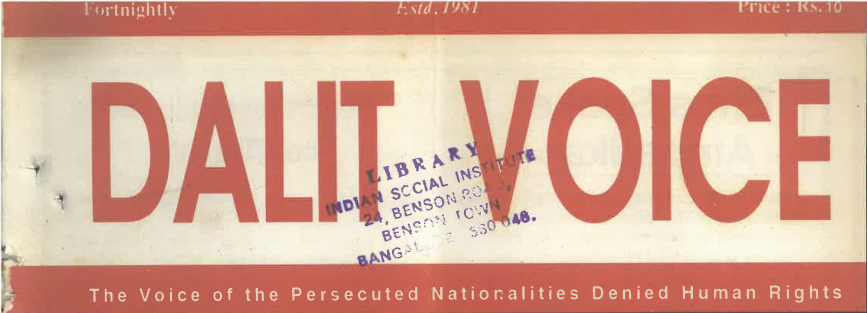
Dalits (Untouchables) who together with Tribals constitute over 30% of the Indian population of 1,000 million did not so far have an organ of their own in English with an all India circulation until Dalit Voice was launched in 1980.
Because of this big handicap Dalits in one part of India did not know what is happening elsewhere due to the language barriers. Even Dr. Babasaheb B.R. Ambedkar, the Saviour of the Untouchables, was known to only a selected few Dalits in India. His books were read by still less. Dalit movement, therefore, could not gain strength because of all these handicaps. And India’s ruling upper castes (Aryans) wanted this situation to continue, even while putting all sorts of hurdles to check the Dalit movement.
UNIQUE FEATURE
A big communication breakthrough was achieved with the launching of the Dalit Voice in 1980-1981. The beauty of Dalit Voice is that though it bears the name of Dalit, it is the “Voice of the Persecuted Nationalities Denied Human Rights” which is also its subtitle. The secret of DV’s popularity is that it fights for the entire Bahujan Samaj comprising Untouchables (20%). Tribals (10%), Backward Castes (35), Muslims (15%), Christians (2.5%), Sikhs (2.5%). All these six segments constitute the original inhabitants of India and together they form over 85% of the Indian population. Hence, the significance of its subtitle. This is unique because every journal in India caters only to one of this six sections while DV covers all the six giving it an all-India sweep.
SHIFT TO DELHI
The popularity of the journal can be made out from the fact that within an year it launched a Tamil edition, Dalit Kural, from Madras, Dalit Voice has circulation all over India and almost every major country in the world. Edited by a noted journalist and writer who had worked for 25 years in different “national” English dailies in Bombay, Delhi and Bangalore, Dalit Voice, a fortnightly, is being regularly published for the past 20 years.
In 1998, it shifted its office to the capital of India because that is where leaders of all national organisations are located. Since DV has now become India’s oldest and the largest circulated journal of the Bahujans, Delhi will be the natural choice for its office. Besides, Delhi is the heart of the Aryan world from where all the problems flow to the rest of India.
Many major academic, research institutions in India and abroad are subscribers of the journal including some of the important libraries. In many important cities, Dalit Voice Readers Forums are formed to discuss what is appearing in the DV.
INTERNET EDITION
In Japan, a group of people are translating Dalit Voice into Japanese and bringing it as a monthly newsletter. In Germany, DV is duplicated and distributed to different universities. An Internet. edition of DV is planned by our readers in West.
The secret of the popularity of Dalit Voice is its unique Editorial policy. It neither supports an individual nor criticises anybody except on ideological issues. Nor it is the organ of any political party. It is not the mouthpiece of any organisation. It is not only against every “national” political party but maintains that socio-cultural revolution has to precede political revolution. This stand is fully in conformity with the thoughts of Dr. Ambedkar.
POVERTY IS NO PROBLEM
The problem of Dalits or any other persecuted nationality in India is not poverty. If the Dalits, Tribals or any other segment is “poor”, this poverty is caused by deprivation. Its human rights has been robbed. Restore its human rights (reservation) in proportion to its population, every section will automatically recover and become rich.
The problems of India, essentially caused by the nationality question, cannot be solved through political changes, not even through economic changes but only through social and cultural transformation.
DV is the one and the only journal in India to discover that loss of cultural identity is the cause of deprivation. Hence every nation “has to search for its roots and strengthen it. Only then it will get strength to fight its oppressors.
Hinduisation of all these six oppressed segments of India is aimed at destroying their identity. India is not a “nation” but a country of hundreds of “nations”. And what is called caste or subcaste comes nearest to the concept of “nation”.
GANDHIAN HUMBUG
The Hindu nazi rulers of India hate DV only because it is waking up the sleeping giants and strengthening their roots (identity).
DV is not only critical of the Gandhian approach but also of Indian communist parties. In fact, the Left movement poses a greater danger to the Dalits and other persecuted nationalities as the Indian Left parties are also controlled by the upper castes. While it is critical of the Indian Left parties, it fully supports the marxian philosophy which was improved upon by Ambedkarism. DV was the first in the country to divide the upper caste rulers into two: “Socialist Brahmins” and “Sacred Brahmins” and declare the former as more dangerous.
Because of this unique and jet refreshing editorial policy, DV has cut a new line of thinking inspiring a large number of Dalit intellectuals. It appeals to Muslims and other “minorities” as well. A large number of Jesuit priests have taken a great fancy to DV.
NO ADVERTISEMENT
Muslims as the single largest persecuted community of India have taken to DV in a big way because there is no non-Muslim journal in India to speak for them. Many Muslims have declared DV as a better Muslim journal compared to others.
At the same times DV has found out that the elite Muslims comprising less than 5% of community is checking the revolutionary fervour of the oppressed Muslims mainly fired by the “Spirit of Islam”. In fact, dividing Islam into “Rituals of Islam” and “Spirit of Islam” is the unique contribution of DV. That is why DV has a great appeal for revolutionary Muslims world- wide.
DV is actively involved in the movement of the Backward Castes who constitute over 35% of the Indian population. Many articles and Editorials of DV on the Mandal Report have received wide attention.
Radical Christians are also attracted to DV because of its bitter criticism of the upper-caste-controlled Church. DV criticises the church on two counts. No. 1. church is not only encouraging caste division inside it, but segregating the Untouchable converts. Besides, (2) the Church through its educational institutions and hospitals is serving the needs of India’s rich, meaning the upper castes neglecting the needs of the “poor”-mainly the Dalits. DV was the first in India to take up the cause of Dalit Christians who constitute 80% of the Christian population.
Started with a modest capital of Rs. 10,000 and no big business or political party support, DV never became a commercial proposition as it did not get any advertisement either from the govt. or the private sector. For any publication, the revenue is from the advertisement and not circulation, in fact, more circulation means more loss. As DV is highly intellectual in content, it can hardly gain mass readership. That is why DV is still running at a loss though a part of the loss is covered by the sale of our books published by the Dalit Sahitya Akademy (DSA).
LINK-UP WITH BLACKS
Some of the DSA books are translated to Japanese, Chinese, German and French and many Indian languages. Some DSA books are out of print and some have gone into many editions. Though DV still has a small circulation, what is published in it is not only translated and reproduced in several Indian language journals of the Dalits and minorities but reproduced in some English journals also. Each copy of DV is read by a minimum of six persons.
DV is being published in six Indian languages Hindi and Punjabi (Delhi), Marathi (Pune), Telugu (Hyderabad), Malayalam (Cochin), Oriya (Bhubaneswar).
The most important attraction in the DV is its Editorial. A back issue of the DV (Rs. 10 a copy annual subscription Rs 200), is sometime sold at Rs 20. Bound volumes of DV are available and scholars, mainly foreign, are its customer. Though still confined to a subscriber-oriented service, DV is also sold in newsstands.
Social scientists and researchers a profession gaining in importance – have found in DV a rich source for analysing the different social, economic, political and religious developments.
Outside India, DV has established an international network by trying to link up the struggle of the Untouchables of India with the African-Americans in USA, Burakumin of Japan, Aboriginals of Australia, Palestinians, French- speaking Canadians.
The Chinese have taken a great liking for DV. Many foreign social scientists specialising on India, like Dr. Barbara Joshi, Lelah Dushkin, Arthur Bonner, Marc Galanter, Gail Omvdet, Jan Myrdal (Sweden), Leon Poliakov (France) are great admirers of Dalit Voice. Amnesty International, Minority Rights Group, International League of Minorities and many other human rights organisations are collaborating with DV. Dalit Sahitya Akademy and DV are recognised as one among the few human rights organisations in India. Many foreigners after reading DV have confessed that they got an entirely new vision of India, correcting many of their previous beliefs.
DV circulation is still small. No intellectual journal can claim mass circulation in India particularly because of the expanding intellectual desert. But considering some of India’s scholarly journals, DV is doing much better.
Hence its modest circulation is indeed big considering the terrible hostility it faces from the ruling upper castes and its total blockout in India’s national toilet papers.
But India has no journal exclusively devoted to social issues. There are any number of journals to analyse economic issues but none for social and cultural issues. It is not in the Interest of the ruling class to publish social problems. Dalit Voice is the only one dealing with social issues and that is why the ICSSR Annual Documentation carries a half-page advertisement on its cover page recommending DV to all Indian and foreign social science institutions.
FRESHNESS & FRAGRANCE
Hindu nazi ideologues keep a strict watch on DV and our books. They say they learn more about India, its problems including developments inside their own organizations only from Dalit Voice. That is why DV has good many subscribers from among the Hindu nazi circles also though in some places DV copies are purchased and destroyed. This happened mainly at Nagpur, Pune, noted RSS centres, and also Trivandrum. Once several hundreds of copies were missing in postal transit. All sorts pinpricks including threats to the Editor are. continuing. The beauty is DV is facing problem both from the Right and Left.
All this is because DV is a new experiment in Indian journalism, breaking an entirely a new path. Our Aryan ruling class never allows any new thinking that challenges the brahminical value system. DV has challenged this stereotype and blazed a new trail in Indian journalism. Hence its freshness and fragrance.
ELITE DALITS
In a country where less than 10% of its population is English-speaking and not even half of this take the trouble of buying and reading an English journal, that too an intellectual journal, we can very well imagine the uphill task facing the Dalit Voice which has its readership mainly from among the newly- educated Dalits.
Even this tiny section of Dalits having turned elite rarely bothers about what is happening in the country. Whatever it is, DV is able to discover the most dedicated among them and win the confidence of a large section of Dalits.
DV has been able to bring about such a miraculous transformation in the outlook and life-style of these Dalits that DV subscribes today call themselves one single family. It is the DV family world-wide. They have become so close.
However, DV is facing one serious dilemma. If all its subscribers had promptly renewed their subscriptions by this time the circulation would have crossed over 50,000. As every day new subscriptions are pouring in, old ones are getting lapsed. This is the main worry facing DV.
So much so, the circulation is almost static. Some experts say this is only a passing phase. Once DV takes off, it is sure to gain speed Whatever it is, DV has a big future as more Dalits and persecuted minorities are bound to wake up with the passing of time.
MONOPOLY OVER ENGLISH
The ruling class is bent upon denying English knowledge to the people. While it sends its children only to English schools, it will continue to tell the “poor” that English is a foreign language and they should not study it. Dalits must blast this myth and consider English as the language of India.
But none of these tricks will work because inside the ruling class itself there are divisions. Coming days, will be full of violence and bloodshed. National and sub-national feelings are bound to tear up the country to pieces. Caste has acquired new power and muscles. Caste itself is turning into a “nation”. “Caste identity is developing very fast. All these are the theories propounded in DV.
The ruling class, whose properties and privileges will come under micreasing attack, will have to unleash more and more violence which in turn will only help sharpen caste and class contradictions. DV will have to shortly change over from a fortnightly to a weekly. besides increasing its pages and layout, to cope with this new situation and rising consciousness.
DYING DAILIES
The most important impact of DV’s new experiment in Indian journalism is that well-established “national” dailies and periodicals are dying. Country’s biggest dailies and journals are selling their products like soap or any other consumer items inducing readers with a plethora of gifts. This is because India’s tiny English-speaking ruling class is solely preoccupied with entertainment, sports, religion, drink, eating, sex, crime, politics, godmen and gossip. They expect the media to cater to their animal instincts. So, today media is full of such trash. And as days pass trash and trivia alone will be sold. DV is a new experiment in Indian journalism and hence it will be its future media. Bahujans must get ready to welcome the 21st century: Dr. Ambedkar Era when DV will take over.