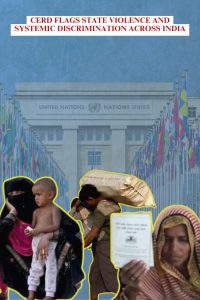
The UN Committee on the Elimination of Racial Discrimination (CERD) has raised serious concerns over the treatment of some of India’s most marginalised communities, including Dalits, Adivasi and tribal peoples, Rohingya, Bengali-speaking Muslims, migrants and asylum-seekers. Its findings follow the first review of India by the Committee since 2007 and examine the country’s combined 20th and 21st periodic reports under the International Convention on the Elimination of All Forms of Racial Discrimination.
The findings were issued after CERD’s 118th session, which also examined Finland, Honduras and Kuwait. This was part of the Committee’s regular review of states that have signed the Convention. CERD’s concluding observations are not court judgments and do not have the force of law. They assess how governments are implementing their obligations under the Convention and identify areas where the Committee finds serious problems.
In India’s case, CERD raised concerns spanning caste, ethnicity, religion, citizenship and policing. One of its gravest concerns was the alleged conduct of law-enforcement agencies towards Indigenous and Tribal Peoples, Scheduled Tribes, Scheduled Castes, particularly Dalits, ethnic and ethno-religious groups and non-citizens. CERD recorded reports of excessive force, racially motivated violence, extrajudicial killings, arbitrary and prolonged detention, torture, ill-treatment and sexual violence. It called for prompt, thorough and impartial investigations, with accountability where violations are established.
The reference to Dalits and Scheduled Castes also brings an older disagreement into the review. The Indian government maintains that caste should not be treated as equivalent to race or “descent” for the purposes of CERD. Its submissions nevertheless contain information on Scheduled Castes and Scheduled Tribes and measures intended to address their disadvantages. CERD’s treatment of caste within its examination of descent and discrimination places caste exclusion within the scope of the Committee’s scrutiny, even as the Indian state rejects that equivalence.
CERD also drew particular attention to Rohingya, Bengali-speaking Muslims, migrants and asylum-seekers. It noted an increase in law-enforcement operations involving these groups, particularly after a 2017 Home Affairs order and the April 2025 Pahalgam attack. Reports of police stops and identity checks based on racial profiling allegedly resulted in arbitrary arrests and detention, torture and other mistreatment. The Committee also raised concerns about deportations and forcible returns involving people who may require international protection.
During the review, CERD Country Rapporteur Stamatia Stavrinaki referred to independent monitoring that recorded more than 1,300 anti-Muslim hate-speech incidents in 2025, including recurring rhetoric attributed to senior officials. India’s delegation responded that legislation enacted in 2023 criminalises acts amounting to hate speech and hate crimes, with additional protections applying when offences target Scheduled Castes and Scheduled Tribes. It also pointed to freedom of religion as a constitutional guarantee.
But CERD’s observations focused on what these protections mean in practice. Alongside the government’s account of its legal safeguards, the Committee recorded concerns about discrimination, hate speech, violence and the conduct of law-enforcement agencies. It called on India to address hate crimes against Rohingya, Bengali-speaking Muslims, migrants and asylum-seekers, refrain from collective expulsions and ensure access to international protection. This includes respecting non-refoulement, the principle that people should not be returned to a place where they face a serious risk of persecution or other grave harm.
The findings also address citizenship and documentation. CERD noted the absence of adequate disaggregated data on Indigenous and Tribal Peoples, ethnic and ethno-religious groups, migrants, refugees, asylum-seekers and stateless people. It highlighted the categorisation of Bengali-speaking Muslims as “non-original inhabitants” and reports that they face more stringent scrutiny during National Register of Citizens verification. The Committee also noted that much of India’s available data on Scheduled Castes, Scheduled Tribes and refugees still derives from the 2011 Census, while acknowledging the delayed 2026 Census and its proposed collection of caste data through self-identification.
The treatment of Bengali-speaking Muslims in the NRC process raises a broader question about how citizenship is administered. CERD’s concern is not simply that documentation is required, but that particular ethnic and religious groups are reportedly subjected to different levels of scrutiny. In a political environment where Muslims are repeatedly cast as outsiders or demographic threats, administrative categories such as “non-original inhabitants” can acquire consequences beyond paperwork. The NRC thus becomes part of a wider system in which belonging is subjected to heightened state verification.
The concerns around Rohingya also sit within a longer history of UN scrutiny. A 2025 communication by UN Special Procedures carried allegations that deportation operations against Muslims, including Rohingya, intensified after the Pahalgam attack, involving raids, arrests, ill-treatment and forcible returns. Those allegations came through a separate UN process and were not findings by CERD or a judicial determination.
India is not a party to the 1951 Refugee Convention or its 1967 Protocol and has no comprehensive national refugee law. UNHCR therefore carries out protection-related functions for refugees and asylum-seekers in the country. This absence has become more significant alongside changes to India’s citizenship and immigration regime.
The Citizenship (Amendment) Act, 2019 was defended by BJP ministers as addressing the unfinished business or “wrongs” of Partition. Yet the CAA was not a refugee law. It created a religion-based route to accelerated citizenship for specified non-Muslim communities from Pakistan, Bangladesh and Afghanistan. It did not establish a general system of refugee protection based on persecution or the risk of serious harm.
And in 2025, Parliament enacted the Immigration and Foreigners Act, replacing four earlier laws governing the entry and treatment of foreign nationals. The new law consolidated the state’s immigration powers without creating a corresponding refugee protection framework. CERD’s call for protection against collective expulsions and respect for non-refoulement therefore comes alongside a strengthened legal machinery for controlling and removing foreign nationals, while India still lacks a dedicated process for determining who requires refugee protection. For Rohingya and other asylum-seekers, that leaves a basic question: what domestic procedure requires the danger they may face after removal to be considered before the state deports them?
India’s delegation, led by Solicitor General Tushar Mehta, defended the country’s legal framework and its claims of pluralism and equality. The government reiterated its position that caste should not be equated with race or “descent” under the Convention and pointed to legislation addressing hate speech and protections for Scheduled Castes and Scheduled Tribes.
CERD’s findings place those claims alongside reports of how state institutions operate on the ground. The Committee’s concerns cover law-enforcement violence against Dalits and Adivasi and tribal communities, anti-Muslim hate speech, racial profiling of Bengali-speaking Muslims and Rohingya, and the treatment of people whose citizenship or immigration status is under scrutiny.
For Dalit and Adivasi communities, and for Muslims and other minorities whose belonging is increasingly subjected to state scrutiny, the findings also expose how Hindu nationalism operates through state power. Caste discrimination, communal targeting, citizenship enforcement and policing are often treated as separate questions, even as they converge in the lives of communities whose relationship with the state is shaped by unequal power. CERD’s observations bring these questions into the same examination of discrimination and direct attention towards the institutions through which unequal treatment is carried out.