
The Heuristic That Ate Itself: On the Guardian Open Letter, Campism and the Left’s Historical Amnesia

An open letter published in The Guardian on 20 August, addressed to Iranian political prisoners, was signed by scholars, intellectuals and activists whose work has long been respected across the left and progressive movements. It named the torture and executions carried out by the Islamic Republic, named the airstrikes carried out by the United States and Israel, and used an image the letter said came from the prisoners themselves: caught between two blades of a scissors, cut from both directions at once. The letter closed with two demands. Stop the executions. End the war.

The response to the letter is more interesting than the letter itself. A cluster of criticisms converge on a single move, stated with varying degrees of bluntness but always amounting to the same claim: solidarity of this kind is a category error. If you live in the West, your only legitimate object of criticism is your own government. Not Iran. Not the state doing the executing. Your voice belongs to your own empire and nowhere else, and to spend it elsewhere is not just misdirected but complicit, a way of dressing up imperial propaganda as conscience.

Noam Chomsky, one of the most popular public intellectuals and critics of the US, did more than anyone to give this argument its intellectual respectability. He is not, by temperament or by many of the other commitments he holds, a natural ally of the people invoking this argument today, and yet he is a strong defender of its underlying principle. Chomsky’s argument begins as a consequentialist one: your ethical responsibility tracks the predictable consequences of your actions, and since a citizen can usually exert more influence over their own government than over a foreign one, that is where their political effort should primarily go. He illustrated the principle through Soviet dissidents such as Andrei Sakharov, whose criticism remained focused on abuses by the Soviet state rather than extending to every atrocity in the world. Chomsky himself acknowledged that he sometimes criticised official enemies and had even assisted dissidents from the Soviet Union and Eastern Europe. The argument, then, was not simply that people have no right to criticise foreign states, but that their political energy should be directed toward the violence they can actually affect. He pushed the principle further, however, and this is where it becomes more consequential: criticism of an enemy state could itself become morally irresponsible if its predictable effect was to help one’s own government justify further violence. Accurate criticism of Cuba, for example, might be true while still contributing to the suffering caused by the US embargo; his hypothetical Soviet dissident who truthfully documented atrocities by Afghan resistance forces might similarly help the Kremlin justify its war. At that point, the argument stops being merely about where to concentrate one’s efforts and becomes a principle about what should sometimes be left unsaid: a true thing can become the wrong thing to say if the wrong people are likely to benefit from hearing it.

The pitfall of this principle was not merely theoretical. It showed up in Chomsky’s own record, twice, in ways that closely track the logic of the principle itself. Writing on Cambodia in the late 1970s, Chomsky and Edward Herman urged skepticism toward refugee accounts of Khmer Rouge killings, on the grounds that the reporting was disproportionate to the attention given to comparable US-aligned violence; the Khmer Rouge went on to kill an estimated 1.5 to 2 million people. Two decades later, he took a similarly sceptical position toward accounts of atrocities committed against Bosniaks during the Bosnian war, including the Srebrenica genocide, in which more than 8,000 Bosniak men and boys were killed. He (along with our very own South Asian Arundhati Roy and Tariq Ali among others) defended Diana Johnstone’s revisionist account of the war and supported claims that Western journalists had fabricated or seriously misrepresented their reporting on Serb-run detention camps, claims that had already been rejected in court. Both cases show the same problem: a consequentialist principle about the effects of political speech ended up making the political usefulness of true accounts of someone else’s atrocities a reason to treat those accounts with suspicion.

It’s worth taking this history seriously, because it’s less a coincidence than a demonstration. The same logic keeps slipping, almost imperceptibly, from one claim into the next.

The first step is real. Having more leverage over your own government than someone else’s is real. You vote in it, fund it, can plausibly move it through pressure that actually reaches somewhere. That’s just a fact about where political effort tends to have leverage, given the accident of birth. But somewhere along the way it turned into something else: having more pull over your own state became a reason to treat criticism of anyone else’s as out of bounds entirely. Having more influence over one thing doesn’t mean you lose standing to speak about another, and yet that’s the leap the argument keeps making without ever justifying it.

The second step compounds the first. Spending less effort on a foreign government’s abuses because your own effort is better spent at home starts as a practical decision about your time. Left alone long enough it curdles into a belief about how much scrutiny that government actually deserves, independent of who’s doing the scrutinizing or from where. A fact about your own limited attention gets quietly repackaged as a fact about the state being judged, and the state ends up getting let off the hook by an argument that was never really about the state at all.

And finally, the rule keeps growing past its own foundation. Something that might genuinely make sense as one person’s approach to spending their own limited energy gets stretched until it’s presented as a rule for an entire movement to follow, not just for US citizens but for the whole world. A movement isn’t one person with one passport and one government they’re answerable to. It’s full of people across the world including India, Russia, South Africa, Palestine, and Iran itself. What started as a reasonable habit for managing your own attention ends up functioning as an argument for other people’s silence.

The three-step slide is simple: leverage-based emphasis becomes leverage-based exclusivity; exclusivity of effort becomes exclusivity of moral attention; and individual leverage becomes movement-wide priority.

The truth is that the rule does not actually depend on the letter’s signatories being Western or American. If the same position came from Iranians themselves, or from people elsewhere in the Global South, the objection would not disappear. It would change its vocabulary: comprador, foreign agent, native informant, terrorist sympathizer. The charge would still be that they had crossed some line of political loyalty by naming repression committed by a state positioned against Western power. The label changes, but the function does not. What is being policed is therefore less where someone comes from than whether they remain within the political narrative assigned to them. Once they step outside it, they can be rhetorically moved into the enemy’s camp, regardless of their politics, their country, or the people whose interests they are actually speaking about. The reaction to non-Western people endorsing the letter makes this especially clear, as does the effort to discredit the prisoners themselves by scrutinising who they are and the charges under which they are imprisoned. Nor does the logic depend on the conflict being in a particular phase. If the same repression were discussed before a war, after a ceasefire, or when there was no immediate military confrontation, the objection could simply be attached to the next arena of imperialist struggle. If geopolitical struggle is treated as permanent, there will always be a larger enemy available to make scrutiny of its adversary seem untimely, divisive or useful to the other side. The question then becomes less whether a claim about repression is true than whether saying it is acceptable within the prevailing geopolitical alignment.

What emerges is a corrupted heuristic dressed up as a principle. Underneath every step of it sits the same problem: the rule swaps out the actual reason to criticise a government, that it is causing harm, for considerations that are irrelevant to the harm itself: whether it happens to be yours and how close you are to it. Political proximity can affect where your effort is likely to have an effect, but it does not determine which suffering deserves scrutiny or solidarity. Political proximity can affect where your effort is likely to have an effect, but it does not determine which suffering deserves scrutiny or solidarity. Once those things are treated as the same, the rule can exempt any government whose repression falls on a population fighting an external enemy, regardless of what that repression looks like or how far it goes. The same logic appears on the other side too: American and Zionist apologetics invoke the threat posed by an enemy to justify violence carried out by the United States or Israel in the name of fighting that enemy. The camps differ, but the reasoning is familiar: the enemy’s conduct becomes the measure by which the violence of your own side is judged. The enemy’s existence becomes an alibi, and because geopolitical struggle is treated as permanent, that alibi can be renewed indefinitely. The timing changes, the conflict changes, the enemy changes, but the logic survives. None of this is new, and it has a name.

The term is campism. It describes a politics in which geopolitical alignment becomes a basis for moral judgment, so that the position a state occupies in a wider struggle matters the most. A state can receive political sympathy, or escape scrutiny, because it is understood to be resisting a more powerful enemy. The term comes from the Cold War, when the world was commonly understood through opposing political and military blocs, but the habit survived the end of those blocs. It reappears whenever opposition to a dominant power, usually the United States and its allies, becomes the organising framework for political judgment. The conduct of that power’s adversaries is then assessed in relation to the enemy they are confronting rather than on its own terms. The political problem becomes what to do when those adversaries commit their own atrocities, and the account campism tends to reach for is: look elsewhere, or don’t look at all.

Its cousin, tankieism, a specifically Leninist variant of campism, has an even more literal origin. British and other communists who defended the Soviet Union’s decision to send tanks into Hungary in 1956, and again into Czechoslovakia in 1968, to crush uprisings against Soviet-aligned governments, came to be known as “tankies” for that very position: support for the tanks because they belonged to the right side, the red side. The word outlived the regimes it was coined to describe. China, which continues to identify itself as socialist and is governed by a Communist Party, produced its own enduring image of the tension the term evokes when the 1989 Tiananmen Square crackdown became associated with the photograph of a lone protester standing in front of a column of tanks. Today, “tankie” is applied more broadly to people who reproduce the same political reflex around other states. Support for repression, conditional only on which flag is doing the repressing.

Both words matter because naming a pattern lets you recognise it when it appears again, without having to relitigate the same argument from scratch. Each time this argument resurfaces around a new state and a new atrocity, whether in Syria, Venezuela, Ukraine, Hong Kong or Iran, many earnest people treat it as a fresh, good-faith concern about Western hypocrisy, as though the argument has no history and has to be answered again on its own terms.

But the cacophony of campism isn’t fresh. It has a track record, a genealogy, and a mechanism, and that mechanism has appeared in more than one form.

Sometimes it is the anti-imperialism of fools: a real opposition to Western domination gets funnelled into political indulgence toward any state positioned against it, until the enemy of your enemy acquires an immunity from scrutiny of its own. The history of the Iran-Iraq War offers a particularly clear example. Some sections of the Western left initially rejected both states as rival regional powers, then shifted toward support for Iran as the United States increasingly backed Iraq. The position changed with the geopolitical alignment; what remained was the need to oppose whichever side Washington was supporting.

Sometimes the distortion runs in the opposite direction: the world is still read through geopolitical camps, but the preferred camp changes. The Sino-Soviet split showed how quickly an anti-imperialist politics could reorganise itself around a new principal enemy. As relations between China and the Soviet Union deteriorated, sections of the Maoist left came to see the Soviet Union as the greater threat and adjusted their politics accordingly, in some cases arriving at positions that converged with American strategic interests. The geopolitical alignment had changed, but the underlying habit remained: the conduct of states was judged through the position they occupied in the wider struggle between powers.

And sometimes what remains is hollow anti-imperialism: a politics that continues to speak the language of liberation while treating the actual conduct of states as secondary to the bloc they are imagined to belong to. Iran, which presents itself as a central opponent of Western and Israeli power, has supplied Myanmar’s military junta with jet fuel used in its air campaign. States routinely cross the ideological boundaries that political movements draw around them, buying, selling, supplying, funding and arming wherever strategic interests require it. The problem begins when anti-imperialism stops being a politics against domination and becomes a system for deciding whose domination counts. This is also what the Guardian letter hints at by invoking similar techniques and logics of domination even when the states exercising them occupy radically different positions in the international order.

In the more sober accounts that end up duping non-sectarian leftists and progressives, the corruption lies in the principle itself, whose three-step slide remains underneath it all: emphasis into exclusivity, effort into attention, individual scope into collective doctrine. The historical amnesia is part of the mechanism. Each new geopolitical crisis is treated as though the same argument has arrived without a history, detached from the cases in which it has already produced its predictable evasions and distortions. What looks, on any given occasion, like a principled objection to Western moral overreach is often the latest version of a much older habit of allowing geopolitical position to determine who gets to be seen as a perpetrator and who gets to remain the object of solidarity.

None of this requires deciding the Guardian letter was a strong piece of writing. It is a short open letter to prisoners, not a political history of the war or an accounting of the relative power, culpability and geopolitical position of the states involved. Of course it does not contain the kind of distinctions or elaboration that a longer political argument would require. That makes it basic. It does not make the underlying point false. The scissors image is not false equivalence simply because it places two sources of violence in the same frame. A person can be subjected to repression by their own government and violence by a foreign power at the same time, and recognising that simultaneity does not require pretending that the two states are identical, that their histories are interchangeable, or that their forms of power are equal. The person caught between the blades does not experience one violence as an argument against recognising the other. Both are happening. That is the point of the image, and it is a perfectly intelligible point even if the image is too simple to carry the full political analysis surrounding it.

There’s a separate matter sitting alongside all this. Campists and tankies leaning on academics and intellectual signatories until some walked their names back, letters going out in different versions before anyone signed, the actual source of the prisoners’ quote never being pinned down: these are real issues and worth scrutinising, but they are essentially irrelevant to the broader politics of internationalism and anti-imperialism. Treating them as though they settle anything about the letter’s content is itself a move worth watching for. Even in a perfected history of how the letter came to be written, free of every one of these problems, this barrage of responses would not disappear. Saying that a letter has no standing to name a second source of harm at all is not the same as pointing out that it left something, many things, or even everything unweighed. The two criticisms can sound alike because both can be phrased as objections to what the letter did or did not say. But the first is a much larger claim wearing the smaller one’s face.

This does not settle what solidarity should actually attach to, but that question is often orthogonal to the political and ethical concerns of this mutated and cursed discourse. Governments invoke the language of liberation selectively, and alliances shift with whatever circumstance makes them convenient, not because leaders on any side are unusually dishonest, but because states are not built to carry emancipatory politics in the first place. They were built through war-making and control, and that orientation doesn’t disappear because a state happens to be on the weaker or more sympathetic side of a given conflict. Sovereignty, in this light, is not a moral trump card. It structures international law, but its violation or preservation doesn’t by itself settle whether a conflict is just, and a formally lawful war can still produce devastation while an unlawful act can still arise from real and grinding injustice. None of that licenses indifference. It means solidarity has to be aimed at the people bearing the cost of a conflict rather than at whichever government currently claims to speak for them, because a government’s claim to represent the suffering of its people is not the same thing as actually relieving it, and conflating the two is how solidarity with prisoners turns into solidarity with whoever is holding the keys.

If expressing solidarity with Iranian political prisoners alongside opposition to American and Israeli aggression is supposed to somehow launder that aggression, then the charge has already abandoned the letter it claims to be criticising. The letter names American and Israeli violence alongside the violence of the Iranian state. The argument against it therefore rests on a simple but contestable leap: that acknowledging one source of violence somehow lends legitimacy to another. At that point, the problem is no longer the letter but a politics so thoroughly organised around reaction that it has ceased to have independent values. Its political judgment is instead organised around what a statement might signal, who might appropriate it, which enemy might benefit from it, and how it might be made to look once stripped of context. What presents itself as vigilance against imperial propaganda becomes political PR thinking with better branding: a reactive politics that has mistaken anticipating the enemy’s narrative for having a politics of its own.


Paresh Hate is a Bahujan queer researcher, writer, documenter and activist and the Lead Content Manager at Dalit Voice.


Editorial note: This essay does not represent every position historically associated with Dalit Voice or its founding editor, V. T. Rajshekar. His international politics was rooted in solidarity with oppressed peoples, but at times treated geopolitical alignment as central to political judgment, an approach critically examined in this essay. The present editorial direction takes a different view. We retain deep respect for Rajshekar’s contribution to anti-caste thought and journalism while recognising that intellectual inheritance does not require agreement on every political question.
Everything is an Opportunity

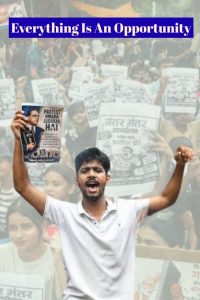
The protests against the irregularities and paper leak in the NEET examination brought thousands of students, parents and supporters onto the streets. The scale of participation, including the visible presence of sections of the middle classes, public figures and artists, reflected a growing willingness to challenge institutions that many increasingly perceive as opaque and unaccountable. That widening participation deserves recognition. It signals that concerns over public education are no longer confined to those who have historically borne the burden of institutional failures.

Yet the state’s response once again demonstrated a familiar pattern. Lathi charges, water cannons, tear gas, detentions, surveillance and criminal cases against protesters indicate that even peaceful demonstrations continue to be treated through the language of policing rather than democratic engagement, no matter how much the protesters try to facilitate dialogue. The violence of the state is not merely reactive to dissent; it is constitutive of its authority and often pre-emptive in its operation. By acting before grievances can acquire wider political legitimacy, it seeks to cast suspicion upon and diminish the credibility of citizens’ claims. Such responses are not isolated excesses but part of a broader tendency in which coercive measures take precedence over any meaningful assessment of public grievances. This pattern is all too familiar for the Muslims, Dalits, workers, and other oppressed communities in the country now. It is no wonder that many of them continue to remain skeptical of this movement even as they lend their solidarity.

The protests have also unfolded within a now routinised political script. Peaceful public mobilisation quickly became an opportunity for the mainstream Godi media to manufacture misinformation, while the state treated the moment as another justification for expanded policing. The original concerns were steadily displaced in newsrooms by manufactured debates over alleged anti-nationalism and public disorder, even as protesters have taken to social media to repeatedly redirect attention to the issues that first brought them to the streets.

Recognising this reality, however, also requires asking difficult questions of protest movements themselves. Large numbers are not only a measure of organisational success; they are also a political responsibility. Every mass mobilisation creates a temporary public capable of imagining new forms of solidarity and new political possibilities. Leadership therefore involves more than maintaining order or ensuring that a demonstration appears respectable. It also involves shaping how participants understand the broader structures within which their immediate grievance exists. But the organisers from CJP have recently shown a remarkable abdication of this responsibility, even as they may be doing so with sincere efforts to protect the movement.

Over the last decade, many protests have come to treat the expression of dissent as an end in itself. In a political climate where public assembly is increasingly surveilled and criminalised, simply occupying the streets and making disagreement visible has acquired democratic significance. That impulse should not be dismissed. But if protests are to aspire to more than bearing witness, they must also confront the difficult question of what political consequences their strategies are intended to produce. The NEET protests, however, did not appear content with symbolic dissent alone. The CJP seems to have approached the movement through a strategic lens, making choices that they believed would improve its chances of achieving concrete outcomes. That is a welcome departure.

The question is whether that strategic calculation expands or contracts the political horizon of the movement. The current strategy of CJP and other organisers does not merely reduce immediate risk; it also diminishes what that movement is capable of becoming. The logic of this strategy leads us towards an ever-receding political horizon, where each concession made in the name of prudence leaves less space for political imagination than the one before. This is where the limitations of a politics centred primarily on respectability become apparent. In the effort to appear reasonable, the strategic moderation may ultimately concede more ground than it preserves. The state does not necessarily refrain from coercion because a movement carefully disciplines itself. Recent history offers little evidence for such confidence.

Many of the choices made reflect a strategic calculation about what constituted acceptable dissent. Expressions of solidarity with incarcerated activists such as Umar Khalid and other Muslims facing prolonged imprisonment were rejected. Attempts to build common cause with other democratic movements such as farmers coming to Delhi on 22 July were resisted, with suggestions that different protests remain physically and politically separate. Participants were instructed on which slogans were permissible, even as some of the approved slogans drew upon nationalist idioms that have, over the last decade, become closely associated with Hindutva politics. The movement also declined to articulate a broader political critique of fascism and majoritarianism or the present government’s treatment of democratic dissent. This was not simply an omission of rhetoric; it marked a refusal to locate the immediate crisis within the wider political conditions that shape how public institutions function and how protests against them are received. Its demands also remained underdeveloped at the structural level. The crisis invited a broader interrogation of the National Testing Agency as an institution and of the direction of educational reforms under the National Education Policy by this government. Instead, the movement largely remained confined to the immediate failures surrounding the paper leak. Many of these suggestions have been made by leftist members of the movement who have been foregrounding these demands for years.

The movement’s current demands combine institutional accountability and immediate relief. They have called for the resignation or dismissal of Union Education Minister Dharmendra Pradhan, the immediate release of Sonam Wangchuk without restrictions on his movement, compensation of ₹1 crore for the families of NEET aspirants who died by suicide following the paper leak, and the withdrawal of all FIRs and legal action against those who participated in the July 20 protest. These are necessary demands, and each deserves to be pursued. But they cannot be mistaken for a sufficient response to the structural crisis of India’s education system. If these demands are achieved without an equally substantive agenda for what follows, the political leverage created by the protests risks dissipating before it can be translated into structural reform.

Equally troubling dynamics from the protest also must be interrogated. The willingness to hand over protesters deemed disruptive or excessively angry to the police without publicly articulating clear criteria for doing so is a decision that demands careful scrutiny. Any movement must protect participants from harassment and deliberate sabotage. But when those distinctions remain opaque, the police are effectively invited to regulate the boundaries of acceptable dissent within the protest itself. Expanding police discretion over who belongs and who does not, in a context of police violence, carries significant political consequences.

Similarly, symbolic gestures such as serving refreshments or showing kindness towards police personnel may reflect genuine human concern, and recognising the difficult conditions under which many lower-ranking officers work is neither unreasonable nor incompatible with criticism. Yet these gestures cannot obscure the structural reality that the police operate as instruments of state power and are institutionally equipped with resources and authority unavailable to ordinary citizens. Empathy for individual officers should not come at the cost of depoliticising the institution they serve.

None of this diminishes the importance of the NEET protests or the courage of those who participated in them, including the organisers, who transformed what began as a meme page into one of the country’s most significant student mobilisations in the recent past. On the contrary, their significance lies precisely in the possibility they opened. The question is whether that possibility ends with registering public anger or extends towards building broader democratic solidarities capable of confronting the structures that repeatedly produce such crises. Every protest is liable to become an opportunity for the police to exercise violence, for Godi media to manufacture misinformation, and for the government to expand its coercive powers. These are calculations movements cannot control. What they can control is whether their own strategies continually retreat before them, or instead expand the political imagination of those who have come together in hope.

No Liberation Alone: The Call for Dalit-Muslim Solidarity

Over the last few years, the relationship between Dalit and Muslim identities has opened in ways that are both politically urgent and intellectually generative. Debates have multiplied: from the constitutional demand to extend Scheduled Caste status to Dalit Muslims and Dalit Christians—beginning with Ghazi Saaduddin v State of Maharashtra—to concerns over a National Population Register being introduced through the Census, even as the long delayed caste census has finally become feasible. From the disquiet around Bihar’s Special Intensive Revision of Electoral Rolls to the earlier specter of the National Register of Citizens, and from the renewed articulation of the Pasmanda Muslim movement to emerging solidarities across universities, each of these moments underscores how social justice politics in India must evolve to survive and flourish.

Across public universities, student alliances between Ambedkarite and Muslim organizations are emerging as fragile but significant experiments in political imagination. The 2019 Maharashtra Lok Sabha elections, where the Vanchit Bahujan Aghadi and the All India Majlis-e-Ittehadul Muslimeen briefly converged, were another testing ground for this idea of solidarity, even as the electoral results revealed both arithmetic limits and organizational shortcomings. Many dismissed these experiments as naive or opportunistic, while others argued that any genuine alliance could only emerge between Dalits and Pasmandas, not Dalits and Muslims as a whole. Yet such thinking misreads both the enemy and the terrain.

By narrowing the horizon of unity to internal gradations of caste within Muslim communities, it sidesteps the central problem of our time: Hindutva. Caste is treated as the only enduring structure of power, while the violent consolidation of Hindu nationalism, which weaponizes both religion and caste, is ignored. Yes, caste operates among Muslims, as it does among every community shaped by the subcontinent’s history. Yet for Hindutva, the Muslim remains the primary target, with Christians not far behind. Anti Muslim hatred is the binding glue of Hindu nationalism, while caste hierarchy is the adhesive that keeps its social base intact. The two reinforce each other.

The post-Mandal moment unsettled the upper-caste hegemony of Hindutva, both as response and effect. Its cadres are drawn from various castes and regions, yet their ideological unity depends on the fiction of a singular Hindu identity. That fiction is sustained by coercing lower-caste Hindus into complicity against Muslims and Christians. It is caste consolidation that forms the sustainability of ethno-religious nationalism, turning the oppressed into foot soldiers of their own subordination.

The everyday experience of violence, surveillance, and humiliation provides a point of convergence between Dalit and Muslim lives. Police encounters, custodial deaths, demolition drives, and denial of housing follow similar social logics. These are not random or isolated acts but techniques of governance designed to mark certain populations as permanently suspect. The language may differ—“illegal encroacher,” “anti-national,” “criminal tribe,”, “anti-Hindu”—but the state’s gaze is the same. Recognizing this continuity is not about comparing suffering but about mapping power and understanding how it operates across identity lines.

There is also a long history of deliberate attempts to divide these solidarities. Colonial administrators categorized and ranked communities, while postcolonial elites preserved graded inequality. Every ruling order has depended on preventing horizontal alliances among the oppressed. Today, the right continues this strategy, using identity politics as a tool of social management. The challenge for social justice politics is to reclaim identity as a site of collective resistance rather than as a source of division, and to do so in ways that link Dalits and Muslims without flattening the distinctiveness of their experiences.

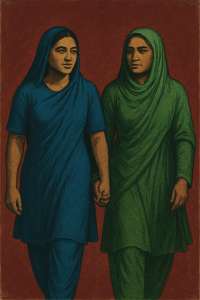
The fractures and mistrust between Dalit and Muslim communities have long been produced by the same structures that govern them. Electoral arithmetic, local competition for scarce resources, and social stigma have been used to keep these groups apart. Yet beneath these divisions lies a shared memory of exclusion and resistance that predates the current moment. Recognizing the legacy of figures like Savitri and Fatima, we must see Dalits and Muslims as fellow targets of the same social order. To rebuild this recognition today means confronting not only oppressive power but also the prejudices left behind in our own communities.

In recent years, cultural expressions have begun to reimagine this shared condition. Neeraj Ghaywan’s Homebound, based on Basharat Peer’s “A Friendship, a Pandemic and a Death Beside the Highway” for The New York Times, offers a striking instance. Set against the backdrop of the COVID-19 lockdown and the migrant crisis, the film traces a friendship between a Dalit man and a Muslim man navigating abandonment and precarity together. Their bond gestures toward a broader political question: what does it mean to build friendship as solidarity in a world determined to divide? To read their companionship politically is to see the possibility of a new ethics of alliance, one that emerges not from ideology alone but from shared vulnerability and mutual care, suggesting how friendship itself can become a form of resistance.

But Dalit–Muslim solidarity cannot remain an occasional alliance or rhetorical gesture. It must become a political project rooted in a shared understanding of power. The question before us is not whether caste exists among Muslims—it does—but whether we can build a politics that breaks both caste and communal domination. That is the only ground on which equality can stand.

V.T. Rajshekhar understood this long before it became a common slogan. Dalit Voice was not only a magazine but a platform insisting on Dalit–Muslim unity as the foundation of any real challenge to Brahminical and Hindu majoritarian power. He refused to treat these communities as separate constituencies; he saw them as parts of a single historical struggle against graded inequality and unfreedom. Reviving his project today means returning to that clarity of purpose, not by repeating his words but by extending his political vision into the realities of our time—where digital surveillance, economic exclusion, and organized hate have replaced older instruments of control. To build on his legacy is to keep the idea of Dalit–Muslim solidarity alive as both strategy and ethics, a politics that seeks not coexistence but collective liberation.

Writing this for the revival of Dalit Voice matters because V.T. Rajshekhar’s work spoke directly to this entanglement, and I— like many others—am a product of this political vision. His idea of “persecuted nationalities” named not only the victims of the Brahminical Hindu order but all those who can challenge it: Dalits, Adivasis, Muslims, Christians, women, the working poor. That vision remains unfinished. Its strength lies in seeing persecution not as fragmented suffering but as a shared political condition. To build from that recognition is to move from sympathy to solidarity, from outrage to organization.


Mohammad Aamir Khan is a student of history and anthropology.

Solidarity is Essential, Despite Being a Dream: An Interview with Beena Pallical

Could you walk us through the key campaigns and strategic initiatives you’re currently leading under the National Campaign on Dalit Human Rights (NCDHR)? What are the central questions and pressures shaping this work today?

The National Campaign on Dalit Human Rights emerged out of a moment of reckoning. Around 1989, there was a surge in caste-based atrocities across the country—entire villages were burned, people were killed, and Dalit communities faced large-scale violence. In places like Andhra Pradesh, these weren’t isolated incidents but part of a broader pattern that created an urgency to come together nationally and confront what was happening on the ground. The first step was to document these atrocities, understand the legal mechanisms in place, and build a national platform where none existed before. Over time, that became the foundation of NCDHR’s work: training more than six or seven thousand human rights defenders—mostly Dalits working at the grassroots—to investigate crimes, support survivors legally, and engage the state on issues of policy. Because we are a rights-based organization, much of our focus has been on how laws and systems can actually serve marginalized people, and one of our major milestones was pushing for amendments to the Prevention of Atrocities Act of 1989, which were finally passed in 2013. But as we continued, we began asking ourselves what happens in the absence of violence—what does a dignified life look like? Beyond justice, people need peace, education, a home, and opportunity. Around 2007–08, our focus expanded from access to justice to economic justice, examining budgets, education, and public entitlements to understand where resources go and who benefits from them. We also turned our attention to gender justice, focusing on Dalit women’s rights, and created the National Dalit Watch to monitor exclusion during disasters. That work began after the 2004 tsunami, when colleagues like Paul Divakar and other senior leaders found that many Dalit families had been denied relief and rehabilitation—a stark reminder of how discrimination persists even in moments of crisis. This pushed us to work on disaster risk reduction and engage with the state on inclusive relief. In recent years, our attention has also turned toward the climate crisis, as its effects are felt most severely by marginalized communities. We are now working to build climate resilience, studying how heatwaves, floods, and other disasters disproportionately affect Dalits and the poor, and collaborating with governments to develop systems that can reduce their impact. These interconnected struggles—justice, livelihood, gender, and climate—continue to define our work today.

You’ve had a prior career in the corporate sector and hold a background in economics. How has this shaped your approach to budget justice and fiscal accountability in your rights-based work?

When I first joined the organization after years in the corporate sector, it was a shock to find that there were hardly any systems in place—people were doing important work, but it was scattered and reactive. Coming from a background where structure and accountability were non-negotiable, I realized that one of the most valuable things I could bring was discipline, because for Dalit organizations the stakes are much higher: one mistake can discredit an entire movement while others can fail and recover easily. That awareness pushed me to help build internal systems, not to mimic corporate culture but to ensure we functioned with a standard of excellence that the world often denies us, and over the years this emphasis on process has strengthened our credibility and sustainability. Within NCDHR, for example, key areas like finance and data—once dominated by upper-caste professionals—are now led almost entirely by people from the community, which I see as one of our quiet revolutions. Even if someone isn’t as polished or formally trained, we invest in them because building community capacity is building the movement itself. At the same time, I’ve seen how development work often suffers from a disconnect between what’s promised in proposals and what happens on the ground— too many organizations speak for marginalized people without actually empowering them. Our principle has been simple: the money must go where the struggle is. That clarity also shapes how we understand India’s broader development model. We know the system is exploitative, yet access to its resources and opportunities remains necessary because Dalits, Adivasis, and Bahujans have historically been excluded from it. It’s similar to debates in the U.S. where marginalized groups seek justice within a system built on injustice—rejecting it entirely means forfeiting rights, while accepting it uncritically means legitimizing oppression. From an Ambedkarite perspective, our task is to claim what is constitutionally ours while continuing to challenge the inequities that structure it, because we built this country through our labor and sacrifice, and what we demand is not charity but justice—an equal share in the nation we sustain. Yet caste discomfort runs deep: even something as basic as the caste census unsettles those who benefit from invisibility because it exposes the truth that those who clean, construct, and serve are still denied recognition and redistribution. India’s policies on paper—affirmative action, targeted budgets, constitutional safeguards—are progressive, but their implementation is riddled with caste bias; I remember a case where funds from the Dalit budget were used to build a road connecting a Dalit basti to the highway, but construction stopped one kilometer short because officials didn’t want Dalits to have access. This is what happens when the idea of social justice exists in the text but not in spirit. Until those in power are sensitized and held accountable, these contradictions will persist. For me, annihilation of caste doesn’t mean erasing identity or ending affirmative action; it means reaching a point where being Dalit no longer determines how one is treated. Our struggle is not just for wealth but for dignity—for a society where our humanity is recognized without qualification, and where justice is not conditional but inherent.

As Chair of the Asia Dalit Rights Forum, how do you approach cross-border solidarities among Dalit and similarly oppressed communities across South Asia? What have you observed about the varying levels of anti-caste consciousness, institutional support, and resistance across different national contexts, particularly where caste is denied or rendered invisible?

I’ve observed striking differences in how caste and anti-caste consciousness manifest across South Asia. In Nepal, for instance, many Dalit groups remain deeply embedded within Hindu structures—sometimes even more devoutly than dominant castes—despite being excluded from temples and subjected to the same discriminatory norms. It’s a contradiction that reveals how deeply caste ideology is internalized, and I often think that one reason for this is that Nepal does not have an Ambedkar. We do, and that changes everything. I’ve spoken about how vital it would be to translate Ambedkar’s writings into Nepali, to make his ideas accessible to communities who are still seeking a vocabulary for their liberation. In Bangladesh, Dalits are mostly descendants of laborers taken from India during colonial times—many from Hindu and Christian communities—while in Sri Lanka, most are plantation workers, and in Pakistan, Dalits are largely sanitation workers from Hindu and Christian backgrounds. Across these contexts, levels of consciousness and resistance vary, but the shared experience of structural exclusion binds us. That’s why building cross-border solidarity has been central to our work at the Asia Dalit Rights Forum: to connect struggles that are often denied or made invisible within national frameworks. I often recall what Paul Divakar says about Ambedkar—how he may not have known, at first, that he was part of a broader community of Mahars and Dalits across regions, yet through connection and organizing, he built a movement that transcended locality. A similar realization happened internationally through spaces like the 1995 Beijing World Conference on Women, where Dalit women leaders such as Ruth Manorama first connected with counterparts from other countries, and later, at the 2001 World Conference Against Racism in Durban, where the Dalit issue was recognized globally for the first time. Over 300 Dalit activists attended, marking a turning point in how we began to see ourselves not just as Indians but as part of a transnational struggle against caste-based discrimination. These connections have deepened our understanding of caste as a global human rights issue, akin to racism or indigenous oppression, and they have given rise to new alliances and platforms for visibility. There is still much work ahead, but this solidarity—rooted in shared histories of exclusion and the shared language of resistance—has been essential in strengthening the Dalit movement’s global voice and ensuring that caste is no longer treated as an internal or isolated matter, but as a fundamental question of justice everywhere.

What has been the most difficult challenge in building a sustained coalition of Dalit organisations around the Special Component Plan (SCP) and Tribal Sub-Plan (TSP) legislation: whether at the level of policy formulation, political traction, or grassroots coordination? And within that process, how do you assess the role of wider solidarities within Bahujan movements, Adivasis, religious minorities, and other structurally excluded communities?

When I first began working on Scheduled Caste Sub Plan (SCP) and Tribal Sub Plan (TSP) budgets, it was almost unthinkable for a Dalit woman to lead conversations on fiscal policy. I remember walking into meetings with MPs and senior policymakers who would look right through me, waiting instead to speak to the men beside me. Even within Dalit movements, there was skepticism—people would hang up my calls or dismiss what I was saying until they realized that my intentions were clear and my work serious. It took years to gain acceptance, not only because I was a woman, but because I wasn’t from a family of activists. I came into this work through a different route, and I had to prove myself in spaces where a young Dalit woman talking about numbers, budget architecture, and policy accountability was unheard of. Over time, I became one of the few women in the country engaging deeply with budgetary issues through a Dalit rights lens, insisting that economic justice is as central to anti-caste struggle as fighting violence. This approach— linking fiscal accountability to social justice—was new for many, but eventually people began to recognize its value. Still, it has been a hard and lonely journey. Even today, some parliamentarians are surprised to learn that I oversee the final numbers and analysis before they go public. Within the movement, too, there’s often more comfort when Dalit women speak about violence rather than structural economics, because it fits more easily into existing narratives of suffering rather than systemic change. At the same time, navigating feminist spaces has been equally fraught. Historically, Indian feminism has been led and defined by dominant-caste women, and Dalit women have often been welcomed only as tokens—expected to listen, not to challenge. Many spaces still struggle to name even one Dalit feminist leader despite decades of activism. I have faced that exclusion personally, but over the years, I’ve realized that the only way to shift this is by showing up, by engaging, and by creating pathways for younger Dalit, Adivasi, and minority women to enter and reshape these spaces. That’s what I am now committed to— ensuring the next generation doesn’t have to start from the margins the way we did. Coalition-building for SCP and TSP work has also been challenging because of the fault lines between marginalized groups. When we reached out to Adivasi organizations, many hesitated to join. Some questioned Ambedkar’s relevance to their struggles, seeing him as a Dalit, not a national leader. This gap reflects the need for more sustained dialogue and exchange, because while Ambedkar emerged from Dalit experience, his vision was one of universal liberation and equality. Yet, movement histories diverge— Adivasi groups have often centered forest and land rights, while Dalit movements have focused on atrocity and access to justice. Even when Adivasi groups came on board for the legislation, these philosophical and political differences remained visible. Building solidarity within the broader Bahujan framework, too, has proven idealistic in today’s context. Kanshi Ram’s idea of Bahujan unity was visionary, but the reality on the ground tells a harder story. The National Crime Records Bureau data shows that states like Uttar Pradesh and Haryana, dominated by Yadavs and Jats respectively— groups categorized as OBCs at least in Uttar Pradesh—also record some of the highest levels of violence against Dalits. So, while the idea of unity among all oppressed groups is powerful, it remains complicated by the fact that many immediate oppressors of Dalits are themselves from other backward communities. The OBC category itself is uneven—between the landed and landless, between those who dominate and those who are barely above Dalits in the social hierarchy. Many so-called OBC communities in states like West Bengal or Uttarakhand still face forms of untouchability, showing how arbitrary and bureaucratic these classifications often are. These fractures make coalition work deeply complex. While solidarity between Dalits, Adivasis, minorities, and women’s groups is absolutely essential, the political environment makes it harder than ever to sustain. Still, we must hold on to that vision. Leaders like V.T. Rajshekar always believed that cross-community solidarity was the only way to build lasting social justice. And though achieving that in today’s climate may seem idealistic, it remains necessary. Even if political unity proves elusive, moral and strategic solidarity— standing together when any of us faces violence or exclusion— remains the foundation of our collective struggle.

With the current push for a caste census, what potential do you see for it to generate accountability and redistribution? Conversely, what risks might it pose, especially in terms of weaponising data for the National Register of Citizens? And specifically, how might it exacerbate existing fractures in Dalit Muslim relations and other inter-community solidarities?

Aadhaar data and census data already function as gateways to the NRC—you don’t even need additional mechanisms for that. I don’t think the caste census will directly affect the NRC, because it will happen anyway, and in many ways, it’s already underway. What worries me more is that many marginalized people may not even be properly enumerated because they lack the required documentation, which will only deepen their exclusion. That said, the caste census will have a significant impact, especially on OBCs. What we saw in Bihar, where around 63.14% of the population was identified as OBCs (including 27.12% of Backward Classes and 36.01% of Extremely Backward Classes), completely changed the political and policy landscape. Those kinds of numbers make people in power nervous because they challenge the existing framework of representation and resource allocation. Knowing the real size and composition of the OBC population could lead to stronger demands for sub-categorization and for a fairer share within reservations and welfare budgets. For Dalits, too, the caste census could reaffirm what we’ve been saying all along—that despite decades of constitutional guarantees, social and economic exclusion persist. If the data shows an increase in the Dalit population, then the 50% cap on reservations will have to be re-examined, because it no longer reflects demographic realities. It will also give renewed legitimacy to affirmative action as a continuing necessity. Another important area is the private sector. These numbers could strengthen the argument for extending reservation policies beyond public employment, something Dalit organizations have been demanding for years. But we also have to recognize the risks. In the current political climate, data can easily be weaponized. The same caste census that could enable justice and redistribution could also be used to monitor, surveil, and divide. If the data is selectively interpreted, it could pit communities—Dalits, OBCs, Muslims— against each other, especially when the government or dominant groups frame it in competitive rather than solidaristic terms. So while a caste census has the potential to bring visibility and accountability, without structural safeguards and political commitment to equity, it could just as easily entrench the very hierarchies it claims to expose.

How do you navigate the relationship between high-level policy advocacy and grassroots mobilisation? Are there moments where these modes of engagement align productively? Or do they sometimes come into conflict in terms of goals, language, or strategy?

They don’t always align. When we go and meet opposition leaders, people in the community ask why we’re meeting them—they were in power and did nothing. If we meet the current government then that’s another issue, either way it’s difficult. But the point, as you said, is that organizations working on public policy must engage with whichever government is in power. For example, the amendments we fought for were drafted by NCDHR and the coalition we anchored and although Congress could not pass it, it was the BJP that finally passed it in Parliament. So we can’t afford to be rigid. Public policy requires negotiation and persistence, no matter who’s in power. Of course, this often creates friction with grassroots activists who see engagement with certain parties as compromise, but for us, it’s a necessary strategy. There’s always this tug of war between those doing field mobilization and those working on legislation or fiscal policy, yet I think awareness on the ground has grown. People now understand the importance of consistent engagement with state and district administrations, not just street-level resistance. Actually, Tamil Nadu is one place where this relationship between policy advocacy and grassroots movements feels most organic. Groups working on horizontal reservations, trans rights, and Dalit issues— like Grace Banu’s work—show how advocacy and mobilization can reinforce each other. The state’s caste composition, with fewer dominant upper-caste groups and a stronger OBC base, may have something to do with it. You rarely find such synergy elsewhere in India. In most other states, the disconnect between policy spaces and ground realities remains wide, often because of ideological suspicion or lack of institutional trust. Still, I think it’s crucial to remember that under Congress, for all their failures, there was at least space for dialogue. We could protest outside a minister’s house, shout slogans, and still be invited to meet later that day to discuss the issue. That space for dissent and debate is essential to any democracy. Today, that space is gone—you can’t protest, you can’t question. The very idea of engagement has been made suspect. So while our movement has always faced internal tensions, we’re now also facing an external environment where engagement itself has become a risk. And yet, we continue, because without sustained policy dialogue, without sitting across the table even from those we oppose, there’s no path to reform. That balance between principle and pragmatism is difficult, but essential.

In recent years, digital spaces have become both critical sites of visibility and vectors of violence. How has social media and online organising reshaped the landscape for Dalit movements? Have you seen tangible shifts in public discourse or policy response as a result of digital interventions?

About ten or fifteen years ago, there was very little Dalit presence online. I don’t mean just the NCDHR, but the larger discourse on caste itself—Dalit issues rarely surfaced in digital spaces. That changed dramatically after Una, when the movement and Jignesh Mewani’s leadership went viral. What began as a local atrocity became a global issue because of online mobilization. People across the world picked it up, and the momentum was unstoppable. Since then, I’ve seen so many young people from our community find their voice online—on Instagram, in independent platforms like Round Table India, and across social media. They’re writing, influencing, and shaping narratives in ways that mainstream media long denied us. This has become an alternative public sphere, a counter-space where Dalit voices can speak for themselves. I’ve also seen firsthand how these digital spaces can shift institutional agendas. I’ve worked directly with Twitter and Facebook, to discuss how caste issues could be better represented, how their algorithms could account for caste-based harassment, and how caste could be included in global policy frameworks. That was a powerful moment—it showed that our collective digital presence could actually influence tech governance and global discourse. These platforms, despite their flaws, have amplified our voices, allowing us to challenge both media bias and social hierarchies. This digital empowerment has been transformative. It’s not just about visibility; it’s about agenda-setting power—shaping what gets discussed, how it’s framed, and who gets to speak. For a long time, we were spoken about but rarely spoken to or allowed to speak for ourselves. Now, through social media and independent digital spaces, the community has found a way to bypass traditional gatekeepers. It’s a crucial shift, and it’s changing how the world sees Dalit politics, culture, and resistance.

Do you have any final thoughts and appeal for our readers?

I think there are two things that are absolutely essential for the future of our movement. The first is solidarity. It may not be an ideal or easily attainable state where all Dalits, Bahujans, Adivasis, and minorities come together as one collective force, but solidarity remains vital. Even if it feels like a dream, it is the foundation on which any hope for justice and equality rests. We have to keep reaching across these lines, standing with one another, even when unity seems impossible, because that moral and political commitment sustains the movement. The second is the need to nurture a new generation of leaders. Our organizations must consciously build young leadership—especially Dalit women leaders as well as Bahujan OBCs—who can take the struggle forward in a rapidly changing world shaped by technology, AI, and new social realities. It’s crucial that they understand these emerging systems and know how to engage with them politically. As seniors in the movement, our responsibility is to ensure that this leadership pipeline continues—that young people from marginalized communities step forward, shape anti-caste politics in their own language, and carry forward the legacy. Because, ultimately, the struggle for equality and dignity must renew itself with every generation—that’s how we keep the movement alive.


Beena Pallical is a Human Rights activist and General Secretary, National Campaign on Dalit Human Rights. She is the chair of Asia Dalit Rights Forum & leads a coalition of Dalit Organisations on the SCP TSP Legislation.