Why India Has No Second Ambedkar

Archival Note

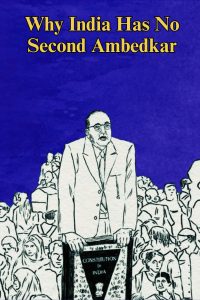
Published in Dalit Voice (Vol. 1, Issue No. 17, 16 June 1982), this essay asks why India has failed to produce intellectuals who can challenge the ruling order rather than serve it. Rajshekar treats intellectual life as a political question, arguing that knowledge has little value when those who possess it refuse to confront power.

The essay places this argument alongside Dr. B.R. Ambedkar’s critique of the Brahminical character of India’s intellectual class. Rajshekar argues that when the intellectual class is tied to caste interests, it becomes an obstacle to the destruction of caste. He also attacks the pressures that push intellectuals towards careers, awards, money and proximity to power, while dissenters are branded as dangerous or “controversial”.

The essay then asks why India did not produce another Ambedkar after independence. Rajshekar connects this to the loss of the limited space he believed Ambedkar had found under British rule, arguing that Dalits and other oppressed communities were left without protection from the ruling order after independence. The essay’s central question is therefore about the political purpose of intellectual life: what happens to a society when those capable of challenging its dominant ideas choose accommodation instead?


The Role of Intellectuals in Society

Every society, every country in the world is shaped and led mainly by its intellectuals. All those who are remembered by history are mostly intellectuals. An intellectual may not get instant recognition by society when alive, but in course of time the person’s greatness will be recognised and recorded on the pages of history. Because an intellectual and intellectual alone can help bring about socio-economic changes.

The Buddha, Plato, Marx, Rousseau, Lenin, Abraham Lincoln, Maxim Gorky, Bernard Shaw, Mao, Thiruvallavar, Mahatma Phule were all great intellectuals. It is intellectuals who not only think but make others think.

After Dr. B. R. Ambedkar, M. N. Roy, Periyar E. V. Ramaswamy and Ram Manohar Lohia, we have hardly produced any intellectual giants in India. India’s Ruling Class has been systematically corrupting any up-and-coming intellectual, and if anyone dares to defy, he is mercilessly crushed. That is why rarely one wants to show originality, innovation. So much so, India has gone into total intellectual bankruptcy.

The very fact that India has not received a single Nobel Prize after it became independent proves that we are a country of mediocre dwarfs. But we are never tired of boasting that we have the second largest scientific manpower in the whole world. If so, what are they doing? Why not a single one has made an international mark?

The one agricultural scientist who received the Magsaysay Award was later found to have got it after making a false claim. But even this man has now taken up a cushy job outside India. This is the disease with our intellectuals. One social scientist, considered very distinguished, is seldom in India and even when at home never rubs the ruling class lest it may upset his lucrative income. Scientists like Khurana have settled down in the USA.

All this is because our society and our value system do not believe in encouraging and promoting intellectuals. India’s Ruling Class wants to make its people surrender their judgement to it. Every intellectual is a suspect. It looks upon him as a source of trouble.

Some of the finest budding, blooming flowers of our society were shot dead, dubbing them as Naxalites. Any person who does not fall in line and conform to the established thinking is considered a threat to society. Dissent is disliked, nay, dangerous. Truth should not be spoken. And those who speak the truth will be branded as “controversial” persons.

Any number of organisations, both govt. and non-govt., are set up to watch and weed out such “dangerous” persons. Innumerable State and private awards are instituted to win over any brilliant writer, scholar, to pocket if not corrupt him.

Courage is an essential prerequisite to become an intellectual. He has to suffer and sacrifice, pay for his commitment. That is why intellectuals and intellectuals alone can lead a society or a movement. An intellectual can lead as well as mislead. But in India, very often our intellectuals have been only misleading the society.

Nobody has painted such an Indian situation better than Dr. B. R. Ambedkar, and things have hardly changed since he wrote it:

“Whether you accept the theory of the great man as the maker of history or whether you do not, this much you will have to concede that in every country the intellectual class is the most influential class, if not the governing class. The intellectual class is the class which can foresee, it is the class which can advise and give lead. In no country does the mass of the people live the life of intelligent thought and action. It is largely imitative and follows the intellectual class.

There is no exaggeration in saying that the entire destiny of a country depends upon its Intellectual class. If the intellectual class is honest, independent and disinterested, it can be trusted to take the initiative and give a proper lead when a crisis arises.

It is true that intellect by itself is no virtue. It is only a means, and the use of means depends upon the ends which an intellectual person pursues. An intellectual man can be a good man but he can easily be a rogue. Similarly, an intellectual class may be a band of high-souled persons, ready to help, ready to emancipate erring humanity, or it may easily be a gang of crooks or a body of advocates of a narrow clique from which it draws its support.

You may think it a pity that the intellectual class in India is simply another name for the Brahmin caste. You may regret that the two are one, that the existence of the intellectual class should be bound with one single caste, that this intellectual class should share the interest & the aspirations of that Brahmin caste, which has regarded itself the custodian of interest of that caste, rather than of the interests of the country.

All this may be very regrettable. But the fact remains that the Brahmins form the intellectual class of the Hindus. It is not only an intellectual class but it is a class which is held in great reverence by the rest of the Hindus. The Hindus are taught that the Brahmins are Bhudevas (gods on earth). The Hindus are taught that Brahmins alone can be their teacher. Varnaram Brahmano Guru. Manu says, “If it be asked how it should be with respect to points of the Dharma which have not been specially mentioned, the answer is that which Brahmins who are Shishthas propound shall doubtless have legal force.”

When such an intellectual class, which holds the rest of the community in its grip, is opposed to the reform of Caste, the chances of success in a movement for break-up of the Caste System appear to me very, very remote.”

A film actor like Amitabh Bachchan or actress like Hema Malini may have millions of fans, but the glamour is temporary. The moment the youth fades, the star sinks. A cricketer or sportsman is adored till his capacity lasts. A wrestler, boxer or a King Kong will be feared until his body strength stays.

A politician like Indira Gandhi or Reagan is adored until the person is in power. Remember, people used to avoid Indira Gandhi like plague when she was defeated by the Janata. Those with money come and go. No Tata or Birla is remembered by history. A beauty queen is glorified till her skin fades.

There is nothing permanent with stars, sportsmen, body-builders, political personalities or wealthy tycoons. But that is not the case with an intellectual. He is respected not only in his lifetime but even after that.

Kalidasa was simply a poet under King Vikramaditya, but the king’s name has faded, but not that of Kalidasa, India’s greatest Sanskrit writer. Sometimes an intellectual is respected and recognised more after his death. Karl Marx’s name will be there as long as history is there. So too Plato, Jesus Christ, Mohamed Paigambar, Lenin, Mao, Martin Luther King.

Progress of any country depends only on its intellectuals. They alone can lead, but in India, alas, our intellectuals have been only misleading the society because they have been impotent and corrupt. That is why they compromise.

Look at the courage of J. B. S. Haldane. He subjected himself to great physical pain by himself becoming a guinea pig of his experiments. Have we produced a scientist of his calibre?

Our scientists are spending their time not in laboratories but in air-conditioned offices, busy pushing files. Intellectuals of India have not given evidence of their courage, their independence of thought and conviction, which are the indices to judge an intellectual.

They are not courageous, because they are so preoccupied with selfish interests. That is why they migrate to foreign countries in search of cushy jobs. Prime Minister Indira Gandhi on June 3 is reported to have expressed concern over “brain drain of scientific talent.” But this is not the first time she and other top leaders are expressing such a concern.

What is the use of a brain that allows itself to be drained? Better not have such brains. What we want is brains with hearts, and such brains will rarely allow itself to be drained. Heartless brains are more dangerous than brainless hearts. Therefore, let the heartless brains go. India will in no way become poorer.

A true intellectual will not sell himself. He can never be bought. He can never seek power and ambition. He will speak the truth, come what may, even at the cost of his life.

The evil has triumphed in India and the country is drifting because our intellectuals do not speak up. So much so, the country has grown sick and its sickness is affecting the outside world as well. But our intellectuals are unperturbed. To them, their caste and cash is more important than the eternal pursuit of truth.

What is the use of learning and knowledge when it does not bring cash or power? Popularity does not depend upon one’s ability but other factors. “Success in life” depends not on learning but on bank balance. In such a society, what use is learning or intellectual pursuits?

Intellectuals are laughed at, despised. Why should we strain the brain when money can be made without it? This is India today.

If our intellectuals are corrupt and spineless, the masses are dumb, deaf and blind because of poverty and illiteracy. The latter are illiterate because they are poor. When they are preoccupied all the time in an endless battle of the belly, where is the time for them to think, even if thinking is possible?

If this is the position of the poorest, what about the educated, employed people who come from this very same revolutionary section, Dalits and other persecuted minorities? The tragedy with this section is they have become easy-going, pleasure-seeking. Not only that. A considerable number of them, particularly the educated Untouchables, hide their identity and turn into bumlickers.

Yes, there are a tiny section of conscientious people among them who are angry. Who wants to rebel?

“The world owes much to rebels who would dare to argue in the face of the pontiff and insist that he is not infallible. I don’t care for the credit which every progressive society must give to its rebels.” (Dr. B. R. Ambedkar, preface to second edition of Annihilation of Caste.)

Ambedkar, however, lived up to the definition of a rebel, an intellectual giant. But such of the rebels are spotted out and finished at the very initial stage. Those who have managed to escape and build up their leadership are recruited by the ever-watchful political parties.

So there is an all-round famine. No ruling class will produce a revolutionary. On the other hand, the revolutionary section is starved to submission by the ruling class.

This answers the oft-repeated question: “Why India has not produced a second Ambedkar?”

Babasaheb lived a major part of his life when India was under the British, who were benevolent rulers. Not only they gave us education, denied to us by Brahmins, but even gave us modern, Western knowledge.

Not only that. If there was any “freedom struggle” and some leaders like Gandhi and Nehru were able to fight the British, it was because of the knowledge they gained from the very British education and the encouragement they gave to fight for liberty and fraternity.

But for the British rule, which in fact meant a Christian rule, India would not have been what it is today. So Ambedkar, despite his open criticism of the British Government, got all the encouragement from the British.

Nobody criticised the British right on their face as Ambedkar did. They gave him all the facilities and also protected him against his enemies. They gave all-out encouragement and built up his leadership.

Once the British were out, Dalits & the persecuted minorities of India had none to protect them. They were virtually thrown to wolves. The independence that India got on Aug. 15, 1947 was the independence given to the high castes to exploit, which they could not do earlier so freely.

The lambs are bound and bundled and handed to wolves on a silver platter. That is the reason why after independence India did not get a second Ambedkar.

No honest, dedicated leadership is tolerated by these ever-watchful headhunters. This is the heinous role played by India’s intellectual class.
Delimitation, Representation, and Marginalization of Dalit-Bahujan Community

The dubious delimitation attempt under the guise of women’s reservation during the special parliamentary session of April 16–18, 2026, was packaged as a routine constitutional necessity aligned with democratic principles of equal representation. It was rightly defeated in parliament because of its vastly inequitable and politicized approach. Yet, to prevent any future such mischievous exercise, any such lop-sided, ill-defined bill must be examined for its implications for India’s deeply stratified social structure, particularly the realities of Dalits, Adivasis, and OBCs. Doing so raises profound concerns about the future of political representation, social justice, and democratic equity for these sections of society. What was being framed as a neutral, population-based recalibration of parliamentary seats risks entrenching caste inequalities unless it explicitly addresses the historical and ongoing exclusion of these communities from political representation.

Formally, delimitation rests on the principle that each vote should carry equal weight; therefore, constituencies must be periodically redrawn to reflect population changes. India’s last delimitation was based on the 2001 Census, with a freeze on seat redistribution extended until after the first census post-2026. The forthcoming exercise, therefore, is expected to rely on updated demographic data—though notably, the absence of a recent census since 2011 introduces significant ambiguity.

As per the 2011 Census, India’s population was 1.21 billion, but contemporary estimates place it at approximately 1.47 billion, leaving around 250–260 million people outside the ambit of representation – a majority of them from the Dalit Bahujan, Tribal and Adivasi communities. This gap is not merely technical; it has direct implications for communities whose demographic weight is substantial but whose political visibility remains limited.

Dalits (Scheduled Castes) constitute approximately 16.6% of India’s population, while Adivasis (Scheduled Tribes) account for about 8.6%, based on 2011 data. OBCs, though not officially enumerated in that census, were widely estimated by the Mandal Commission and are considered by subsequent studies to comprise between 40% and 52% of the population. Taken together, these groups form an overwhelming majority—often described as the Dalit-Bahujan social bloc. Yet, their numerical strength has not translated into proportional political representation, particularly at the national level. While the Constitution provides for reserved constituencies for SCs and STs in Parliament and state assemblies, these reservations are tied to outdated population data and do not extend to OBCs in Parliament.

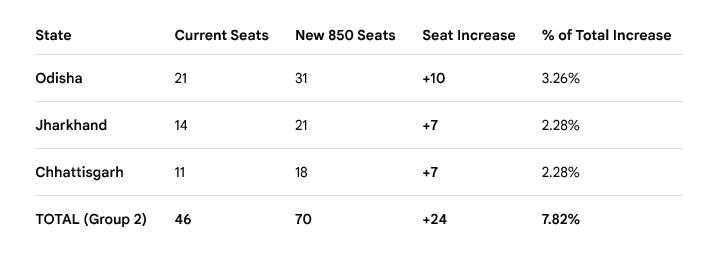
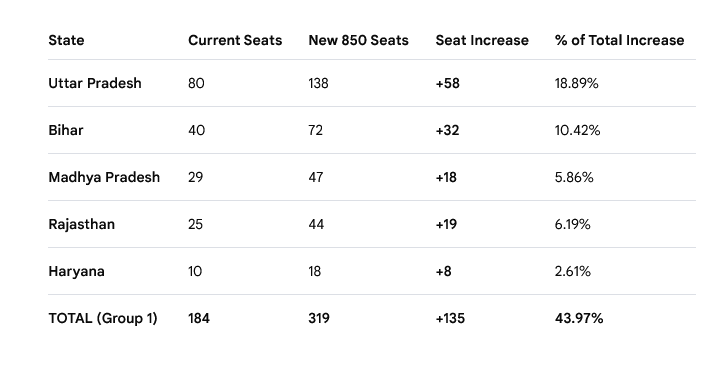
This structural imbalance affecting DBA communities becomes more pronounced in the context of delimitation. A purely population-driven redistribution of seats is expected to increase the parliamentary weight of northern states such as Uttar Pradesh, Bihar, Madhya Pradesh, Haryana and Rajasthan. These states already account for about a 33.89% share of Lok Sabha seats and projections using the 2011 census suggest that their share would rise by approximately 43.97% for a total of 48.97% in an expanded House of around 850 members (see chart 1). These numbers would further increase if the current population estimate of 1.47 billion is considered. Similar rises (see Chart 2) are indicated in states like Jharkhand, Chhattisgarh and Odisha where the combined Dalit and Tribal population exceeds 40%.

Chart 1 - North Indian States

Chart 2 - Tribal Population Dense States
Superficially, these changes might appear beneficial for Dalit-Bahujan communities, given their large presence in these states. Uttar Pradesh, for instance, has one of the highest concentrations of Scheduled Castes in the country, with Dalits comprising over 21% of its population. Bihar’s OBC population is estimated to exceed 50%, while Adivasi populations are significant in states like Madhya Pradesh and Rajasthan.

However, the critical issue is not merely where these populations are concentrated, but how political power is distributed within these regions. Electoral representation and outcomes in these states have historically been shaped by dominant caste coalitions, often marginalizing Dalit-Bahujan voices despite their numerical strength. The expansion of seats, therefore, risks amplifying existing patterns of dominance unless accompanied by structural safeguards ensuring equitable representation.

The absence of political reservation for OBCs in Parliament is particularly significant in this context. Despite constituting nearly half of India’s population, OBCs do not have reserved constituencies at the national level, unlike SCs and STs. This exclusion is compounded by the lack of updated caste data. The Socio-Economic and Caste Census (SECC) conducted in 2011 collected extensive data, but its caste findings have never been fully released or integrated into policymaking. Without a comprehensive caste census, delimitation proceeds in a data vacuum that obscures the actual social composition of constituencies. This effectively perpetuates historical inequalities, allowing representation to be recalibrated based on aggregate population figures while ignoring internal disparities.

For Scheduled Castes and Scheduled Tribes, the situation is equally complex. The number of reserved constituencies is determined by their share in the population, but this share is based on outdated data. If the actual proportion of SCs and STs has changed over the past decade and a half—as is most likely—then the current framework under-represents their presence. Moreover, delimitation could alter the geographical distribution of reserved constituencies in ways that dilute the political influence of these communities.

For example, if SC populations are dispersed across multiple constituencies rather than concentrated in specific areas, the number of reserved seats may not adequately reflect their demographic weight.

Adivasi communities face additional challenges. Concentrated in forested and resource-rich regions, they have long experienced displacement, land alienation, and administrative neglect. While ST-reserved constituencies exist, they do not necessarily guarantee effective representation, particularly when political and economic power remains external to these communities. Delimitation that does not account for the socio-economic vulnerabilities of Adivasis risks reinforcing a pattern in which territorial representation exists without substantive empowerment.

The linkage of delimitation to the implementation of women’s reservation further complicates the picture. The Constitution (106th Amendment) Act, 2023, which mandates 33% reservation for women in Parliament and state assemblies, has been widely celebrated as a landmark reform. However, its implementation is contingent upon the completion of a fresh census and subsequent delimitation. This conditionality effectively delays the realization of women’s representation, potentially by several years.

For Dalit-Bahujan women, who face intersecting forms of marginalization based on caste, class, occupation and gender, this delay is particularly consequential. Without explicit provisions ensuring representation for SC, ST, and OBC women within the broader quota, there is the risk that the benefits of women’s reservation will be disproportionately captured by upper-caste women. At the same time, the government has been noted to ignore calls by Dalit transgender activists for horizontal reservation for transgender persons even as BJP has sought to introduce exclusionary amendments to the existing Transgender Act.

Data from local government institutions, where reservations for women and OBCs are already in place, provides important insights. Studies have shown that while women’s reservation in Panchayati Raj institutions has increased female participation, the distribution of benefits is uneven. In many cases, women from dominant social groups are more likely to occupy leadership positions, while Dalit and Adivasi women continue to face barriers such as social discrimination, limited access to resources, and proxy representation. Extending this pattern to Parliament without corrective measures will reproduce similar inequalities at scale.

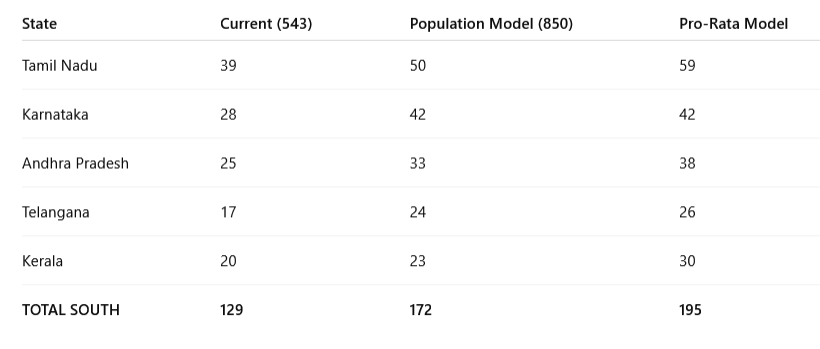
The federal dimension of delimitation has attracted considerable attention, particularly the potential shift in political power from southern and western states to the northern Hindi belt. Southern states such as Tamil Nadu, Kerala, Karnataka, and Andhra Pradesh have achieved population control, higher literacy levels, and better health outcomes compared to many northern states. Consequently, their population growth has stabilized, while their share of parliamentary seats is likely to decline in relative terms—from around 23.8% to approximately 20.2%, even if the absolute number of seats increases from 129 to 172 (see Chart 3) purely on the basis of population.

Chart 3 - South India States

While this shift is framed as a question of regional imbalance, it also has implications for Dalit-Bahujan communities. Southern states have historically implemented more robust social justice policies, including reservations for OBCs in education and employment, welfare schemes targeting marginalized communities, and relatively stronger institutional frameworks for addressing caste discrimination. A reduction in their political influence at the national level could weaken the policy emphasis on social justice, affecting the oppressed caste populations across the region.

At the same time, the expansion of representation in northern states does not automatically translate into improved outcomes for marginalized communities. These regions continue to face significant challenges in terms of poverty, education, healthcare, and social inequality. According to National Family Health Survey (NFHS-5) data, indicators such as child malnutrition, maternal mortality, and access to sanitation remain worse in several northern states compared to the national average, with Dalit-Bahujan communities disproportionately affected. Without targeted interventions, increased political representation at the state level will not lead to substantive improvements in their socio-economic status.

The method by which delimitation is being introduced further raises concerns about social justice and democratic practice. Rather than being debated as an independent issue, it has been embedded within the operational framework of women’s reservation, limiting the scope for independent and broader scrutiny. This approach mirrors a broader pattern of policymaking in which significant structural changes are introduced with limited consultation and legislative debate. For communities that have historically been excluded from decision-making processes, such methods exacerbate existing deficits in representation.

The delay in conducting the census adds another layer of social justice complexity. A census is not merely a statistical exercise; it is the foundation upon which policies related to representation, resource allocation, and social justice are built. The absence of up-to-date data undermines the credibility of the delimitation process and raises questions about its fairness toward oppressed communities. For Dalit-Bahujan communities, whose claims to representation are often contested or minimized, the lack of reliable data is particularly detrimental.

Experts have suggested alternative approaches that incorporate indicators such as fiscal contribution, socio-economic development, and human development outcomes alongside population. Such models could help balance the principle of equal caste representation with the need to ensure equitable participation of Dalit-Bahujans in governance. However, these proposals have not been considered, and the insistence on a purely population-based approach that suggests a preference for a framework that aligns with existing political advantages of dominant communities.

Ultimately, delimitation is not just a technical exercise; it is a reconfiguration of the political landscape that will shape distribution of power for decades. For the broader Dalit-Bahujan population, the stakes are particularly high. Without explicit safeguards, updated data, and inclusive policymaking, the process risks reinforcing the very inequalities it should seek to address.

Democracy, at its core, is about ensuring that those who have historically been excluded are meaningfully included in decision-making. A delimitation process that prioritizes numerical redistribution without addressing structural inequities falls short of this ideal. In its current form, it risks transforming demographic strength into political invisibility, leaving Dalit-Bahujan communities as passive participants in a system that continues to marginalize their voices and political equality.

The question, therefore, is not whether delimitation should occur, but how it should be conducted. A just and equitable process must begin with a comprehensive caste census, ensuring that the social composition of the population is accurately reflected. It must include provisions for OBC political representation, recognizing their demographic significance. It must update and strengthen SC/ST reservations based on current data, ensuring that these communities are neither underrepresented nor misrepresented. It must incorporate intersectional safeguards to ensure that Dalit-Bahujan women are not excluded from the benefits of gender-based reservation. And above all, it must be conducted through a transparent, consultative process that includes the voices of those most affected.

Without these measures, delimitation risks becoming an instrument of consolidation for the dominant castes rather than democratization—a mechanism that redistributes seats while leaving power structures intact. For a country that has long struggled with the legacies of caste and inequality, such an outcome would represent not progress, but regression.


*Data based on analysis merging figures from Census of India 2011, Election Commission of India, Times of India and numbers in the Delimitation proposal of 131st Amendment Bill.


Oliver D’Souza is a former journalist and an author.

Erasing Recognition: Maharashtra’s Ideological Withdrawal of the 5 Percent Muslim Quota

The Maharashtra government’s formal cancellation of the 5 percent reservation for socially and educationally backward Muslims has reopened a constitutional and political question that has lingered unresolved since 2014. The decision of the Social Justice Department in February 2026 to withdraw all resolutions and circulars linked to the earlier policy has now been challenged before the Bombay High Court. The petition argues that the state’s move is arbitrary, discriminatory, and constitutionally unsustainable. What is at stake is not simply a lapsed ordinance. It is the steady hollowing out of institutional mechanisms that once acknowledged the measurable backwardness of sections of the Muslim community in Maharashtra.

In 2014, the then Congress–NCP government introduced an ordinance granting 5 percent reservation to Muslims under a Special Backward Category referred to as SBC-A or SEBC for identified communities. The policy was not framed as a blanket religious quota. It was grounded in data identifying nearly fifty Muslim sub-communities as socially and educationally backward. Caste certificates and validity certificates were issued accordingly. The ordinance also granted 16 percent reservation to Marathas. When the matter reached the Bombay High Court in November 2014, the court stayed implementation. The ordinance subsequently lapsed in December 2014 because it was not converted into a statute within the constitutionally mandated timeframe.

The lapse of the ordinance did not erase the underlying findings regarding backwardness. Significantly, when examining the matter, the Bombay High Court had invalidated the Maratha quota but upheld the 5 percent reservation for Muslims in government and aided educational institutions, observing that quantifiable data justified inclusion of the identified Muslim sub-communities. The court also ensured that the reservation did not breach the Supreme Court’s 50 percent ceiling on total reservations. In other words, the judiciary did not reject the premise that sections of the Muslim community in Maharashtra were socially and educationally backward. It accepted that premise within constitutional limits.

What has now occurred is not a judicial reversal but an executive withdrawal. The current government led by Chief Minister Devendra Fadnavis has declared that all decisions and circulars linked to the 2014 ordinance stand cancelled. No new caste or validity certificates will be issued. No admissions will be granted under the 5 percent quota. The state’s position is that since the ordinance lapsed years ago, the matter is closed. Yet the petition before the Bombay High Court contends that such closure is neither automatic nor neutral. It demands that the state produce the quantified data relied upon to justify the cancellation and argues that no adverse finding was recorded by the State Backward Class Commission against the Muslim SEBC classification.

The core constitutional question is whether the executive can extinguish a policy recognizing demonstrable backwardness without fresh data, consultation, or reasoned justification. Reservations in India are not acts of charity. They are instruments flowing from Articles 14, 15, and 16 of the Constitution, aimed at substantive equality. When the state recognizes backwardness through data and then withdraws recognition without a comparable evidentiary exercise, it risks violating the very principle of non arbitrariness that undergirds Article 14. The petition asserts precisely this. It claims that the withdrawal lacks a factual foundation and disregards earlier judicial acknowledgement of backwardness among the specified Muslim communities.

The broader political context cannot be ignored. Since 2014, legal and administrative interventions affecting Muslims across India have rarely taken the form of dramatic constitutional amendments. Instead, they have unfolded through incremental executive decisions, procedural reinterpretations, and selective policy withdrawals. Each move is presented as routine governance. Taken together, they redraw the boundaries of belonging. In Maharashtra, the divergence is instructive. When Maratha reservations faced legal obstacles, the political system mobilized sustained legislative and legal energy to revive and defend them. No comparable urgency animated efforts to secure the Muslim quota framework after the ordinance lapsed. This difference in institutional will reveal how majoritarian priorities shape the afterlife of welfare policy.

The immediate impact of the cancellation is administrative, but its consequences are social. Recognition as a socially and educationally backward group is not merely symbolic. It determines eligibility for certificates, admissions, and recruitment processes that structure access to mobility. By halting issuance of caste and validity certificates and foreclosing admissions under the 5 percent category, the state effectively closes an acknowledged route into higher education and public employment. In a context where representation of Muslims in state services remains disproportionately low, such closure compounds rather than corrects inequality.

There is also a question of institutional consistency. The High Court had previously confined the Muslim quota to government and aided institutions and ensured that it did not breach the 50 percent ceiling mandated by the Supreme Court. The framework that survived judicial scrutiny was already limited and constitutionally trimmed. The present withdrawal does not respond to a judicial directive striking it down. It removes a scheme that had been partially upheld within constitutional parameters. That distinction matters because it underscores that the current shift originates in executive choice rather than constitutional compulsion.

Another dimension concerns reliance and expectation. For years after 2014, administrative processes acknowledged the classification through issuance of certificates. Students and families structured educational decisions around that recognition. Even if the ordinance formally lapsed, the state’s conduct created a practical regime. Abruptly extinguishing that regime without transitional safeguards disregards the principle that governance must account for legitimate expectations generated by its own actions. The Constitution does not treat citizens as passive recipients of fluctuating executive moods.

For Muslims in Maharashtra, the stakes are immediate and material. Access to government colleges and public employment is not a symbolic concession but one of the few constitutionally structured routes out of entrenched disadvantage. For the constitutional order, the implications are equally stark. The cancellation of the 5 percent reservation is therefore not a technical tidying up of a lapsed ordinance. It reflects an ideological choice about who merits structural support from the state and who must navigate inequality without it.


Paresh Hate is a Bahujan queer researcher, writer, documenter and activist and the Lead Content Manager at Dalit Voice.

No Liberation Alone: The Call for Dalit-Muslim Solidarity

Over the last few years, the relationship between Dalit and Muslim identities has opened in ways that are both politically urgent and intellectually generative. Debates have multiplied: from the constitutional demand to extend Scheduled Caste status to Dalit Muslims and Dalit Christians—beginning with Ghazi Saaduddin v State of Maharashtra—to concerns over a National Population Register being introduced through the Census, even as the long delayed caste census has finally become feasible. From the disquiet around Bihar’s Special Intensive Revision of Electoral Rolls to the earlier specter of the National Register of Citizens, and from the renewed articulation of the Pasmanda Muslim movement to emerging solidarities across universities, each of these moments underscores how social justice politics in India must evolve to survive and flourish.

Across public universities, student alliances between Ambedkarite and Muslim organizations are emerging as fragile but significant experiments in political imagination. The 2019 Maharashtra Lok Sabha elections, where the Vanchit Bahujan Aghadi and the All India Majlis-e-Ittehadul Muslimeen briefly converged, were another testing ground for this idea of solidarity, even as the electoral results revealed both arithmetic limits and organizational shortcomings. Many dismissed these experiments as naive or opportunistic, while others argued that any genuine alliance could only emerge between Dalits and Pasmandas, not Dalits and Muslims as a whole. Yet such thinking misreads both the enemy and the terrain.

By narrowing the horizon of unity to internal gradations of caste within Muslim communities, it sidesteps the central problem of our time: Hindutva. Caste is treated as the only enduring structure of power, while the violent consolidation of Hindu nationalism, which weaponizes both religion and caste, is ignored. Yes, caste operates among Muslims, as it does among every community shaped by the subcontinent’s history. Yet for Hindutva, the Muslim remains the primary target, with Christians not far behind. Anti Muslim hatred is the binding glue of Hindu nationalism, while caste hierarchy is the adhesive that keeps its social base intact. The two reinforce each other.

The post-Mandal moment unsettled the upper-caste hegemony of Hindutva, both as response and effect. Its cadres are drawn from various castes and regions, yet their ideological unity depends on the fiction of a singular Hindu identity. That fiction is sustained by coercing lower-caste Hindus into complicity against Muslims and Christians. It is caste consolidation that forms the sustainability of ethno-religious nationalism, turning the oppressed into foot soldiers of their own subordination.

The everyday experience of violence, surveillance, and humiliation provides a point of convergence between Dalit and Muslim lives. Police encounters, custodial deaths, demolition drives, and denial of housing follow similar social logics. These are not random or isolated acts but techniques of governance designed to mark certain populations as permanently suspect. The language may differ—“illegal encroacher,” “anti-national,” “criminal tribe,”, “anti-Hindu”—but the state’s gaze is the same. Recognizing this continuity is not about comparing suffering but about mapping power and understanding how it operates across identity lines.

There is also a long history of deliberate attempts to divide these solidarities. Colonial administrators categorized and ranked communities, while postcolonial elites preserved graded inequality. Every ruling order has depended on preventing horizontal alliances among the oppressed. Today, the right continues this strategy, using identity politics as a tool of social management. The challenge for social justice politics is to reclaim identity as a site of collective resistance rather than as a source of division, and to do so in ways that link Dalits and Muslims without flattening the distinctiveness of their experiences.

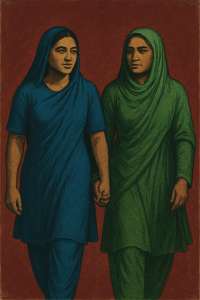
The fractures and mistrust between Dalit and Muslim communities have long been produced by the same structures that govern them. Electoral arithmetic, local competition for scarce resources, and social stigma have been used to keep these groups apart. Yet beneath these divisions lies a shared memory of exclusion and resistance that predates the current moment. Recognizing the legacy of figures like Savitri and Fatima, we must see Dalits and Muslims as fellow targets of the same social order. To rebuild this recognition today means confronting not only oppressive power but also the prejudices left behind in our own communities.

In recent years, cultural expressions have begun to reimagine this shared condition. Neeraj Ghaywan’s Homebound, based on Basharat Peer’s “A Friendship, a Pandemic and a Death Beside the Highway” for The New York Times, offers a striking instance. Set against the backdrop of the COVID-19 lockdown and the migrant crisis, the film traces a friendship between a Dalit man and a Muslim man navigating abandonment and precarity together. Their bond gestures toward a broader political question: what does it mean to build friendship as solidarity in a world determined to divide? To read their companionship politically is to see the possibility of a new ethics of alliance, one that emerges not from ideology alone but from shared vulnerability and mutual care, suggesting how friendship itself can become a form of resistance.

But Dalit–Muslim solidarity cannot remain an occasional alliance or rhetorical gesture. It must become a political project rooted in a shared understanding of power. The question before us is not whether caste exists among Muslims—it does—but whether we can build a politics that breaks both caste and communal domination. That is the only ground on which equality can stand.

V.T. Rajshekhar understood this long before it became a common slogan. Dalit Voice was not only a magazine but a platform insisting on Dalit–Muslim unity as the foundation of any real challenge to Brahminical and Hindu majoritarian power. He refused to treat these communities as separate constituencies; he saw them as parts of a single historical struggle against graded inequality and unfreedom. Reviving his project today means returning to that clarity of purpose, not by repeating his words but by extending his political vision into the realities of our time—where digital surveillance, economic exclusion, and organized hate have replaced older instruments of control. To build on his legacy is to keep the idea of Dalit–Muslim solidarity alive as both strategy and ethics, a politics that seeks not coexistence but collective liberation.

Writing this for the revival of Dalit Voice matters because V.T. Rajshekhar’s work spoke directly to this entanglement, and I— like many others—am a product of this political vision. His idea of “persecuted nationalities” named not only the victims of the Brahminical Hindu order but all those who can challenge it: Dalits, Adivasis, Muslims, Christians, women, the working poor. That vision remains unfinished. Its strength lies in seeing persecution not as fragmented suffering but as a shared political condition. To build from that recognition is to move from sympathy to solidarity, from outrage to organization.


Mohammad Aamir Khan is a student of history and anthropology.