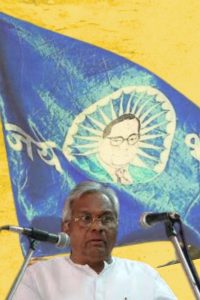
Two Serious Mistakes That Killed the Dalit Movement

Archival Note

Delivered at a BAMCEF state convention in Gulbarga (now Kalaburagi) in November 2009, this speech reflects V.T. Rajshekhar’s thinking at a particular moment in the history of the anti-caste movement. While some of its references and political judgments are rooted in that context, its central argument continues to provoke debate: what enables oppressed communities to build lasting power?

The version reproduced below has been abridged for contemporary readers. The overall argument and structure have been retained, while passages closely tied to the political context of 2009, repeated arguments, and material of primarily historical interest have been omitted. The focus remains on the speech’s two central themes: the responsibility of educated Bahujans to strengthen collective institutions, and the argument that electoral success alone cannot sustain social transformation without intellectual, organisational, and cultural power.

The complete, unabridged speech is available in the Dalit Voice archives: https://dalitvoice.net/two-serious-mistakes-that-killed-dalit-movement/


Two Serious Mistakes That Killed the Dalit Movement

Abridged from a speech delivered at the BAMCEF Karnataka State Convention, Gulbarga, November 22, 2009

Brother Waman Meshram and brothers and sisters of the Bahujan Samaj,

Thank you for inviting me to inaugurate the first Karnataka state convention of BAMCEF at Gulbarga.

We have watched the steady growth of BAMCEF under the leadership of Brother Waman Meshram. Organising educated employees is never easy, yet BAMCEF has emerged as one of the country’s most significant Bahujan organisations. It is fitting that this convention is being held in Gulbarga, a region associated with the legacy of Shyam Sundar, whose work left a lasting mark on anti-caste politics.

Today I wish to speak about two questions that I believe have deeply affected the Bahujan movement.

The first concerns the educated Dalits who have benefited from constitutional safeguards and reservations.

The second concerns the widespread belief that political power alone can transform society.

The First Mistake

Reservations opened opportunities that were denied to our people for generations. But education and employment were never meant to be ends in themselves. Babasaheb Ambedkar saw them as instruments for the emancipation of the entire community.

Over the years, however, I have watched with concern as many educated Dalits achieved personal success but drifted away from the larger movement. Babasaheb himself warned that educated Dalits should not forget the people from whom they came.

Our communities need educated people who build institutions, mentor younger generations, strengthen organisations, write, teach, and remain accountable to society. Without that commitment, education risks becoming only a means of individual advancement.

This is why BAMCEF matters. Organising educated Bahujans into a socially conscious force is difficult, but it is indispensable if education is to become a source of collective strength rather than individual mobility.

The Second Mistake

Much has been said about political power being the key to social progress. Electoral representation is important, but we must ask whether elections alone are sufficient to transform deeply unequal social structures.

Political office without organised social strength is fragile. Governments come and go. Lasting change requires a society that is organised, politically conscious, and capable of sustaining its own institutions.

Those who dominate society do not rely only on elections. They exercise influence through education, the media, the bureaucracy, finance, and other institutions. If we neglect these spheres while concentrating only on electoral politics, our victories will remain temporary.

Political power is not given but taken. To secure it requires strength—not merely physical strength, but intellectual strength.

This is why independent Bahujan media is not a luxury but a necessity. A movement that depends entirely on others to tell its story cannot shape its own future.

What is needed first is intellectual strength. We must produce honest intellectuals, strengthen our organisations, build institutions, and develop leadership that remains rooted in the community.

Political power becomes meaningful only when it rests upon an organised and self-confident society.

That is the challenge before us.

Thank you.

Jai Bhim!

Erasing Recognition: Maharashtra’s Ideological Withdrawal of the 5 Percent Muslim Quota

The Maharashtra government’s formal cancellation of the 5 percent reservation for socially and educationally backward Muslims has reopened a constitutional and political question that has lingered unresolved since 2014. The decision of the Social Justice Department in February 2026 to withdraw all resolutions and circulars linked to the earlier policy has now been challenged before the Bombay High Court. The petition argues that the state’s move is arbitrary, discriminatory, and constitutionally unsustainable. What is at stake is not simply a lapsed ordinance. It is the steady hollowing out of institutional mechanisms that once acknowledged the measurable backwardness of sections of the Muslim community in Maharashtra.

In 2014, the then Congress–NCP government introduced an ordinance granting 5 percent reservation to Muslims under a Special Backward Category referred to as SBC-A or SEBC for identified communities. The policy was not framed as a blanket religious quota. It was grounded in data identifying nearly fifty Muslim sub-communities as socially and educationally backward. Caste certificates and validity certificates were issued accordingly. The ordinance also granted 16 percent reservation to Marathas. When the matter reached the Bombay High Court in November 2014, the court stayed implementation. The ordinance subsequently lapsed in December 2014 because it was not converted into a statute within the constitutionally mandated timeframe.

The lapse of the ordinance did not erase the underlying findings regarding backwardness. Significantly, when examining the matter, the Bombay High Court had invalidated the Maratha quota but upheld the 5 percent reservation for Muslims in government and aided educational institutions, observing that quantifiable data justified inclusion of the identified Muslim sub-communities. The court also ensured that the reservation did not breach the Supreme Court’s 50 percent ceiling on total reservations. In other words, the judiciary did not reject the premise that sections of the Muslim community in Maharashtra were socially and educationally backward. It accepted that premise within constitutional limits.

What has now occurred is not a judicial reversal but an executive withdrawal. The current government led by Chief Minister Devendra Fadnavis has declared that all decisions and circulars linked to the 2014 ordinance stand cancelled. No new caste or validity certificates will be issued. No admissions will be granted under the 5 percent quota. The state’s position is that since the ordinance lapsed years ago, the matter is closed. Yet the petition before the Bombay High Court contends that such closure is neither automatic nor neutral. It demands that the state produce the quantified data relied upon to justify the cancellation and argues that no adverse finding was recorded by the State Backward Class Commission against the Muslim SEBC classification.

The core constitutional question is whether the executive can extinguish a policy recognizing demonstrable backwardness without fresh data, consultation, or reasoned justification. Reservations in India are not acts of charity. They are instruments flowing from Articles 14, 15, and 16 of the Constitution, aimed at substantive equality. When the state recognizes backwardness through data and then withdraws recognition without a comparable evidentiary exercise, it risks violating the very principle of non arbitrariness that undergirds Article 14. The petition asserts precisely this. It claims that the withdrawal lacks a factual foundation and disregards earlier judicial acknowledgement of backwardness among the specified Muslim communities.

The broader political context cannot be ignored. Since 2014, legal and administrative interventions affecting Muslims across India have rarely taken the form of dramatic constitutional amendments. Instead, they have unfolded through incremental executive decisions, procedural reinterpretations, and selective policy withdrawals. Each move is presented as routine governance. Taken together, they redraw the boundaries of belonging. In Maharashtra, the divergence is instructive. When Maratha reservations faced legal obstacles, the political system mobilized sustained legislative and legal energy to revive and defend them. No comparable urgency animated efforts to secure the Muslim quota framework after the ordinance lapsed. This difference in institutional will reveal how majoritarian priorities shape the afterlife of welfare policy.

The immediate impact of the cancellation is administrative, but its consequences are social. Recognition as a socially and educationally backward group is not merely symbolic. It determines eligibility for certificates, admissions, and recruitment processes that structure access to mobility. By halting issuance of caste and validity certificates and foreclosing admissions under the 5 percent category, the state effectively closes an acknowledged route into higher education and public employment. In a context where representation of Muslims in state services remains disproportionately low, such closure compounds rather than corrects inequality.

There is also a question of institutional consistency. The High Court had previously confined the Muslim quota to government and aided institutions and ensured that it did not breach the 50 percent ceiling mandated by the Supreme Court. The framework that survived judicial scrutiny was already limited and constitutionally trimmed. The present withdrawal does not respond to a judicial directive striking it down. It removes a scheme that had been partially upheld within constitutional parameters. That distinction matters because it underscores that the current shift originates in executive choice rather than constitutional compulsion.

Another dimension concerns reliance and expectation. For years after 2014, administrative processes acknowledged the classification through issuance of certificates. Students and families structured educational decisions around that recognition. Even if the ordinance formally lapsed, the state’s conduct created a practical regime. Abruptly extinguishing that regime without transitional safeguards disregards the principle that governance must account for legitimate expectations generated by its own actions. The Constitution does not treat citizens as passive recipients of fluctuating executive moods.

For Muslims in Maharashtra, the stakes are immediate and material. Access to government colleges and public employment is not a symbolic concession but one of the few constitutionally structured routes out of entrenched disadvantage. For the constitutional order, the implications are equally stark. The cancellation of the 5 percent reservation is therefore not a technical tidying up of a lapsed ordinance. It reflects an ideological choice about who merits structural support from the state and who must navigate inequality without it.


Paresh Hate is a Bahujan queer researcher, writer, documenter and activist and the Lead Content Manager at Dalit Voice.

If Untouchability Must Go, Caste Must Go: Bola Paswan Shastri

The first report of the Scheduled Caste & Tribes Commission headed by Bola Paswan Shastri says: “Untouchability is a byproduct of the Hindu caste system”. It also calls for “determined and consistent onslaught on the basic evil: i.e. the caste system”. But the commission, whose first report (total pages 230) is yet to be accepted by the Government of India though it was submitted over a year ago (Feb. 8, 1980), does not indicate how caste system can be destroyed. Some suggestions made by it to fight caste system are akin to Gandhian prescriptions, all of which have been tried but failed to cure the patient. 

Shastri, a highly respected former Chief Minister of Bihar and himself an untouchable, makes an important point when he says that caste riots are spreading from rural to urban centres. This is a new development in the history of India. Visiting (12-8-78) Villupuram (Tamil Nadu) where largescale atrocities broke out resulting in the death of several untouchables, he says (Page 113): A new phenomenon, is developing ……. The clash between the caste Hindus and the Harijans has so far confined to the rural areas only. I have no knowledge of any clash between caste Hindus and Harijans in the urban area in the recent past. Villupuram is the first urban area”. This is an eye-opener. Just as ‘caste riots’ (Hindu-Dalit) are spreading to urban areas, communal riots (Hindu- Muslim) so far confined to urban areas are spreading to rural areas. The over-fed Hindu communalists are out for the blood of the untouchables, tribes and minorities. Therefore, the persecuted minorities should be more vigilant. This is the message in the Shastri Commission report.

The Commission has regretted that no State Government has conducted a survey of the working of the PCR, Act nor set up any special court for trial. It is foolish to expect the government to undertake such a work because if any Government makes such an attempt the government will be toppled by the ruling class. The high castes who control every Government do not want to enforce the PCR Act. This is the simple truth.

As regards the root causes of atrocities (page 86) the Commission cites social causes. The social cause lies in the practice of untouchability which is a byproduct of the Hindu caste system pushing the SCs down to the lowest rung of the social ladder in the caste hierarchy. How can we remove untouchability without disturbing the caste scaffolding? Will not the Hindu religion shake if the caste system – its very foundation – is sought to be destroyed? Who is prepared to make such a sacrifice? If caste goes all the property and privileges enjoyed by the high castes of India will also go. Therefore, we can safely conclude that as long as the ruling class of India is allowed to continue, the caste system will also continue. Hence the need to destroys the ruling class becomes all the more urgent. We thank Bola Paswan Shastri for boldly hinting at the need to destroy caste.  

We also appreciate the commission’s recommendation for a special police force comprising 50% SC constables to be posted particularly in sensitive areas. We would go a step forward and recommend that the other half the special force should be Muslims. In that case, the jurisdiction of such a force can be extended to areas prone to Hindu-Muslim riots as well. Such a force should be airlifted within four hours of the violence breaking out. But why confine the recruitment of the special police force only to the level of constables? Even officers manning it should be SCs, STs and Muslims – 50:50.  

The Commission has passed strictures on the work of the Central and State Governments for not fulfilling the job quota to SCs. The SCs will not come to the desired level even after the next 10 years, it says.  

The percentage of reservation was raised by the Government of India vide resolution No. 27/25/68 – ESTT (S.C.T) dt. 25th March 1979 in proportion to the population of these communities as shown in the 1961 census. The report mentions that the 15% reservation to SCs is to be enforced through direct recruitment on all-India basis: – a) by open competition b) posts to be filled by promotions c) and on the basis of seniority. But, the commission, observes that “the actual percentage of SCs are nowhere near the prescribed one”. In annexure I, it has given the data to prove the failure of the Government. However, in Class IV posts, reservations have exceeded the quota fixed because these positions of sweepers, scavengers etc. are permanently reserved for the untouchables, as there are none else to take up these jobs. The real position of SCs, in RBI, nationalised banks, public industries different Government departments are all furnished. A very valuable document.