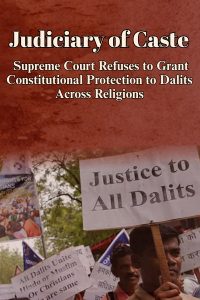
On 24 March 2026, the Supreme Court of India delivered a judgment that appears, at first glance, to simply restate settled constitutional law. Scheduled Caste status, it held, is limited to Hindus, Sikhs, and Buddhists, and conversion to any other religion results in its “immediate and complete loss.” In doing so, the Court upheld an earlier Andhra Pradesh High Court ruling that denied a Christian pastor protection under the Scheduled Castes and Scheduled Tribes (Prevention of Atrocities) Act after he alleged caste abuse and threats to his life. The reasoning was categorical. Caste, for the purposes of constitutional protection, cannot survive religious conversion. Christianity, the Court asserted, does not recognise caste. The legal consequence is stark. A person born into caste oppression can lose the law’s recognition of that oppression simply by changing faith.
This judgment is not merely a technical reiteration of Clause 3 of the Constitution (Scheduled Castes) Order, 1950. It is a political act that redefines the relationship between caste, religion, and the state. It insists that caste is a bounded, religion-specific phenomenon rather than a pervasive social structure. It collapses the distinction between theology and lived reality, and in doing so, it weakens one of the most significant legal architectures available to confront caste violence in India.
Pastor Chintada Anand Paul approached the courts alleging casteist abuse and threats under the SC/ST (Prevention of Atrocities) Act. His argument was simple and empirically grounded. Caste is a matter of birth, social location, and historical disadvantage. Conversion does not erase stigma, occupation, or the violence that structures everyday life. The Court rejected this claim. It held that one cannot simultaneously profess Christianity and claim Scheduled Caste status, as the two are “mutually exclusive.” It further imposed a stringent burden on those who seek reconversion, demanding proof not just of religious change but of total dissociation from the prior faith and acceptance by the original caste community. The effect is to transform caste from a lived structure of oppression into a matter of formal religious identity. This move is conceptually flawed and politically dangerous.
Caste in India has never been reducible to theology. It is a system that organises labour, space, marriage, and dignity across centuries. It determines who cleans, who owns land, who is touched, who is excluded, and who is killed. Conversion may alter belief, but it does not alter these material conditions. A person who has historically been forced into sanitation work does not cease to be socially marked because they now pray in a church or a mosque. Their neighbours do not forget. Their employers do not forget. The state itself does not forget, as evidenced by the continued concentration of Dalit-origin communities, including Muslim and Christian groups, in sanitation labour.
We need a clearer understanding of what conversion has meant in anti-caste politics, particularly keeping in mind the legacy of B. R. Ambedkar, whose political choices have defined anti-caste possibilities for many of us. Conversion was never a naive belief that caste would simply disappear with a change of religion. It was a political act, a refusal of graded inequality, and an assertion of dignity against a system that denied it. What the present judgment reveals is not the failure of that strategy, but the persistence of caste as a social structure that exceeds religious boundaries, and the state’s refusal to recognise that persistence.
Empirical evidence across regions confirms this persistence. Studies of Muslim and Christian communities show entrenched hierarchies, occupational segregation, endogamy, and practices analogous to untouchability. Dalit Muslims report being denied access to shared burial grounds, segregated in schools, and excluded from social interaction by both Hindus and upper caste Muslims. Rural poverty and landlessness among these communities are significantly higher than among upper caste Muslims, placing them at the bottom of an already marginalised population. Similar patterns exist among Dalit Christians. The continuity is not accidental.
The Court’s assertion that Christianity does not recognise caste is therefore beside the point. The question is not whether religious texts endorse caste, but whether social life reproduces it. By privileging theology over sociology, the judgment adopts an abstract view of religion while ignoring empirical reality. It mistakes doctrine for practice and, in doing so, denies protection to those who continue to experience caste violence.
This denial has deep historical roots. The Constitution (Scheduled Castes) Order, 1950 restricted SC status to Hindus, later expanded in 1956 to include Sikhs and in 1990, under the V. P. Singh government, to include Navayana Buddhists. Muslims and Christians had been excluded since the beginning, with a petition seeking reservation benefits for Dalit Muslims and Christians pending before a three-judge bench of the Supreme Court since January 2011. This exclusion was not a neutral reflection of social reality, but a product of political choices that sought to contain caste within a “Hindu” frame. It allowed the state to acknowledge caste where it was unavoidable while maintaining the fiction of a casteless modernity elsewhere. The result has been a long-standing invisibilisation of caste among religious minorities.
This invisibilisation has served multiple purposes. It has enabled upper caste dominance within minority communities by suppressing internal hierarchies. It has allowed the state to deny the universality of caste oppression. And it has fractured anti-caste politics by creating differential access to legal recognition and protection.
A troubling dimension of this moment is the relative silence, and at times loud opposition, from sections of anti-caste movements themselves. This hesitation is often rooted in a politics of scarcity, where access to reservations and legal protections is treated as a finite resource to be defended rather than expanded. In this frame, the inclusion of Dalit Muslims and Dalit Christians is seen not as a necessary correction of historical injustice, but as a potential dilution of already inadequate entitlements. This logic mirrors, in unsettling ways, the very arguments long deployed by upper caste groups against reservations, where claims of merit, competition, and limited opportunity are mobilised to resist redistribution. When anti-caste politics adopts this grammar, it risks reproducing the exclusions it seeks to dismantle. Instead of challenging the state to expand its commitment to justice, it internalises constraint and turns marginalised communities into competitors, when the demands of justice should be deployed toward the state, which fails to adequately provide mechanisms of dignity for all. The consequence is a fragmented politics that weakens the collective force required to confront caste as a structural system, allowing decisions like this judgment to stand with far less resistance than they should provoke.
The present judgment intensifies this fragmentation. By insisting that caste is only related to Indic religions, it effectively tells Dalit Christians and Dalit Muslims that their oppression is either illusory or legally irrelevant. By denying them access to the SC/ST (Prevention of Atrocities) Act, it removes a crucial mechanism for addressing violence that is explicitly caste-based in nature.
This has serious consequences for anti-caste politics. The SC category has historically functioned as more than a system of reservations. It has been a framework through which the state acknowledges caste as a structural injustice. It provides what has been described as a minimum moral and legal vocabulary to name oppression. To restrict this framework along religious lines is to weaken its conceptual foundation. It suggests that caste is not a pervasive social system, but a bounded religious phenomenon. This undermines the possibility of building solidarities across communities that experience similar forms of violence.
The judgment also produces perverse incentives. It penalises those who sought escape from caste through conversion by stripping them of legal protections. It creates a situation where individuals must choose between religious freedom and access to justice. This is in direct tension with the constitutional guarantees of equality and freedom of religion. It also ignores the historical reality that many conversions were attempts to escape caste oppression, not evidence of its disappearance.
Further, the Court’s approach to Scheduled Tribes reveals the inconsistency of its reasoning. While SC status is treated as rigidly tied to religion, ST status is assessed through social and cultural criteria, including community recognition and continuity of practices. This distinction implicitly acknowledges that identity is not reducible to formal religious affiliation. Yet the same logic is denied to Scheduled Castes. The result is an incoherent framework that treats similar questions differently without sufficient justification.
The requirement of “unimpeachable proof” for reconversion further entrenches exclusion. It places an onerous burden on individuals to demonstrate not only a change in faith, but acceptance by caste communities that have historically excluded them. It effectively grants caste groups the power to determine who can re-enter, reinforcing the very hierarchies the law is supposed to dismantle.
At a broader level, the judgment reflects a deeper anxiety within the Indian state, which has more and more started resembling the ‘Republic of Caste’. Recognising caste across religions would require acknowledging its totalising presence in society. It would necessitate expanding the scope of affirmative action and anti-discrimination measures beyond what has been available since Ambedkar’s time. By maintaining the current framework, the state, lazily at best and maliciously at worst, avoids these challenges.
Caste is a system of graded inequality that structures life chances across communities. To deny its existence in certain contexts is to deny the experiences of those who live it daily. The Supreme Court had an opportunity to move beyond the limitations of a 1950 framework and align constitutional interpretation with these realities. Instead, it has reaffirmed a restrictive reading that privileges formal categories.
If anti-caste politics is to remain meaningful, it must resist this narrowing. We must insist that caste is a shared structure of oppression that cuts across religious boundaries. We must demand that legal frameworks reflect this reality. And we must challenge the idea that dignity and protection can be contingent on faith. The question, ultimately, is not whether caste exists within a particular religion. It is whether the state is willing to recognise and confront caste wherever it operates.
Paresh Hate is a Bahujan queer researcher, writer, documenter and activist and the Lead Content Manager at Dalit Voice.