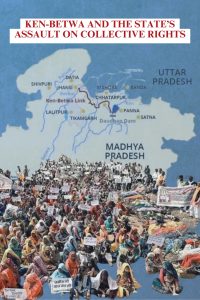
Ken-Betwa and the State’s Assault on Collective Rights

The protests against the Ken-Betwa Link Project in Madhya Pradesh emerged from long-standing concerns about the displacement of affected communities and the manner in which one of India’s largest river-linking schemes was being implemented. The Union and Madhya Pradesh governments have presented the Ken-Betwa Link Project as a nationally significant initiative to address chronic water scarcity in the drought-prone Bundelkhand region, arguing that it would strengthen irrigation while improving drinking water availability and power generation. Adivasis in the region have challenged this developmentalist narrative that is often built by ignoring the costs of implementation, which tramples their constitutional rights and livelihoods. The latest phase of the movement began on 3 July 2026 along the Barana River near Kupi village in Chhatarpur district and became one of the most visible mobilisations against the project. Protesters combined forms of civil disobedience with demands that rehabilitation be carried out according to the spirit of the law.

Led largely by Adivasi women and project-affected families, the agitation centred on the Ken-Betwa Link Project as well as the Majhgaon and Runjh irrigation projects. Protesters organised a series of symbolic demonstrations including jal satyagraha (standing in water as a form of protest), chita andolan (lying on funeral pyres) and a symbolic faansi satyagraha, presenting them as expressions of communities being pushed towards “social death” through displacement. Movement leader Amit Bhatnagar also undertook an indefinite hunger strike that lasted nearly two weeks until the protests were forcefully cleared. Protest leaders have maintained that authorities should implement the projects in accordance with existing laws governing land acquisition and environmental protection while respecting the constitutional rights of affected communities which prioritize rehabilitation. The administration has also failed to honour assurances reportedly made during discussions held in April 2026 before the protests came to this intense point. Bhatnagar has pointed to a ₹400-crore corruption scandal linked to the project, which shows massive irregularities in land acquisition and rehabilitation.

Displacement in this case has extended far beyond the loss of land. The affected families stand to lose access to forests, access to water resources, livelihood opportunities and more. Some residents have faced false criminal cases, illegal evictions, electricity disconnections and the demolition of schools as intimidation tactics and extra-legal punishment for participating in the protests. In this context, the protests called for transparent identification of all project-affected families and insisted that rehabilitation precede any displacement. The protests were also occurring within broader demands for an end to coercive administrative practices, especially when it comes to extractive displacement under the banner of development, conveniently marketed as pro-people and welfarist. Given the history of these practices, the movement is not simply a dispute over compensation but one in the long line of political struggles for democratic accountability and constitutional protections for Adivasi and rural communities.

Before dawn on 19 July 2026, a large police contingent cleared the protest site, citing public safety concerns because demonstrators were gathered beneath an under-construction bridge and along the river. While  the administration has rejected allegations of wrongdoing and maintained that all legal procedures were being followed, multiple videos show the heavy-handed use of violence in ending the protests. Authorities stated that protesters were transported back to their villages rather than arrested. Bhatnagar was taken to hospital after his health deteriorated during the prolonged fast. However, this is a clear sign of forcible suppression of the movement, with protestors alleging mass detentions and the use of force to prevent Bhatnagar from addressing the media.

The agitation reflects wider debates surrounding the Ken-Betwa Link Project. As India’s first river-linking project under the National Perspective Plan, it occupies a central place in the government’s broader river interlinking agenda, with an estimated cost of ₹44,605 crore. Environmental groups, hydrologists and rural and Adivasi communities who have been affected have questioned the project’s ecological viability. They dispute the assumption that the Ken basin has surplus water and warn of its impact on forests and the Panna Tiger Reserve. Extensive deforestation and inadequate rehabilitation weaken the project’s developmental claims, while many have already pointed to decentralised water conservation which offers less destructive alternatives that states are reluctant to explore.

The legal framework governing such projects already recognises that displacement extends beyond the acquisition of privately owned land. The Right to Fair Compensation and Transparency in Land Acquisition, Rehabilitation and Resettlement Act, 2013 (LARR Act) defines project-affected families and provides for rehabilitation and resettlement alongside compensation. Apart from the generic failure of implementation in the Ken-Batwa case, the statutory application has repeatedly been criticised for excluding people whose livelihoods depend on forests, rivers and other common resources or who lack formal land titles, leaving many of those most affected outside its protections. This accountability gap is underscored by the Ministry of Tribal Affairs’ press release, “Rehabilitation of Displaced Tribals” (31 July 2025), which stated that the Union government does not centrally maintain data on displaced or project-affected families, even as it continues to promote large infrastructure projects across the country.

But it is clear that the questions raised here cannot be answered simply by demanding due process in compensatory practices. For decades, scholars of displacement, including Walter Fernandes, have argued that the framework governing displacement requires a more expansive rethinking. Yet policy institutions have largely failed to address these concerns, while successive governments have continued to pursue different forms of displacement through both public and private infrastructure initiatives. Fernandes argues that compensation cannot be confined to the market value of acquired land because displacement disrupts livelihoods rather than simply transferring property. He contends that rehabilitation should recognise all project-affected persons, including those dependent on common resources without formal legal ownership, and enable them to rebuild their lives instead of treating compensation as a one-time financial payment.

Although legislation such as the LARR Act is frequently criticised by corporate interests as placing excessive constraints on land acquisition, the Ken-Betwa experience suggests a different problem. Since the introduction of the Act, human right activists have pointed to the limited procedural and substantive protections that the Act provides. But even the minimal formal recognition and rights seem to be rendered ineffective when the state itself becomes the principal agent of acquisition. As Sanjoy Chakravorty argues in his formulation of the “taking state”, the concentration of acquisition powers within the state enables it to overcome legal safeguards through administrative practice. The struggle over Ken-Betwa is therefore also a struggle over whether constitutional and statutory protections can meaningfully constrain state-led development when the communities bearing its costs are Adivasi and rural populations.

The July protests also represent more than a local struggle over rehabilitation. They also highlight a wider contest over how large infrastructure projects should proceed when they affect the rights of tribal communities and fragile ecosystems. Not only is the Indian state continuously engaged in authoritarian extractivism, but has effectively framed its biddings under the PR of welfare while continuously trampling the civil liberties and the right to dissent of people affected. The events unfolding at Ken-Betwa over the last few days reaffirm that struggles against displacement cannot be left to affected communities alone, but require broader democratic solidarity across movements.


Paresh Hate is a Bahujan queer researcher, writer, documenter and activist and the Lead Content Manager at Dalit Voice.
Custody, Caste, and the Persistence of Police Violence in Tamil Nadu

The death of 26-year-old Dalit youth Akash Denison in police custody in Sivaganga district has once again forced Tamil Nadu to confront a recurring contradiction. A state that prides itself on a legacy of social justice continues to witness a pattern of custodial deaths that disproportionately claim the lives of the poor and the marginalized, including Dalits.

Akash Denison’s death on March 8 at the Government Rajaji Hospital in Madurai has triggered protests, political demands for an inquiry, and renewed scrutiny of police conduct in the state. Yet for activists and anti-caste organisations, the case is not an aberration. It is another entry in a long list of custodial deaths that expose systemic violence embedded within the criminal justice system.


The death of Akash Denison

Akash Denison, an engineering graduate from Krishnapuram Colony in Manamadurai, was arrested on March 6 along with another youth in connection with a sickle attack on two individuals in Zion Nagar the previous day. According to the Tamil Nadu police, the assault followed a petty quarrel and was captured on CCTV footage.

Police sources stated that Denison was a “history-sheeter” with several pending cases, including one for attempted murder. The official version claims that he sustained serious injuries while trying to escape arrest, allegedly falling from a bridge. He was initially treated at Sivaganga Government Medical College Hospital before being remanded to judicial custody until March 18 by a magistrate. He was then transferred to the convict ward at the Government Rajaji Hospital in Madurai.

On the morning of March 8, Denison reportedly developed breathing difficulties around 5:45 am. Despite attempts by doctors to revive him, he died shortly thereafter. Police have suggested that complications from his injuries, possibly fat embolism caused by fractures, could have led to the death, though post-mortem confirmation is awaited.

The family disputes this account entirely. Denison’s father, Rajesh Kannan, alleges that his son was brutally assaulted in custody. According to the family, police officers took him to a secluded area near Sivaganga, placed stones on his legs, and beat him until his bones were shattered. The father also claims that officers hurled caste slurs during the assault. His mother, Anandhi, has alleged that police had earlier threatened to kill her son if he was ever caught.

Before his death, Denison reportedly told his parents that he had been assaulted by the police. The family has demanded that the case be registered under the Scheduled Castes and Scheduled Tribes (Prevention of Atrocities) Act and that those responsible be prosecuted. The body remains in the hospital mortuary pending further proceedings and a magisterial inquiry.


Political and civil society response

The death has drawn strong reactions from Dalit organisations and political leaders. Thol. Thirumavalavan, leader of the Viduthalai Chiruthaigal Katchi, demanded a thorough investigation into the custodial death. He stated that Denison had informed his family about police assault and caste abuse before he died. Thirumavalavan questioned the circumstances of the death and asked why a detainee under state custody died while being treated in hospital. If police officers were responsible, he said, strict action must be taken and justice ensured for the victim’s family.

Human rights activist Henri Tiphagne of People’s Watch called the incident the 26th custodial death in Tamil Nadu in recent years and urged the Madras High Court to take suo motu cognisance of the case. He also stressed that the post-mortem must follow Supreme Court guidelines for custodial death investigations. Meanwhile, local protests erupted in Manamadurai, with residents blocking roads and demanding accountability.


A pattern that refuses to disappear

Denison’s death cannot be understood in isolation. Tamil Nadu has seen a troubling number of custodial deaths in recent years, many of them involving individuals from marginalised backgrounds and arising from arrests for relatively minor offences.

Data compiled by People’s Watch shows that 32 custodial deaths occurred during the tenure of the current state government between May 2021 and August 2025. In an analysis of 27 of these deaths over the past four years, nearly 40 percent of the victims belonged to Scheduled Castes or Scheduled Tribes.

The pattern cuts across the state but is particularly pronounced in the southern police zone, which includes Madurai, Ramanathapuram, Tirunelveli, and Sivaganga districts. In most cases, the police have attributed the deaths to illness or sudden medical conditions such as seizures or chest pain. Yet post-mortem reports, family testimonies, and FIRs often reveal extensive injuries suggesting custodial torture.

One of the most widely known custodial deaths in Tamil Nadu was the 2020 killing of P. Jayaraj and his son J. Bennix in Sathankulam, which sparked nationwide outrage. The two were arrested for allegedly violating pandemic lockdown regulations and were later found to have suffered severe torture while in police custody. The case remains under judicial process.

More recently, in June 2025, temple security guard Ajith Kumar died in police custody in Sivaganga district after being detained for questioning in a theft case. His death, too, triggered allegations of brutal assault by police.

Other cases reflect similar patterns. Baskar, a Dalit man arrested in Cuddalore in 2024 for allegedly selling tobacco, died after being remanded to jail; his family said his body showed signs of torture. Seventeen-year-old Gokul Sree died in a juvenile correction facility in Chengalpattu in 2022, with 96 injuries found during the post-mortem. In another case, tribal man P. Marimuthu died in 2025 while in custody of the forest department after being accused of possessing leopard teeth.

Across these cases, the victims were overwhelmingly from poor families and were frequently arrested for petty crimes such as theft, minor altercations, or illicit liquor brewing.


Marginalisation and vulnerability

The demographic pattern is difficult to ignore. Among the 27 custodial deaths examined by researchers, nine victims were from Scheduled Castes and two were from Scheduled Tribes. Many of the others were from economically vulnerable communities or were daily wage labourers.

For activists, this concentration reflects deeper structural inequalities. The Lokniti-CSDS report State of Policing 2025 adds another disturbing dimension. According to the study, 56 percent of police personnel in Tamil Nadu expressed strong support for the idea that violence is sometimes necessary to obtain information from suspects.

Institutional accountability has also remained weak. Data from the National Crime Records Bureau indicates that only one police officer has been convicted for custodial violence in Tamil Nadu between 2011 and 2022.


The contradiction of social justice politics

Tamil Nadu’s political culture is deeply shaped by the anti-caste and rationalist movements associated with figures like Periyar E. V. Ramasamy. The state’s dominant political parties frequently invoke this legacy to emphasise commitments to equality and social justice. Yet activists argue that the persistence of custodial deaths exposes a gap between rhetoric and institutional practice.

Several Dalit organisations have pointed out that the criminal justice system, particularly the police, continues to reproduce caste hierarchies even within a political environment that publicly rejects them. Allegations of caste-based abuse, such as those made by Denison’s family, are therefore not isolated claims but part of a broader critique of structural discrimination. Without meaningful accountability, the promise of social justice risks becoming symbolic rather than substantive.


The struggle for accountability

In many custodial death cases, legal proceedings stretch for years, and evidence often disappears. Activists say police stations frequently claim that CCTV footage was automatically deleted within weeks, making independent verification difficult. Even in high-profile cases such as the Sathankulam deaths, final judgments have taken years to materialise.

For families like that of Akash Denison, the struggle is immediate and intensely personal. His parents have refused to accept the official explanation for his death and have demanded a transparent investigation. Their demand echoes a larger question confronting the state: whether the cycle of custodial violence can finally be broken.

For now, Denison’s death stands as another reminder that the distance between the ideals of social justice and the realities of policing in Tamil Nadu remains painfully wide.

What makes Akash Denison’s death particularly troubling is not only the allegation of brutality but the familiarity of the pattern it fits into. Custodial deaths in Tamil Nadu have repeatedly revealed how the weight of policing falls most heavily on those already pushed to the margins, where poverty, caste, and criminalisation intersect. Each case prompts outrage, promises of inquiry, and temporary administrative action, yet the underlying culture of impunity rarely changes. If the state’s commitment to social justice is to mean anything beyond political vocabulary, it must confront the violence embedded within its own institutions. That requires more than compensation or isolated suspensions. It requires transparent investigations, swift prosecutions, and structural reform of policing practices. Until then, the death of Akash Denison will remain not an exception but a grim reminder of how fragile constitutional protections become when they collide with caste prejudice and unchecked state power.


Paresh Hate is a Bahujan queer researcher, writer, documenter and activist and the Lead Content Manager at Dalit Voice.