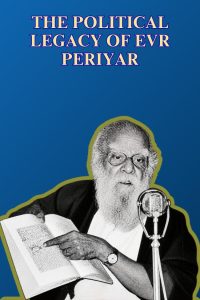
The Political Legacy of EVR Periyar

Archival Note

Published in Dalit Voice (Vol. 24, Issue No. 5, 1 March 2005), this essay by Rajendra of Ambedkar Pratishthana defends Periyar E.V. Ramaswamy against attempts to portray him as anti-Dalit. The essay recalls Periyar’s role in the anti-caste struggle, his break with the Congress and his relationship with Dr. B.R. Ambedkar. It asks the present generation to remember Periyar alongside Phule, Ambedkar and Shyam Sunder as part of the history of the anti-caste struggle.

The essay places particular emphasis on Periyar’s relationship with Ambedkar. It recalls Periyar’s efforts to bring Ambedkar into the Jat-Pat-Todak Mandal conference and the mutual respect between the two leaders. For Rajendra, Periyar’s importance lies in a politics of self-respect that directly challenged Brahminical social authority. He also presents Periyar within a wider Bahujan politics, arguing that Dalits and Backward Castes have a shared stake in fighting Brahminism. This makes the essay an important record of a political tradition that saw Ambedkar and Periyar as connected figures in the anti-caste movement rather than as representatives of opposing camps.

Published in September, the month of Periyar’s birth anniversary, the essay speaks to a contemporary tendency to divide anti-caste politics between Ambedkarite and Periyarist traditions, particularly in Tamil Nadu. That division can obscure the historical connections between the two movements and the different ways in which they confronted caste. Periyar’s emphasis on self-respect remains important because it locates caste oppression in the social relations and cultural authority that make hierarchy appear natural. His work also shows why anti-caste politics must challenge the ideas and institutions through which caste reproduces itself, alongside the struggle for political and legal rights. Revisiting Periyar through this history helps recover a broader anti-caste tradition in which his contribution and Ambedkar’s can be understood together without treating them as interchangeable.


Periyar E.V.R. As Champion Of Dalits

Periyar E.V. Ramaswamy is a leader of international repute and is hailed as a great thinker, reformer, revolutionary and humanist. The United Nations itself recognised this during his lifetime.

So any discussion on his sterling qualities and services to the oppressed people, victims of Brahminism, is ridiculous. Some Dalits under Brahminical influence have lately started branding Periyar as anti-Dalit. They should not be ungrateful to the extent of falsifying history itself. Dr. Ambedkar wanted his children to be sincere and truthful.

The present generation should know the history of their progress and the services and sacrifices of elders like Phule, Periyar, Babasaheb and Shyam Sunder.

Vaikom struggle: Periyar’s self-respect movement began in an aggressive way at Vaikom, in the present Kerala. It was on behalf of the Untouchable castes who were not allowed even to walk on a street right before a temple. Periyar rushed there and fought on their behalf.

This historic agitation led by Periyar attracted Muslim leader E.V.K. Abdulla and Christian leader Gorge Joseph. Gandhi, as a true Hindu, criticized Periyar for supporting the Untouchables. Sikhs came from Punjab and ran the free kitchen (langar). This will establish the truth of Periyar’s universal leadership.

Periyar was then arrested by the Trivancore state police and kept in prison for this agitation. Yet the agitation continued. Finally, the Untouchables won the right to walk on the road. This may not be a material gain, but a self-respect achievement for Untouchables. The agitation became famous as “Vaikom struggle”. Dr. Ambedkar wrote an Editorial about this historic achievement in his journal, Mooka Nayak.

Declaration to destroy Congress: The Congress, the original Brahmin party of India, passed a resolution in 1917 showing its concern for the welfare of Untouchables. M.K. Gandhi, the dictator of the Congress, claimed credit for this action of the Brahmin party. But the truth is Gandhi came to know about the British giving recognition to Untouchables and providing political rights based on the census of 1911, for which Prince Agha Khan was responsible.

From that day onwards, Congress started discussing social reforms in its sessions. But even such discussions were stopped when the Brahmins set fire to the Congress session pandal in Maharashtra. At the Madras session of the Congress, Periyar Ramaswamy, who was then an active worker of the Congress, forced a discussion on social problems, mainly Untouchability.

Rowdies engaged by Brahmins then dragged Periyar out of the pandal and thrashed him. Periyar declared on the spot that he would destroy the Congress in Tamil Nadu and he did it. The Congress is wiped out in Tamil Nadu.

Dr. Ambedkar respected Periyar: Dr. Ambedkar had great respect for Periyar and Periyar had respect for Dr. Ambedkar. It was Periyar who advised the organizers of Jat-Pat-Todak Mandal of Lahore, when they invited him to the conference, to invite Dr. Ambedkar, being a better person, well read, better informed and able to speak English.

Jat-Pat-Todak Mandal approached Dr. Ambedkar, who agreed and prepared a speech for the conference. But Gandhi planned his usual trick, which resulted in Dr. Ambedkar cancelling his engagement.

Later, Dr. Ambedkar got his speech published as a book, titled Annihilation of Caste.

Three greatest personalities: Some Dalit leaders are critical of Periyar just because he belonged to a Backward Caste. They also quote and misquote Dr. Ambedkar on the subject. They know only the title of this book. But they do not know the history behind this book.

Dr. Ambedkar always made it a point to meet Periyar when he visited Madras. One such visit was when Jinnah attended the Muslim League meeting at Madras. On this occasion, all the three greatest personalities of the day, Dr. Ambedkar, Jinnah and Periyar, met and discussed the Indian caste problem. A photo with these three taken during that meeting of the great statesmen is in my possession. Another important photo with me is of Periyar with the great Bheem Sena leader Shyam Sunder.

Birthday celebration in UP: Kanshi Ram is another great revolutionary of India. He organised the Bahujan Samaj Party which came to power in UP and celebrated Periyar’s birth anniversary.

Kanshi Ram knows who is who among the Bahujans. If Periyar had been anti-Dalit, as made out by some Dalits in Tamil Nadu, would India’s topmost Dalit leader praise Periyar? Similarly, our Editor has assigned the No.2 place to Periyar among the three greatest revolutionaries of “independent” India.

With all these facts, why do some Dalits call Periyar anti-Dalit? The mistake is not of Dalits but of the Backward Castes. It is easy to call it Brahminism.

The pity is the Backward Castes are the agents and foot-soldiers of Brahmins.

They ill-treated Dalits all over India, including Tamil Nadu, pushing Dalits to Islam at Meenakshi Puram 25 years ago. The BCs must mend their attitude towards Dalits, Muslims and Christians.

Dalits are duty bound to lead the entire Bahujan Samaj. That can be fulfilled only when BCs, at least the Most Backward Castes (MBC) like the barber, dhobi, potter, blacksmith etc., understand the importance of building Bahujan Samaj. Muslims and Christians also are distancing themselves from BCs. As an Ambedkarite, I call upon the BCs to join Dalits to fight Brahminism.

Periyar spent his whole life in this work for over half a century.
Custody, Caste, and the Persistence of Police Violence in Tamil Nadu

The death of 26-year-old Dalit youth Akash Denison in police custody in Sivaganga district has once again forced Tamil Nadu to confront a recurring contradiction. A state that prides itself on a legacy of social justice continues to witness a pattern of custodial deaths that disproportionately claim the lives of the poor and the marginalized, including Dalits.

Akash Denison’s death on March 8 at the Government Rajaji Hospital in Madurai has triggered protests, political demands for an inquiry, and renewed scrutiny of police conduct in the state. Yet for activists and anti-caste organisations, the case is not an aberration. It is another entry in a long list of custodial deaths that expose systemic violence embedded within the criminal justice system.


The death of Akash Denison

Akash Denison, an engineering graduate from Krishnapuram Colony in Manamadurai, was arrested on March 6 along with another youth in connection with a sickle attack on two individuals in Zion Nagar the previous day. According to the Tamil Nadu police, the assault followed a petty quarrel and was captured on CCTV footage.

Police sources stated that Denison was a “history-sheeter” with several pending cases, including one for attempted murder. The official version claims that he sustained serious injuries while trying to escape arrest, allegedly falling from a bridge. He was initially treated at Sivaganga Government Medical College Hospital before being remanded to judicial custody until March 18 by a magistrate. He was then transferred to the convict ward at the Government Rajaji Hospital in Madurai.

On the morning of March 8, Denison reportedly developed breathing difficulties around 5:45 am. Despite attempts by doctors to revive him, he died shortly thereafter. Police have suggested that complications from his injuries, possibly fat embolism caused by fractures, could have led to the death, though post-mortem confirmation is awaited.

The family disputes this account entirely. Denison’s father, Rajesh Kannan, alleges that his son was brutally assaulted in custody. According to the family, police officers took him to a secluded area near Sivaganga, placed stones on his legs, and beat him until his bones were shattered. The father also claims that officers hurled caste slurs during the assault. His mother, Anandhi, has alleged that police had earlier threatened to kill her son if he was ever caught.

Before his death, Denison reportedly told his parents that he had been assaulted by the police. The family has demanded that the case be registered under the Scheduled Castes and Scheduled Tribes (Prevention of Atrocities) Act and that those responsible be prosecuted. The body remains in the hospital mortuary pending further proceedings and a magisterial inquiry.


Political and civil society response

The death has drawn strong reactions from Dalit organisations and political leaders. Thol. Thirumavalavan, leader of the Viduthalai Chiruthaigal Katchi, demanded a thorough investigation into the custodial death. He stated that Denison had informed his family about police assault and caste abuse before he died. Thirumavalavan questioned the circumstances of the death and asked why a detainee under state custody died while being treated in hospital. If police officers were responsible, he said, strict action must be taken and justice ensured for the victim’s family.

Human rights activist Henri Tiphagne of People’s Watch called the incident the 26th custodial death in Tamil Nadu in recent years and urged the Madras High Court to take suo motu cognisance of the case. He also stressed that the post-mortem must follow Supreme Court guidelines for custodial death investigations. Meanwhile, local protests erupted in Manamadurai, with residents blocking roads and demanding accountability.


A pattern that refuses to disappear

Denison’s death cannot be understood in isolation. Tamil Nadu has seen a troubling number of custodial deaths in recent years, many of them involving individuals from marginalised backgrounds and arising from arrests for relatively minor offences.

Data compiled by People’s Watch shows that 32 custodial deaths occurred during the tenure of the current state government between May 2021 and August 2025. In an analysis of 27 of these deaths over the past four years, nearly 40 percent of the victims belonged to Scheduled Castes or Scheduled Tribes.

The pattern cuts across the state but is particularly pronounced in the southern police zone, which includes Madurai, Ramanathapuram, Tirunelveli, and Sivaganga districts. In most cases, the police have attributed the deaths to illness or sudden medical conditions such as seizures or chest pain. Yet post-mortem reports, family testimonies, and FIRs often reveal extensive injuries suggesting custodial torture.

One of the most widely known custodial deaths in Tamil Nadu was the 2020 killing of P. Jayaraj and his son J. Bennix in Sathankulam, which sparked nationwide outrage. The two were arrested for allegedly violating pandemic lockdown regulations and were later found to have suffered severe torture while in police custody. The case remains under judicial process.

More recently, in June 2025, temple security guard Ajith Kumar died in police custody in Sivaganga district after being detained for questioning in a theft case. His death, too, triggered allegations of brutal assault by police.

Other cases reflect similar patterns. Baskar, a Dalit man arrested in Cuddalore in 2024 for allegedly selling tobacco, died after being remanded to jail; his family said his body showed signs of torture. Seventeen-year-old Gokul Sree died in a juvenile correction facility in Chengalpattu in 2022, with 96 injuries found during the post-mortem. In another case, tribal man P. Marimuthu died in 2025 while in custody of the forest department after being accused of possessing leopard teeth.

Across these cases, the victims were overwhelmingly from poor families and were frequently arrested for petty crimes such as theft, minor altercations, or illicit liquor brewing.


Marginalisation and vulnerability

The demographic pattern is difficult to ignore. Among the 27 custodial deaths examined by researchers, nine victims were from Scheduled Castes and two were from Scheduled Tribes. Many of the others were from economically vulnerable communities or were daily wage labourers.

For activists, this concentration reflects deeper structural inequalities. The Lokniti-CSDS report State of Policing 2025 adds another disturbing dimension. According to the study, 56 percent of police personnel in Tamil Nadu expressed strong support for the idea that violence is sometimes necessary to obtain information from suspects.

Institutional accountability has also remained weak. Data from the National Crime Records Bureau indicates that only one police officer has been convicted for custodial violence in Tamil Nadu between 2011 and 2022.


The contradiction of social justice politics

Tamil Nadu’s political culture is deeply shaped by the anti-caste and rationalist movements associated with figures like Periyar E. V. Ramasamy. The state’s dominant political parties frequently invoke this legacy to emphasise commitments to equality and social justice. Yet activists argue that the persistence of custodial deaths exposes a gap between rhetoric and institutional practice.

Several Dalit organisations have pointed out that the criminal justice system, particularly the police, continues to reproduce caste hierarchies even within a political environment that publicly rejects them. Allegations of caste-based abuse, such as those made by Denison’s family, are therefore not isolated claims but part of a broader critique of structural discrimination. Without meaningful accountability, the promise of social justice risks becoming symbolic rather than substantive.


The struggle for accountability

In many custodial death cases, legal proceedings stretch for years, and evidence often disappears. Activists say police stations frequently claim that CCTV footage was automatically deleted within weeks, making independent verification difficult. Even in high-profile cases such as the Sathankulam deaths, final judgments have taken years to materialise.

For families like that of Akash Denison, the struggle is immediate and intensely personal. His parents have refused to accept the official explanation for his death and have demanded a transparent investigation. Their demand echoes a larger question confronting the state: whether the cycle of custodial violence can finally be broken.

For now, Denison’s death stands as another reminder that the distance between the ideals of social justice and the realities of policing in Tamil Nadu remains painfully wide.

What makes Akash Denison’s death particularly troubling is not only the allegation of brutality but the familiarity of the pattern it fits into. Custodial deaths in Tamil Nadu have repeatedly revealed how the weight of policing falls most heavily on those already pushed to the margins, where poverty, caste, and criminalisation intersect. Each case prompts outrage, promises of inquiry, and temporary administrative action, yet the underlying culture of impunity rarely changes. If the state’s commitment to social justice is to mean anything beyond political vocabulary, it must confront the violence embedded within its own institutions. That requires more than compensation or isolated suspensions. It requires transparent investigations, swift prosecutions, and structural reform of policing practices. Until then, the death of Akash Denison will remain not an exception but a grim reminder of how fragile constitutional protections become when they collide with caste prejudice and unchecked state power.


Paresh Hate is a Bahujan queer researcher, writer, documenter and activist and the Lead Content Manager at Dalit Voice.

Anti-Brahminism as an Ideology

The editorial ‘Anti-Brahminism as an Ideology’ from the original Dalit Voice run’s Vol. 2, Issue No. 10 (01/03/1983) critically explores anti-Brahminism as a powerful indigenous philosophy and social movement that has profoundly shaped Indian history, society, and politics by opposing the entrenched caste hierarchy symbolized by Brahmin dominance. While acknowledging that anti-Brahminism does not constitute a systematic ideology in the classical sense, the piece argues that it functions as a necessary and enduring counterpoint to Brahminism’s religiously sanctioned exploitation, embedded in a caste system that subjugates millions, including women and even Brahmins themselves. Tracing the genealogy of this resistance through seminal figures—from Buddha and Phule to Ambedkar, Periyar, and Lohia—the essay positions anti-Brahminism as a secular, revolutionary force committed to the destruction of caste’s core institutions: sacred scriptures, priesthood, and caste itself.

At the same time, V. T. Rajshekar’s framing of caste as a specifically Indian and Brahminical phenomenon invites critical unsettling. Treating caste as an exclusively Hindu aberration risks obscuring the broader social logic through which descent-based and occupation-linked hierarchies reproduce themselves globally. Comparable regimes of inherited exclusion—such as those experienced by Haratine and Osu communities in parts of Africa, the Burakumin in Japan, and Quilombola and Palenque communities in Latin America—demonstrate that caste-like structures are not civilizational anomalies but recurring social forms produced at the intersection of labour, purity, and power. Contemporary Dalit movements have increasingly foregrounded these parallels, forging transnational solidarities that situate anti-caste struggle within a wider global politics against racialization, coerced labour, and inherited inequality.

The essay also situates anti-Brahminism at the centre of a broad spectrum of social movements, including Dravidian identity politics and Dalit emancipation, which mobilize histories and cultures of India’s “original inhabitants” to counter Aryan and Brahminical narratives. While such claims of indigeneity are politically potent and historically intelligible within anti-caste struggles, they must be read as strategic polemics rather than settled historical truths. Across genetics, archaeology, linguistics, and critical historiography, the evidence points to long population continuity and repeated admixture in South Asia, with categories such as Shudra, “untouchable,” and tribe emerging much later as historically contingent social hierarchies rather than as markers of a singular, primordial indigenous people. Recognizing this does not diminish anti-Brahminism’s political force; rather, it sharpens its critique by anchoring caste firmly in relations of domination and social reproduction rather than in competing origin myths.

Yet, engaging this legacy from the vantage point of the twenty-first century—long after Rajshekar’s original intervention—also demands a critical reckoning with the limits of anti-Brahminism as a purely negative philosophy. Contemporary anti-caste politics is increasingly fragmented, particularly in the electoral sphere, where alliances and compromises risk diluting its radical horizon, a trajectory that would have deeply troubled Ambedkar. The present conjuncture calls for renewed efforts to articulate a positive and shared minimum programme of anti-Brahminism or anti-caste politics—one that foregrounds liberty, equality, and dignity, and translates these principles into concrete social-justice demands, as many anti-caste thinkers and practitioners are already attempting to do. Importantly, while the essay does not necessarily state this explicitly, it underscores the dual role of anti-Brahminism in fostering self-respect and political consciousness among marginalized communities,  In presenting anti-Brahminism not merely as opposition but as a constructive and historic force for justice, the essay challenges readers at this summit to engage deeply with the legacies of caste resistance and the ongoing struggle for equality, dignity, and democracy in India.

The essay is a key text from the archives of Dalit Voice for exposing the tensions within broader national and leftist movements. For contemporary NGOs, academics, activists, and journalists, this piece serves as a vital reminder that caste oppression remains foundational to India’s social inequalities and that any emancipatory work must confront this reality head-on. It also raises critical questions about the complexities of identity politics, the role of religion and tradition in oppression, and the necessity of inclusive yet uncompromising strategies for social transformation.


V. T. Rajshekar


“Anti-Brahminism” may not be a perfect, systematic ideology, but it undoubtedly is a powerful philosophy which once moved, and still moves, millions of people—not only among Hindus in India, but others as well. Since some urban-bred people cannot so much appreciate the importance and significance of this most powerful indigenous ideology, an effort is being made here to go into its different aspects.”

How can anti-Brahminism, a negative concept, be an ideology or a philosophy? It is being described so for want of any other appropriate name. When Brahminism can be a philosophy, why not anti-Brahminism? Suffice it to say that the revolt against the domination of Brahmins and even those non-Brahmins immediately below them in the Hindu caste hierarchy by those who have suffered at the hands of Brahminism has played and continues to play a great role in shaping Indian society and politics. Anti-Brahminism has, therefore, been the central theme of all protest movements in India for centuries—from the days the Aryans invaded India.

However, anti-Brahminism cannot be confined merely to a revolt against the Brahmins alone but includes all those non-Brahmins who subscribe to their value system. Brahminism is, therefore, more dangerous than Brahmins, because the Brahmins themselves have been victims of Brahminism. From the Buddha, the greatest enemy of Brahminism, Basaveshwara, Guru Nanak, Raja Ram Mohan Roy, Dayananda Saraswati, to Mahatma Phule, Narayana Guru, Ambedkar, Lohia, and Periyar E. V. Ramaswamy—all of them rank among India’s most virulent crusaders against Brahminism. Therefore, anti-Brahminism can be considered the most indigenous among the different secular ideologies of India. Social or political leaders can ignore this ideology only at their peril.

What gives teeth to anti-Brahminism is the caste system, which is a specific Indian phenomenon. Caste is the curse of Hinduism, with its ascending scale of reverence and descending degree of contempt. Anti-Brahminism believes that the caste structure, with the Brahmin standing at the apex of this deathless pyramid, is the root cause of exploitation, inhumanity, and slavery in India. The Brahmin domination has religious sanction, and the Brahmin hereditary priesthood plays a central role in perpetuating Brahminism. Therefore, anti-Brahminism calls for the destruction of its three major institutions—the “Sacred Scriptures,” the caste system, and priestcraft. This is the quintessence of its philosophy.

Including the Brahmin, every Hindu has been a victim of Brahminism, particularly the Untouchables, many of whom have sought refuge in other religions to escape its tyranny. Women, including women among Brahmins, have suffered silently from the barbarity of Brahminism. Even Vivekananda and Gandhi, two of its greatest pillars, were forced to speak out against the havoc caused by Brahminism. M. N. Roy and Nehru—both Brahmins—had also lent powerful support to anti-Brahminism. “Democracy and caste cannot coexist,” they said. Anti-Brahminism has thus become the most powerful ideology that has moved every social, cultural, literary, and political movement in India since the days of Jainism, over 2,500 years ago. Every political party was rocked by it. Even the Communist parties were not spared, and many splits took place because Indian Marxists refused to heed the pulls of this ideology.

Mahatma Phule of Maharashtra is considered the father of this anti-Brahminism in recent times. Author of several books on this philosophy and founder of the powerful Satya Shodak Movement, he described the Manusmriti as an unholy book. Dr. B. R. Ambedkar, an “Untouchable”, was mainly inspired by Phule, who belonged to a backward (gardener) caste. Anti-Brahminism also became the ideology of a powerful social, cultural, and political movement for realising the Dravidian identity of Tamils. Founded in 1944 by Periyar E. V. Ramaswamy, the DMK of Annadurai came as an offshoot of DK in 1949. EVR improved upon this philosophy and ridiculed the Hindu gods and the Hindu religion itself. Hinduism (its correct name is Brahminism), he said, was founded by Brahmins to exploit the poor, illiterate, and ignorant masses. The abolition of Brahmin priestly services was his basic programme.

Ambedkar followed a similar line of thinking. He said caste deadens, paralyses, and cripples the people. It has ruined the Hindus and has destroyed, demoralised, and devitalised Hindu society. Ranked among the greatest thinkers and philosophers of modern India, Ambedkar, in his innumerable books, has given a call to free every woman and man from the thralldom of “sacred scriptures.” He also considered the priest as the real villain of Brahminism. Both Ambedkar and EVR dubbed Brahminism as a reactionary philosophy.

What did anti-Brahminism achieve? By reviving the glorious cultural and social traditions of the original inhabitants of India before the Aryan invasion, it helped them to find their roots, gain self-identity, and recover self-respect. Phule, Ambedkar, and EVR said shudras and atishudras (Untouchables), along with tribals, were the original inhabitants of India before the Aryan invasion, and they had enough historical evidence. To condemn the Brahmin as a stranger in Tamil Nadu has become a handy weapon of the non-Brahmin to beat the Brahmin with, but popularising the myth of their Dravidian origin also gave Tamil non-Brahmin Hindus both an identity and a self-confidence, says E. F. Irschick.

Evidence has also been found to prove that Tamil society was free from idol worship and the caste system before Brahminism invaded. The Indus Valley Civilization has conclusively proved that the Aryans were not the first or the most important creators of Indian culture. Father Heras said that Tamils were the purest cultural descendants of the Indus Valley.

Brahminism, being a proselytising religion, savagely persecuted Jains and Buddhists and reconverted them to Hinduism—a new name given to Brahminism after the death of the Buddha. Murder and torture of Buddhists and Jains are cited by many historians. Behind the DK-DMK slogan of “Tamil for Tamilians” lies the conviction that Aryans are the aliens and non-Brahmins are the Dravidians. Anti-Brahminism has thus brought a new awakening, a new pride among the non-Brahmins, and convinced them that their poverty and suffering were due to Brahminism.

The emphasis given to social revolution has made them conscious of their exploitation at the hands of Brahmins. So much so that many non-Brahmins preferred British rule to Brahmin rule. Both Ambedkar and Periyar EVR boldly said so. It is this anti-Brahminism that drove EVR out of the Congress and made him found the Self-Respect Movement. Later, he launched an agitation for a separate Dravidastan. EVR also said that the so-called nationalism is nothing but Brahminism in another form. The growth of RSS and Jan Sangh (now BJP) has confirmed their fear.

Lohia contributed a great deal to the promotion of anti-Brahminism in the Hindi heartland. Lohiaites all over India are today in the vanguard of anti-Brahminism. It is to be noted that all the leaders of anti-Brahminism came into conflict with the Indian Left movement for ignoring the basic principles of its philosophy. All of them warned that Marxism, an alien philosophy, cannot take root in India as long as it fails to attack Brahminism and its three pillars. Ambedkar said Brahminism and capitalism are the twin enemies of the working class and that both must be attacked simultaneously. He criticised Dange, the lone Lenin Order winner in India, and others controlling the Communist parties as a “bunch of Brahmin boys.” EVR was also critical of the Brahmin domination of the Communist parties—so too was Lohia. Caste being the principal contradiction in India, its elimination should be our prime effort.

One of the greatest impacts of anti-Brahminism was on education. Phule and Ambedkar launched an education drive among the low castes, laying stress on anti-Brahminism in their books. Ambedkar set up a chain of educational institutions. Both Phule and Periyar introduced anti-Brahmin interpretations of the Puranas. The Ramayana and Mahabharata, the epics, are interpreted as a fight between Brahmins and non-Brahmins. Bonfires of the Gita and Manusmriti, which spread the poison of Brahminism, became popular. Ambedkar himself publicly burnt the Manusmriti in 1927. Periyar entered temples and broke idols, burnt scriptures, tarred hotel name boards bearing Brahmin names, and cut Brahmin tufts. His most popular programme, which turned out to be a mass movement, was “self-respect.”

Why this War Preparation?

The “earthquake” in Meenakshipuram has drawn the attention of the whole country, its Government, Parliament, press, public, political parties, religious leaders and other busybodies. There is an endless discussion on the mass conversion of untouchables to Islam. Hindu society is shaking in its shoes. The tiny village has suddenly become a centre of pilgrimage to all sorts of trouble-makers.

Union Minister of State for Home Yogendra Makwana’s visit to the village renamed Rehamat Nagar became a front-page news in the national press. Eve’s Weekly called it a “national crisis”. Home Minister Zail Singh was grilled by MPs Including a CPM leader and they all extracted an assurance from him that the Government of India was seized of the matter. The Shankaracharya of Kanchi Karnakoti Peetha sent a three-man team of Brahmin (religious) leaders headed by the Pejawara Swamy, president of the Vishwa Hindu Parishad. Scores of “fact-finding teams beelined” to the village. They met the Prime Minister, who according to AlCC general secretary Moopanar expressed grave concern over this. The Hindus suddenly overcome by compassion and love towards the “Harijans” decided to dig wells in Rehamat Nagar. Makwana, after a stormy visit to the areas gripped by bloody Hindu violence on untouchables, got locked in a verbal battle with Chief Minister M. G. Ramachandran over his remark that the “Harijans are not safe under the Tamil Nadu police. The well-planned visit of Makwana had raised high hopes in the Hindu communal circles that they would discover “Arab money” and the “threat” to convert the ‘poor Harijans’. But he discovered nothing. His wait turned out to be a big disappointment to the communal Hindus. On the other hand, his off-the- record talks with the press man at Madurai and Madras and Dalit leaders revealed the truth. 

Our representative present at such informal talks writes: Makwana mission was a total failure. He could do nothing with the untouchable converts to Islam. He admitted that some of them even shouted “Makwana go back” slogans. Besides the untouchables of Rehamat Nagar, Dalit representatives of neighbouring villages, particularly Dalit lawyers, teachers and other educated Dalits, told him that they ware ill-treated only because they were Hindus. Therefore, they had decided to quit Hinduism to gain social status. Makwana admitted that he had written letters to the Shankaracharyas but this was wrong on his part. The methods adopted by the Hindus would provoke even those one or two still remaining as Hindus in each family. If Hindus behaved this way, he said, nobody could stop the exodus. He feared that even if a single convert was assaulted, it might result Hindu-Muslim clash causing serious repercussions all over India. He condemned reports about Arab money. According to him ill-treated by Hindus police atrocities and the frustration of the youth were the three causes for the conversion He said very clearly that he was not against “conversion to Islam” writes our representative in Madras. 

As regards the allegations made by the RSS and other Hindu communalists that Arab money was paid and that force was used for conversion, they must be specific. Which country paid the money, who brought it and who received it and how much? All these details with their names, must be published. So, also the names of those who used force for the conversion. 

Untouchables and tribals all over India are desperate. Hinduism has made mincemeat out of them. They are suffocated in the air-tight, stinking dungeon of Hinduism. It is this desperation that is driving them out of the Hindu fold. Ambedkar had opened the gates and showed the way. Even to this day, untouchables are a set of people who are negatively defined by their exclusion from the Hindu community. This takes both religious and social forms. Their movement under Ambedkar to seek a more positive identity at the time of independence was thwarted by Gandhi and other communal politicians for political reasons. Now the Hindu community has failed to integrate them in the last 30 years of our “national” existence, they should refuse to be fooled again by the myth created by the high castes that they are Hindus. The truth is that the untouchables were never Hindus, nor will they ever become Hindus except in negative forms. So the question before them is how they should get rid of their negative identity socially and religiously. It is time that they should now decide for themselves and not allow anybody to exploit them. The only way and the best way is to quit Hinduism and announce it publicly. They may lose the crumbs of reservations which have reduced them to the level of permanent beggars before the closed doors of the Hindus. The untouchables of Rehmat Nagar have at an example by renouncing Hindus and thus gaining manhood. 

But the way this conversion episode is tackled is something unprecedented. The whole thing looks mysterious. Why did Meenakshipuram receive so much attention; Why did the Hindu press, which always used to suppress any news about conversion, suddenly go berserk over Meenakshipuram? There appears to be a method in this madness, this breast-beating by the Brahmins, the SOS of the Shankaracharyas. It looks as if the sky is collapsing over Tamil Nadu. And this cry of “wolf, wolf” is not stopping even after impartial observers declared that there is no wolf, not even a mouse. Why this scare-mongering? 

This is what makes us suspicious about the whole thing. We feel there is a deep-rooted conspiracy behind these exercises. Something big is in the offing-chief Minister M. G. R.. said that conversions to Islam are not new to Tamil Nadu. A report in the Hindu (July 7) says M.G. R. gave statistics to prove that “almost every year from 1969 to 1978 there had been cases of such conversion in two villages in Bodinaickanur taluk, Madurai District In Tirunelveli district too there had been such mass conversions, in 1944, in 3 villages involving  170, 40 and 27 Harijans families“. In six other villages also “Harijans as families or individuals has taken to Islam in the past. So it was incorrect to say that the conversion was a new phenomenon“, he said. Different Dalit organisations have arrived at the same conclusion. 

Then why all this un-ending deafening noise? A sort of a war-preparation? Our information is that the RSS and other communalists are planning to repeat Moradabad’s events in the South, may be between Muslims and untouchables themselves. Tamil Nadu has been so far free from communal clashes, because, thanks to Periyar, it had always voted for his followers. To wrest Tamil Nadu from the Periyar’s followers and restore the Brahmin supremacy, the twin interest-free “vote banks”-scheduled castes and Muslims – are needed. And the communal bigots cannot get a better opportunity than the current conversion controversy in which these two persecuted minorities are locked. This appears to be the game. We call both the Dalits, Muslims and Christians to beware of this fascist game and nip it in the bud. Muslims and Christian organisations all over India and Tamil Nadu in particular must immediately jump and take positions. Dravida Khazagam, DMK, Marxists and other Left elements should realise that any chance given to the Hindu communalists to poke their nose will be a setback to their respective movement.