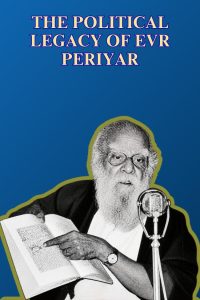
The Political Legacy of EVR Periyar

Archival Note

Published in Dalit Voice (Vol. 24, Issue No. 5, 1 March 2005), this essay by Rajendra of Ambedkar Pratishthana defends Periyar E.V. Ramaswamy against attempts to portray him as anti-Dalit. The essay recalls Periyar’s role in the anti-caste struggle, his break with the Congress and his relationship with Dr. B.R. Ambedkar. It asks the present generation to remember Periyar alongside Phule, Ambedkar and Shyam Sunder as part of the history of the anti-caste struggle.

The essay places particular emphasis on Periyar’s relationship with Ambedkar. It recalls Periyar’s efforts to bring Ambedkar into the Jat-Pat-Todak Mandal conference and the mutual respect between the two leaders. For Rajendra, Periyar’s importance lies in a politics of self-respect that directly challenged Brahminical social authority. He also presents Periyar within a wider Bahujan politics, arguing that Dalits and Backward Castes have a shared stake in fighting Brahminism. This makes the essay an important record of a political tradition that saw Ambedkar and Periyar as connected figures in the anti-caste movement rather than as representatives of opposing camps.

Published in September, the month of Periyar’s birth anniversary, the essay speaks to a contemporary tendency to divide anti-caste politics between Ambedkarite and Periyarist traditions, particularly in Tamil Nadu. That division can obscure the historical connections between the two movements and the different ways in which they confronted caste. Periyar’s emphasis on self-respect remains important because it locates caste oppression in the social relations and cultural authority that make hierarchy appear natural. His work also shows why anti-caste politics must challenge the ideas and institutions through which caste reproduces itself, alongside the struggle for political and legal rights. Revisiting Periyar through this history helps recover a broader anti-caste tradition in which his contribution and Ambedkar’s can be understood together without treating them as interchangeable.


Periyar E.V.R. As Champion Of Dalits

Periyar E.V. Ramaswamy is a leader of international repute and is hailed as a great thinker, reformer, revolutionary and humanist. The United Nations itself recognised this during his lifetime.

So any discussion on his sterling qualities and services to the oppressed people, victims of Brahminism, is ridiculous. Some Dalits under Brahminical influence have lately started branding Periyar as anti-Dalit. They should not be ungrateful to the extent of falsifying history itself. Dr. Ambedkar wanted his children to be sincere and truthful.

The present generation should know the history of their progress and the services and sacrifices of elders like Phule, Periyar, Babasaheb and Shyam Sunder.

Vaikom struggle: Periyar’s self-respect movement began in an aggressive way at Vaikom, in the present Kerala. It was on behalf of the Untouchable castes who were not allowed even to walk on a street right before a temple. Periyar rushed there and fought on their behalf.

This historic agitation led by Periyar attracted Muslim leader E.V.K. Abdulla and Christian leader Gorge Joseph. Gandhi, as a true Hindu, criticized Periyar for supporting the Untouchables. Sikhs came from Punjab and ran the free kitchen (langar). This will establish the truth of Periyar’s universal leadership.

Periyar was then arrested by the Trivancore state police and kept in prison for this agitation. Yet the agitation continued. Finally, the Untouchables won the right to walk on the road. This may not be a material gain, but a self-respect achievement for Untouchables. The agitation became famous as “Vaikom struggle”. Dr. Ambedkar wrote an Editorial about this historic achievement in his journal, Mooka Nayak.

Declaration to destroy Congress: The Congress, the original Brahmin party of India, passed a resolution in 1917 showing its concern for the welfare of Untouchables. M.K. Gandhi, the dictator of the Congress, claimed credit for this action of the Brahmin party. But the truth is Gandhi came to know about the British giving recognition to Untouchables and providing political rights based on the census of 1911, for which Prince Agha Khan was responsible.

From that day onwards, Congress started discussing social reforms in its sessions. But even such discussions were stopped when the Brahmins set fire to the Congress session pandal in Maharashtra. At the Madras session of the Congress, Periyar Ramaswamy, who was then an active worker of the Congress, forced a discussion on social problems, mainly Untouchability.

Rowdies engaged by Brahmins then dragged Periyar out of the pandal and thrashed him. Periyar declared on the spot that he would destroy the Congress in Tamil Nadu and he did it. The Congress is wiped out in Tamil Nadu.

Dr. Ambedkar respected Periyar: Dr. Ambedkar had great respect for Periyar and Periyar had respect for Dr. Ambedkar. It was Periyar who advised the organizers of Jat-Pat-Todak Mandal of Lahore, when they invited him to the conference, to invite Dr. Ambedkar, being a better person, well read, better informed and able to speak English.

Jat-Pat-Todak Mandal approached Dr. Ambedkar, who agreed and prepared a speech for the conference. But Gandhi planned his usual trick, which resulted in Dr. Ambedkar cancelling his engagement.

Later, Dr. Ambedkar got his speech published as a book, titled Annihilation of Caste.

Three greatest personalities: Some Dalit leaders are critical of Periyar just because he belonged to a Backward Caste. They also quote and misquote Dr. Ambedkar on the subject. They know only the title of this book. But they do not know the history behind this book.

Dr. Ambedkar always made it a point to meet Periyar when he visited Madras. One such visit was when Jinnah attended the Muslim League meeting at Madras. On this occasion, all the three greatest personalities of the day, Dr. Ambedkar, Jinnah and Periyar, met and discussed the Indian caste problem. A photo with these three taken during that meeting of the great statesmen is in my possession. Another important photo with me is of Periyar with the great Bheem Sena leader Shyam Sunder.

Birthday celebration in UP: Kanshi Ram is another great revolutionary of India. He organised the Bahujan Samaj Party which came to power in UP and celebrated Periyar’s birth anniversary.

Kanshi Ram knows who is who among the Bahujans. If Periyar had been anti-Dalit, as made out by some Dalits in Tamil Nadu, would India’s topmost Dalit leader praise Periyar? Similarly, our Editor has assigned the No.2 place to Periyar among the three greatest revolutionaries of “independent” India.

With all these facts, why do some Dalits call Periyar anti-Dalit? The mistake is not of Dalits but of the Backward Castes. It is easy to call it Brahminism.

The pity is the Backward Castes are the agents and foot-soldiers of Brahmins.

They ill-treated Dalits all over India, including Tamil Nadu, pushing Dalits to Islam at Meenakshi Puram 25 years ago. The BCs must mend their attitude towards Dalits, Muslims and Christians.

Dalits are duty bound to lead the entire Bahujan Samaj. That can be fulfilled only when BCs, at least the Most Backward Castes (MBC) like the barber, dhobi, potter, blacksmith etc., understand the importance of building Bahujan Samaj. Muslims and Christians also are distancing themselves from BCs. As an Ambedkarite, I call upon the BCs to join Dalits to fight Brahminism.

Periyar spent his whole life in this work for over half a century.
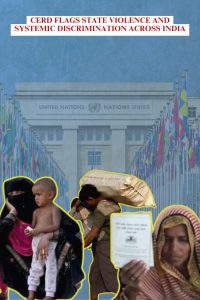
CERD Flags State Violence and Systemic Discrimination Across India

The UN Committee on the Elimination of Racial Discrimination (CERD) has raised serious concerns over the treatment of some of India’s most marginalised communities, including Dalits, Adivasi and tribal peoples, Rohingya, Bengali-speaking Muslims, migrants and asylum-seekers. Its findings follow the first review of India by the Committee since 2007 and examine the country’s combined 20th and 21st periodic reports under the International Convention on the Elimination of All Forms of Racial Discrimination.

The findings were issued after CERD’s 118th session, which also examined Finland, Honduras and Kuwait. This was part of the Committee’s regular review of states that have signed the Convention. CERD’s concluding observations are not court judgments and do not have the force of law. They assess how governments are implementing their obligations under the Convention and identify areas where the Committee finds serious problems.

In India’s case, CERD raised concerns spanning caste, ethnicity, religion, citizenship and policing. One of its gravest concerns was the alleged conduct of law-enforcement agencies towards Indigenous and Tribal Peoples, Scheduled Tribes, Scheduled Castes, particularly Dalits, ethnic and ethno-religious groups and non-citizens. CERD recorded reports of excessive force, racially motivated violence, extrajudicial killings, arbitrary and prolonged detention, torture, ill-treatment and sexual violence. It called for prompt, thorough and impartial investigations, with accountability where violations are established.

The reference to Dalits and Scheduled Castes also brings an older disagreement into the review. The Indian government maintains that caste should not be treated as equivalent to race or “descent” for the purposes of CERD. Its submissions nevertheless contain information on Scheduled Castes and Scheduled Tribes and measures intended to address their disadvantages. CERD’s treatment of caste within its examination of descent and discrimination places caste exclusion within the scope of the Committee’s scrutiny, even as the Indian state rejects that equivalence.

CERD also drew particular attention to Rohingya, Bengali-speaking Muslims, migrants and asylum-seekers. It noted an increase in law-enforcement operations involving these groups, particularly after a 2017 Home Affairs order and the April 2025 Pahalgam attack. Reports of police stops and identity checks based on racial profiling allegedly resulted in arbitrary arrests and detention, torture and other mistreatment. The Committee also raised concerns about deportations and forcible returns involving people who may require international protection.

During the review, CERD Country Rapporteur Stamatia Stavrinaki referred to independent monitoring that recorded more than 1,300 anti-Muslim hate-speech incidents in 2025, including recurring rhetoric attributed to senior officials. India’s delegation responded that legislation enacted in 2023 criminalises acts amounting to hate speech and hate crimes, with additional protections applying when offences target Scheduled Castes and Scheduled Tribes. It also pointed to freedom of religion as a constitutional guarantee.

But CERD’s observations focused on what these protections mean in practice. Alongside the government’s account of its legal safeguards, the Committee recorded concerns about discrimination, hate speech, violence and the conduct of law-enforcement agencies. It called on India to address hate crimes against Rohingya, Bengali-speaking Muslims, migrants and asylum-seekers, refrain from collective expulsions and ensure access to international protection. This includes respecting non-refoulement, the principle that people should not be returned to a place where they face a serious risk of persecution or other grave harm.

The findings also address citizenship and documentation. CERD noted the absence of adequate disaggregated data on Indigenous and Tribal Peoples, ethnic and ethno-religious groups, migrants, refugees, asylum-seekers and stateless people. It highlighted the categorisation of Bengali-speaking Muslims as “non-original inhabitants” and reports that they face more stringent scrutiny during National Register of Citizens verification. The Committee also noted that much of India’s available data on Scheduled Castes, Scheduled Tribes and refugees still derives from the 2011 Census, while acknowledging the delayed 2026 Census and its proposed collection of caste data through self-identification.

The treatment of Bengali-speaking Muslims in the NRC process raises a broader question about how citizenship is administered. CERD’s concern is not simply that documentation is required, but that particular ethnic and religious groups are reportedly subjected to different levels of scrutiny. In a political environment where Muslims are repeatedly cast as outsiders or demographic threats, administrative categories such as “non-original inhabitants” can acquire consequences beyond paperwork. The NRC thus becomes part of a wider system in which belonging is subjected to heightened state verification.

The concerns around Rohingya also sit within a longer history of UN scrutiny. A 2025 communication by UN Special Procedures carried allegations that deportation operations against Muslims, including Rohingya, intensified after the Pahalgam attack, involving raids, arrests, ill-treatment and forcible returns. Those allegations came through a separate UN process and were not findings by CERD or a judicial determination.

India is not a party to the 1951 Refugee Convention or its 1967 Protocol and has no comprehensive national refugee law. UNHCR therefore carries out protection-related functions for refugees and asylum-seekers in the country. This absence has become more significant alongside changes to India’s citizenship and immigration regime.

The Citizenship (Amendment) Act, 2019 was defended by BJP ministers as addressing the unfinished business or “wrongs” of Partition. Yet the CAA was not a refugee law. It created a religion-based route to accelerated citizenship for specified non-Muslim communities from Pakistan, Bangladesh and Afghanistan. It did not establish a general system of refugee protection based on persecution or the risk of serious harm.

And in 2025, Parliament enacted the Immigration and Foreigners Act, replacing four earlier laws governing the entry and treatment of foreign nationals. The new law consolidated the state’s immigration powers without creating a corresponding refugee protection framework. CERD’s call for protection against collective expulsions and respect for non-refoulement therefore comes alongside a strengthened legal machinery for controlling and removing foreign nationals, while India still lacks a dedicated process for determining who requires refugee protection. For Rohingya and other asylum-seekers, that leaves a basic question: what domestic procedure requires the danger they may face after removal to be considered before the state deports them?

India’s delegation, led by Solicitor General Tushar Mehta, defended the country’s legal framework and its claims of pluralism and equality. The government reiterated its position that caste should not be equated with race or “descent” under the Convention and pointed to legislation addressing hate speech and protections for Scheduled Castes and Scheduled Tribes.

CERD’s findings place those claims alongside reports of how state institutions operate on the ground. The Committee’s concerns cover law-enforcement violence against Dalits and Adivasi and tribal communities, anti-Muslim hate speech, racial profiling of Bengali-speaking Muslims and Rohingya, and the treatment of people whose citizenship or immigration status is under scrutiny.

For Dalit and Adivasi communities, and for Muslims and other minorities whose belonging is increasingly subjected to state scrutiny, the findings also expose how Hindu nationalism operates through state power. Caste discrimination, communal targeting, citizenship enforcement and policing are often treated as separate questions, even as they converge in the lives of communities whose relationship with the state is shaped by unequal power. CERD’s observations bring these questions into the same examination of discrimination and direct attention towards the institutions through which unequal treatment is carried out.

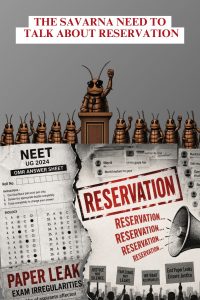
The Savarna Need to Talk About Reservation

Say what you will about the CJP protests against the NEET paper leak, everyone has already said that the immediate demands are not enough to change the education system. Education scholars are more likely to tell you about the 5-point charter submitted by the CJP to the Government of India. But one class of discourse generators is rattled by the protests themselves, or has been looking for an opportunity to vent its pre-existing frustrations or biases and has now found the perfect one . This is the oppressed castes’ general status and their tiresome, repeated, annoying rant against reservation.

This includes someone fabricating a fake post by actor Vijay Varma about his one non-reserved category friend suffering in some educational institution, which the pro-protest actor quickly said he had never posted. His acting in the anti-Mandal movement film Hurdang alongside Sunny Kaushal, however, may not have made his supposed stance difficult to believe had the post been genuine. Whether he posted it or not, and whether he believes the logic underneath that post, are different questions.

Mrunal Thakur, another actor, apparently posted a story on her Instagram account suggesting that the key moment that changed the game for everyone during these protests was NEET aspirant Harsh Dubey questioning the dominant narrative around the protests, arguing that the focus on the paper leak has overshadowed other longstanding issues in medical admissions. This was apparently a clip from a conversation with NDTV’s Shiv Aroor, where Dubey said questions around reservation policy and the difficulties faced by general category students also deserve public attention. Whether Mrunal Thakur will also come out and deny posting this is a matter of no one’s concern. Bollywood celebrities have shown their political illiteracy and general inhumanity more than once.

But this idea that neither the BJP nor the CJP wants to touch reservation, and that this is what led to the compromise, is one of those Savarna delusions burdened with so many argumentative flaws that a sane mind can hardly engage with it. To begin with, despite its classist and meritocratic articulation of the protests, the CJP does not appear to be opposed to reservation, partly reflected in its use of Ambedkarite symbolism, whether sincere or strategic. One also forgets that the BJP is a heterogeneous party with multiple caste groups and not simply Brahmins and other general category persons. There is no consensus on this question even within the Hindutva fold, something evident from the raita vs. trad debates that have long existed within their own ideological circles. To treat a single interview, one that merely regurgitates the most banal opinion circulating on the Savarna reactionary internet, as having played any pivotal role in shaping the protests is fantasy writing in its purest form.

But what is up with the casteist Savarnas? In a protest that brought together people from the non-protesting middle classes and celebrities, wherein status and privilege are also disproportionately held by oppressor castes, what has made the casteist Savarnas launch into their regular rant with great vigour? Are Savarnas simply waiting for any needle to move so they can carry their anti-reservation agenda? Are they simply incapable of shutting up for once?

Why, then, does every major public mobilisation touching education or even employment seem to invite an anti-reservation chorus from casteist Savarnas? The answer is not that reservation is secretly the central issue every time, like the Dubeys make it out to be. It is that reservation has become the preferred language through which sections of the Savarna public interpret almost every institutional crisis. Whenever a crisis emerges in education or public recruitment, reservation is summoned as the familiar explanation, even when it has little to do with the event itself. It is less a response to the facts before them than a political reflex.

This reflex performs an ideological function. It redirects public anger away from institutions and towards beneficiaries of affirmative action. A paper leak points towards failures of governance, regulation, corruption, examination agencies, and political accountability. None of these explanations preserve the moral authority of the existing Brahminical social order. Reservation, on the other hand, offers an already available narrative; and if Savarna public discourse has shown anything, it is that they love readily available labour, intellectual and otherwise. The next generation of casteists also lack imagination and will rely on the intellectual dis-labour of their Savarna forefathers.

These complaints are very vapid. They transform a structural failure into a grievance against redistributive and representational justice. Instead of asking why an examination system repeatedly fails millions of students, they ask who supposedly enjoys unfair advantages, even though the empirical facts reveal it is they who do. The institution escapes scrutiny because caste once again becomes framed as the problem only when it attempts to correct itself.

There is another reason why these moments are politically useful. Large protests produce so much uncertainty. They reopen public debate and create the possibility that questions long considered settled may be discussed again, especially now that social media has permitted everyone to have an opinion, for good and bad alike. For anti-reservation voices, this is an opportunity to attach their long-standing campaign to a movement that was never organised around their demands. They seek legitimacy through proximity of discourse. If enough people begin associating educational injustice with reservation rather than with state failure, the moment gets a new meaning.

This explains why Harsh Dubey’s interview came to acquire symbolic importance far beyond its actual place in the protests. It offered something many casteist Savarnas had been waiting for: an apparently articulate voice on national television through which they could restate arguments that have circulated for decades. Reservation disrupts the comforting belief that educational success reflects individual merit alone. Every conversation about admissions threatens to reopen the history of caste privilege that made merit appear natural in the first place. It is therefore unsurprising that even a movement against examination malpractice becomes, for some, another occasion to defend inherited advantages while presenting themselves as victims of an unjust system. The anti-reservation discourse surrounding the NEET protests tells us less about the movement than about the persistence of Savarna political common sense.


DalitThinkerToday is a Chartered Accountant by profession from Sangli, Maharashtra, who occasionally dabbles in thinking about politics when people in her oppressor-caste-majority office frustrate her. This is her pseudonym.

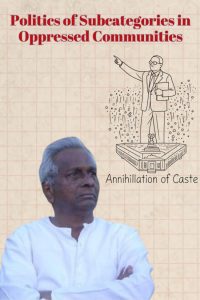
Politics of Subcategories in Oppressed Communities

Archival Note

Published in Dalit Voice (Vol. 17, Issue No. 11, 16 April 1998), this essay enters debates over whether oppressed communities should relinquish their jati identities as part of the struggle against caste. Rajshekar argues that such demands misunderstand the relationship between caste hierarchy and the identities of historically oppressed communities, and questions whether calls for caste abolition are being applied equally across society.

Building his argument through a close reading of Dr. B.R. Ambedkar’s discussion of subcastes in Annihilation of Caste, Rajshekar contends that abolishing subcastes without dismantling the caste order would strengthen existing hierarchies. He therefore defends jati identity as a political question rather than treating it as an obstacle to emancipation.

The latter part of the essay draws on examples from Kerala to argue for separate representation within the Scheduled Castes and questions the classification of some communities under the reservation system. These assertions reflect Rajshekar’s interpretation and should not be read as established historical or legal fact.


Debate On “Jati” Identity


Subcaste abolition will strengthen Hindus & their caste system: Dr. Ambedkar

Our fake democrats, socialists, and other savarna outfits say: “Don’t ask about caste, don’t think about caste, and don’t talk about caste.” They repeat this mantra through their media, so much so that our innocent Dalits and BCs, who are the original victims of the caste system, have also started repeating this very same mantra. As they are the original victims of the caste system, they want to annihilate this devilish system. That is why, when the savarnas just whisper about destroying caste, the Dalits and BCs shout and scream. But why are the savarnas (Hindus), who are the beneficiaries of the caste system, advising only Dalits not to ask about caste, not to think about caste, and not to talk about caste? Are the Hindus willing to surrender the benefits of their caste system? Will they lead a movement, the ultimate result of which will destroy the power and prestige of the savarnas? This is a serious question that we Dalits and BCs have to answer.

CALL TO ELAVAS

No Pope can be a revolutionary. Similarly, no upper-caste man can be a revolutionary. The source of his income, power, prestige, and property is his caste system. So, can he think sincerely of destroying caste? Still, he talks about destroying caste. Why? This is where we become suspicious of his motive. While they call upon us to destroy our caste, what they actually mean is to destroy our ethnic identities, but not their caste system. When they say yes, they actually mean no, and vice versa.

Sree Narayana Guru, the liberator of the Elavas of Kerala, once said:

“Don’t ask about caste, don’t think about caste, and don’t talk about caste,” but his disciple, Sahodharan Ayyappan, the most revolutionary among the disciples of Sree Narayana Guru, reversed the statement and said: “We must always ask, think, and talk about caste.”

USE THORN TO REMOVE THORN

Caste is a thorn in the body of our society. So, we have to use another thorn to remove this thorn. After its removal, we will discard both the thorns. We have lost all human rights due to the caste system. So, we must use the very caste to regain our human rights. Only after we regain all human rights can we think of the removal of caste.

The fact is, we (SC/ST/BCs) have no caste because we are not Hindus. As the original inhabitants of India, what we have are our ethnic identities, which are not caste. Our Editor is right. We are not Hindus. So, destroying caste is not our duty. It is the duty of Hindus.

While they go on strengthening their own evil caste, why are they interested in destroying our ethnic identities like the Pulaya (Pariah), Elava, etc.? This is the puzzle. The fear of the upper castes is that our caste consciousness may help us regain our lost human rights. That is why they advise us to destroy our caste (ethnic identities). For this, they want to destroy our “subcastes” first, which are our ethnic identities. When they use the word “subcaste,” they make us think that we are a part of the Hindu caste system. They know that when we destroy our “subcaste,” we will lose our identity, join the Hindu caste system, and become their most obedient slaves.

INNOCENT DALITS MISLED

Some innocent Dalits also join this Hindu anti-caste campaign. For this, they want us to give up our “sub-caste” first and unite all subcastes in the name of “Dalit.” But can they destroy our identity? Never. Is it a true solution to get our human rights? No. Babasaheb says:

“But assuming that the fusion of subcastes is possible, what guarantee is there that the abolition of subcastes will necessarily lead to the abolition of castes? On the contrary, it may happen that process may stop with the abolition of subcastes. In that case, the abolition of subcastes will only help to strengthen the castes and make them more powerful and therefore far more mischievous. This remedy is, therefore, neither practicable nor effective and may easily prove to be a wrong remedy.” (W&S Vol. 1, p. 67).

Here Babasaheb says that if we abolish the subcastes, it will only help to strengthen the caste system and make the Hindus more powerful.

That means, when we strengthen the subcastes, the Hindu caste system will be destroyed and Hinduism itself will be abolished. That is why the savarnas call upon us to destroy our caste, meaning our ethnic identity, so that enslaving the entire indigenous Dalits and BCs becomes easy.

Some Dalits may have a genuine doubt that when we strengthen our subcaste identity, our people may get divided and fight, which in turn may destroy the very “Dalit concept” and “Dalit unity.” If our people are fighting each other even now on the basis of subcastes, it is not because of these subcastes but because they are Hinduised. They also think that they are Hindus. That is why each subcaste thinks that it is “superior” to other subcastes.

The fighting is not because of our subcastes but because of this wrong notion of superiority or inferiority that they copied from Hindus.

When we educate our people on Ambedkarism and Buddhism, remove the “Hindu mind” from their brains, they will know that we are all different but equal. Each community should recognise the human rights of other communities.

Strengthening the “caste identity,” without proper education, will be a dangerous thing for the Dalits and BCs.

KERALA SCENE

How do we ensure the human rights of each and every subcaste? The good old democratic principle is by giving adequate representation to every subcaste in every field. Otherwise, only the powerful subcaste will gain everything at the cost of other weaker subcastes.

In Kerala, the Pulaya subcaste is the biggest of all other Dalit subcastes. The word “Pulayan” means the owner of the land, peasant, intellectual, etc. Now, as they have lost all their lands, the meaning of the word Pulaya is landless people. They have become the most depressed class in Kerala. The Paraya (Pariah) subcaste is also depressed and landless. They were scavengers in Kerala. Pulaya, Paraya, Valluva, Nayadi, and Chakliyas are the most depressed classes in Kerala. All these subcastes have no adequate representation in the governance of the state.

In Kerala, there are 68 subcastes in the list of Scheduled Castes.

In this list, there are so many subcastes that should actually have been included in the BC list because they are socially and economically forward.

K.R. NARAYANAN IS FORWARD

Recently, I examined the reservation list of some educational institutions, especially in MBBS and Engineering. I could find hardly two or three SC candidates who actually hail from the most downtrodden people of Kerala, i.e., Pulaya, Paraya, Chakliya, etc. Even the MLAs and MPs from reserved constituencies are actually from the forward communities but included in the SC list. This is a serious injustice to the SCs.

President K.R. Narayanan belongs to the Parava community (not Pariah). This community should have been included in the BC list. The Paravas were not unseeables but only Untouchables like the Elavas of Kerala. The hereditary occupation of the Parava women was washing, and hence they were not Untouchables.

In my area, the Paravas behave like the savarnas and discriminate against the Pulayas, Parayas (Pariah), and other Untouchables. They will not even invite these communities to their marriages. There are so many communities in the SC list who behave like the savarnas. They treat the SC people with contempt. In a fight between an SC and a savarna, they side with the savarnas. And yet, they are having all facilities, including reservations, in the name of SC. But at the same time, they will not join us in our struggle for our human rights. The original SC people are fighting and fighting without gaining anything. The benefit goes to other people who oppose and insult them in society. I have no doubt that if the original SC people understand these facts, they will demand adequate representation for each subcaste.

I can tell you that among those who are in the forefront of the “caste annihilation campaign,” we can find many such touchable SC castes. Hindus use these touchable SC subcastes to criticise our Editor’s “caste identity” thesis.

So, to end these problems, each and every subcaste must get proportional representation in every field according to its population in the governance of the country.

On May 31, 1936, Babasaheb organised a Mahar conference in Bombay. Does it mean that he hated other subcastes? What we should build between different subcastes is fraternity (brotherhood). When we fight for our human rights, we cannot oppose the human rights of other communities. This is what our Editor means when he advocates “caste identity.”

All over the world, we can see thousands of ethnic identities. None is interested in destroying its identity. Then, why should we alone destroy our identity?

However, our ethnic identities are not jati or caste. Our people are imitating the Hindus, thinking that they are Hindus. That is why some innocent, unthinking Dalits demand the destruction of our caste.

CASTE SYMBOLISES IDENTITY

What we want to destroy is the casteism of Aryans and also non-Aryans. Destroying our identity means destroying our soul. So, we must think and talk about caste, whether it is Aryan or non-Aryan.

If the upper-caste people do not use their caste identity, how can we identify them, whether it is a cobra or a rat snake? Without identifying our Enemy first, we cannot fight the Enemy.

So, ask, think, and talk about caste for liberation. Remember, as we strengthen our identity, we should also enlighten our people on Ambedkarism and Buddhism.

Our upper-caste rulers acquired everything by their communal thinking. We also can have everything in the same way. So, we too must be communalists.

That means we must love our people.

The savarnas advise us to love the enemy. We must know the trap behind this advice. They know very well that we consider them our Enemy. That is why they ask us to love the enemy. How can we fight our enemy when we don’t hate this Enemy? If we don’t hate the Enemy, we cannot fight and secure our liberation. So, we must hate our Enemy. It is our right to hate and fight our enemy to win our liberation.

What the enemy hates, we must love, and what the enemy loves, we must hate.

Then only will we get a clear picture of the Enemy’s mind. That is why, when they ask us to destroy our caste, we say no. That is why, when they ask us to love our enemy, we oppose it.

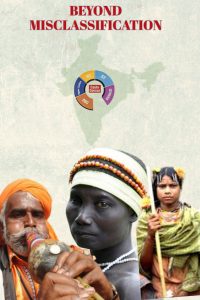
Beyond Misclassification: Why Denotified Tribes Need a Separate Constitutional Schedule

In 2027, India will undertake a caste enumeration for the first time since 1931. For Denotified, Nomadic, and Semi Nomadic Tribes, this moment carries a weight that goes far beyond bureaucratic exercise. Community leaders have secured an assurance from the Union government that these groups will be enumerated in the upcoming Census. Yet there is no clarity on how this enumeration will occur, and no commitment to a separate column in the Census form. For communities whose very history is one of erasure and stigma, the difference between being vaguely “included” and being specifically counted is the difference between visibility and continued disappearance.

Denotified Tribes, commonly referred to as DNTs, are communities that were once branded as “criminal tribes” under the colonial Criminal Tribes Act of 1871. That law empowered the state to register, surveil, and control entire communities on the presumption that criminality was hereditary. The Act was amended in 1924 and finally repealed in 1952. With repeal came “denotification”, but not dignity. The label changed, the suspicion remained. Soon after independence, many States enacted Habitual Offenders laws, which enabled continued police targeting of members of these communities. The colonial imagination of the “born criminal” quietly survived inside the postcolonial state.

Enumeration has always been central to their oppression and their exclusion. From 1911 onwards, colonial Census reports explicitly counted “criminal tribes”. The 1931 Census was the last time these communities were distinctly enumerated. After independence, the Republic chose not to enumerate castes beyond Scheduled Castes and Scheduled Tribes. In principle this was framed as a break from colonial caste fixation. In practice, it meant that communities who had been stigmatized as criminals vanished statistically. A people once over counted for surveillance became under counted for justice.

Over the decades, most DNT communities were absorbed into the categories of Scheduled Castes, Scheduled Tribes, or Other Backward Classes. The most recent National Commission for Denotified, Nomadic, and Semi Nomadic Tribes, headed by Bhiku Ramji Idate, identified nearly 1,200 such communities. It also found that around 268 DNT communities had not been classified in any of these categories. The Commission made clear that without an accurate enumeration, policy would continue to operate in the dark. It was not the first to say so. Successive commissions, including the earlier Renke Commission, began with the same problem: before welfare, there must be identification.

The current demand for a separate Census column arises from lived experience of what community leaders describe as political misclassification. When DNTs are folded into the SC, ST, or OBC lists, they are forced to compete with larger and often more politically organized communities within those categories. In many regions, denotified and nomadic jatis remain among the most educationally and economically deprived, yet they are statistically indistinguishable from groups with far greater access to resources and representation. Leaders from north India point to villages where not a single member of certain denotified communities has completed secondary education, despite being listed as SC for decades. Formal inclusion has not translated into substantive equality.

The argument now being made is not simply for recognition, but for graded recognition. Community leaders have begun to invoke the Supreme Court’s 2024 judgment permitting sub classification within SC and ST categories. They argue that even if sub classification is operationalized within existing lists, it will not address the specific stigma of denotification. The demand is for a separate Constitutional Schedule for DNTs, on par with the existing SC and ST Schedules, along with internal sub classification to account for graded backwardness between settled and nomadic denotified communities. The point is not symbolic parity but structural correction.

The distinction between settled and nomadic DNT communities is not trivial. According to accounts presented before commissions, until the 1960s most denotified communities were similarly placed in conditions of deprivation. Over time, some settled groups were able to leverage land, local networks, or small enterprises to improve their situation marginally. Nomadic and semi nomadic communities, lacking fixed residence, documentation, and access to schooling, were left further behind. Without internal differentiation, a uniform policy risks reproducing internal hierarchies within the DNT category itself.

The state’s existing welfare approach has demonstrated the limits of piecemeal intervention. The Social Justice Ministry’s SEED scheme was designed to support DNTs in education, health, housing, and livelihood. Yet in the last five years, only a fraction of the planned expenditure has been utilized. As is increasingly visible across affirmative action and social justice programmes, the egalitarian edge of such schemes has been administratively diluted. However, a principal reason for this failure is bureaucratic paralysis around certification. To access benefits, individuals must possess a DNT certificate, even if they are already classified as SC, ST, or OBC. Many States simply do not issue such certificates. In effect, the state announces schemes for a category it refuses to formally recognize. The result is predictable. Benefits reach a minuscule fraction of those intended.

This administrative failure is not accidental. Without a clear Constitutional status or a separate Census code, DNTs exist in a grey zone. They are recognized enough to be invoked in speeches, but not recognized enough to command uniform policy implementation. Associations such as the All India Denotified Nomadic Tribes Development Council have repeatedly emphasized that wherever they approach courts or governments, the first question posed is numerical strength: How many are you? In the absence of official data, estimates vary wildly. Some leaders claim crores in a single State. The truth is that no one knows properly. In a democracy that allocates representation and resources through numbers, ignorance is exclusion.

The moral and political stakes are higher than administrative design. The original branding of these communities as criminal was not an incidental error. It was a tool of governance rooted in caste ideology and colonial control. To be marked as criminal by birth is to be denied the presumption of innocence that underpins modern citizenship. Denotification in 1952 did not come with an institutional apology, reparations, or structural safeguards against continued profiling. Instead, Habitual Offenders laws and everyday policing practices reproduce suspicion that continue till date across judicial and policing contexts. The stigma has seeped into schooling, employment, and housing. It has hardened into social fact.

Against this history, the promise of enumeration without clarity is inadequate, a familiar strategy through which governments acknowledge caste without confronting its structural consequences. If DNTs are merely to be counted under pre existing SC, ST, or OBC headings, their specific trajectory of criminalization and denotification will once again dissolve into larger aggregates. Critics may argue that creating a separate Schedule risks proliferating categories which often is worrying because of the expanding powers allowed to the state to regulate. But according to the DNT activists, a separate column in the Census is not an exercise in identity fragmentation. It is a demand for empirical truth. It is a claim that policy must correspond to history. Without distinct data, there can be no targeted allocation, no evaluation of outcomes, no accountability.

What stands before the government is a simple choice. It can treat the 2027 Census as a technical formality and subsume DNTs within existing codes. Or it can confront a century and a half of stigmatization by ensuring that these communities are distinctly counted and constitutionally recognized. In a republic that claims to have broken with colonial injustice, it is indefensible that the descendants of those once branded hereditary criminals must still beg to be seen as a category of citizens. With so many anti-caste hopes pinned onto the upcoming Census, this is not a minor technical demand. It is a test of whether the Republic is prepared to reckon with the communities it once marked as criminal and then has forgotten. If counting determines power in a broken democracy, then refusing to count is continuing violence.


Paresh Hate is a Bahujan queer researcher, writer, documenter and activist and the Lead Content Manager at Dalit Voice.