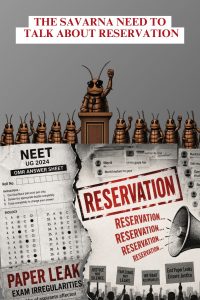
The Savarna Need to Talk About Reservation

Say what you will about the CJP protests against the NEET paper leak, everyone has already said that the immediate demands are not enough to change the education system. Education scholars are more likely to tell you about the 5-point charter submitted by the CJP to the Government of India. But one class of discourse generators is rattled by the protests themselves, or has been looking for an opportunity to vent its pre-existing frustrations or biases and has now found the perfect one . This is the oppressed castes’ general status and their tiresome, repeated, annoying rant against reservation.

This includes someone fabricating a fake post by actor Vijay Varma about his one non-reserved category friend suffering in some educational institution, which the pro-protest actor quickly said he had never posted. His acting in the anti-Mandal movement film Hurdang alongside Sunny Kaushal, however, may not have made his supposed stance difficult to believe had the post been genuine. Whether he posted it or not, and whether he believes the logic underneath that post, are different questions.

Mrunal Thakur, another actor, apparently posted a story on her Instagram account suggesting that the key moment that changed the game for everyone during these protests was NEET aspirant Harsh Dubey questioning the dominant narrative around the protests, arguing that the focus on the paper leak has overshadowed other longstanding issues in medical admissions. This was apparently a clip from a conversation with NDTV’s Shiv Aroor, where Dubey said questions around reservation policy and the difficulties faced by general category students also deserve public attention. Whether Mrunal Thakur will also come out and deny posting this is a matter of no one’s concern. Bollywood celebrities have shown their political illiteracy and general inhumanity more than once.

But this idea that neither the BJP nor the CJP wants to touch reservation, and that this is what led to the compromise, is one of those Savarna delusions burdened with so many argumentative flaws that a sane mind can hardly engage with it. To begin with, despite its classist and meritocratic articulation of the protests, the CJP does not appear to be opposed to reservation, partly reflected in its use of Ambedkarite symbolism, whether sincere or strategic. One also forgets that the BJP is a heterogeneous party with multiple caste groups and not simply Brahmins and other general category persons. There is no consensus on this question even within the Hindutva fold, something evident from the raita vs. trad debates that have long existed within their own ideological circles. To treat a single interview, one that merely regurgitates the most banal opinion circulating on the Savarna reactionary internet, as having played any pivotal role in shaping the protests is fantasy writing in its purest form.

But what is up with the casteist Savarnas? In a protest that brought together people from the non-protesting middle classes and celebrities, wherein status and privilege are also disproportionately held by oppressor castes, what has made the casteist Savarnas launch into their regular rant with great vigour? Are Savarnas simply waiting for any needle to move so they can carry their anti-reservation agenda? Are they simply incapable of shutting up for once?

Why, then, does every major public mobilisation touching education or even employment seem to invite an anti-reservation chorus from casteist Savarnas? The answer is not that reservation is secretly the central issue every time, like the Dubeys make it out to be. It is that reservation has become the preferred language through which sections of the Savarna public interpret almost every institutional crisis. Whenever a crisis emerges in education or public recruitment, reservation is summoned as the familiar explanation, even when it has little to do with the event itself. It is less a response to the facts before them than a political reflex.

This reflex performs an ideological function. It redirects public anger away from institutions and towards beneficiaries of affirmative action. A paper leak points towards failures of governance, regulation, corruption, examination agencies, and political accountability. None of these explanations preserve the moral authority of the existing Brahminical social order. Reservation, on the other hand, offers an already available narrative; and if Savarna public discourse has shown anything, it is that they love readily available labour, intellectual and otherwise. The next generation of casteists also lack imagination and will rely on the intellectual dis-labour of their Savarna forefathers.

These complaints are very vapid. They transform a structural failure into a grievance against redistributive and representational justice. Instead of asking why an examination system repeatedly fails millions of students, they ask who supposedly enjoys unfair advantages, even though the empirical facts reveal it is they who do. The institution escapes scrutiny because caste once again becomes framed as the problem only when it attempts to correct itself.

There is another reason why these moments are politically useful. Large protests produce so much uncertainty. They reopen public debate and create the possibility that questions long considered settled may be discussed again, especially now that social media has permitted everyone to have an opinion, for good and bad alike. For anti-reservation voices, this is an opportunity to attach their long-standing campaign to a movement that was never organised around their demands. They seek legitimacy through proximity of discourse. If enough people begin associating educational injustice with reservation rather than with state failure, the moment gets a new meaning.

This explains why Harsh Dubey’s interview came to acquire symbolic importance far beyond its actual place in the protests. It offered something many casteist Savarnas had been waiting for: an apparently articulate voice on national television through which they could restate arguments that have circulated for decades. Reservation disrupts the comforting belief that educational success reflects individual merit alone. Every conversation about admissions threatens to reopen the history of caste privilege that made merit appear natural in the first place. It is therefore unsurprising that even a movement against examination malpractice becomes, for some, another occasion to defend inherited advantages while presenting themselves as victims of an unjust system. The anti-reservation discourse surrounding the NEET protests tells us less about the movement than about the persistence of Savarna political common sense.


DalitThinkerToday is a Chartered Accountant by profession from Sangli, Maharashtra, who occasionally dabbles in thinking about politics when people in her oppressor-caste-majority office frustrate her. This is her pseudonym.
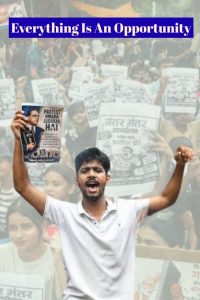
Everything is an Opportunity

The protests against the irregularities and paper leak in the NEET examination brought thousands of students, parents and supporters onto the streets. The scale of participation, including the visible presence of sections of the middle classes, public figures and artists, reflected a growing willingness to challenge institutions that many increasingly perceive as opaque and unaccountable. That widening participation deserves recognition. It signals that concerns over public education are no longer confined to those who have historically borne the burden of institutional failures.

Yet the state’s response once again demonstrated a familiar pattern. Lathi charges, water cannons, tear gas, detentions, surveillance and criminal cases against protesters indicate that even peaceful demonstrations continue to be treated through the language of policing rather than democratic engagement, no matter how much the protesters try to facilitate dialogue. The violence of the state is not merely reactive to dissent; it is constitutive of its authority and often pre-emptive in its operation. By acting before grievances can acquire wider political legitimacy, it seeks to cast suspicion upon and diminish the credibility of citizens’ claims. Such responses are not isolated excesses but part of a broader tendency in which coercive measures take precedence over any meaningful assessment of public grievances. This pattern is all too familiar for the Muslims, Dalits, workers, and other oppressed communities in the country now. It is no wonder that many of them continue to remain skeptical of this movement even as they lend their solidarity.

The protests have also unfolded within a now routinised political script. Peaceful public mobilisation quickly became an opportunity for the mainstream Godi media to manufacture misinformation, while the state treated the moment as another justification for expanded policing. The original concerns were steadily displaced in newsrooms by manufactured debates over alleged anti-nationalism and public disorder, even as protesters have taken to social media to repeatedly redirect attention to the issues that first brought them to the streets.

Recognising this reality, however, also requires asking difficult questions of protest movements themselves. Large numbers are not only a measure of organisational success; they are also a political responsibility. Every mass mobilisation creates a temporary public capable of imagining new forms of solidarity and new political possibilities. Leadership therefore involves more than maintaining order or ensuring that a demonstration appears respectable. It also involves shaping how participants understand the broader structures within which their immediate grievance exists. But the organisers from CJP have recently shown a remarkable abdication of this responsibility, even as they may be doing so with sincere efforts to protect the movement.

Over the last decade, many protests have come to treat the expression of dissent as an end in itself. In a political climate where public assembly is increasingly surveilled and criminalised, simply occupying the streets and making disagreement visible has acquired democratic significance. That impulse should not be dismissed. But if protests are to aspire to more than bearing witness, they must also confront the difficult question of what political consequences their strategies are intended to produce. The NEET protests, however, did not appear content with symbolic dissent alone. The CJP seems to have approached the movement through a strategic lens, making choices that they believed would improve its chances of achieving concrete outcomes. That is a welcome departure.

The question is whether that strategic calculation expands or contracts the political horizon of the movement. The current strategy of CJP and other organisers does not merely reduce immediate risk; it also diminishes what that movement is capable of becoming. The logic of this strategy leads us towards an ever-receding political horizon, where each concession made in the name of prudence leaves less space for political imagination than the one before. This is where the limitations of a politics centred primarily on respectability become apparent. In the effort to appear reasonable, the strategic moderation may ultimately concede more ground than it preserves. The state does not necessarily refrain from coercion because a movement carefully disciplines itself. Recent history offers little evidence for such confidence.

Many of the choices made reflect a strategic calculation about what constituted acceptable dissent. Expressions of solidarity with incarcerated activists such as Umar Khalid and other Muslims facing prolonged imprisonment were rejected. Attempts to build common cause with other democratic movements such as farmers coming to Delhi on 22 July were resisted, with suggestions that different protests remain physically and politically separate. Participants were instructed on which slogans were permissible, even as some of the approved slogans drew upon nationalist idioms that have, over the last decade, become closely associated with Hindutva politics. The movement also declined to articulate a broader political critique of fascism and majoritarianism or the present government’s treatment of democratic dissent. This was not simply an omission of rhetoric; it marked a refusal to locate the immediate crisis within the wider political conditions that shape how public institutions function and how protests against them are received. Its demands also remained underdeveloped at the structural level. The crisis invited a broader interrogation of the National Testing Agency as an institution and of the direction of educational reforms under the National Education Policy by this government. Instead, the movement largely remained confined to the immediate failures surrounding the paper leak. Many of these suggestions have been made by leftist members of the movement who have been foregrounding these demands for years.

The movement’s current demands combine institutional accountability and immediate relief. They have called for the resignation or dismissal of Union Education Minister Dharmendra Pradhan, the immediate release of Sonam Wangchuk without restrictions on his movement, compensation of ₹1 crore for the families of NEET aspirants who died by suicide following the paper leak, and the withdrawal of all FIRs and legal action against those who participated in the July 20 protest. These are necessary demands, and each deserves to be pursued. But they cannot be mistaken for a sufficient response to the structural crisis of India’s education system. If these demands are achieved without an equally substantive agenda for what follows, the political leverage created by the protests risks dissipating before it can be translated into structural reform.

Equally troubling dynamics from the protest also must be interrogated. The willingness to hand over protesters deemed disruptive or excessively angry to the police without publicly articulating clear criteria for doing so is a decision that demands careful scrutiny. Any movement must protect participants from harassment and deliberate sabotage. But when those distinctions remain opaque, the police are effectively invited to regulate the boundaries of acceptable dissent within the protest itself. Expanding police discretion over who belongs and who does not, in a context of police violence, carries significant political consequences.

Similarly, symbolic gestures such as serving refreshments or showing kindness towards police personnel may reflect genuine human concern, and recognising the difficult conditions under which many lower-ranking officers work is neither unreasonable nor incompatible with criticism. Yet these gestures cannot obscure the structural reality that the police operate as instruments of state power and are institutionally equipped with resources and authority unavailable to ordinary citizens. Empathy for individual officers should not come at the cost of depoliticising the institution they serve.

None of this diminishes the importance of the NEET protests or the courage of those who participated in them, including the organisers, who transformed what began as a meme page into one of the country’s most significant student mobilisations in the recent past. On the contrary, their significance lies precisely in the possibility they opened. The question is whether that possibility ends with registering public anger or extends towards building broader democratic solidarities capable of confronting the structures that repeatedly produce such crises. Every protest is liable to become an opportunity for the police to exercise violence, for Godi media to manufacture misinformation, and for the government to expand its coercive powers. These are calculations movements cannot control. What they can control is whether their own strategies continually retreat before them, or instead expand the political imagination of those who have come together in hope.