
The Right Not to Sing

Nationalist Demands in the New Law

The Prevention of Insults to National Honour (Amendment) Bill, 2026 was introduced by Amit Shah in the Rajya Sabha on 24 July 2026. Its Statement of Objects and Reasons recalls that Rajendra Prasad, as President of the Constituent Assembly, said on 24 January 1950 that Vande Mataram would be “honoured equally” with Jana Gana Mana. It notes that no legal provision existed to prevent interference with the singing of the National Song and proposes to address this by amending Section 3 of the 1971 Act, which already made intentionally preventing the singing of the National Anthem, or disturbing an assembly engaged in singing it, punishable with imprisonment of up to three years, a fine, or both, with a mandatory minimum of one year for a second and subsequent conviction. The amendment extends that same offence, and the same penalties, to the National Song. Article 51A(a) names the Constitution, the national flag and the national anthem as objects of citizens’ respect; it has never named the National Song.

The amendment arrived alongside a separate, longer-running push to change what gets sung. Vande Mataram has six stanzas; since 1937, only the first two have been used at national gatherings, a convention set by the Congress Working Committee. The Ministry of Home Affairs had already moved to reverse that convention on its own, issuing a protocol on 28 January 2026 requiring the full six-stanza version at government, ceremonial and cultural events, well before this amendment existed. That protocol was advisory and, as the courts would go on to hold twice over the following months, carried no penalty of its own. Only after those two challenges failed did the government tighten the position twice more: a July 9 MHA letter to all states specifying that only the official six-stanza version could be recited whenever the song was sung in mass singing, and then, on 24 July, the amendment itself. Where both the song and the anthem are performed at one event, Vande Mataram now goes first. Schools are directed to open assemblies with it, although many schools already practiced this of their own volition. It is to be played at state functions, civilian award ceremonies, flag-hoisting events, and the arrivals and departures of the President and Governors.


The Political Fight Over the Song
The push for the full six-stanza version followed a ten-hour special discussion in the Lok Sabha in December 2025 marking the song’s 150th anniversary, in which the Prime Minister accused the Congress of having “sowed the seeds of division” by trimming the song. In 1937, the Congress Working Committee, after consultation with Mohandas Gandhi, Jawaharlal Nehru, Rabindranath Tagore, Subhas Chandra Bose, Rajendra Prasad and Vallabhbhai Patel, decided that only the first two stanzas would be used at national gatherings because of objections to the religious imagery in the later verses. Tagore had written to Nehru that the first two stanzas had “acquired a separate individuality and an inspiring significance of its own,” while the later verses, read in context, “[are] liable to be interpreted in ways that might wound [Muslim] susceptibilities.” Congress rejected the Prime Minister’s charge, pointing to this 1937 decision and Tagore’s letter and accusing the government of manufacturing the controversy for present gain in the context of then upcoming elections, a charge Priyanka Gandhi Vadra made directly. The Congress Working Committee has since reaffirmed the two-stanza position for its own party programmes.

The dispute has now also moved into a question of federal authority after the Karnataka government ordered on 8 September that only the first two stanzas be sung at state government programmes, except when the President, Vice-President, Prime Minister or Governor is present. Within days, advocate Girish Bharadwaj filed a PIL challenging the state’s authority to prescribe a shorter version, arguing that the matter falls within Parliament’s residuary legislative powers and that the state order conflicts with the 2026 amendment to the Prevention of Insults to National Honour Act. The petition also challenged the procedure by which the Karnataka Cabinet took the decision, alleging that it was approved as an “Informal Discussion” without a Cabinet Note or Law Department advice. Governor Thaawarchand Gehlot then wrote to Chief Minister D.K. Shivakumar, invoking Articles 162, 256 and 257(1) and asking the government to reconsider its order on the ground that it conflicted with the Union’s statutory and executive framework. On 16 September, BJP MLA S.N. Channabasappa walked out of a government programme in Shivamogga after only the first two stanzas were sung.

The opposition, however, has also been weak in resisting the Centre’s position. In Kerala, the Congress-led UDF government initially circulated the Centre’s instruction that Vande Mataram be sung in full during the Har Ghar Tiranga campaign from 9 to 17 August. This put a Congress-led government in the position of appearing to implement the same six-stanza version promoted by the BJP-led Union government, despite Congress’s objections to treating the full version, with its references to Hindu deities, as a compulsory expression of national identity. The CPI(M) criticised the UDF’s position, with Leader of the Opposition Pinarayi Vijayan arguing that the song “in its entirety is not compatible with secularism” and that “there is nothing wrong with reciting the opening stanzas”, and accusing the UDF of surrendering to an RSS agenda. The UDF subsequently clarified that it would not follow the full version, and the state government ultimately omitted Vande Mataram from its official Independence Day function.

The song’s meaning has remained contested within the communities whose religious commitments are most directly implicated by it, a history the government’s “everybody knows what is national song” formulation simply passes over. The distinction made in 1937 remains central to the dispute: the Congress Working Committee accepted the first two stanzas for national gatherings while recognising objections to the later verses and their religious imagery. Muslim religious authorities have continued to make this distinction. Darul Uloom Deoband and Maulana Mahmood Madani have objected to the later verses on the grounds that their depiction of the motherland as divine conflicts with the Islamic doctrine of tawhid, while the All India Sunni Ulema Board ruled in 2006 that Muslims could sing the first two stanzas.

The dispute, however, has not been confined to Muslim objections. During the 2006 centenary controversy, the Shiromani Gurdwara Parbandhak Committee initially instructed its schools not to sing Vande Mataram, with its president arguing that it promoted a particular religion and did not fulfil the aspirations of minorities, before subsequently backing away from that position. In 2026, the Andhra Pradesh Christian Leaders Forum objected to the newly mandated full version, specifically citing its references to Durga and their implications for Christian beliefs. The question is therefore not simply whether Vande Mataram is the national song, but what religious content the state is asking people to affirm when it mandates the complete text. The Home Ministry’s circular treats that underlying question as though it had never been contested. Where it does allude to the religious objection, it reduces it to a question of Muslim reluctance, allowing a disagreement over religious belief to be recast as a question of patriotism.


The Text Behind the Mandate
The distinction between the first two stanzas and the later verses can be traced to how the song was written. Bankim Chandra Chattopadhyay had written the first two stanzas in the 1870s, describing a land of rivers, fruit and gentle winds. He added four more when he incorporated the song into his 1882 novel Anandamath, and those later stanzas carry the divine imagery: the third stanza calls the motherland “protector of millions and destroyer of enemies,” the fourth names her Durga, Lakshmi and Saraswati outright, while the fifth and sixth complete the poem as a vow of devotion.

Anandamath provides the setting in which those later stanzas acquire their political and religious meaning. Bankim Chandra Chattopadhyay is one of the key figures of proto-Hindutva politics in British India, and the novel is set during the Sannyasi Rebellion. Its protagonist, Mahendra, a zamindar separated from his family amid famine and unrest, falls in with the Santans, a band of ascetic soldiers who have taken up arms to liberate the motherland from Muslim rule, with the British entering the story only later. One of Satyananda’s disciples wants to “pull down the city of the renegades” and “throw it into the river.” Bhavananda, inducting Mahendra into the cause, tells him “unless we drive these tipsy long-beards away, a Hindu can no longer hope to save his religion,” and answers the question of method with “we will beat them.” He then leads Mahendra to the order’s temple, where, standing before the idols of Durga and Kali, he tries to fill him with religious fervor for the fight ahead. Elsewhere in the novel, the Santans send emissaries into villages to gather bands of Hindus, then raid Muslim settlements, which are burned “to ashes.” Characters imagine the day a mosque will be razed to build a temple to Radha-Madhava in its place. The four later stanzas of Vande Mataram were written for, and inside, this story. This is the context of the text now mandated by law.


The Limits of the Law’s Imagination
That January 28 protocol was challenged twice. In February, Muhammed Sayeed Noori approached the Supreme Court, arguing that requiring the complete version raised questions of religious freedom and conscience. On 25 March, the Court declined to entertain the petition, holding that the protocol was advisory and carried no penalty for those who chose not to sing, while leaving open the possibility of intervention if the advisory hardened into actual discrimination or coercion. A parallel challenge in the Karnataka High Court, filed by Bengaluru-based advocate Somashekhar Rajavamshi, objected specifically to the inclusion of stanzas three through six and their references to Durga, Saraswati and Lakshmi; the High Court dismissed it on 9 April on the same ground, that the protocol did not make singing the full version mandatory.

The 2026 amendment changes that position. The January protocol could prescribe the full version’s use; it could not, on its own, criminalise a refusal to sing it. The amendment extends the National Song to the Section 3 offence applicable to the National Anthem since 1971: intentionally preventing its singing, or disturbing an assembly engaged in singing it.

On 22 September 2026, the Supreme Court heard a petition by T. M. Krishna, with senior advocate S. Muralidhar appearing for him. The petition challenges the 2026 amendment insofar as it extends the existing criminal provision to the National Song. It also challenges the Home Ministry’s directions requiring the complete six-stanza version at official functions. The petition argues that the amended provision and the directions violate Articles 14 (equality before the law), 15(1) (prohibition of discrimination on specified grounds), 19(1)(a) (freedom of speech and expression), 21 (protection of life and personal liberty) and 25(1) (freedom of conscience and the right to profess, practise and propagate religion).

The Court refused to decide whether the National Song should consist of two stanzas or six, indicating that this was for the democratically elected state to determine rather than for the Court to prescribe. Justice Bagchi also questioned the suggestion that religious references in all six stanzas are, by themselves, incompatible with the Constitution’s secular character, pointing to the reference to God in the US national anthem. That another country’s anthem contains a religious line does not make it a benchmark for what India’s Constitution should tolerate; it only shows that one other state has also let religious language sit inside a national symbol. Whether a lingering religious motif of that kind is compatible with secularism is exactly the question in front of the Court, and pointing to a second, unexamined instance of the same thing does not answer it. The Centre has two weeks to respond, and the Court has not yet ruled on the constitutional validity of the amendment or the six-stanza directions.

At the hearing, however, the Court drew a distinction between the State’s choice of a national symbol and the use of criminal law in relation to participation in it. Nothing in the amendment says that simply refusing to sing Vande Mataram is itself an offence; the crime, as under the original Section 3, is preventing others from singing or disturbing an assembly engaged in it. The question before the Court is therefore whether the protection recognised in Bijoe Emmanuel, which concerned refusal to sing the National Anthem under that same original section, also protects a person who refuses to sing the National Song on grounds of conscience or religion while leaving others free to do so.

That leaves an odd gap. If the amendment truly does not touch a refusal that neither prevents others from singing nor disturbs an assembly, the state loses nothing by saying so outright, and Krishna’s petition should fall outside the law’s reach without a fight. The Centre resisted even the issuing of notice, and Solicitor General Mehta pressed the Court not to entertain the petition at all. That resistance points to a state interest that Section 3’s text does not itself supply: the discretion to withhold, for as long as possible, any confirmation that non-participation is safe.

Bijoe Emmanuel v. State of Kerala, which the Court said still governs the field and has never been challenged, is the case that established that refusal to sing the National Anthem, where the person neither prevents others from singing nor disturbs the assembly, does not constitute an offence under Section 3. In 1986, the Court considered three schoolchildren in Kerala who belonged to the Jehovah’s Witnesses faith. They believed that singing the National Anthem was incompatible with their religious convictions, although they had no objection to the words or sentiments of Jana Gana Mana. During their school’s morning assembly, they stood silently while the anthem was sung. After the issue was raised, they were expelled from school, despite an inquiry finding that they were law-abiding and had shown no disrespect. The Supreme Court held that their expulsion violated their fundamental rights. It also held that there was no law obliging anyone to sing the National Anthem and that their standing silently while it was sung did not constitute an offence under Section 3 because it neither prevented the singing nor disturbed the assembly.

The Court in Bijoe Emmanuel answered for the facts it had: the children stood, in silence, while others sang, and that was respect enough. Whether sitting, or some other form of non-participation, would count the same way was never argued before it, and the judgment does not say. The Court’s later National Anthem jurisprudence went further than Bijoe Emmanuel by imposing a general requirement to stand, but went no further in deciding whether an able-bodied person who chose not to comply had thereby committed an act of disrespect. In Shyam Narayan Chouksey v. Union of India, the Court initially ordered, in 2016, that the National Anthem be played before every feature film and that everyone present stand. It subsequently recognised exceptions for people unable to stand and for occasions when the anthem appeared within a film, newsreel or documentary. In 2018, it made the playing of the anthem before films optional and handed the wider question of its regulation to the government. What remained unresolved was whether an able-bodied person who deliberately remained seated when the National Anthem was played had thereby shown disrespect.

Article 51A(a) requires citizens to respect the Constitution, the national flag and the national anthem. That language concerns respect for specified national symbols, while Section 3 concerns conduct that interferes with their public performance. The Constitution speaks of an attitude of respect; Section 3 defines specific acts that the law prohibits. Bijoe Emmanuel is the only case here that actually examined a specific act of non-participation and ruled on whether it counted as respectful: the children stood silently while others sang. Chouksey, by contrast, imposed a general rule about what everyone present in a cinema hall had to do when the anthem was played, and later withdrew the requirement that the anthem be played there at all. The distinction between respectful and disrespectful non-participation has therefore never actually been adjudicated on its own terms. That leaves the discretion to decide sitting with whoever is enforcing the law in the moment, not with any settled rule a citizen could rely on in advance. And even supposing that gap could be closed, and the state produced a clean definition of respectful non-participation tomorrow, a further question is why a person should have to demonstrate respect for a national symbol through participation of any kind, rather than simply being left alone by the law altogether.

Article 51A(a) itself answers none of this. The Fundamental Duties, inserted into the Constitution by the 42nd Amendment in 1976, are not enforceable in court. No citizen has ever been prosecuted for an abstract failure to respect the Constitution, the flag or the anthem. Section 3 punishes specific conduct: preventing a performance, disturbing an assembly, even though the boundaries of that conduct can still be interpreted and policed according to the discretion of whoever is enforcing the law. Article 51A(a) supplies the word “respect” and nothing else. It does not say what respect consists of, and it does not say respect must be shown rather than merely left unviolated. The state has built a criminal statute that reaches only interference, and rested it on a duty clause that was written to describe an attitude, not to compel an act.


The Right Not to Sing
The present controversy asks a larger question about the limits of state power over national rituals. A person may have a religious objection to the text, reject the use of a national symbol altogether, or simply choose not to participate. If that refusal does not prevent anyone else from singing, what is the state entitled to demand from the person who refuses? Even as the space for conscientious objection shrinks in the shadow of ultranationalism, we must continue to ask: why should the state require that refusal to take a prescribed form of respect, and why can it not leave room for people to decline participation altogether?
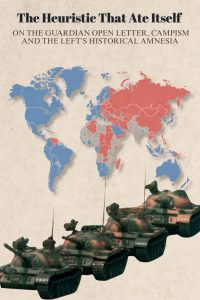
The Heuristic That Ate Itself: On the Guardian Open Letter, Campism and the Left’s Historical Amnesia

An open letter published in The Guardian on 20 August, addressed to Iranian political prisoners, was signed by scholars, intellectuals and activists whose work has long been respected across the left and progressive movements. It named the torture and executions carried out by the Islamic Republic, named the airstrikes carried out by the United States and Israel, and used an image the letter said came from the prisoners themselves: caught between two blades of a scissors, cut from both directions at once. The letter closed with two demands. Stop the executions. End the war.

The response to the letter is more interesting than the letter itself. A cluster of criticisms converge on a single move, stated with varying degrees of bluntness but always amounting to the same claim: solidarity of this kind is a category error. If you live in the West, your only legitimate object of criticism is your own government. Not Iran. Not the state doing the executing. Your voice belongs to your own empire and nowhere else, and to spend it elsewhere is not just misdirected but complicit, a way of dressing up imperial propaganda as conscience.

Noam Chomsky, one of the most popular public intellectuals and critics of the US, did more than anyone to give this argument its intellectual respectability. He is not, by temperament or by many of the other commitments he holds, a natural ally of the people invoking this argument today, and yet he is a strong defender of its underlying principle. Chomsky’s argument begins as a consequentialist one: your ethical responsibility tracks the predictable consequences of your actions, and since a citizen can usually exert more influence over their own government than over a foreign one, that is where their political effort should primarily go. He illustrated the principle through Soviet dissidents such as Andrei Sakharov, whose criticism remained focused on abuses by the Soviet state rather than extending to every atrocity in the world. Chomsky himself acknowledged that he sometimes criticised official enemies and had even assisted dissidents from the Soviet Union and Eastern Europe. The argument, then, was not simply that people have no right to criticise foreign states, but that their political energy should be directed toward the violence they can actually affect. He pushed the principle further, however, and this is where it becomes more consequential: criticism of an enemy state could itself become morally irresponsible if its predictable effect was to help one’s own government justify further violence. Accurate criticism of Cuba, for example, might be true while still contributing to the suffering caused by the US embargo; his hypothetical Soviet dissident who truthfully documented atrocities by Afghan resistance forces might similarly help the Kremlin justify its war. At that point, the argument stops being merely about where to concentrate one’s efforts and becomes a principle about what should sometimes be left unsaid: a true thing can become the wrong thing to say if the wrong people are likely to benefit from hearing it.

The pitfall of this principle was not merely theoretical. It showed up in Chomsky’s own record, twice, in ways that closely track the logic of the principle itself. Writing on Cambodia in the late 1970s, Chomsky and Edward Herman urged skepticism toward refugee accounts of Khmer Rouge killings, on the grounds that the reporting was disproportionate to the attention given to comparable US-aligned violence; the Khmer Rouge went on to kill an estimated 1.5 to 2 million people. Two decades later, he took a similarly sceptical position toward accounts of atrocities committed against Bosniaks during the Bosnian war, including the Srebrenica genocide, in which more than 8,000 Bosniak men and boys were killed. He (along with our very own South Asian Arundhati Roy and Tariq Ali among others) defended Diana Johnstone’s revisionist account of the war and supported claims that Western journalists had fabricated or seriously misrepresented their reporting on Serb-run detention camps, claims that had already been rejected in court. Both cases show the same problem: a consequentialist principle about the effects of political speech ended up making the political usefulness of true accounts of someone else’s atrocities a reason to treat those accounts with suspicion.

It’s worth taking this history seriously, because it’s less a coincidence than a demonstration. The same logic keeps slipping, almost imperceptibly, from one claim into the next.

The first step is real. Having more leverage over your own government than someone else’s is real. You vote in it, fund it, can plausibly move it through pressure that actually reaches somewhere. That’s just a fact about where political effort tends to have leverage, given the accident of birth. But somewhere along the way it turned into something else: having more pull over your own state became a reason to treat criticism of anyone else’s as out of bounds entirely. Having more influence over one thing doesn’t mean you lose standing to speak about another, and yet that’s the leap the argument keeps making without ever justifying it.

The second step compounds the first. Spending less effort on a foreign government’s abuses because your own effort is better spent at home starts as a practical decision about your time. Left alone long enough it curdles into a belief about how much scrutiny that government actually deserves, independent of who’s doing the scrutinizing or from where. A fact about your own limited attention gets quietly repackaged as a fact about the state being judged, and the state ends up getting let off the hook by an argument that was never really about the state at all.

And finally, the rule keeps growing past its own foundation. Something that might genuinely make sense as one person’s approach to spending their own limited energy gets stretched until it’s presented as a rule for an entire movement to follow, not just for US citizens but for the whole world. A movement isn’t one person with one passport and one government they’re answerable to. It’s full of people across the world including India, Russia, South Africa, Palestine, and Iran itself. What started as a reasonable habit for managing your own attention ends up functioning as an argument for other people’s silence.

The three-step slide is simple: leverage-based emphasis becomes leverage-based exclusivity; exclusivity of effort becomes exclusivity of moral attention; and individual leverage becomes movement-wide priority.

The truth is that the rule does not actually depend on the letter’s signatories being Western or American. If the same position came from Iranians themselves, or from people elsewhere in the Global South, the objection would not disappear. It would change its vocabulary: comprador, foreign agent, native informant, terrorist sympathizer. The charge would still be that they had crossed some line of political loyalty by naming repression committed by a state positioned against Western power. The label changes, but the function does not. What is being policed is therefore less where someone comes from than whether they remain within the political narrative assigned to them. Once they step outside it, they can be rhetorically moved into the enemy’s camp, regardless of their politics, their country, or the people whose interests they are actually speaking about. The reaction to non-Western people endorsing the letter makes this especially clear, as does the effort to discredit the prisoners themselves by scrutinising who they are and the charges under which they are imprisoned. Nor does the logic depend on the conflict being in a particular phase. If the same repression were discussed before a war, after a ceasefire, or when there was no immediate military confrontation, the objection could simply be attached to the next arena of imperialist struggle. If geopolitical struggle is treated as permanent, there will always be a larger enemy available to make scrutiny of its adversary seem untimely, divisive or useful to the other side. The question then becomes less whether a claim about repression is true than whether saying it is acceptable within the prevailing geopolitical alignment.

What emerges is a corrupted heuristic dressed up as a principle. Underneath every step of it sits the same problem: the rule swaps out the actual reason to criticise a government, that it is causing harm, for considerations that are irrelevant to the harm itself: whether it happens to be yours and how close you are to it. Political proximity can affect where your effort is likely to have an effect, but it does not determine which suffering deserves scrutiny or solidarity. Political proximity can affect where your effort is likely to have an effect, but it does not determine which suffering deserves scrutiny or solidarity. Once those things are treated as the same, the rule can exempt any government whose repression falls on a population fighting an external enemy, regardless of what that repression looks like or how far it goes. The same logic appears on the other side too: American and Zionist apologetics invoke the threat posed by an enemy to justify violence carried out by the United States or Israel in the name of fighting that enemy. The camps differ, but the reasoning is familiar: the enemy’s conduct becomes the measure by which the violence of your own side is judged. The enemy’s existence becomes an alibi, and because geopolitical struggle is treated as permanent, that alibi can be renewed indefinitely. The timing changes, the conflict changes, the enemy changes, but the logic survives. None of this is new, and it has a name.

The term is campism. It describes a politics in which geopolitical alignment becomes a basis for moral judgment, so that the position a state occupies in a wider struggle matters the most. A state can receive political sympathy, or escape scrutiny, because it is understood to be resisting a more powerful enemy. The term comes from the Cold War, when the world was commonly understood through opposing political and military blocs, but the habit survived the end of those blocs. It reappears whenever opposition to a dominant power, usually the United States and its allies, becomes the organising framework for political judgment. The conduct of that power’s adversaries is then assessed in relation to the enemy they are confronting rather than on its own terms. The political problem becomes what to do when those adversaries commit their own atrocities, and the account campism tends to reach for is: look elsewhere, or don’t look at all.

Its cousin, tankieism, a specifically Leninist variant of campism, has an even more literal origin. British and other communists who defended the Soviet Union’s decision to send tanks into Hungary in 1956, and again into Czechoslovakia in 1968, to crush uprisings against Soviet-aligned governments, came to be known as “tankies” for that very position: support for the tanks because they belonged to the right side, the red side. The word outlived the regimes it was coined to describe. China, which continues to identify itself as socialist and is governed by a Communist Party, produced its own enduring image of the tension the term evokes when the 1989 Tiananmen Square crackdown became associated with the photograph of a lone protester standing in front of a column of tanks. Today, “tankie” is applied more broadly to people who reproduce the same political reflex around other states. Support for repression, conditional only on which flag is doing the repressing.

Both words matter because naming a pattern lets you recognise it when it appears again, without having to relitigate the same argument from scratch. Each time this argument resurfaces around a new state and a new atrocity, whether in Syria, Venezuela, Ukraine, Hong Kong or Iran, many earnest people treat it as a fresh, good-faith concern about Western hypocrisy, as though the argument has no history and has to be answered again on its own terms.

But the cacophony of campism isn’t fresh. It has a track record, a genealogy, and a mechanism, and that mechanism has appeared in more than one form.

Sometimes it is the anti-imperialism of fools: a real opposition to Western domination gets funnelled into political indulgence toward any state positioned against it, until the enemy of your enemy acquires an immunity from scrutiny of its own. The history of the Iran-Iraq War offers a particularly clear example. Some sections of the Western left initially rejected both states as rival regional powers, then shifted toward support for Iran as the United States increasingly backed Iraq. The position changed with the geopolitical alignment; what remained was the need to oppose whichever side Washington was supporting.

Sometimes the distortion runs in the opposite direction: the world is still read through geopolitical camps, but the preferred camp changes. The Sino-Soviet split showed how quickly an anti-imperialist politics could reorganise itself around a new principal enemy. As relations between China and the Soviet Union deteriorated, sections of the Maoist left came to see the Soviet Union as the greater threat and adjusted their politics accordingly, in some cases arriving at positions that converged with American strategic interests. The geopolitical alignment had changed, but the underlying habit remained: the conduct of states was judged through the position they occupied in the wider struggle between powers.

And sometimes what remains is hollow anti-imperialism: a politics that continues to speak the language of liberation while treating the actual conduct of states as secondary to the bloc they are imagined to belong to. Iran, which presents itself as a central opponent of Western and Israeli power, has supplied Myanmar’s military junta with jet fuel used in its air campaign. States routinely cross the ideological boundaries that political movements draw around them, buying, selling, supplying, funding and arming wherever strategic interests require it. The problem begins when anti-imperialism stops being a politics against domination and becomes a system for deciding whose domination counts. This is also what the Guardian letter hints at by invoking similar techniques and logics of domination even when the states exercising them occupy radically different positions in the international order.

In the more sober accounts that end up duping non-sectarian leftists and progressives, the corruption lies in the principle itself, whose three-step slide remains underneath it all: emphasis into exclusivity, effort into attention, individual scope into collective doctrine. The historical amnesia is part of the mechanism. Each new geopolitical crisis is treated as though the same argument has arrived without a history, detached from the cases in which it has already produced its predictable evasions and distortions. What looks, on any given occasion, like a principled objection to Western moral overreach is often the latest version of a much older habit of allowing geopolitical position to determine who gets to be seen as a perpetrator and who gets to remain the object of solidarity.

None of this requires deciding the Guardian letter was a strong piece of writing. It is a short open letter to prisoners, not a political history of the war or an accounting of the relative power, culpability and geopolitical position of the states involved. Of course it does not contain the kind of distinctions or elaboration that a longer political argument would require. That makes it basic. It does not make the underlying point false. The scissors image is not false equivalence simply because it places two sources of violence in the same frame. A person can be subjected to repression by their own government and violence by a foreign power at the same time, and recognising that simultaneity does not require pretending that the two states are identical, that their histories are interchangeable, or that their forms of power are equal. The person caught between the blades does not experience one violence as an argument against recognising the other. Both are happening. That is the point of the image, and it is a perfectly intelligible point even if the image is too simple to carry the full political analysis surrounding it.

There’s a separate matter sitting alongside all this. Campists and tankies leaning on academics and intellectual signatories until some walked their names back, letters going out in different versions before anyone signed, the actual source of the prisoners’ quote never being pinned down: these are real issues and worth scrutinising, but they are essentially irrelevant to the broader politics of internationalism and anti-imperialism. Treating them as though they settle anything about the letter’s content is itself a move worth watching for. Even in a perfected history of how the letter came to be written, free of every one of these problems, this barrage of responses would not disappear. Saying that a letter has no standing to name a second source of harm at all is not the same as pointing out that it left something, many things, or even everything unweighed. The two criticisms can sound alike because both can be phrased as objections to what the letter did or did not say. But the first is a much larger claim wearing the smaller one’s face.

This does not settle what solidarity should actually attach to, but that question is often orthogonal to the political and ethical concerns of this mutated and cursed discourse. Governments invoke the language of liberation selectively, and alliances shift with whatever circumstance makes them convenient, not because leaders on any side are unusually dishonest, but because states are not built to carry emancipatory politics in the first place. They were built through war-making and control, and that orientation doesn’t disappear because a state happens to be on the weaker or more sympathetic side of a given conflict. Sovereignty, in this light, is not a moral trump card. It structures international law, but its violation or preservation doesn’t by itself settle whether a conflict is just, and a formally lawful war can still produce devastation while an unlawful act can still arise from real and grinding injustice. None of that licenses indifference. It means solidarity has to be aimed at the people bearing the cost of a conflict rather than at whichever government currently claims to speak for them, because a government’s claim to represent the suffering of its people is not the same thing as actually relieving it, and conflating the two is how solidarity with prisoners turns into solidarity with whoever is holding the keys.

If expressing solidarity with Iranian political prisoners alongside opposition to American and Israeli aggression is supposed to somehow launder that aggression, then the charge has already abandoned the letter it claims to be criticising. The letter names American and Israeli violence alongside the violence of the Iranian state. The argument against it therefore rests on a simple but contestable leap: that acknowledging one source of violence somehow lends legitimacy to another. At that point, the problem is no longer the letter but a politics so thoroughly organised around reaction that it has ceased to have independent values. Its political judgment is instead organised around what a statement might signal, who might appropriate it, which enemy might benefit from it, and how it might be made to look once stripped of context. What presents itself as vigilance against imperial propaganda becomes political PR thinking with better branding: a reactive politics that has mistaken anticipating the enemy’s narrative for having a politics of its own.


Paresh Hate is a Bahujan queer researcher, writer, documenter and activist and the Lead Content Manager at Dalit Voice.


Editorial note: This essay does not represent every position historically associated with Dalit Voice or its founding editor, V. T. Rajshekar. His international politics was rooted in solidarity with oppressed peoples, but at times treated geopolitical alignment as central to political judgment, an approach critically examined in this essay. The present editorial direction takes a different view. We retain deep respect for Rajshekar’s contribution to anti-caste thought and journalism while recognising that intellectual inheritance does not require agreement on every political question.

West Bengal’s Electoral Roll Purge and the Architecture of Disenfranchisement

In the run-up to polling, West Bengal isn’t just approaching an election. It is also seeing a redrawing of who gets to participate. Voting is set for April 23 and April 29, yet for millions the right to vote has already been taken away through administrative action. The Special Intensive Revision (SIR) of electoral rolls has operated in much the same way as its precursor in Bihar and its antecedent, the National Register of Citizens in Assam: as a tool of exclusion shaped by bureaucratic force, opaque technology, and nationalist ideological direction.

Between 9 and 9.1 million names, close to 12 percent of the electorate, have been removed ahead of the 2026 Assembly elections. Over 6 million were categorised as absent, shifted, deceased, or duplicate. The deeper problem sits with the remaining 2.7 million people whose status is still unresolved. Many of them submitted documents, established links to earlier rolls including the 2002 list, and yet found their voting rights in suspension. The election is proceeding even as their claims remain undecided.

The exercise has been presented as an attempt to produce a “pure electoral roll.” In practice, it signals a move away from inclusion towards filtration. An AI-assisted system has been used to identify what are described as “logical discrepancies” in voter data: minor spelling differences in names, age gaps within families, or several individuals linked to a single parent. In a context where documentation is often uneven and shaped by linguistic and clerical variation, these benchmarks turn ordinary inconsistencies into reasons for exclusion.

The pattern becomes clearer in the numbers. Muslims, who make up about 27 percent of West Bengal’s population, account for roughly 34 percent of those removed, around 3.11 million people. Districts such as Murshidabad and Malda have seen particularly high levels of deletion. Dalit Hindu communities, especially those with histories of migration like the Matua community, have also been heavily affected in districts such as North 24-Parganas and Nadia. The impact is spread across groups, but it consistently bears down on those who are already vulnerable, dependent on documents, and politically marginal.

In border districts adjoining Bangladesh, where narratives of migration and infiltration have long circulated, deletions are especially high. North 24-Parganas alone has lost more than 1.26 million voters. In parts of Kolkata, close to 30 percent of voters in certain constituencies have been removed. Some polling booths have seen more than half their electorate disappear from the rolls. Entire neighbourhoods have effectively been thinned out in the days before voting.

The process has moved quickly, concentrated in the immediate lead-up to the election. While appeal mechanisms exist on paper, they are limited in practice. Nineteen appellate tribunals were established to hear challenges, but access has been restricted, hearings limited, and even legal representation reportedly curtailed. Deadlines for inclusion in supplementary rolls leave little room for proper adjudication. The rolls were frozen on April 9, excluding those whose cases are still pending.

What emerges is a system in which rights are not formally denied but held in suspension. Voters are asked to appeal, yet the process does not conclude in time to restore their participation. Disenfranchisement takes shape through delay and procedure rather than through an explicit refusal.

The Election Commission has carried out the revision using methods that remain difficult to scrutinise. The algorithm used to identify discrepancies has not been fully explained, and the criteria themselves differ from earlier exercises at this scale. A process once associated with expanding the franchise now casts large numbers of voters as suspect. In both its design and its execution, the approach sits closer to a broader political direction than to an independent constitutional role.

On the ground, the disruption is uneven and immediate. Within the same household, some names remain while others are missing, often without explanation. Individuals with long-established records, including presence in earlier electoral rolls, have been excluded due to clerical inconsistencies that frequently originate in state documentation itself. Differences in dates of birth, variations in spelling, or changes over time are enough to trigger doubt. The burden of proof rests entirely on the individual, even when the discrepancy is administrative.

This is how bureaucratic violence works. It does not rely on overt force. Instead, it imposes procedural demands that many cannot meet within the time and access available to them. It requires documents, verification, and compliance under compressed timelines. The outcome may appear technical, but its consequences are clearly political.

West Bengal remains a central electoral focus for the Bharatiya Janata Party, which has sought to expand its presence in the state. Campaign language around “infiltrators” overlaps with the categories produced through the SIR process. Administrative labels such as “doubtful” voters sit alongside political claims about illegal migration, often directed at Muslims. In this alignment, the revision of electoral rolls becomes part of a wider effort to reshape the electorate before voting takes place.

What is being reshaped is not only a voter list. It is the basis on which political participation is granted. The right to vote is becoming conditional, dependent on continuous verification and open to withdrawal through processes that lack transparency and accountability. The creation of large categories of “doubtful” voters embeds that uncertainty.

This is not an abstract question of representation. It reflects a further narrowing of an already constrained democratic space. When millions are excluded from the electoral process through procedural means, the issue extends beyond electoral outcomes. It concerns who is recognised as part of the political community, and who can be removed from it without consequence.


Paresh Hate is a Bahujan queer researcher, writer, documenter and activist and the Lead Content Manager at Dalit Voice.