An open letter published in The Guardian on 20 August, addressed to Iranian political prisoners, was signed by scholars, intellectuals and activists whose work has long been respected across the left and progressive movements. It named the torture and executions carried out by the Islamic Republic, named the airstrikes carried out by the United States and Israel, and used an image the letter said came from the prisoners themselves: caught between two blades of a scissors, cut from both directions at once. The letter closed with two demands. Stop the executions. End the war.
The response to the letter is more interesting than the letter itself. A cluster of criticisms converge on a single move, stated with varying degrees of bluntness but always amounting to the same claim: solidarity of this kind is a category error. If you live in the West, your only legitimate object of criticism is your own government. Not Iran. Not the state doing the executing. Your voice belongs to your own empire and nowhere else, and to spend it elsewhere is not just misdirected but complicit, a way of dressing up imperial propaganda as conscience.
Noam Chomsky, one of the most popular public intellectuals and critics of the US, did more than anyone to give this argument its intellectual respectability. He is not, by temperament or by many of the other commitments he holds, a natural ally of the people invoking this argument today, and yet he is a strong defender of its underlying principle. Chomsky’s argument begins as a consequentialist one: your ethical responsibility tracks the predictable consequences of your actions, and since a citizen can usually exert more influence over their own government than over a foreign one, that is where their political effort should primarily go. He illustrated the principle through Soviet dissidents such as Andrei Sakharov, whose criticism remained focused on abuses by the Soviet state rather than extending to every atrocity in the world. Chomsky himself acknowledged that he sometimes criticised official enemies and had even assisted dissidents from the Soviet Union and Eastern Europe. The argument, then, was not simply that people have no right to criticise foreign states, but that their political energy should be directed toward the violence they can actually affect. He pushed the principle further, however, and this is where it becomes more consequential: criticism of an enemy state could itself become morally irresponsible if its predictable effect was to help one’s own government justify further violence. Accurate criticism of Cuba, for example, might be true while still contributing to the suffering caused by the US embargo; his hypothetical Soviet dissident who truthfully documented atrocities by Afghan resistance forces might similarly help the Kremlin justify its war. At that point, the argument stops being merely about where to concentrate one’s efforts and becomes a principle about what should sometimes be left unsaid: a true thing can become the wrong thing to say if the wrong people are likely to benefit from hearing it.
The pitfall of this principle was not merely theoretical. It showed up in Chomsky’s own record, twice, in ways that closely track the logic of the principle itself. Writing on Cambodia in the late 1970s, Chomsky and Edward Herman urged skepticism toward refugee accounts of Khmer Rouge killings, on the grounds that the reporting was disproportionate to the attention given to comparable US-aligned violence; the Khmer Rouge went on to kill an estimated 1.5 to 2 million people. Two decades later, he took a similarly sceptical position toward accounts of atrocities committed against Bosniaks during the Bosnian war, including the Srebrenica genocide, in which more than 8,000 Bosniak men and boys were killed. He (along with our very own South Asian Arundhati Roy and Tariq Ali among others) defended Diana Johnstone’s revisionist account of the war and supported claims that Western journalists had fabricated or seriously misrepresented their reporting on Serb-run detention camps, claims that had already been rejected in court. Both cases show the same problem: a consequentialist principle about the effects of political speech ended up making the political usefulness of true accounts of someone else’s atrocities a reason to treat those accounts with suspicion.
It’s worth taking this history seriously, because it’s less a coincidence than a demonstration. The same logic keeps slipping, almost imperceptibly, from one claim into the next.
The first step is real. Having more leverage over your own government than someone else’s is real. You vote in it, fund it, can plausibly move it through pressure that actually reaches somewhere. That’s just a fact about where political effort tends to have leverage, given the accident of birth. But somewhere along the way it turned into something else: having more pull over your own state became a reason to treat criticism of anyone else’s as out of bounds entirely. Having more influence over one thing doesn’t mean you lose standing to speak about another, and yet that’s the leap the argument keeps making without ever justifying it.
The second step compounds the first. Spending less effort on a foreign government’s abuses because your own effort is better spent at home starts as a practical decision about your time. Left alone long enough it curdles into a belief about how much scrutiny that government actually deserves, independent of who’s doing the scrutinizing or from where. A fact about your own limited attention gets quietly repackaged as a fact about the state being judged, and the state ends up getting let off the hook by an argument that was never really about the state at all.
And finally, the rule keeps growing past its own foundation. Something that might genuinely make sense as one person’s approach to spending their own limited energy gets stretched until it’s presented as a rule for an entire movement to follow, not just for US citizens but for the whole world. A movement isn’t one person with one passport and one government they’re answerable to. It’s full of people across the world including India, Russia, South Africa, Palestine, and Iran itself. What started as a reasonable habit for managing your own attention ends up functioning as an argument for other people’s silence.
The three-step slide is simple: leverage-based emphasis becomes leverage-based exclusivity; exclusivity of effort becomes exclusivity of moral attention; and individual leverage becomes movement-wide priority.
The truth is that the rule does not actually depend on the letter’s signatories being Western or American. If the same position came from Iranians themselves, or from people elsewhere in the Global South, the objection would not disappear. It would change its vocabulary: comprador, foreign agent, native informant, terrorist sympathizer. The charge would still be that they had crossed some line of political loyalty by naming repression committed by a state positioned against Western power. The label changes, but the function does not. What is being policed is therefore less where someone comes from than whether they remain within the political narrative assigned to them. Once they step outside it, they can be rhetorically moved into the enemy’s camp, regardless of their politics, their country, or the people whose interests they are actually speaking about. The reaction to non-Western people endorsing the letter makes this especially clear, as does the effort to discredit the prisoners themselves by scrutinising who they are and the charges under which they are imprisoned. Nor does the logic depend on the conflict being in a particular phase. If the same repression were discussed before a war, after a ceasefire, or when there was no immediate military confrontation, the objection could simply be attached to the next arena of imperialist struggle. If geopolitical struggle is treated as permanent, there will always be a larger enemy available to make scrutiny of its adversary seem untimely, divisive or useful to the other side. The question then becomes less whether a claim about repression is true than whether saying it is acceptable within the prevailing geopolitical alignment.
What emerges is a corrupted heuristic dressed up as a principle. Underneath every step of it sits the same problem: the rule swaps out the actual reason to criticise a government, that it is causing harm, for considerations that are irrelevant to the harm itself: whether it happens to be yours and how close you are to it. Political proximity can affect where your effort is likely to have an effect, but it does not determine which suffering deserves scrutiny or solidarity. Political proximity can affect where your effort is likely to have an effect, but it does not determine which suffering deserves scrutiny or solidarity. Once those things are treated as the same, the rule can exempt any government whose repression falls on a population fighting an external enemy, regardless of what that repression looks like or how far it goes. The same logic appears on the other side too: American and Zionist apologetics invoke the threat posed by an enemy to justify violence carried out by the United States or Israel in the name of fighting that enemy. The camps differ, but the reasoning is familiar: the enemy’s conduct becomes the measure by which the violence of your own side is judged. The enemy’s existence becomes an alibi, and because geopolitical struggle is treated as permanent, that alibi can be renewed indefinitely. The timing changes, the conflict changes, the enemy changes, but the logic survives. None of this is new, and it has a name.
The term is campism. It describes a politics in which geopolitical alignment becomes a basis for moral judgment, so that the position a state occupies in a wider struggle matters the most. A state can receive political sympathy, or escape scrutiny, because it is understood to be resisting a more powerful enemy. The term comes from the Cold War, when the world was commonly understood through opposing political and military blocs, but the habit survived the end of those blocs. It reappears whenever opposition to a dominant power, usually the United States and its allies, becomes the organising framework for political judgment. The conduct of that power’s adversaries is then assessed in relation to the enemy they are confronting rather than on its own terms. The political problem becomes what to do when those adversaries commit their own atrocities, and the account campism tends to reach for is: look elsewhere, or don’t look at all.
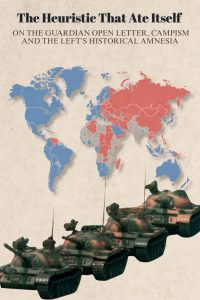
Its cousin, tankieism, a specifically Leninist variant of campism, has an even more literal origin. British and other communists who defended the Soviet Union’s decision to send tanks into Hungary in 1956, and again into Czechoslovakia in 1968, to crush uprisings against Soviet-aligned governments, came to be known as “tankies” for that very position: support for the tanks because they belonged to the right side, the red side. The word outlived the regimes it was coined to describe. China, which continues to identify itself as socialist and is governed by a Communist Party, produced its own enduring image of the tension the term evokes when the 1989 Tiananmen Square crackdown became associated with the photograph of a lone protester standing in front of a column of tanks. Today, “tankie” is applied more broadly to people who reproduce the same political reflex around other states. Support for repression, conditional only on which flag is doing the repressing.
Both words matter because naming a pattern lets you recognise it when it appears again, without having to relitigate the same argument from scratch. Each time this argument resurfaces around a new state and a new atrocity, whether in Syria, Venezuela, Ukraine, Hong Kong or Iran, many earnest people treat it as a fresh, good-faith concern about Western hypocrisy, as though the argument has no history and has to be answered again on its own terms.
But the cacophony of campism isn’t fresh. It has a track record, a genealogy, and a mechanism, and that mechanism has appeared in more than one form.
Sometimes it is the anti-imperialism of fools: a real opposition to Western domination gets funnelled into political indulgence toward any state positioned against it, until the enemy of your enemy acquires an immunity from scrutiny of its own. The history of the Iran-Iraq War offers a particularly clear example. Some sections of the Western left initially rejected both states as rival regional powers, then shifted toward support for Iran as the United States increasingly backed Iraq. The position changed with the geopolitical alignment; what remained was the need to oppose whichever side Washington was supporting.
Sometimes the distortion runs in the opposite direction: the world is still read through geopolitical camps, but the preferred camp changes. The Sino-Soviet split showed how quickly an anti-imperialist politics could reorganise itself around a new principal enemy. As relations between China and the Soviet Union deteriorated, sections of the Maoist left came to see the Soviet Union as the greater threat and adjusted their politics accordingly, in some cases arriving at positions that converged with American strategic interests. The geopolitical alignment had changed, but the underlying habit remained: the conduct of states was judged through the position they occupied in the wider struggle between powers.
And sometimes what remains is hollow anti-imperialism: a politics that continues to speak the language of liberation while treating the actual conduct of states as secondary to the bloc they are imagined to belong to. Iran, which presents itself as a central opponent of Western and Israeli power, has supplied Myanmar’s military junta with jet fuel used in its air campaign. States routinely cross the ideological boundaries that political movements draw around them, buying, selling, supplying, funding and arming wherever strategic interests require it. The problem begins when anti-imperialism stops being a politics against domination and becomes a system for deciding whose domination counts. This is also what the Guardian letter hints at by invoking similar techniques and logics of domination even when the states exercising them occupy radically different positions in the international order.
In the more sober accounts that end up duping non-sectarian leftists and progressives, the corruption lies in the principle itself, whose three-step slide remains underneath it all: emphasis into exclusivity, effort into attention, individual scope into collective doctrine. The historical amnesia is part of the mechanism. Each new geopolitical crisis is treated as though the same argument has arrived without a history, detached from the cases in which it has already produced its predictable evasions and distortions. What looks, on any given occasion, like a principled objection to Western moral overreach is often the latest version of a much older habit of allowing geopolitical position to determine who gets to be seen as a perpetrator and who gets to remain the object of solidarity.
None of this requires deciding the Guardian letter was a strong piece of writing. It is a short open letter to prisoners, not a political history of the war or an accounting of the relative power, culpability and geopolitical position of the states involved. Of course it does not contain the kind of distinctions or elaboration that a longer political argument would require. That makes it basic. It does not make the underlying point false. The scissors image is not false equivalence simply because it places two sources of violence in the same frame. A person can be subjected to repression by their own government and violence by a foreign power at the same time, and recognising that simultaneity does not require pretending that the two states are identical, that their histories are interchangeable, or that their forms of power are equal. The person caught between the blades does not experience one violence as an argument against recognising the other. Both are happening. That is the point of the image, and it is a perfectly intelligible point even if the image is too simple to carry the full political analysis surrounding it.
There’s a separate matter sitting alongside all this. Campists and tankies leaning on academics and intellectual signatories until some walked their names back, letters going out in different versions before anyone signed, the actual source of the prisoners’ quote never being pinned down: these are real issues and worth scrutinising, but they are essentially irrelevant to the broader politics of internationalism and anti-imperialism. Treating them as though they settle anything about the letter’s content is itself a move worth watching for. Even in a perfected history of how the letter came to be written, free of every one of these problems, this barrage of responses would not disappear. Saying that a letter has no standing to name a second source of harm at all is not the same as pointing out that it left something, many things, or even everything unweighed. The two criticisms can sound alike because both can be phrased as objections to what the letter did or did not say. But the first is a much larger claim wearing the smaller one’s face.
This does not settle what solidarity should actually attach to, but that question is often orthogonal to the political and ethical concerns of this mutated and cursed discourse. Governments invoke the language of liberation selectively, and alliances shift with whatever circumstance makes them convenient, not because leaders on any side are unusually dishonest, but because states are not built to carry emancipatory politics in the first place. They were built through war-making and control, and that orientation doesn’t disappear because a state happens to be on the weaker or more sympathetic side of a given conflict. Sovereignty, in this light, is not a moral trump card. It structures international law, but its violation or preservation doesn’t by itself settle whether a conflict is just, and a formally lawful war can still produce devastation while an unlawful act can still arise from real and grinding injustice. None of that licenses indifference. It means solidarity has to be aimed at the people bearing the cost of a conflict rather than at whichever government currently claims to speak for them, because a government’s claim to represent the suffering of its people is not the same thing as actually relieving it, and conflating the two is how solidarity with prisoners turns into solidarity with whoever is holding the keys.
If expressing solidarity with Iranian political prisoners alongside opposition to American and Israeli aggression is supposed to somehow launder that aggression, then the charge has already abandoned the letter it claims to be criticising. The letter names American and Israeli violence alongside the violence of the Iranian state. The argument against it therefore rests on a simple but contestable leap: that acknowledging one source of violence somehow lends legitimacy to another. At that point, the problem is no longer the letter but a politics so thoroughly organised around reaction that it has ceased to have independent values. Its political judgment is instead organised around what a statement might signal, who might appropriate it, which enemy might benefit from it, and how it might be made to look once stripped of context. What presents itself as vigilance against imperial propaganda becomes political PR thinking with better branding: a reactive politics that has mistaken anticipating the enemy’s narrative for having a politics of its own.
Paresh Hate is a Bahujan queer researcher, writer, documenter and activist and the Lead Content Manager at Dalit Voice.
Editorial note: This essay does not represent every position historically associated with Dalit Voice or its founding editor, V. T. Rajshekar. His international politics was rooted in solidarity with oppressed peoples, but at times treated geopolitical alignment as central to political judgment, an approach critically examined in this essay. The present editorial direction takes a different view. We retain deep respect for Rajshekar’s contribution to anti-caste thought and journalism while recognising that intellectual inheritance does not require agreement on every political question.