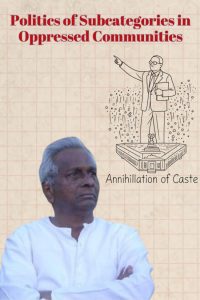
Politics of Subcategories in Oppressed Communities

Archival Note

Published in Dalit Voice (Vol. 17, Issue No. 11, 16 April 1998), this essay enters debates over whether oppressed communities should relinquish their jati identities as part of the struggle against caste. Rajshekar argues that such demands misunderstand the relationship between caste hierarchy and the identities of historically oppressed communities, and questions whether calls for caste abolition are being applied equally across society.

Building his argument through a close reading of Dr. B.R. Ambedkar’s discussion of subcastes in Annihilation of Caste, Rajshekar contends that abolishing subcastes without dismantling the caste order would strengthen existing hierarchies. He therefore defends jati identity as a political question rather than treating it as an obstacle to emancipation.

The latter part of the essay draws on examples from Kerala to argue for separate representation within the Scheduled Castes and questions the classification of some communities under the reservation system. These assertions reflect Rajshekar’s interpretation and should not be read as established historical or legal fact.


Debate On “Jati” Identity


Subcaste abolition will strengthen Hindus & their caste system: Dr. Ambedkar

Our fake democrats, socialists, and other savarna outfits say: “Don’t ask about caste, don’t think about caste, and don’t talk about caste.” They repeat this mantra through their media, so much so that our innocent Dalits and BCs, who are the original victims of the caste system, have also started repeating this very same mantra. As they are the original victims of the caste system, they want to annihilate this devilish system. That is why, when the savarnas just whisper about destroying caste, the Dalits and BCs shout and scream. But why are the savarnas (Hindus), who are the beneficiaries of the caste system, advising only Dalits not to ask about caste, not to think about caste, and not to talk about caste? Are the Hindus willing to surrender the benefits of their caste system? Will they lead a movement, the ultimate result of which will destroy the power and prestige of the savarnas? This is a serious question that we Dalits and BCs have to answer.

CALL TO ELAVAS

No Pope can be a revolutionary. Similarly, no upper-caste man can be a revolutionary. The source of his income, power, prestige, and property is his caste system. So, can he think sincerely of destroying caste? Still, he talks about destroying caste. Why? This is where we become suspicious of his motive. While they call upon us to destroy our caste, what they actually mean is to destroy our ethnic identities, but not their caste system. When they say yes, they actually mean no, and vice versa.

Sree Narayana Guru, the liberator of the Elavas of Kerala, once said:

“Don’t ask about caste, don’t think about caste, and don’t talk about caste,” but his disciple, Sahodharan Ayyappan, the most revolutionary among the disciples of Sree Narayana Guru, reversed the statement and said: “We must always ask, think, and talk about caste.”

USE THORN TO REMOVE THORN

Caste is a thorn in the body of our society. So, we have to use another thorn to remove this thorn. After its removal, we will discard both the thorns. We have lost all human rights due to the caste system. So, we must use the very caste to regain our human rights. Only after we regain all human rights can we think of the removal of caste.

The fact is, we (SC/ST/BCs) have no caste because we are not Hindus. As the original inhabitants of India, what we have are our ethnic identities, which are not caste. Our Editor is right. We are not Hindus. So, destroying caste is not our duty. It is the duty of Hindus.

While they go on strengthening their own evil caste, why are they interested in destroying our ethnic identities like the Pulaya (Pariah), Elava, etc.? This is the puzzle. The fear of the upper castes is that our caste consciousness may help us regain our lost human rights. That is why they advise us to destroy our caste (ethnic identities). For this, they want to destroy our “subcastes” first, which are our ethnic identities. When they use the word “subcaste,” they make us think that we are a part of the Hindu caste system. They know that when we destroy our “subcaste,” we will lose our identity, join the Hindu caste system, and become their most obedient slaves.

INNOCENT DALITS MISLED

Some innocent Dalits also join this Hindu anti-caste campaign. For this, they want us to give up our “sub-caste” first and unite all subcastes in the name of “Dalit.” But can they destroy our identity? Never. Is it a true solution to get our human rights? No. Babasaheb says:

“But assuming that the fusion of subcastes is possible, what guarantee is there that the abolition of subcastes will necessarily lead to the abolition of castes? On the contrary, it may happen that process may stop with the abolition of subcastes. In that case, the abolition of subcastes will only help to strengthen the castes and make them more powerful and therefore far more mischievous. This remedy is, therefore, neither practicable nor effective and may easily prove to be a wrong remedy.” (W&S Vol. 1, p. 67).

Here Babasaheb says that if we abolish the subcastes, it will only help to strengthen the caste system and make the Hindus more powerful.

That means, when we strengthen the subcastes, the Hindu caste system will be destroyed and Hinduism itself will be abolished. That is why the savarnas call upon us to destroy our caste, meaning our ethnic identity, so that enslaving the entire indigenous Dalits and BCs becomes easy.

Some Dalits may have a genuine doubt that when we strengthen our subcaste identity, our people may get divided and fight, which in turn may destroy the very “Dalit concept” and “Dalit unity.” If our people are fighting each other even now on the basis of subcastes, it is not because of these subcastes but because they are Hinduised. They also think that they are Hindus. That is why each subcaste thinks that it is “superior” to other subcastes.

The fighting is not because of our subcastes but because of this wrong notion of superiority or inferiority that they copied from Hindus.

When we educate our people on Ambedkarism and Buddhism, remove the “Hindu mind” from their brains, they will know that we are all different but equal. Each community should recognise the human rights of other communities.

Strengthening the “caste identity,” without proper education, will be a dangerous thing for the Dalits and BCs.

KERALA SCENE

How do we ensure the human rights of each and every subcaste? The good old democratic principle is by giving adequate representation to every subcaste in every field. Otherwise, only the powerful subcaste will gain everything at the cost of other weaker subcastes.

In Kerala, the Pulaya subcaste is the biggest of all other Dalit subcastes. The word “Pulayan” means the owner of the land, peasant, intellectual, etc. Now, as they have lost all their lands, the meaning of the word Pulaya is landless people. They have become the most depressed class in Kerala. The Paraya (Pariah) subcaste is also depressed and landless. They were scavengers in Kerala. Pulaya, Paraya, Valluva, Nayadi, and Chakliyas are the most depressed classes in Kerala. All these subcastes have no adequate representation in the governance of the state.

In Kerala, there are 68 subcastes in the list of Scheduled Castes.

In this list, there are so many subcastes that should actually have been included in the BC list because they are socially and economically forward.

K.R. NARAYANAN IS FORWARD

Recently, I examined the reservation list of some educational institutions, especially in MBBS and Engineering. I could find hardly two or three SC candidates who actually hail from the most downtrodden people of Kerala, i.e., Pulaya, Paraya, Chakliya, etc. Even the MLAs and MPs from reserved constituencies are actually from the forward communities but included in the SC list. This is a serious injustice to the SCs.

President K.R. Narayanan belongs to the Parava community (not Pariah). This community should have been included in the BC list. The Paravas were not unseeables but only Untouchables like the Elavas of Kerala. The hereditary occupation of the Parava women was washing, and hence they were not Untouchables.

In my area, the Paravas behave like the savarnas and discriminate against the Pulayas, Parayas (Pariah), and other Untouchables. They will not even invite these communities to their marriages. There are so many communities in the SC list who behave like the savarnas. They treat the SC people with contempt. In a fight between an SC and a savarna, they side with the savarnas. And yet, they are having all facilities, including reservations, in the name of SC. But at the same time, they will not join us in our struggle for our human rights. The original SC people are fighting and fighting without gaining anything. The benefit goes to other people who oppose and insult them in society. I have no doubt that if the original SC people understand these facts, they will demand adequate representation for each subcaste.

I can tell you that among those who are in the forefront of the “caste annihilation campaign,” we can find many such touchable SC castes. Hindus use these touchable SC subcastes to criticise our Editor’s “caste identity” thesis.

So, to end these problems, each and every subcaste must get proportional representation in every field according to its population in the governance of the country.

On May 31, 1936, Babasaheb organised a Mahar conference in Bombay. Does it mean that he hated other subcastes? What we should build between different subcastes is fraternity (brotherhood). When we fight for our human rights, we cannot oppose the human rights of other communities. This is what our Editor means when he advocates “caste identity.”

All over the world, we can see thousands of ethnic identities. None is interested in destroying its identity. Then, why should we alone destroy our identity?

However, our ethnic identities are not jati or caste. Our people are imitating the Hindus, thinking that they are Hindus. That is why some innocent, unthinking Dalits demand the destruction of our caste.

CASTE SYMBOLISES IDENTITY

What we want to destroy is the casteism of Aryans and also non-Aryans. Destroying our identity means destroying our soul. So, we must think and talk about caste, whether it is Aryan or non-Aryan.

If the upper-caste people do not use their caste identity, how can we identify them, whether it is a cobra or a rat snake? Without identifying our Enemy first, we cannot fight the Enemy.

So, ask, think, and talk about caste for liberation. Remember, as we strengthen our identity, we should also enlighten our people on Ambedkarism and Buddhism.

Our upper-caste rulers acquired everything by their communal thinking. We also can have everything in the same way. So, we too must be communalists.

That means we must love our people.

The savarnas advise us to love the enemy. We must know the trap behind this advice. They know very well that we consider them our Enemy. That is why they ask us to love the enemy. How can we fight our enemy when we don’t hate this Enemy? If we don’t hate the Enemy, we cannot fight and secure our liberation. So, we must hate our Enemy. It is our right to hate and fight our enemy to win our liberation.

What the enemy hates, we must love, and what the enemy loves, we must hate.

Then only will we get a clear picture of the Enemy’s mind. That is why, when they ask us to destroy our caste, we say no. That is why, when they ask us to love our enemy, we oppose it.
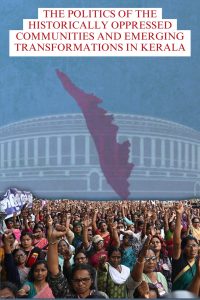
The Politics of the Historically Oppressed Communities and Emerging Transformations in Kerala

Introduction

The recent election campaigns and electoral outcomes in Kerala reveal an important shift in the political economy of the state. Historically oppressed communities, particularly Dalits, Adivasis, Queer people, coastal communities and plantation labour populations, are increasingly reshaping democratic discourse through political responses to unequal development, land alienation, labour precarity, ecological vulnerability and exclusion from institutional power. Kerala’s development model has long been celebrated for its welfare system, literacy and public health achievements. Yet beneath this progressive image, structural inequalities around caste, land ownership, labour relations and representation persisted. The recent elections indicate that the historically oppressed communities are no longer willing to remain silent participants within larger ideological coalitions and are instead asserting independent political agency. A key feature of this shift is the emergence of intersectional solidarity linking caste, labour, ecology, gender, climate vulnerability and democratic representation. The growing assertion of Dalit and Adivasi leadership is therefore not merely symbolic identity politics, but also rooted in struggles over land, labour, rehabilitation, environmental governance and access to state power.


Decline of the Left in Kerala and the Crisis of the “Casteless” Narrative

One of the most significant political developments in Kerala is the visible decline of the CPM and the broader Left among sections of historically oppressed communities. The Left historically built legitimacy through class politics, labour struggles, land reforms and welfare governance. However, many Dalit and Adivasi intellectuals increasingly argue that Left politics failed to adequately confront the persistence of caste within Kerala society. The long-standing “casteless Kerala” narrative often invisibilized continuing inequalities in land ownership, institutional representation, educational access and social dignity. The political posturing around “castelessness,” including within universal welfare and “zero poverty” narratives, was increasingly criticized for masking structural caste inequalities rather than confronting them. This critique intensified further with the Left government’s endorsement of Economically Weaker Sections (EWS) reservation in Kerala. Many Dalit and Adivasi activists viewed this as an ideological shift that diluted the structural basis of caste-based reservation by reframing affirmative action through economic criteria.

Within Dalit intellectual circles, this was interpreted as evidence that the Left was increasingly accommodating upper-caste anxieties and middle-class aspirations rather than deepening anti-caste politics. The implications were both political and ideological. Historically oppressed communities increasingly expect political frameworks that directly address caste, land inequality, ecological injustice and democratic representation instead of subsuming them entirely within class-based narratives. The decline of older ideological certainties has also accelerated the emergence of intersectional solidarities among communities confronting different forms of structural exclusion.


Open Political Assertion by Dalit and Adivasi Leadership

A defining feature of the current political moment is that Dalit and Adivasi leadership in Kerala has increasingly begun to openly assert political positions in the public sphere. Discussions around leaders such as Sunny M. Kapicadu, C. K. Janu, and Manikuttan as potential or symbolic candidates in Kerala elections reflected an important democratic shift. The significance of these discussions lay not only in electoral arithmetic, but also in the broader recognition that historically oppressed communities now expect direct political participation and negotiated representation. Similarly, public declarations of support for the UDF by intellectuals and activists representing 52 organisations and networks, including the press conferences of Geethanandan and Ambujakshan, reflected a new political culture. This demonstrated that the leaders representing the historically oppressed communities were increasingly willing to negotiate alliances publicly.

This marks a departure from older political expectations, where historically oppressed communities were often expected to remain within broader secular or class-based coalitions without independently articulating political positions. Increasingly, intersectional solidarity is becoming the basis for new political alliances and democratic negotiations in Kerala.


Intellectual Assertion and Intersectional Solidarity

The recent transformations in Kerala cannot be understood only through elections. The state has also witnessed the rise of a strong generation of Dalit and Adivasi intellectuals, writers, filmmakers, journalists and public scholars who have reshaped democratic discourse. Intellectuals such as Sunny M. Kapicadu have consistently challenged caste invisibilization within Kerala’s progressive discourse while raising questions of constitutional morality, burial rights, land inequality and dignity. C. K. Janu’s long-standing struggles around Adivasi land rights and displacement continue to shape debates on indigenous justice.

Public intellectuals and scholars, including Dinu Veyil, Dhanya Raman, Rekha Raj, Vinil Paul, Syamkumar, Malavika Binny and many others, have contributed through academic research, anti-caste writing, feminist critique and public engagement. Mainstream media interventions by Rejimon Kuttappan, literary contributions by Dalit and Adivasi poets and writers, including Vedan and cinematic interventions by Dr. Biju, Mrudula Devi, Vinayakan and Leela Santhosh and many more, show how questions of caste, labour, ecological vulnerability and democratic exclusion are increasingly entering Kerala’s public sphere through multiple platforms. One important political framework emerging from these interventions is intersectional solidarity.

More than a slogan, intersectional solidarity is increasingly becoming a political formation through which historically oppressed communities are building collective democratic assertion across caste, labour, gender, ecological and livelihood struggles. Dalit, Adivasi, coastal, feminist, labour and climate-vulnerable communities are increasingly recognizing shared experiences of exclusion while also acknowledging the specificity of caste oppression. Grassroots women leaders such as Gomathi Akka, representing plantation labour women from Idukki; Maglin Philomina, from the fishing community in Thiruvananthapuram; and Ammini K, Adivasi women leader from Wayanad reflect this transformation. Their experiences reveal the intersection of caste, labour exploitation, gender inequality, climate vulnerability and livelihood insecurity. Similarly, the 266-day protest by ASHA workers in Kerala reflected growing anger over low wages and the contradictions within the state’s celebrated public health model, helping build solidarities that extended beyond conventional political and social camps.

The emergence of intersectional solidarity has also been shaped by institutional struggles and public resistance against caste oppression within Kerala’s educational and cultural spaces. Protests and mobilizations around caste discrimination at the K. R. Narayanan National Institute of Visual Science and Arts, caste exclusion within campuses and universities, atrocities against historically oppressed communities and allegations of extrajudicial aggression have contributed to a broader political consciousness among youth and social movements. Historically oppressed communities increasingly responded through protests, demonstrations, public campaigns and collective resistance. These struggles helped make caste violence, institutional discrimination and state accountability central concerns within Kerala’s democratic discourse.


Elections, Representation and the Future of Kerala Politics

The recent elections also revealed a deeper crisis within Kerala’s traditional bipolar political structure. The BJP’s growing vote share, reportedly reaching around 15.18% in certain contexts, reflects not only ideological polarization but also the fragmentation of older welfare-based political coalitions. Economic insecurity, youth unemployment, migration anxieties, agrarian distress and dissatisfaction with established political structures have created conditions for alternative political mobilizations. Historically oppressed communities are no longer electorally peripheral; they are becoming strategically central to Kerala’s political future.

These shifts have also complicated the UDF’s traditional social base, historically associated with sections of upper-caste and Christian communities. As the BJP attempts to expand its influence within these constituencies, the UDF is increasingly being positioned as a broader anti-BJP coalition at the state level, particularly because of the continued presence of the Muslim League within the alliance. For many supporters, this regional electoral arithmetic is also tied to a larger national calculation that strengthening the Congress-led opposition within state legislatures remains necessary to counter the BJP nationally.

At the same time, questions of representation have become increasingly important in the context of the formation of the UDF ministry. The inclusion of three Dalit MLAs as ministers is viewed by many as politically significant because it reflects growing pressure from historically oppressed communities for meaningful participation in governance and institutional power. It also suggests that mainstream political formations increasingly recognize the electoral and political importance of Dalit assertion within Kerala’s changing democratic landscape. However, the continued absence of Adivasi representation within the ministry remains deeply disappointing. In a state where Adivasi communities continue to face land insecurity, displacement, ecological vulnerability and inadequate rehabilitation, the lack of ministerial representation reinforces the long-standing invisibilization of indigenous communities within institutional power.

This contradiction reveals a deeper political economy reality within Kerala society. As historically oppressed communities increasingly build intersectional solidarities and engage more directly with questions of governance, development, representation and resource distribution, dominant social and political interests increasingly perceive this emerging unity as a challenge to existing power structures. The growing assertion of Dalit, Adivasi, coastal, plantation labour and other historically oppressed communities is therefore not merely an electoral development. It is increasingly shaped through solidarities across communities that were historically treated as separate social and political constituencies. This reflects a deeper democratization of political participation, where historically excluded communities are demanding a role in shaping policy, development priorities and governance itself. The central political question facing Kerala today is whether democratic institutions are capable of moving beyond symbolic inclusion toward structural participation and justice.


Conclusion

The recent electoral shifts in Kerala represent more than temporary political dissatisfaction. They reflect a deeper restructuring of democratic consciousness within the state’s political economy. Historically oppressed communities are engaging with politics through questions of land, labour, ecology, dignity, climate justice, rehabilitation and democratic participation, rather than functioning as permanent vote banks for any political formation. The growing visibility of Dalit and Adivasi intellectuals, grassroots leaders, journalists, filmmakers and activists reflects how historically oppressed communities are producing their own political narratives instead of depending on representation through dominant structures.

The future of Kerala politics may depend on how political parties respond to demands emerging from historically oppressed communities. The consolidation of intersectional solidarity among these communities may become one of the defining political developments shaping Kerala’s democratic future. What is unfolding in Kerala is therefore not simply a shift in voting behaviour. It represents the emergence of a new democratic phase in which historically oppressed communities are actively reshaping the political economy of the state.


Jinu Sam Jacob belongs to the Dalit community and is a social development practitioner with 18 years of experience working on human rights, climate justice, governance, urban poverty within and outside India. He has worked with organizations including Plan International, Save the Children, CRY and IIHS. Currently, he is based out of Bengaluru and working as Consultant for development Organisations, CSRs and Philanthropists. He is co-ordinating Alliance of Climate Frontline Communities and engaging in international advocacy with UNFCCC. He is also an advisor for the South Asian Sanitary Labour Network.

Catholic Priests Back Fishermen

TRIVANDRUM, July 1:

Twenty five Catholic priests in their soutane squatted and fasted before the state secretariat today in support of the demands of the fishermen.

The fishermen have been agitating for a total ban on mechanised fishing in the sea from June to August, which are the monsoon months, when fishermen usually face unemployment.

The priests walked after the morning prayer, from the cathedral church at Palaym to the secretariat – one km away.

Meanwhile, the Trivandrum fishermen’s union announced that it would organise picketing of the secretariat from Saturday unless the state government ordered a ban on mechanised fishing.

(Times of India 2-8-1981.)