
Call for Essays – Injustice in Formal Institutions

Dalit Voice is inviting pitches for a thematic booklet on injustice and discrimination in formal institutions. Formal institutions often claim to operate through rules and ideas of merit and professionalism with a veneer of neutrality and objectivity. But the everyday life of institutions reveals that they are shaped by the same structural and ideological patterns of discrimination and inequality that shape society more broadly. At the same time, institutional practices themselves help reproduce and shape discriminatory social relations within and beyond those institutions, especially when they wield significant power within society. We want to examine how systems of social power and discrimination exist within and enter institutional life, how they shape the experiences of people from marginalised and oppressed communities, and how institutions in turn affect those who encounter them from the outside.

The call is open for social justice writing on universities and schools, workplaces, courts, government departments, political parties, media organisations, cultural institutions, NGOs, religious institutions, professional bodies and other formally constituted organisations.


Some possible questions include:

  • What happens when an institution’s stated rules come up against practices of discrimination and bigotry?
  • What does discrimination and bigotry look like in the functioning of a particular institution?
  • How do people from marginalised and oppressed communities navigate institutions where they remain underrepresented or unequally situated?
  • What happens when discriminatory and bigoted practices within an institution are challenged?
  • How have particular institutions changed in response to struggles over social justice?
  • How do institutional rules, norms and practices reproduce existing forms of social power or create new forms of discrimination?
  • How do people respond to and challenge institutional forms of discrimination?

These questions are intended to suggest possible directions rather than define the scope of the call. Contributors are welcome to approach the theme from other angles.


Formats

  1. Long-form essays — 3 pieces
    Approx. 4,000-5000 words
    Honorarium: ₹8,000 per piece

We are looking for deeply researched pieces that investigate a specific institution, question, history, event or development. The research need not be academic. It might involve interviews, documents, archival material, reporting, data or other sources appropriate to the subject. We want essays that have something substantive to establish or uncover, rather than opinion pieces expanded to 4,000 words.


  1. Short commentary — 5 pieces
    Approx. 1500-2000 words
    Honorarium: ₹3,000 per piece

These can engage with an institutional development, controversy, decision, debate or question, whether recent or longstanding. We are looking for pieces that offer a fresh way of thinking about the subject and develop a clear argument.


  1. Reviews — 3 pieces
    Approx. 1200-1500 words
    Honorarium: ₹2,000 per piece

Reviews of books or other forms of media that offer an entry point into questions of social inequality, discrimination, bigotry and formal institutions. We are particularly interested in reviews that use the work to open up a wider political, social or intellectual question.


Sending a pitch

When sending a pitch, please give us a clear sense of what you want to write, what you want to examine, and why the subject is worth examining. Rather than pitching the broad issue itself, identify a concrete subject through which you can explore the larger questions raised by the theme.

For example, a pitch on “discrimination in higher education” would be too broad. A pitch examining patterns of exclusion in the recruitment practices of a particular university, the handling of a discrimination complaint, the experience of a particular group within the institution, or the history of an institutional policy gives us a clearer sense of the proposed piece.

For long-form essays, please explain what you intend to investigate and what material or sources you expect to draw on. For commentaries, tell us the argument you want to develop. For reviews, tell us the larger question you want to explore through the book.

Priority will be given to pitches from and about communities that experience structural marginalisation and oppression, including Dalits, OBCs, Adivasis, religious minorities, women, queer and trans persons, and other historically excluded groups.

All submissions should be original and unpublished.

Dalit Voice reserves the right to edit commissioned pieces for length, clarity and consistency with the booklet’s editorial requirements.


Submission

Please send:

  • A 500 word pitch of your proposed piece
  • A short bio less of less than 100 words
  • The name of the format you are applying for

Each contributor may submit one pitch only.

Send your pitch to dsa@dalitsahityaacademy.com.


Timeline

Pitch submission deadline: 23 October 2026.

Selected contributors will be notified and commissions confirmed by 30 October 2026.

Accepted contributors will be expected to submit the completed piece by 22 November 2026.

The booklet is being produced on a fixed schedule. If a commissioned piece is not submitted within the stipulated timeline, the commission will be withdrawn so that the booklet can proceed on schedule. If you expect a problem meeting the deadline, please let us know before it passes.

Honorarium will be paid upon submission of the completed commissioned piece.
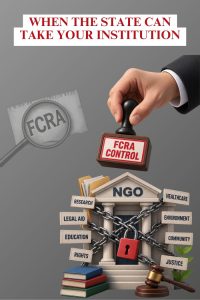
When the State Can Take Your Institution: FCRA and How the Civil Society Is Being Choked Financially

India’s Foreign Contribution (Regulation) Act was introduced in 1976, during the Emergency, to regulate foreign influence in Indian political life. The 2010 Act replaced that framework with a broader system for regulating foreign contributions to organisations and associations. Over time, FCRA has also given the state increasing power over whether organisations can access foreign funding and continue their work. The latest changes take that process further.

The Foreign Contribution (Regulation) Amendment Bill, 2026 was introduced in the Lok Sabha on 25 March and referred to a Joint Parliamentary Committee on 12 August. It is not law yet. The 2026 Rules, however, are already in force. Together, they significantly tighten the conditions under which organisations receiving foreign contributions can operate.

The Bill proposes a Designated Authority to supervise foreign contributions and assets after an organisation’s FCRA registration is cancelled, surrendered, expires or is not renewed. The Authority can take provisional custody of the foreign contribution and relevant assets. If the registration is not restored or renewed within the prescribed period, the assets can vest permanently in the Authority and subsequently be transferred or disposed of, with the proceeds going to the Consolidated Fund of India. The proposed framework also covers assets created partly from foreign contributions.

There is an important detail here. The principle of asset vesting is not entirely new. Section 15 of the existing FCRA already provides for the vesting of assets created out of foreign contribution when an organisation’s registration is cancelled or surrendered. What the 2026 Bill does is build a much more elaborate administrative machinery around that principle, giving the state greater control over what happens to those assets. And this matters because the state already has considerable power to make an organisation incapable of functioning long before anyone arrives to take possession of its assets.

The state does not need to seize an organisation’s property to make it unviable. The cancellation or non-renewal of an FCRA registration can cut off its access to foreign funding, while investigations and regulatory proceedings can tie up its finances and consume the administrative capacity needed to keep the organisation running. By the time an organisation is able to challenge such action, it may already have lost the ability to function as it once did.

The 2020 amendments established much of the architecture that made this possible. The ceiling on administrative expenditure was reduced from 50% to 20% of foreign contributions. That expenditure includes basic organisational costs such as personnel, salaries, travel and management. At the same time, organisations receiving foreign contributions were prohibited from transferring those funds to other organisations, effectively ending the sub-granting arrangements through which larger organisations had supported smaller grassroots groups.

The consequences for smaller organisations were particularly severe. A national organisation could previously receive foreign funding and pass some of it to a local group working in a remote district. After 2020, that channel was closed. The local organisation had to deal with the compliance burden itself, even when it lacked the staff, money or administrative capacity to do so.

The 2020 amendments also required foreign contributions to be received through an FCRA account at the State Bank of India’s New Delhi Main Branch on Sansad Marg. For organisations working in rural areas or distant states, even a basic banking requirement became another layer of centralised administrative control.

This has happened alongside a dramatic contraction in the number of active FCRA organisations. Thousands of registrations have been cancelled or allowed to lapse over the years. Organisations including Amnesty International India, Oxfam India and the Centre for Policy Research have faced cancellation, suspension or non-renewal.

The 2026 Rules add further conditions. Organisations must now identify the purposes for which they intend to use foreign contributions and the states or Union Territories in which they intend to operate. Their FCRA registration is consequently tied more closely to specified purposes and geographical areas. The Rules also expand disclosure requirements concerning activities, office bearers, publications and social media accounts. An organisation must demonstrate that it has undertaken “reasonable activity” by utilising at least ₹10 lakh in foreign contribution over the preceding two financial years. For organisations receiving foreign contributions in instalments under prior permission, the release of a subsequent instalment is tied to utilisation of at least 75% of the previous instalment and a field inquiry.

These requirements are presented as compliance measures. But compliance itself is a mechanism of control where the state has the power to decide whether an organisation has done enough, worked in the right place, spent enough money or remained within the purposes recorded on its certificate.

This is particularly useful to a government that wants to curb progressive work while abandoning its own responsibilities to the people. Organisations working with communities affected by caste violence, displacement, environmental destruction, poverty and state violence can be weakened through the same machinery that is supposed to regulate their funding. The state retreats from its public obligations while strengthening its ability to constrain those who organise in the spaces it leaves behind.

The implications extend beyond organisations conventionally described as NGOs into spaces that are squarely political. Civil society includes legal aid groups, research institutions, health organisations, women’s collectives, workers’ organisations, environmental groups, educational initiatives and organisations working with Dalit, Adivasi and minority communities. These institutions document violence, gather evidence, challenge government policy and provide services where state institutions are inaccessible or inadequate.

It also includes religious and minority institutions. The government has stressed that the 2026 Rules continue to permit specified faith-based welfare and religious activities, including religious education, maintenance of places of worship and charitable work. At the same time, the Rules place foreign-funded activities within increasingly specific categories and exclude proselytisation from the permissible religious purposes.

This is pertinent in a country where schools, hospitals, shelters and charitable institutions are run by religious and minority organisations, especially in a context where successive governments have failed to carry out their public and institutional duties effectively. Why should the state possess such extensive administrative power over institutions that provide social services while it fails to do the bare minimum?

As Azam Khan writes in Maktoob, the changes represent “a systematic attempt to control and subjugate the social fabric of India.” An independent organisation that researches caste violence, documents environmental destruction, provides legal aid to workers or challenges a government policy creates an institutional space from which the state can be questioned. That space matters precisely because it exists outside direct government control.

The history of FCRA shows how this power has accumulated. A law introduced to regulate foreign political influence has become a mechanism through which the state can determine which organisations receive foreign resources and how long they are allowed to operate with them. The 2020 amendments tightened the financial conditions. The 2026 Rules add further administrative requirements. The 2026 Bill extends state control to what can happen to an organisation’s assets after its FCRA registration ends.

The result is a civil society whose institutional survival is increasingly placed in the hands of the executive. Independent institutions create space for people to organise outside the state and produce knowledge that can challenge official accounts. When those institutions are weakened, the communities that depend on them lose some of their capacity to make their experiences visible and press their demands. And when that space shrinks, so does the space available for dissent.


DalitThinkerToday is a Chartered Accountant by profession from Sangli, Maharashtra, who occasionally dabbles in thinking about politics when people in her oppressor-caste-majority office frustrate her. This is her pseudonym.