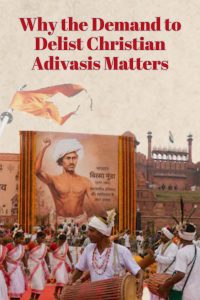
The demand to remove Christian Adivasis from the Scheduled Tribe list has moved from the margins of Hindutva advocacy toward the centre of national politics. On May 24, around 50,000 tribal persons gathered at Delhi’s Red Fort for a rally organised by the RSS-linked Janjati Suraksha Manch (JSM), where speakers called for the de-listing of Christian Adivasis from the Scheduled Tribe category. The presence of Union Home Minister Amit Shah transformed the event from an organisational mobilisation into a signal of political endorsement.
What was presented as a defence of tribal culture carries wider political implications. The campaign serves two connected functions. It assists the incorporation of tribal populations into a Hindutva political framework by constructing Christianity as a threat to tribal identity. At the same time, it weakens forms of Adivasi politics that have historically centred on land, forests, resources, self-governance and autonomy. The controversy over de-listing therefore reaches far beyond reservations. It concerns who gets to define Adivasi identity and what kinds of political claims can be made in its name.
This is not a new conflict. For decades, organisations associated with the Sangh Parivar have attempted to reshape the political vocabulary through which tribal communities are understood. The preference for the term “Vanvasi” over “Adivasi” is part of that project. Naming is never a neutral exercise. The term “Adivasi” became associated with political movements that understood tribal communities as possessing distinct histories, social formations and relationships to territory that cannot be reduced to the categories of the postcolonial Indian state. It also came to be linked with struggles over land, autonomy, self-representation and cultural rights. “Vanvasi,” by contrast, has been promoted by RSS-affiliated organisations as part of an effort to situate tribal communities within a broader Hindu civilisational framework. The dispute over terminology concerns who has the authority to define tribal identity and whether tribal politics will be articulated through its own historical experiences and political demands or incorporated into a larger majoritarian narrative.
The de-listing campaign emerges from this history. It seeks to make religious affiliation increasingly central to the way tribal identity is understood and recognised. Its supporters argue that conversion to Christianity severs individuals from tribal traditions and therefore undermines the basis on which constitutional protections were granted. Yet once religious affiliation becomes the basis for determining who is a legitimate member of the political community, the implications extend well beyond Christianity.
Across central and eastern India, the strongest currents within Adivasi politics have historically developed around struggles over land, displacement, mining, forests and self-governance. Whether in Jharkhand, Chhattisgarh, Odisha or Maharashtra, tribal movements have repeatedly confronted state institutions, extractive industries and dominant social groups over control of territory and resources. Opposition to mining projects and industrial land acquisition, struggles over the implementation of the Forest Rights Act and PESA, demands for a separate Sarna religious code, and movements against displacement have all shaped contemporary Adivasi politics. These mobilisations have generally been organised around questions of land, governance, cultural recognition and collective rights. The Fifth Schedule, PESA, forest rights legislation and movements against displacement emerged from these material struggles. They did not emerge from divisions between Christian and non-Christian Adivasis.
That is precisely what makes the current campaign politically consequential. It redirects attention away from conflicts over land, extraction and governance and toward conflicts within Adivasi communities themselves. Christian Adivasis become a separate political category whose claims can be isolated from those of the wider community. Such divisions weaken collective mobilisation against displacement, mining expansion, land alienation and other forms of dispossession. They also benefit those who have long sought a more fragmented and manageable Adivasi politics, whether in the service of electoral consolidation or the continued extraction of resources from tribal regions.
These concerns have been repeatedly voiced by Adivasi organisations across Jharkhand. More than one hundred tribal leaders, academics, activists and community organisations called for a boycott of the Delhi conclave before it took place. Their objections reflected a broader pattern. Campaigns around de-listing receive substantial organisational energy and political support, while struggles over land alienation, mining expansion, displacement and forest rights rarely attract comparable urgency from the same actors. That contrast raises an obvious question: why are religious differences within Adivasi communities relevant at all while ongoing conflicts over land, forests and resources are not?
The campaign also seeks to alter the constitutional terms through which tribal identity is recognised. Scheduled Tribe recognition was never designed as a reward for adherence to a particular religion. Article 342 contains no religious qualification, and Adivasi status does not disappear because an individual changes faith.
The constitutional histories of Scheduled Castes and Scheduled Tribes are different, but neither category was originally conceived as contingent on religious affiliation. Dalit Christians and Dalit Muslims continue to challenge their exclusion from Scheduled Caste status on the grounds that caste oppression survives conversion. Rather than correcting that injustice, the demand to de-list Christian Adivasis seeks to extend a similar logic of religious exclusion into a constitutional category where it has historically had no place. Recent judicial and political developments have made such efforts appear increasingly plausible, contributing to a broader perception that protections available to historically oppressed communities are open to reinterpretation through the language of religious belonging.
The de-listing campaign also reveals the conditions under which Hindutva is prepared to recognise tribal distinctiveness. Organisations associated with the Sangh Parivar have long sought to incorporate Adivasi communities into a broader Hindu civilisational framework while simultaneously acknowledging them as culturally distinct. The demand to remove Christian Adivasis from the Scheduled Tribe list narrows the space for that distinctiveness. Tribal identity remains legitimate so long as it can be accommodated within a majoritarian political project; conversion is treated as a point at which recognition becomes conditional.
Christianity has undoubtedly transformed many tribal societies over the past century, as have education, migration, urbanisation and countless other social processes. Those transformations do not erase histories of marginalisation, nor do they justify making religious affiliation the basis of constitutional recognition.
At stake in the controversy is more than the status of Christian Adivasis alone. The demand seeks to normalise the idea that constitutional protections can be conditioned by religious affiliation and that communities historically recognised because of marginalisation can be reorganised through the language of religious belonging. The immediate target may be Christian Adivasis, but the wider effect is the weakening of political traditions organised around land, resources, self-governance and collective rights. In regions where Adivasi communities continue to confront displacement, mining expansion and the erosion of democratic control over local resources, such fragmentation serves interests far more powerful than the communities being asked to embrace it.
Paresh Hate is a Bahujan queer researcher, writer, documenter and activist and the Lead Content Manager at Dalit Voice.