What a State Is Made to Hold: The Unfinished Case for Reservation in the Private Sector

“The purpose of a system is what it does,” Stafford Beer once said: not what its charter claims, not what its founders intended, not what its defenders insist it’s secretly working toward once the numbers look bad. The line comes from Beer’s work in cybernetics and systems theory, but it travels well, because it was really a warning against taking any institution’s word for itself. Apply it to the state and the sentence stops being quippy and starts being uncomfortable. A state does not do what its Constitution’s preamble promises. It does not do what its bare acts say it must. It does what its politicians ignore until an election forces a promise out of them. It does what a police force using violence on citizens with impunity does. It does the slow torture bureaucrats in government offices administer by attrition. It does the routine ignoring of injustice courts specialise in. Everything else is marketing.

A state’s default setting isn’t a neutral one, but it isn’t a fixed conspiracy either: it simply doesn’t move unless it’s made to. Every gain anyone has pulled out of a state came after someone made not conceding more expensive than conceding.

Reservation itself carries the memory of that fact in its own founding story. Ambedkar’s original demand, at the Round Table Conferences, was a separate electorate for the Depressed Classes: our own constituencies, our own voters, our own representatives answerable to no one else’s veto, a political existence independent of Hindu society rather than embedded inside it. The Communal Award of August 1932 granted exactly that. Gandhi, in prison, announced a fast unto death to force its withdrawal, blackmailing the Depressed Classes and its leaders as well as the British rulers, on the ground that a separate electorate would permanently divide Hindu society. Ambedkar held out against a starving man for days before the political pressure, not the argument, became unbearable on practical grounds, and what emerged from the negotiation at Poona was not the separate electorate but reserved seats inside a joint electorate: more seats than the Award had granted, 148 in the provincial legislatures instead of the original allotment, but folded back into the same political body Ambedkar had tried to exit. Reservation was not the original ask. It is what remained after the original mandate was made impossible by someone else’s leverage and the Hindu moral bankruptcy behind it. The instrument defended for ninety years since it has itself been a settlement, arriving at under duress, from a wider claim.

Rahul Sonpimple, founder of the All India Independent Scheduled Castes Association (AIISCA), made a version of this point at a press meeting on private sector reservation in Delhi on 27th September, framing reservation as something closer to a treaty than an entitlement: a thin, fragile thread and the only one tying Dalits, Adivasis and OBCs to the Indian state, functioning not as generosity but as a negotiated peace. It buys the state and the dominant castes who still hold most of the country’s assets a measure of calm from a majority whose rightful share has otherwise been denied, while giving the numerically dominant Bahujan population some working proxy for the democratic weight their numbers should carry. A contract, not a gift. Except a contract is only as good as what a party can be made to perform under it, and a state that already treats its own preamble as marketing will treat a contract no differently.

A contract implies parties, and a state, unlike a private employer, actually has one with its citizens. It demands loyalty, taxation, submission to its law, alongside the monopoly to dictate the political fates of those within its territory, in exchange for a set of standing obligations back. A private firm asks for labour under a contract either side can in principle at least walk from, and owes nothing back to someone who was never bound to it in any comparable way. That asymmetry is a large part of why a claim on the state’s own hiring is different in kind from a claim on a firm’s, not because the state behaves more responsibly in practice, as we are all well-aware, but because it owes something on the terms of the relationship itself. Although an obligation the state owes but doesn’t perform is worth exactly as much as a preamble it doesn’t act on.

A private firm is not identical to the state, and the case for reaching it anyway doesn’t depend on pretending otherwise. It rests on two separate facts. The economy itself has changed since the framers drew the line at public employment, and a social justice framework confined to the public sector now leaves most of economic life untouched, because most of it no longer sits inside the public sector at all, a gap widened further by the same state’s ongoing privatisation of what public capacity remains, shrinking the one terrain where proportional representation currently carries legal force. But the second fact runs deeper and doesn’t depend on how recent liberalisation is: a private sector built on land, credit, licenses and infrastructure the state provides, privatising its profits while routinely and unsparingly socialising its costs through subsidy, tax concession and public investment, has never sat outside the state’s reach in the first place, this was true of Indian capital before 1991 as much as after it. A firm that depends on the state which itself takes from the public commons for that much can never be allowed to answer to nothing beyond its own balance sheet.

Even so, there’s a real limit to what representation alone produces. Elevated individuals from a movement or caste often become instruments of the institution’s own legitimation rather than being accountable to the base that elevated them, and when they try to push further beyond the constraints and the logics of those systems, they get cut down by the sheer weight of social forces unwilling to tolerate the progress already made. Despite that, political reservation has still converted into something more durable than individual token presence, an independent structure of Bahujan power that didn’t exist before it, even as oppressor-caste violence against that rise has grown alongside it. What government service has that the private sector doesn’t is exactly this: decades of organised structure built up around the reserved seat, structure that keeps contesting the ceiling even where it doesn’t break through it. The private sector has never had an equivalent foothold, and no amount of employer voluntarism has ever built one. That’s the case for statutory reservation even in its thinnest form: not that a quota alone delivers equality, especially substantively, but that it’s the minimum legal anchor around which durable, organisable power can be built at all.

Against that backdrop, private sector reservation is not a new demand groping for its first hearing. It has been formally raised for close to two decades. The All India Confederation of SC/ST Organisations was pressing the case as early as 2012, organising a march on Delhi backed by three dozen SC/ST organisations, arguing plainly that no nation stays strong while its economic and social levels remain this split. But even before that, in 2003, then Prime Minister Atal Bihari Vajpayee addressed a meeting of SC and ST MPs and said that the private sector cannot exist in isolation and has to be responsive to the needs of the society, making it essential to have reservation in the private sector. This was followed by a broad consensus among electoral parties across the ideological spectrum on the matter, even though it has not yet been translated into political will or substantive action. One concrete effort came in 2006, under Prime Minister Manmohan Singh, when he appealed directly to Indian industries to become the government’s partner on the question. However, rather than legislate a mandate, the government let industry regulate itself: CII, FICCI and ASSOCHAM each adopted a Voluntary Code of Conduct built around four pillars, Employability, Education, Entrepreneurship Development and Employment. That October, the PMO had already constituted a Coordination Committee on Affirmative Action in the Private Sector, chaired by the Principal Secretary to the Prime Minister, drawing on the Department of Personnel and Training, the Ministry of Social Justice and Empowerment, the Ministry of Tribal Affairs, and serviced by the Department of Industrial Policy and Promotion. The Committee has met nine times since. By 2010, the government’s own review found adoption of the voluntary codes was slow; by 2013, it was still describing the same dialogue as ongoing; by 2015, industry associations were reporting hundreds of member companies signed on. Twenty years of this arrangement has produced a voluntary code without enforceable duties, and industry associations professing over a lakh of beneficiaries with no verifiable representation data to back the figure. Now we cannot sit once again with a renewed appeal for goodwill. What is needed is to go beyond an empty promise and fight for a statutory guarantee: a binding quota, backed by rule of law, not another code any signatory can stop honouring when they feel like it.

On 26 July 2024, that demand reached Parliament directly. Chandrashekhar Azad, MP for Nagina, introduced a private member’s bill titled the Reservation for the Scheduled Castes, the Scheduled Tribes and the Other Backward Classes in Private Sector Act, 2024, one of three private member’s bills he introduced in the Lok Sabha that day. It covers private firms, educational institutions and other establishments employing at least twenty people with no government financial stake. Even this bill stops short of a binding hiring quota: its mechanism is incentive-based, requiring the central government to induce private firms toward reservation through special concessions and lower-interest loans via nationalised banks, with an annual implementation report tabled in both Houses. Structurally, a private member’s bill has almost no chance of becoming law: enactment is the exception, not the rule, and has been for decades. That a bill this cautious, relying on incentives rather than quotas, remains a private member’s bill and is still pending says something about how far Parliament remains from treating this as settled business.

But the case for the demand itself rests on documented discrimination. Sukhadeo Thorat and Paul Attewell’s 2007 correspondence study sent matched applications under upper-caste Hindu, Dalit and Muslim names to private-sector job advertisements in the English dailies and found discrimination operating at the very first screening stage, before any interview, before any assessment of merit beyond a name on a page. Zahra Siddique’s 2011 work went further, quantifying the size of the gap and who was driving it: low-caste applicants had to send 20% more resumes than high-caste applicants to get the same callback rate, with the disparity sharpest when the recruiter was male or Hindu, and more pronounced at smaller firms than larger ones. Axmann, Swanson and Cuspinera Contreras, using Indian Human Development Survey data in 2016, found significant wage discrimination against Dalits and Adivasis specifically inside the private sector. Madheswaran and Singhari, drawing on National Sample Survey employment data the same year, found SC workers earning less than equally qualified forward-caste workers in urban labour markets, with the gap wider in private employment than public, and unequal access to occupations itself doing much of the work in producing the disparity. Pattayat’s 2024 study of rural non-farm workers, using NSSO and PLFS data spanning 2004-05 to 2019-20, found the earnings gap persisting across that entire period and examined how much of it discrimination itself accounted for.

Article 15(5) already gives the state constitutional room to act on half of this. Inserted by the 93rd Amendment in 2005 and in force since January 2006, it permits special provision by law for socially and educationally backward classes, Scheduled Castes and Scheduled Tribes in admission to educational institutions, explicitly including private institutions, aided or unaided, with the sole carve-out for Article 30(1) minority institutions. Because education sits on the Concurrent List, both Parliament and state legislatures can act under it, and several states have already legislated on private educational admissions. Tamil Nadu enacted a 2006 law providing 69% reservation for Backward Classes, Most Backward Classes and Denotified Communities, Scheduled Castes and Scheduled Tribes in private educational institutions. Andhra Pradesh had already applied SC, ST and Backward Class reservations to admissions in private professional institutions through its admission rules. Karnataka’s 2006 Professional Educational Institutions Act provides for 50% reservation for SCs, STs and OBCs in unaided non-minority professional institutions. Maharashtra enacted a 2006 law providing reservation for SCs, STs, Denotified Tribes, Nomadic Tribes and OBCs in private professional educational institutions, while Haryana’s 2016 Backward Classes Act provides reservation for Backward Classes in admissions to educational institutions, including private institutions.

What that record shows is that Article 15(5) has been given statutory effect at the state level, but unevenly and without a nationwide framework. A Parliamentary Standing Committee report presented to the Rajya Sabha in August 2025 said that private educational institutions are currently under no national legal obligation to implement reservation because there is no central statute mandating it. It recommended that Parliament legislate 27%, 15% and 7.5% reservation for OBCs, SCs and STs respectively in private higher educational institutions, with government reimbursement of the associated costs on the model of the Right to Education Act. Although a sincere Caste Census may tell us that the necessary numbers should be much higher, the constitutional ceiling on reservation itself also needs to be revisited.

What Article 15(5) doesn’t reach at all is employment, and that gap isn’t small: education and employment were never separable; a degree that doesn’t convert into a job is a credential, not a livelihood. One state that tried a binding private-sector quota by its own legislation ran straight into that trap. Haryana’s 2020 State Employment of Local Candidates Act mandated 75% reservation for domiciled candidates in private jobs under a salary threshold, with a 10% district sub-cap built in, not a caste quota, a domicile one. The Punjab and Haryana High Court struck it down in 2023 as unconstitutional and violative of Part III of the Constitution; the challenge to that judgment remains pending before the Supreme Court. The deeper problem predates the ruling: the 93rd Amendment gave the state constitutional room to reach private education specifically and never extended that room to private employment. Domicile was the classification that failed here, not caste, but replacing domicile with caste would not by itself resolve the Article 19(1)(g) problem, because no amendment has yet done for employment what the 93rd did for education. That is what this demand still needs and hasn’t gotten: not just a statute, but a constitutional amendment opening the same room for private employment that the 93rd opened for private education, without which any statute meets the wall Haryana did.

Winning that room would still only secure a narrower claim than the one Ambedkar himself eventually made. Private sector reservation, at its most comprehensive, means reservation in private employment, reservation in private educational institutions, and an Equal Employment Opportunity Act as organizations like AIISCA and others have been demanding: legislation with a working complaint mechanism, an investigation process, ongoing monitoring, and real accountability, reaching recruitment, wages, promotion, workplace treatment, termination, occupational allocation, contract employment and professional advancement, not just the moment of hire. That last piece is the one twenty years of voluntary codes never touched, because a Voluntary Code of Conduct had no enforceable complaint mechanism and no statutory consequence for ignoring it. A statute would. But even this full slate, a foothold at every stage of the employment relationship, asks only for fair terms of entry into an economy whose ownership stays exactly where it already is. It is a claim to be treated fairly inside the room. It has never been a claim on who owns the room.

Ambedkar’s own economic writing sits alongside all of this as one part of a longer record, that expands the horizon of economic fight itself. In States and Minorities, the memorandum he prepared for the Constituent Assembly on behalf of the Scheduled Caste Federation, he proposed a state control over economy in which key industries would be owned and run directly by the state and basic industries owned by the state and run through its own corporations, with land held under state ownership and cultivated through cooperative farming, aimed at dismantling landlordism and the agrarian exploitation caste had built itself around. That program was never incorporated into the Constitution in the form Ambedkar proposed. Although a version of that was found in the Nehruvian socialist project, which was itself eventually given up in the face of global neoliberal onslaught. What it shows, regardless of anyone’s own view of state ownership as a remedy, is how early and how directly Ambedkar located the actual target in who owns the economy, not merely who holds a fair position inside it.

Ambedkar’s economic target, and the demand for reservation in the private sector, concern forms of structural injustice that are harder to see than the moments when that injustice erupts into visible violence. That shapes not only who gets to have this conversation and on what terms, but who is willing to listen to it. Oppressor-caste liberals attend to Dalit-Bahujan life most readily through the news cycle of atrocity, because atrocity is visceral and immediately legible, while the guilt of a grieving conscience often springs into action only when Dalit-Bahujan rage forces that attention. A Dalit-Bahujan body demands attention in a way a hiring statistic does not. A wage-discrimination dataset spanning fifteen years, a Coordination Committee that has gone nowhere, a bill pending in Parliament since 2024, none of these produces the same urgency because none offers an easy villain, a headline image or a clean moment of collective horror to perform. Grieving a corpse asks nothing ongoing of anyone. But there is a real villain here, even if it is harder to identify in any single moment: the state, which owes more than what it does and routinely shows where its priorities lie, alongside the structural violence produced through years of oppressor-caste apathy at best and antipathy at worst.

The historical record here is a caution, not a reason to wait. What survived Poona wasn’t Ambedkar’s original demand: it was a narrower settlement that still had to be fought for afterward, seat by seat, for decades, before it was more than ink. The same will be true of a private-sector statute and an Equal Employment Opportunity Act alongside it. Winning them will not finish anything on its own; a seat is captured as often as it’s built on. Beer’s sentence applies once more, now to the law: a statute’s purpose isn’t what its statement of objects and reasons says either. It’s what the Act does. Whether the complaint mechanism gets used, whether a violation carries any real cost, whether the oversight committee holds its next meeting or goes missing in action the way it already has. None of that follows from any bill becoming an act. It follows only if the pressure that forces the act into existence keeps being applied after it exists. Because a state, as established, only holds what it’s made to hold.


Paresh Hate is a Bahujan queer researcher, writer, documenter and activist and the Lead Content Manager at Dalit Voice.
Why India Has No Second Ambedkar

Archival Note

Published in Dalit Voice (Vol. 1, Issue No. 17, 16 June 1982), this essay asks why India has failed to produce intellectuals who can challenge the ruling order rather than serve it. Rajshekar treats intellectual life as a political question, arguing that knowledge has little value when those who possess it refuse to confront power.

The essay places this argument alongside Dr. B.R. Ambedkar’s critique of the Brahminical character of India’s intellectual class. Rajshekar argues that when the intellectual class is tied to caste interests, it becomes an obstacle to the destruction of caste. He also attacks the pressures that push intellectuals towards careers, awards, money and proximity to power, while dissenters are branded as dangerous or “controversial”.

The essay then asks why India did not produce another Ambedkar after independence. Rajshekar connects this to the loss of the limited space he believed Ambedkar had found under British rule, arguing that Dalits and other oppressed communities were left without protection from the ruling order after independence. The essay’s central question is therefore about the political purpose of intellectual life: what happens to a society when those capable of challenging its dominant ideas choose accommodation instead?


The Role of Intellectuals in Society

Every society, every country in the world is shaped and led mainly by its intellectuals. All those who are remembered by history are mostly intellectuals. An intellectual may not get instant recognition by society when alive, but in course of time the person’s greatness will be recognised and recorded on the pages of history. Because an intellectual and intellectual alone can help bring about socio-economic changes.

The Buddha, Plato, Marx, Rousseau, Lenin, Abraham Lincoln, Maxim Gorky, Bernard Shaw, Mao, Thiruvallavar, Mahatma Phule were all great intellectuals. It is intellectuals who not only think but make others think.

After Dr. B. R. Ambedkar, M. N. Roy, Periyar E. V. Ramaswamy and Ram Manohar Lohia, we have hardly produced any intellectual giants in India. India’s Ruling Class has been systematically corrupting any up-and-coming intellectual, and if anyone dares to defy, he is mercilessly crushed. That is why rarely one wants to show originality, innovation. So much so, India has gone into total intellectual bankruptcy.

The very fact that India has not received a single Nobel Prize after it became independent proves that we are a country of mediocre dwarfs. But we are never tired of boasting that we have the second largest scientific manpower in the whole world. If so, what are they doing? Why not a single one has made an international mark?

The one agricultural scientist who received the Magsaysay Award was later found to have got it after making a false claim. But even this man has now taken up a cushy job outside India. This is the disease with our intellectuals. One social scientist, considered very distinguished, is seldom in India and even when at home never rubs the ruling class lest it may upset his lucrative income. Scientists like Khurana have settled down in the USA.

All this is because our society and our value system do not believe in encouraging and promoting intellectuals. India’s Ruling Class wants to make its people surrender their judgement to it. Every intellectual is a suspect. It looks upon him as a source of trouble.

Some of the finest budding, blooming flowers of our society were shot dead, dubbing them as Naxalites. Any person who does not fall in line and conform to the established thinking is considered a threat to society. Dissent is disliked, nay, dangerous. Truth should not be spoken. And those who speak the truth will be branded as “controversial” persons.

Any number of organisations, both govt. and non-govt., are set up to watch and weed out such “dangerous” persons. Innumerable State and private awards are instituted to win over any brilliant writer, scholar, to pocket if not corrupt him.

Courage is an essential prerequisite to become an intellectual. He has to suffer and sacrifice, pay for his commitment. That is why intellectuals and intellectuals alone can lead a society or a movement. An intellectual can lead as well as mislead. But in India, very often our intellectuals have been only misleading the society.

Nobody has painted such an Indian situation better than Dr. B. R. Ambedkar, and things have hardly changed since he wrote it:

“Whether you accept the theory of the great man as the maker of history or whether you do not, this much you will have to concede that in every country the intellectual class is the most influential class, if not the governing class. The intellectual class is the class which can foresee, it is the class which can advise and give lead. In no country does the mass of the people live the life of intelligent thought and action. It is largely imitative and follows the intellectual class.

There is no exaggeration in saying that the entire destiny of a country depends upon its Intellectual class. If the intellectual class is honest, independent and disinterested, it can be trusted to take the initiative and give a proper lead when a crisis arises.

It is true that intellect by itself is no virtue. It is only a means, and the use of means depends upon the ends which an intellectual person pursues. An intellectual man can be a good man but he can easily be a rogue. Similarly, an intellectual class may be a band of high-souled persons, ready to help, ready to emancipate erring humanity, or it may easily be a gang of crooks or a body of advocates of a narrow clique from which it draws its support.

You may think it a pity that the intellectual class in India is simply another name for the Brahmin caste. You may regret that the two are one, that the existence of the intellectual class should be bound with one single caste, that this intellectual class should share the interest & the aspirations of that Brahmin caste, which has regarded itself the custodian of interest of that caste, rather than of the interests of the country.

All this may be very regrettable. But the fact remains that the Brahmins form the intellectual class of the Hindus. It is not only an intellectual class but it is a class which is held in great reverence by the rest of the Hindus. The Hindus are taught that the Brahmins are Bhudevas (gods on earth). The Hindus are taught that Brahmins alone can be their teacher. Varnaram Brahmano Guru. Manu says, “If it be asked how it should be with respect to points of the Dharma which have not been specially mentioned, the answer is that which Brahmins who are Shishthas propound shall doubtless have legal force.”

When such an intellectual class, which holds the rest of the community in its grip, is opposed to the reform of Caste, the chances of success in a movement for break-up of the Caste System appear to me very, very remote.”

A film actor like Amitabh Bachchan or actress like Hema Malini may have millions of fans, but the glamour is temporary. The moment the youth fades, the star sinks. A cricketer or sportsman is adored till his capacity lasts. A wrestler, boxer or a King Kong will be feared until his body strength stays.

A politician like Indira Gandhi or Reagan is adored until the person is in power. Remember, people used to avoid Indira Gandhi like plague when she was defeated by the Janata. Those with money come and go. No Tata or Birla is remembered by history. A beauty queen is glorified till her skin fades.

There is nothing permanent with stars, sportsmen, body-builders, political personalities or wealthy tycoons. But that is not the case with an intellectual. He is respected not only in his lifetime but even after that.

Kalidasa was simply a poet under King Vikramaditya, but the king’s name has faded, but not that of Kalidasa, India’s greatest Sanskrit writer. Sometimes an intellectual is respected and recognised more after his death. Karl Marx’s name will be there as long as history is there. So too Plato, Jesus Christ, Mohamed Paigambar, Lenin, Mao, Martin Luther King.

Progress of any country depends only on its intellectuals. They alone can lead, but in India, alas, our intellectuals have been only misleading the society because they have been impotent and corrupt. That is why they compromise.

Look at the courage of J. B. S. Haldane. He subjected himself to great physical pain by himself becoming a guinea pig of his experiments. Have we produced a scientist of his calibre?

Our scientists are spending their time not in laboratories but in air-conditioned offices, busy pushing files. Intellectuals of India have not given evidence of their courage, their independence of thought and conviction, which are the indices to judge an intellectual.

They are not courageous, because they are so preoccupied with selfish interests. That is why they migrate to foreign countries in search of cushy jobs. Prime Minister Indira Gandhi on June 3 is reported to have expressed concern over “brain drain of scientific talent.” But this is not the first time she and other top leaders are expressing such a concern.

What is the use of a brain that allows itself to be drained? Better not have such brains. What we want is brains with hearts, and such brains will rarely allow itself to be drained. Heartless brains are more dangerous than brainless hearts. Therefore, let the heartless brains go. India will in no way become poorer.

A true intellectual will not sell himself. He can never be bought. He can never seek power and ambition. He will speak the truth, come what may, even at the cost of his life.

The evil has triumphed in India and the country is drifting because our intellectuals do not speak up. So much so, the country has grown sick and its sickness is affecting the outside world as well. But our intellectuals are unperturbed. To them, their caste and cash is more important than the eternal pursuit of truth.

What is the use of learning and knowledge when it does not bring cash or power? Popularity does not depend upon one’s ability but other factors. “Success in life” depends not on learning but on bank balance. In such a society, what use is learning or intellectual pursuits?

Intellectuals are laughed at, despised. Why should we strain the brain when money can be made without it? This is India today.

If our intellectuals are corrupt and spineless, the masses are dumb, deaf and blind because of poverty and illiteracy. The latter are illiterate because they are poor. When they are preoccupied all the time in an endless battle of the belly, where is the time for them to think, even if thinking is possible?

If this is the position of the poorest, what about the educated, employed people who come from this very same revolutionary section, Dalits and other persecuted minorities? The tragedy with this section is they have become easy-going, pleasure-seeking. Not only that. A considerable number of them, particularly the educated Untouchables, hide their identity and turn into bumlickers.

Yes, there are a tiny section of conscientious people among them who are angry. Who wants to rebel?

“The world owes much to rebels who would dare to argue in the face of the pontiff and insist that he is not infallible. I don’t care for the credit which every progressive society must give to its rebels.” (Dr. B. R. Ambedkar, preface to second edition of Annihilation of Caste.)

Ambedkar, however, lived up to the definition of a rebel, an intellectual giant. But such of the rebels are spotted out and finished at the very initial stage. Those who have managed to escape and build up their leadership are recruited by the ever-watchful political parties.

So there is an all-round famine. No ruling class will produce a revolutionary. On the other hand, the revolutionary section is starved to submission by the ruling class.

This answers the oft-repeated question: “Why India has not produced a second Ambedkar?”

Babasaheb lived a major part of his life when India was under the British, who were benevolent rulers. Not only they gave us education, denied to us by Brahmins, but even gave us modern, Western knowledge.

Not only that. If there was any “freedom struggle” and some leaders like Gandhi and Nehru were able to fight the British, it was because of the knowledge they gained from the very British education and the encouragement they gave to fight for liberty and fraternity.

But for the British rule, which in fact meant a Christian rule, India would not have been what it is today. So Ambedkar, despite his open criticism of the British Government, got all the encouragement from the British.

Nobody criticised the British right on their face as Ambedkar did. They gave him all the facilities and also protected him against his enemies. They gave all-out encouragement and built up his leadership.

Once the British were out, Dalits & the persecuted minorities of India had none to protect them. They were virtually thrown to wolves. The independence that India got on Aug. 15, 1947 was the independence given to the high castes to exploit, which they could not do earlier so freely.

The lambs are bound and bundled and handed to wolves on a silver platter. That is the reason why after independence India did not get a second Ambedkar.

No honest, dedicated leadership is tolerated by these ever-watchful headhunters. This is the heinous role played by India’s intellectual class.

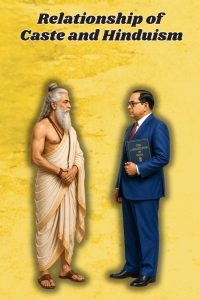
Relationship of Caste and Hinduism

Archival Note

Published in Dalit Voice (Vol. 29, Issue No. 03, 01/02/2010), this essay by V. T. Rajshekar examines Hinduism through the question of caste. He traces caste divisions to the Purusha Sukta and the Bhagavad Gita, then turns to the Manusmriti and its treatment of Brahmins, Sudras and women.

Rajshekar connects these religious texts to the oppression of Dalits and cites accounts of violence against Untouchables alongside condemnations of caste from writers and public figures. His argument leads to a direct question: if caste is part of the religious order Rajshekar identifies as Hinduism, can Hinduism exist without caste?

The essay closes by putting that question to the Hindu believer featured in the film that prompted Rajshekar’s article. How can Hindu faith be reconciled with the caste system? And if caste is rejected, what does that mean for the religious traditions that Rajshekar argues have sustained it?

Read the full piece here


British Anthropologist Details Barbarity of Hinduism

“Revelations: How do you know god exists”, is a film by Anthony Thomas (Channel 4). I saw this film on Aug. 16, 2009. I was particularly interested in what the Hindus had to say. I lived in India for 15 years and found their belief system very confusing. The Hindus as well as the others interviewed failed to show us how he knew god exists.

PART-1

The caste system & origins of Hinduism:

Hinduism is based on myth. Seven rishis overheard “wisdom” being spoken by the gods. This wisdom they passed on to mankind as the four Vedas:

  1. Rig Veda
  2. Yajur Veda
  3. Sama Veda
  4. Atharva Veda

The Rig Veda is our principal concern. It is a composition of 1,028 poems. But more of this later.

HINDU & GREEK GODS

33 crore gods:

According to Lord Winstone (April 17, 2006), the Hindus have about 330,000,000 gods. Shiva, one of the main gods, has 1,008 epithets. Most deities have consorts: Shiva’s wife is Parvati, Vishnu’s wife is Lakshmi and Brahma’s wife is Sarasvati. Mention must be made of two other important gods: Durga and Kali. Sitala is the goddess of smallpox. And the Hindu deity Devagana, it is believed, lives in the anus. And so on.

The Greeks also believed in gods and goddesses. The Greek philosophers found that the gods and goddesses resembled mortals too much and the “myths were nothing but human notions”.

Xenophanes who lived about the year 570 BC was the exponent of this view. There followed developments from a mythological mode to one based on experience and reason. The aim of Greek philosophy was to find natural rather than supernatural explanations for natural processes. The Greek gods and goddesses were then relegated to the realms of fiction.

But the Hindus, on the other hand, continue to believe in their gods and goddesses to this day. The Hindu belief that human beings are born unequal is based on a Vedic hymn called Purusha Sukta found in the fourth veda, the Rig Veda.

According to the Purusha Sukta, the social divisions into which all human beings fall are:

(1) Brahmins, the highest caste, (2) Kshatriyas, the warrior caste, (3) Vaisyas, the merchant caste and (4) Sudras, the working caste.

GOD CREATED CASTE SYSTEM

Outside this demarcation based on strict hereditary lines are the outcastes or Untouchables, who do not belong to any caste at all. They are called Dalits today. It was further confirmed by God Krishna in the Bhagavad Gita (4.13):

The fourfold caste was created by me by the different distribution of guna and karma.

It was finally codified by someone called Manu, the greatest lawgiver.

Who was this Manu?

Manu was born directly of the god Brahma and was hermaphrodite. The human race began from Manu and his family. (Romila Thaper: A History of India, p. 28).

HINDU LAWS OF MANU

Gidoomal and Thomson on p. 17 of their book, A Way of Life, say:

Manu represents the beginning. A semi-divine mythical creature; he is the first man, the first king of India, the first to light the sacrificial fire and the first and the greatest lawgiver.

Every Hindu man and woman is expected to follow the laws of Manu which came to be called Varnashrama Dharma or Manusmriti. They were written down about 200 BC. Hindus follow the laws of Manu to the letter even to this day. And what are some of the laws set by Manu for Hindus to follow?

Here are some taken at random:

(1) The Brahmins are the highest caste. They are the gods among humans.

(2) The drum, the illiterate, the low caste, animals and women must be beaten to make them fit.

(3) A woman must never be independent.

(4) The Brahmin is holy and has a claim to veneration even if he commits shameful deeds.

(5) A Brahmin is born as the highest on earth, the lord of all created things. Whatever exists in the world is the property of the Brahmin on account of the excellence of his origin. The Brahmin is indeed entitled to it all.

(6) The lord has prescribed only one occupation for Sudras (the lowest caste). They must perform service without malice to the other three castes.

(7) Those who educate Sudras will go to hell. A Sudra is unfit to receive education. The upper varnas or castes should not impart education or give advice to a Sudra. Violators will go to hell, called Asamvritta.

(8) If a Sudra (low caste) listens to a recitation of the Vedas (Hindu holy books), his ears shall be filled with tin or lac. If he recites Vedic texts, his tongue shall be cut. Only the Brahmins are entitled to receive the teachings imparted in the Vedas.

ATROCITIES AGAINST DALITS

It is difficult to credit the misanthropic effusions as law to this man who, it is said, was the son of Brahma, the supreme god. No wonder Indian women in 2000 AD

“publicly burned copies of the Manusmriti declaring that the text was misogynistic” (Introducing Hinduism, Lall & Von Lodon, p. 30).

Then there are millions and millions of people in India who have no caste at all. They are without caste because of sins committed by them in a previous incarnation. They are called outcastes or Untouchables. Today they are referred to as Dalits.

The effect of Manu on the outcastes has been devastating. From the time they are born till they die they suffer discrimination and humiliation at every turn of their lives.

GOD ORDERED HINDUS TO KILL DALITS

They have no redress. Here are a few examples of atrocities chosen at random which are committed against the Untouchables:

(1) 1969: India: A Million Mutinies Now by V. S. Naipaul (Viking): “In 1969, 40 Untouchables (Harijans) were burnt alive in a hut.”

(2) April 14, 1992: Commemorating the birthday of Dr. Ambedkar: “20 houses belonging to Untouchables were burnt at Kadalur village (80 km from Madras).” Reported by Henry Thiagaraj in The Wounded Society.

(3) June 18, 2000: The London Observer. “A picture showing a village of low castes (Untouchables) being massacred by high caste thugs in Bihar, India.”

(4) March 30, 2003: The Guardian: “A young lower caste woman was set on fire and burned to death yesterday by the upper caste father of the man she accused of raping her.”

(5) Dec. 16, 2005: Dalit Voice (magazine, p. 9). Gohana (Haryana) incident in Aug. 2005 when 60 Untouchable houses were burnt with police looking on.

(6) 2006: Indian National Bureau of Crime report. 27,007 crimes had been committed against Dalits. Many go unreported (See box):

In 1999, William Dalrymple, reviewing Robert Deliege’s book, The Untouchables of India, says in the London Sunday Times:

“Hindus actually believe god has authorised atrocities to be committed against these Untouchables.”

UNIVERSALLY CONDEMNED

Never in any part of this wide, wide world, whether savage or civilised, is systematic murder of human beings given such divine approval, except in India. Dalrymple goes on to say in the same review:

“In many high caste-dominated villages no Untouchable is allowed to ride a bicycle, sit down or even wear shoes in the presence of a high caste Hindu… Reported incidents of serious violence against Untouchables run at about 9,000 cases annually and this is the tip of the iceberg”.

The caste system of which untouchability is the indispensable part is integral to Hinduism.

‘….those whose conduct has been evil will quickly attain evil birth, the birth of a dog, the birth of a hog, or the birth of a Chandala (Untouchable).

Chandogya, translated by Dr. S. Radhakrishnan and quoted by Pratima Bowes in her The Hindu Religious Tradition (p. 57).

The caste system and especially untouchability is universally condemned.

(1) Dr. Karan Singh, a leading Hindu thinker, in his Essays on Hinduism, quoted by Gidoomal & Thomson (p. 9), described the ill-treatment of Untouchables “over the centuries as a standing disgrace”.

(2) Pratima Bowes, The Hindu Religious Tradition (p. 17): The opinion (is) often expressed that the caste system is the centre of the Hindu religion and that the breakdown of this system means the end of this religion.

(3) Caspar Melville, editor of the New Humanist, Nov. 2005 (p. 19), is “against the caste system, the subordination of women and the invested power of the Brahmin”.

(4) Buddha to Manmohan Singh: The caste system has been condemned by writers and reformers from Buddha, Akbar, Mahatma Phule, Periyar, Gora, Tilak, Guru Nanak, Mahavira, Tukaram, Ram Mohan Roy, the Bhakti movement of Southern India to Manmohan Singh, the Prime Minister of India, and countless others.

(5) Jawaharlal Nehru in Glimpses of World History (p. 112) says: “The caste system had the seeds of decay in it. It was based on perpetuating inequality and injustice and any such attempt was bound to fail in the end. No sound and stable society can be built upon the basis of inequality and injustice or on the exploitation of one class or group by another.”

BLEAK FUTURE OF HINDUISM

I give you three sources:

(1) Loon and Lall: Introducing Hinduism (p. 127):

As knowledge of India grows around the world: Bollywood, Indian fashions, Indian classical music, tandoori cooking and India’s famed gurus Hinduism will come under increasing scrutiny.

On p. 161, they go on to say:

Secular Indians and many others with a humanist vision think of the future of India as bleak.

(2) Ram Gidoomal & Robin Thomson in A Way of Life, (p. 150) say:

Whoever is in power, the tensions over caste and class will continue.

(3) Nirad Chaudry in his Preface to Hinduism (p. XI) says:

I have lost faith in the tenets of Hinduism, indeed in all established religions long ago.

CONCLUSION

Hinduism without the caste system is like Hamlet without the Prince.

I would like to ask the Hindu believer in the film wrapped in saffron robes and daubed in symbols of Hindu piety how he could reconcile his Hindu faith without the caste system.

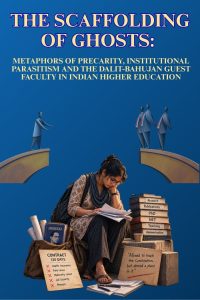
The Scaffolding of Ghosts: Metaphors of Precarity, Institutional Parasitism and the Dalit-Bahujan Guest Faculty in Indian Higher Education

“They take our sweat to cement the arches of their intellectual temples, but reserve the sanctuary for their own kin. We are allowed into the university only as day-laborers of the mind, expected to clean the dust of their theories and vanish before the sun sets.”

— Notes from an Unappointed Ad-Hoc Scholar


I. Introduction: The Ivory Plantation and the Underground Specters

The modern Indian university is not an agora of enlightenment; it is a meticulously landscaped plantation whose ivory towers are held upright by bamboo scaffolding made of invisible hands. If you walk through the marble corridors of Delhi University, the red-brick courtyards of Hyderabad, or the ancient stone arcades of state universities in Uttar Pradesh and Maharashtra, you will breathe an air thick with the incense of academic grandiosity. High-table seminars deliberate on post-colonial subalternity, international journals publish lavish treatises on “decolonizing the mind,” and vice-chancellors deliver pious speeches on national progress. Yet, step beneath the floorboards of this grand theater, into the subterranean basements where tutorial sheets are evaluated and attendance registers are marked, and you will encounter an army of specters. They are the Guest Faculty, the Ad-Hoc Scholars, the Temporary Lecturers—disproportionately hailing from Dalit, Bahujan, and Adivasi communities—who inhabit the university not as citizens of letters, but as unacknowledged day-laborers of the intellect.

To understand the crisis of the Dalit-Bahujan guest lecturer is to understand a sophisticated, modernized form of institutional untouchability. It is a system that does not banish the untouchable body from the temple of learning, but rather admits it on the condition that it remains eternally temporary, economically broken, and structurally voiceless. The old caste order barred the Shudra and Ati-Shudra from listening to the Vedas by pouring molten lead into their ears; the modern neoliberal-feudal university permits them to teach the Vedas, the Constitution, and Quantum Mechanics, but ensures that their monthly stipend of a few thousand rupees arrives six months late, without healthcare, without maternity leave, and with the permanent threat of instant dismissal at the end of every 120-day contract cycle.


IIA. The Reservation Bypass: How Public Universities Invented the “Academic Coolie”

For seven decades, the Indian Constitution guaranteed that public universities—the primary engines of social mobility for marginalized communities—would reflect the demographic reality of the nation through affirmative action (Reservation). However, the Savarna oligarchy that controls the levers of academic administration executed a masterstroke of systemic evasion. Rather than directly opposing reservations—which would invite constitutional penalties and street protest—they rendered the permanent faculty position an endangered species. By deliberately freezing regular recruitment for decades, university administrations created an artificial vacuum, which they then filled with temporary, contract, and guest faculty.

Consider the brutal arithmetic of this institutional fraud. When a university advertises a permanent Assistant Professor position, it is legally bound to apply the constitutional quota (15% SC, 7.5% ST, 27% OBC, alongside EWS). But when the university hires a “Guest Lecturer” or “Ad-hoc Teacher” to take the exact same classes, grade the exact same papers, and invigilate the exact same examinations, the reservation roster is blithely discarded under the legal pretext that guest teaching is “hourly engagement” or “contingent work.”


IIB. The Reservation Bypass: Institutional Anomie: Higher Education Disparity Data

  • 33%+ Sanctioned Faculty Vacancies Left unfilled across Central and State universities.
  • 50% Undergraduate Teaching Load Executed by guest, ad-hoc, and contract labor.
  • 4.2% SC/ST Full Professors Representation in premier institutions.

This is the Reservation Bypass Architecture. By shifting the bulk of teaching workloads onto unreserved, arbitrarily appointed guest arrangements, university syndicates have successfully preserved permanent professorships as exclusive fiefdoms of elite caste networks. The Dalit-Bahujan scholar who spent a decade earning a PhD from a premier central institution, publishing peer-reviewed papers, and passing the National Eligibility Test (NET), arrives at the university gates expecting the fulfillment of constitutional promises. Instead, they are directed to the guest room—a cramped closet under the stairs—and handed an hourly wage contract that pays less than the daily minimum wage of an industrial supervisor.


III. The Metaphor of the Academic Plantation: The Sugar Mill of the Mind

To capture the existential dread of the guest faculty, one must discard the sterile vocabulary of human resource management and turn to the literature of plantation economies. The guest scholar is the cane-cutter of the academic sugar mill. Every morning, they arrive at the campus with bundles of intellect harvested from nights of lamp-lit reading, only to feed them into the administrative crusher. The sweetness—the tuition fees paid by students, the accreditation scores (NAAC) awarded to the college, the university’s ranking metrics—is extracted by the administration to polish the institution’s facade. The leftover bagasse—the exhausted, underpaid, un-benefited human being—is swept out at the end of the term.

There is a cruel satire in how elite institutions market their commitment to social justice. A college will organize a national seminar on “Ambedkarite Hermeneutics” or “Post-Colonial Subalternity,” funded by public grants. The keynote speaker, a tenured professor enjoying a six-figure salary, housing allowances, and sabbatical privileges, will deliver an impassioned address on the plight of the marginalized. Meanwhile, the microphone is adjusted, the water glasses are refilled, and the attendance registers are compiled by a guest lecturer who holds a Doctorate in Marathi Literature, belongs to the Mahar or Matang community, and is wondering if their bank balance of ₹412 will stretch to cover next month’s room rent.

“We are asked to lecture on human rights in the morning and beg the clerk for our unpaid honorarium in the afternoon. The university teaches equality through our mouths while practicing feudalism on our throats.”

This paradox is structural rather than incidental. The tenured Savarna academic elite requires the guest faculty in the same way the Victorian aristocracy required domestic servants. The presence of a vast, desperate reserve army of unemployed and underemployed Dalit-Bahujan PhDs allows tenured professors to reduce their own teaching workloads, delegate tedious administrative drudgery, pursue prestigious foreign fellowships, and maintain an aura of Olympian intellectual detachment. The guest lecturer becomes the institutional sponge that absorbs all the friction, labor, and anxiety of the educational machine, allowing those above them to glide seamlessly through the realm of pure thought.


IV. The 120-Day Executioner: Contracts, Caste Privilege, and Psychological Castration

The contract structure of guest and ad-hoc appointments is designed with psychological precision to break the spirit of resistance. In many state and central universities, appointments are made for 120 days, 89 days, or purely on a “per-lecture” basis (capped at a paltry monthly maximum). At the end of every term, the guest faculty undergoes a symbolic execution: their contract terminates, their temporary library pass expires, and they are cast back into the abyss of non-existence.

To be re-appointed for the next term, the scholar must perform a ritual of submission. They must court the favor of Departmental Heads, College Principals, and Governing Body members. In a society where social capital is coterminous with caste networks, this ritual is deeply stacked against Dalit-Bahujan scholars. A Savarna candidate, connected through family ties, alumni networks, shared dietary habits, and cultural codes, effortlessly navigates the informal corridors of power. They engage in light banter over filter coffee or tea with the Principal, discussing shared acquaintances and theoretical inclinations. The Dalit-Bahujan candidate, lacking this inherited cultural currency, enters the administrative office carrying the heavy burden of historical exclusion, acutely aware that any slip of tongue, any display of political assertion, or even a lack of “servile deference” can result in immediate, unwritten blacklisting.

Satire turns into horror when one examines the “Interview Boards” for ad-hoc and guest panels. Every few months, thousands of scholars line up outside principal offices across university towns like cattle at an auction. They hold thick files containing books they have written, research articles published in Scopus-indexed journals, and certificates of national awards. They are called into the interview room for precisely 90 seconds. 90 seconds to justify ten years of doctoral labor. The committee members—often bored, scrolling through their smartphones—ask a superficial question, check the candidate’s last name (a transparent proxy for caste identity in the Indian context), and make a silent mark on their scorecards. The process is repeated term after term, year after year, converting vibrant young intellectuals into anxious, sycophantic mendicants.


V. The Political Economy of Silence: Why the Academic Subaltern Cannot Speak

Why do guest faculty not unionize and shut down the university until their demands for regularisation are met? The answer lies in the totalizing nature of their precarity. Tenured faculty can go on strike because their salaries are protected by civil service rules and UGC regulations. Permanent staff have trade unions, legal representation, and tenure protection. The guest lecturer has none of these shield walls.

If a guest teacher speaks out against administrative corruption, caste discrimination, or delayed payments, they are not served with a show-cause notice—they are simply not invited back next semester. No order is issued; no explanation is required. The phone simply stops ringing. Their name disappears from the timetable as quietly as a drop of water evaporating on a hot slate. This form of retaliation is clean, silent, and untraceable. It is the bureaucratic equivalent of an extra-judicial disappearance.

Furthermore, this precarious labor market actively fractures solidarity among the oppressed. When fifty Dalit-Bahujan PhD graduates are competing for two temporary guest slots paying a meager hourly wage, the university successfully pits victim against victim. Solidarity is replaced by a desperate, panicky competition for survival. The scholar who raises their voice against an unjust workload is instantly replaced by another scholar whose rent is due tomorrow and whose family is waiting for a remittance back in the village.


VI. A Personal Monologue: A Letter from the Shadows

Let me speak to you not as an abstract sociological voice, but as Mujammil Shahin Siraj Shaikh—a chronicler who has watched the brightest minds of my generation wither in the waiting rooms of higher education.

I have seen my friend—a man who spent six years translating obscure 19th-century anti-caste manuscripts, a scholar whose mind burns with the brilliance of a supernova—standing outside the account section of a state university in the scorching summer heat of June. He was not there to collect a research grant or a publication prize. He was begging a clerk, who was half-asleep under a whirring ceiling fan, to release his lecture fees for the previous semester—money that had been withheld for seven months because a signature on a voucher sheet was missing a middle initial. His mother in the village needed insulin; his landlord had threatened to lock his room by the weekend. In his pocket was a copy of Antonio Gramsci’s Hegemony and the Intellectuals, a book he had taught to fifty eager undergraduate students that very morning.

What does it do to a human soul to articulate theories of freedom, justice, and human dignity on the lectern, while living a personal reality of complete disenfranchisement? It creates a profound, tearing schizophrenia. The guest scholar lives in two worlds simultaneously: in the morning, they are “Doctor,” an authority figure guiding the next generation toward critical thought; in the evening, they are a pauper, calculating whether they can afford egg curry or must settle for plain rice to survive till the end of the month.

This humiliation is explicitly gendered and caste-coded. Bahujan women guest lecturers face a double furnace of oppression. They navigate not only the structural precarity of temporary contracts and caste bias but also the insidious sexual harassment and paternalistic condescension inherent in hierarchical university departments, where renewal of contracts is frequently dangled as a weapon of behavioral control by senior male academics.


VII. The Imperial Caste-Class Trap: Data, Statistics, and Structural Reality

The tragedy of the guest faculty is not a temporary glitch in an otherwise healthy educational system; it is the logical outcome of a neoliberal state colluding with a feudal social structure. Let us examine the national indicators that illustrate this structural betrayal:

  • Systemic Vacancies as Policy: According to official data presented in Parliament and AISHE reports, thousands of faculty positions remain vacant across Central Universities, IITs, and NITs. The vast majority of these unfilled posts belong to the reserved categories (SC, ST, OBC). By leaving these posts vacant under the pretext of “Non-Availability of Suitable Candidates” (NASC)—a notorious administrative euphemism used for decades to reject qualified Dalit-Bahujan applicants—universities fill the operational gap by hiring guest lecturers at a fraction of the cost.
  • The Economic Exploitation Ratio: A permanent Assistant Professor under the 7th Pay Commission earns a starting basic pay of approximately ₹57,700 plus allowances (totalling upwards of ₹85,000 to ₹1,000,000+ monthly). A Guest Faculty member teaching the exact same course load is capped at a maximum ceiling (often ₹50,000 in central norms, but frequently down to ₹12,000 – ₹20,000 in state universities), with zero pay during vacations, zero health insurance, zero Provident Fund, and zero annual increments. The university extracts 100% of the labor value while paying less than 20% of the cost.
  • The Psychological Toll: Studies on academic precarity show alarming rates of chronic anxiety, depression, and existential despair among ad-hoc and guest educators. When social identity (caste stigma) combines with economic instability, the result is an intolerable mental crucible. The tragic institutional suicides of scholars like Rohit Vemula and Payal Tadvi are merely the visible tip of an underwater iceberg of silent, slow-motion institutional violence inflicted on thousands of contract educators daily.


VIII. Reclaiming the Temple: A Call for Radical Academic Emancipation

We must strip away the romantic mythologies of the Indian university. The university is not a sanctuary of pure scholarship; it is a battleground of social power. As long as higher education relies on an underclass of disenfranchised, underpaid, and structurally vulnerable Dalit-Bahujan guest faculty, every degree awarded by these institutions is tainted by the sweat of unfree labor.

To dismantle this modern plantation system, we do not need incremental policy tweaks or patronizing sympathies from academic senates. We require radical structural restructuring:

  • Immediate Abolition of the “Guest/Ad-Hoc” Bypass: Higher education regulatory bodies (UGC, Ministry of Education) must mandate that any teaching position required for more than one academic term MUST be converted into a regular, permanent position subject to constitutional reservation rosters.
  • Equal Pay for Equal Work: Until regularisation is achieved, guest faculty performing identical teaching, evaluation, and administrative duties must receive equal hourly and monthly remuneration, along with full health coverage and seasonal pay continuity, in strict compliance with Supreme Court mandates on labor rights.
  • National Audit of Reservation Rosters: A high-powered, independent judicial commission comprising Dalit, Bahujan, and Adivasi jurists must audit the faculty recruitment records and vacancy distributions of all central and state universities to expose and penalize administrative manipulation of reservation panels.
  • Democratization of Departmental Governance: Departmental chairs and university committees must be stripped of arbitrary, unilateral power over contract renewals. Evaluation of teaching staff must be transparent, peer-reviewed, and protected against personal and caste-based bias.

Until these measures are implemented, the Dalit-Bahujan intellectual will remain a ghost in the machine—hired to teach the youth how to think, but forbidden from claiming a place to exist. But let the managers of the academic plantation take warning: ghosts do not remain silent forever. The scaffolding of precarity is rotting from within, and when it collapses, it will take the ivory tower down with it.


Mujammil Shahin Siraj Shaikh is a Pune-based independent researcher and prospective PhD scholar examining structural inequality, public policy and institutional power in modern India.

When the State Can Take Your Institution: FCRA and How the Civil Society Is Being Choked Financially

India’s Foreign Contribution (Regulation) Act was introduced in 1976, during the Emergency, to regulate foreign influence in Indian political life. The 2010 Act replaced that framework with a broader system for regulating foreign contributions to organisations and associations. Over time, FCRA has also given the state increasing power over whether organisations can access foreign funding and continue their work. The latest changes take that process further.

The Foreign Contribution (Regulation) Amendment Bill, 2026 was introduced in the Lok Sabha on 25 March and referred to a Joint Parliamentary Committee on 12 August. It is not law yet. The 2026 Rules, however, are already in force. Together, they significantly tighten the conditions under which organisations receiving foreign contributions can operate.

The Bill proposes a Designated Authority to supervise foreign contributions and assets after an organisation’s FCRA registration is cancelled, surrendered, expires or is not renewed. The Authority can take provisional custody of the foreign contribution and relevant assets. If the registration is not restored or renewed within the prescribed period, the assets can vest permanently in the Authority and subsequently be transferred or disposed of, with the proceeds going to the Consolidated Fund of India. The proposed framework also covers assets created partly from foreign contributions.

There is an important detail here. The principle of asset vesting is not entirely new. Section 15 of the existing FCRA already provides for the vesting of assets created out of foreign contribution when an organisation’s registration is cancelled or surrendered. What the 2026 Bill does is build a much more elaborate administrative machinery around that principle, giving the state greater control over what happens to those assets. And this matters because the state already has considerable power to make an organisation incapable of functioning long before anyone arrives to take possession of its assets.

The state does not need to seize an organisation’s property to make it unviable. The cancellation or non-renewal of an FCRA registration can cut off its access to foreign funding, while investigations and regulatory proceedings can tie up its finances and consume the administrative capacity needed to keep the organisation running. By the time an organisation is able to challenge such action, it may already have lost the ability to function as it once did.

The 2020 amendments established much of the architecture that made this possible. The ceiling on administrative expenditure was reduced from 50% to 20% of foreign contributions. That expenditure includes basic organisational costs such as personnel, salaries, travel and management. At the same time, organisations receiving foreign contributions were prohibited from transferring those funds to other organisations, effectively ending the sub-granting arrangements through which larger organisations had supported smaller grassroots groups.

The consequences for smaller organisations were particularly severe. A national organisation could previously receive foreign funding and pass some of it to a local group working in a remote district. After 2020, that channel was closed. The local organisation had to deal with the compliance burden itself, even when it lacked the staff, money or administrative capacity to do so.

The 2020 amendments also required foreign contributions to be received through an FCRA account at the State Bank of India’s New Delhi Main Branch on Sansad Marg. For organisations working in rural areas or distant states, even a basic banking requirement became another layer of centralised administrative control.

This has happened alongside a dramatic contraction in the number of active FCRA organisations. Thousands of registrations have been cancelled or allowed to lapse over the years. Organisations including Amnesty International India, Oxfam India and the Centre for Policy Research have faced cancellation, suspension or non-renewal.

The 2026 Rules add further conditions. Organisations must now identify the purposes for which they intend to use foreign contributions and the states or Union Territories in which they intend to operate. Their FCRA registration is consequently tied more closely to specified purposes and geographical areas. The Rules also expand disclosure requirements concerning activities, office bearers, publications and social media accounts. An organisation must demonstrate that it has undertaken “reasonable activity” by utilising at least ₹10 lakh in foreign contribution over the preceding two financial years. For organisations receiving foreign contributions in instalments under prior permission, the release of a subsequent instalment is tied to utilisation of at least 75% of the previous instalment and a field inquiry.

These requirements are presented as compliance measures. But compliance itself is a mechanism of control where the state has the power to decide whether an organisation has done enough, worked in the right place, spent enough money or remained within the purposes recorded on its certificate.

This is particularly useful to a government that wants to curb progressive work while abandoning its own responsibilities to the people. Organisations working with communities affected by caste violence, displacement, environmental destruction, poverty and state violence can be weakened through the same machinery that is supposed to regulate their funding. The state retreats from its public obligations while strengthening its ability to constrain those who organise in the spaces it leaves behind.

The implications extend beyond organisations conventionally described as NGOs into spaces that are squarely political. Civil society includes legal aid groups, research institutions, health organisations, women’s collectives, workers’ organisations, environmental groups, educational initiatives and organisations working with Dalit, Adivasi and minority communities. These institutions document violence, gather evidence, challenge government policy and provide services where state institutions are inaccessible or inadequate.

It also includes religious and minority institutions. The government has stressed that the 2026 Rules continue to permit specified faith-based welfare and religious activities, including religious education, maintenance of places of worship and charitable work. At the same time, the Rules place foreign-funded activities within increasingly specific categories and exclude proselytisation from the permissible religious purposes.

This is pertinent in a country where schools, hospitals, shelters and charitable institutions are run by religious and minority organisations, especially in a context where successive governments have failed to carry out their public and institutional duties effectively. Why should the state possess such extensive administrative power over institutions that provide social services while it fails to do the bare minimum?

As Azam Khan writes in Maktoob, the changes represent “a systematic attempt to control and subjugate the social fabric of India.” An independent organisation that researches caste violence, documents environmental destruction, provides legal aid to workers or challenges a government policy creates an institutional space from which the state can be questioned. That space matters precisely because it exists outside direct government control.

The history of FCRA shows how this power has accumulated. A law introduced to regulate foreign political influence has become a mechanism through which the state can determine which organisations receive foreign resources and how long they are allowed to operate with them. The 2020 amendments tightened the financial conditions. The 2026 Rules add further administrative requirements. The 2026 Bill extends state control to what can happen to an organisation’s assets after its FCRA registration ends.

The result is a civil society whose institutional survival is increasingly placed in the hands of the executive. Independent institutions create space for people to organise outside the state and produce knowledge that can challenge official accounts. When those institutions are weakened, the communities that depend on them lose some of their capacity to make their experiences visible and press their demands. And when that space shrinks, so does the space available for dissent.


DalitThinkerToday is a Chartered Accountant by profession from Sangli, Maharashtra, who occasionally dabbles in thinking about politics when people in her oppressor-caste-majority office frustrate her. This is her pseudonym.

When Bengal’s Voter Rolls Become Deportation Lists

A report by Human Rights Watch has accused Indian authorities of forcibly expelling ethnic Bengali residents—predominantly Muslims—from West Bengal into Bangladesh without due process, leaving families stranded for days between the border forces of the two countries. According to the report, the Border Security Force (BSF) has, since early June, repeatedly attempted to push groups of people across the border, only for Bangladesh’s Border Guard (BGB) to refuse entry because no process of nationality verification had taken place. Families, including children and pregnant women, were reportedly left in the “zero line” between the two countries before some were eventually taken back by Indian authorities.

Several of those identified in the report were not recent entrants into India. They reportedly possessed Aadhaar cards, had lived in the country for decades and had participated in previous elections. Their detention followed the deletion of their names from West Bengal’s revised electoral rolls after the controversial voter-list revision that preceded the Bharatiya Janata Party’s victory in the state elections. In several reported cases, exclusion from the electoral rolls appears to have become the basis for detention and attempted deportation.

Over the last decade, citizenship has increasingly been determined through documentation rather than constitutional status alone. West Bengal is not the beginning of this story. The National Register of Citizens (NRC) exercise in Assam excluded nearly two million people from the final register, leaving thousands in prolonged legal uncertainty. Detention centres, foreigners’ tribunals and endless documentary verification, alongside the ethno-nationalist zeal with which these practices have been defended, have transformed citizenship from an assumed legal status into something that must be repeatedly established before the state. This is not to suggest that the pre-NRC order was free of structural violence, but the contemporary mutations mark a significant escalation in how citizenship itself is administered and contested. The current developments suggest that this administrative logic is no longer confined to Assam but is increasingly shaping citizenship practices elsewhere in India.

The political language surrounding these exercises follows a template that the Bharatiya Janata Party has steadily developed since the 1990s, drawing on older nationalist anxieties around borders. In West Bengal, where a shared Bengali identity historically complicated such narratives, that vocabulary has nevertheless gained political ground. Chief Minister Suvendu Adhikari has openly defended a policy of “detect, delete and deport”, claiming that thousands of alleged Bangladeshi “infiltrators” have already been sent back, even as both the legality of these actions and the official figures cited remain open to serious question.

The Human Rights Watch report also raises questions about the apparent bypassing of established repatriation procedures between India and Bangladesh. Dhaka has repeatedly maintained that it will not accept individuals pushed across the border outside agreed processes of nationality verification. The consequence has been families stranded for days between two states, each refusing immediate responsibility for people whose legal status remains contested.

These events expose a larger weakness in India’s legal framework governing migration and displacement. India remains outside the 1951 Refugee Convention and its 1967 Protocol and has no comprehensive refugee or asylum law. The principle of non-refoulement—the obligation not to return a person to a territory where they face persecution or other serious harm—therefore does not exist as a comprehensive statutory guarantee. Indian courts have, in some cases, extended Article 21 protections to non-citizens. Even so, refugee protection continues to depend largely on executive policy and judicial interpretation rather than a coherent legislative framework.

The people described in the Human Rights Watch report are not necessarily refugees in the legal sense. Many are individuals whose nationality itself is disputed. Ideally, constitutional safeguards and judicial oversight would protect such vulnerable populations. Instead, the higher judiciary has, over the years, increasingly retreated from that role in matters of citizenship, at times reinforcing rather than restraining the state’s exclusionary powers. Yet the absence of a clear legal framework leaves similar questions to executive discretion: who is heard, who is detained, who is deported and what procedural safeguards apply before those decisions are made.

The law says little about undocumented migrants whose labour sustains agriculture, construction, brick kilns, domestic work, manufacturing and much of the informal economy. Their work is absorbed into the economy while their precarious legal status leaves them vulnerable to wage theft, coercion, detention and deportation. Their labour is needed; their rights remain contingent.

The implications also extend to caste. Documentary citizenship has never operated on a socially level field. Landlessness, forced migration, displacement, informal labour and unequal access to education and state institutions have meant that documentary histories are themselves unevenly distributed. Communities historically pushed to the margins—including Dalits, Adivasis, denotified and nomadic tribes, migrant workers and many borderland populations—are often least equipped to satisfy expanding bureaucratic demands for proof. Administrative neutrality can therefore reproduce deeply unequal social outcomes without ever invoking caste explicitly.

That is why the current moment should not be viewed simply as a border issue or a dispute over illegal immigration. The expulsions are the endpoint of a much longer administrative process through which citizenship itself becomes uncertain. The border merely reveals a process that begins much earlier—in electoral rolls, identity databases, police verification, citizenship registers and executive discretion.

The expulsions at the India-Bangladesh border are not an isolated border episode. They reveal how questions of citizenship are increasingly being settled through administrative action before they are settled in law. Once belonging itself becomes contingent on documents that can be revised, withdrawn or disputed, the Constitution ceases to function as a guarantee and instead becomes something that citizens must repeatedly prove themselves entitled to.


Paresh Hate is a Bahujan queer researcher, writer, documenter and activist and the Lead Content Manager at Dalit Voice.
Nepal’s Apology and After

Nepal’s new government has done something no previous government was willing to do. In March 2026, it issued a formal apology to Dalits, acknowledging centuries of caste discrimination and exclusion. Soon after, Sita Badi became the first Dalit woman to hold a full cabinet position at the federal level, taking charge of the Ministry of Women, Children and Senior Citizens.

For a country where caste oppression has long been treated as a social problem rather than a political one, these developments carry weight. The Nepali state has publicly acknowledged that caste inequality was not simply a matter of social prejudice but a system sustained through institutions, laws and political power.

The apology, delivered in Parliament by Rabi Lamichhane, promised that no Nepali would again have to bow before caste hierarchy. Yet questions emerged almost immediately. The statement was expected to come from the President or Prime Minister as a formal act of the state. Instead, it came through the chairperson of the ruling party speaking on behalf of the government.

Dalit organisations have responded by focusing less on the language of recognition than on the machinery of reform. The Feminist Dalit Organisation (FEDO) has called for inclusive budgeting, stronger protections against violence, economic empowerment programmes, citizenship rights and greater participation in decision-making. It has also pushed for legislation to implement Article 40 of Nepal’s Constitution and for long-promised commitments on proportional representation. These demands are not new. Neither are most of the constitutional provisions involved.

The Nepali state did not discover caste discrimination in 2026. Dalit organisations, activists and movements have spent decades documenting exclusion, violence and underrepresentation. Constitutional guarantees already exist. National commissions already exist. Yet proportional representation remains incomplete, Article 40 remains only partially implemented, and Dalit organisations continue to press for reforms that have been discussed for years.

The government announced a 100-point reform agenda and promised key initiatives within 15 days. More than 55 days after the formation of the new Parliament, little progress had been made on many of those commitments.

Constitutional provisions can remain unimplemented for years even when legislatures are functioning. The deeper issue is political will. Successive governments have been willing to acknowledge caste discrimination, establish commissions and make commitments. They have been far less willing to spend political capital on reforms that would alter representation, budgeting priorities and institutional accountability.

Since the current parliamentary session began in May, lawmakers have spent weeks locked in disputes over Prime Minister Balendra Shah’s conduct, parliamentary procedure, dress codes, attendance and political remarks. Opposition parties have staged protests, boycotts and obstruction. Debates over the government’s policy programme and budget priorities have repeatedly been pushed aside. None of these disputes concern the constitutional reforms Dalit organisations continue to demand.

Nepal’s political class has found the language to acknowledge historical caste injustice while leaving many of the reforms demanded by Dalit organisations unresolved. Sita Badi’s appointment sits within the same political landscape. Her rise from the historically oppressed Badi community to the federal cabinet would have been difficult to imagine only a generation ago. For Dalit women in particular, her appointment breaks through a barrier that Nepal’s political establishment left standing for decades.

Civil society groups are now working with the National Dalit Commission to prepare a broader position paper on social justice, restoration and historical reconciliation. Nepal’s apology has opened a political opportunity. Dalit organisations have treated it as such. They have responded not with celebration alone but with demands, proposals and constitutional claims.


Paresh Hate is a Bahujan queer researcher, writer, documenter and activist and the Lead Content Manager at Dalit Voice.

Friendship With China 

Big changes are likely to take place in India’s relationship with China.  

The forthcoming visit of the Chinese Foreign Minister Huang Hua to India – the first visit by a Chinese leader since the Sino-Indian border clash. Chinese Prime Minister Zhao Zing’s prediction of closer India-China friendship made during his recent visit to Pakistan and Nepal and the assurance given by the Chinese leaders in Peking during the visit of the India-China Friendship Association delegation led by its President B. B. Mandal, West Bengal Minister, have all indicated that China is very keen to have closer friendship with India.

No power on earth can stop the unity of these two giants because the revolutionary sections in both the countries and elsewhere know full well that when these countries come together the very face of the earth will change.  

India and China are not only the two most populous countries in the world but represent the most ancient civilisations as well. Both are Asian and both got independence together. There are ever so many things in common including a common border running to thousands of miles.  

This writer was in China late in 1980, leading a goodwill delegation and we all experienced the warmth of friendship the Chinese have towards India.

The Dalits and other persecuted minorities comprising the most revolutionary sections of India cannot get a more trusted friend in the world than China. The way the minorities: Muslims and Christians – are looked after in China, should help us in solving our minority problems. Therefore, we the revolutionary sections of India, have to learn a great deal from China which has come out on the top of the world within 30 years. Respected and feared. We and other six members in our goodwill delegation were eye-witness to this “Chinese miracle”.  

During our extensive tour of China, we saw how they have ended exploitation of man by man and how they brought about total liberation of women and transformed a whole mass of humanity into a major world power. Out of the 150 or so member countries in the UNO China’s rank is as high as within 15. But India is pushed to the 120th rank or so. A beggar nation! This is because we have failed to learn from the Chinese experiments.  

On behalf of the untouchables of India, the Karnataka Dalit Action Committee had given a reception to the first Chinese goodwill delegation during its visit to Bangalore. And we recall how much the Chinese are concerned about the plight of Dalits and other persecuted minorities of India.  

Therefore, we hail the forthcoming visit of the Chinese Foreign Minister Huang Hua and call upon the Dalits and other persecuted minorities to extend a warm welcome and try to forge closer links with China.