The Right Not to Sing

Nationalist Demands in the New Law

The Prevention of Insults to National Honour (Amendment) Bill, 2026 was introduced by Amit Shah in the Rajya Sabha on 24 July 2026. Its Statement of Objects and Reasons recalls that Rajendra Prasad, as President of the Constituent Assembly, said on 24 January 1950 that Vande Mataram would be “honoured equally” with Jana Gana Mana. It notes that no legal provision existed to prevent interference with the singing of the National Song and proposes to address this by amending Section 3 of the 1971 Act, which already made intentionally preventing the singing of the National Anthem, or disturbing an assembly engaged in singing it, punishable with imprisonment of up to three years, a fine, or both, with a mandatory minimum of one year for a second and subsequent conviction. The amendment extends that same offence, and the same penalties, to the National Song. Article 51A(a) names the Constitution, the national flag and the national anthem as objects of citizens’ respect; it has never named the National Song.

The amendment arrived alongside a separate, longer-running push to change what gets sung. Vande Mataram has six stanzas; since 1937, only the first two have been used at national gatherings, a convention set by the Congress Working Committee. The Ministry of Home Affairs had already moved to reverse that convention on its own, issuing a protocol on 28 January 2026 requiring the full six-stanza version at government, ceremonial and cultural events, well before this amendment existed. That protocol was advisory and, as the courts would go on to hold twice over the following months, carried no penalty of its own. Only after those two challenges failed did the government tighten the position twice more: a July 9 MHA letter to all states specifying that only the official six-stanza version could be recited whenever the song was sung in mass singing, and then, on 24 July, the amendment itself. Where both the song and the anthem are performed at one event, Vande Mataram now goes first. Schools are directed to open assemblies with it, although many schools already practiced this of their own volition. It is to be played at state functions, civilian award ceremonies, flag-hoisting events, and the arrivals and departures of the President and Governors.


The Political Fight Over the Song
The push for the full six-stanza version followed a ten-hour special discussion in the Lok Sabha in December 2025 marking the song’s 150th anniversary, in which the Prime Minister accused the Congress of having “sowed the seeds of division” by trimming the song. In 1937, the Congress Working Committee, after consultation with Mohandas Gandhi, Jawaharlal Nehru, Rabindranath Tagore, Subhas Chandra Bose, Rajendra Prasad and Vallabhbhai Patel, decided that only the first two stanzas would be used at national gatherings because of objections to the religious imagery in the later verses. Tagore had written to Nehru that the first two stanzas had “acquired a separate individuality and an inspiring significance of its own,” while the later verses, read in context, “[are] liable to be interpreted in ways that might wound [Muslim] susceptibilities.” Congress rejected the Prime Minister’s charge, pointing to this 1937 decision and Tagore’s letter and accusing the government of manufacturing the controversy for present gain in the context of then upcoming elections, a charge Priyanka Gandhi Vadra made directly. The Congress Working Committee has since reaffirmed the two-stanza position for its own party programmes.

The dispute has now also moved into a question of federal authority after the Karnataka government ordered on 8 September that only the first two stanzas be sung at state government programmes, except when the President, Vice-President, Prime Minister or Governor is present. Within days, advocate Girish Bharadwaj filed a PIL challenging the state’s authority to prescribe a shorter version, arguing that the matter falls within Parliament’s residuary legislative powers and that the state order conflicts with the 2026 amendment to the Prevention of Insults to National Honour Act. The petition also challenged the procedure by which the Karnataka Cabinet took the decision, alleging that it was approved as an “Informal Discussion” without a Cabinet Note or Law Department advice. Governor Thaawarchand Gehlot then wrote to Chief Minister D.K. Shivakumar, invoking Articles 162, 256 and 257(1) and asking the government to reconsider its order on the ground that it conflicted with the Union’s statutory and executive framework. On 16 September, BJP MLA S.N. Channabasappa walked out of a government programme in Shivamogga after only the first two stanzas were sung.

The opposition, however, has also been weak in resisting the Centre’s position. In Kerala, the Congress-led UDF government initially circulated the Centre’s instruction that Vande Mataram be sung in full during the Har Ghar Tiranga campaign from 9 to 17 August. This put a Congress-led government in the position of appearing to implement the same six-stanza version promoted by the BJP-led Union government, despite Congress’s objections to treating the full version, with its references to Hindu deities, as a compulsory expression of national identity. The CPI(M) criticised the UDF’s position, with Leader of the Opposition Pinarayi Vijayan arguing that the song “in its entirety is not compatible with secularism” and that “there is nothing wrong with reciting the opening stanzas”, and accusing the UDF of surrendering to an RSS agenda. The UDF subsequently clarified that it would not follow the full version, and the state government ultimately omitted Vande Mataram from its official Independence Day function.

The song’s meaning has remained contested within the communities whose religious commitments are most directly implicated by it, a history the government’s “everybody knows what is national song” formulation simply passes over. The distinction made in 1937 remains central to the dispute: the Congress Working Committee accepted the first two stanzas for national gatherings while recognising objections to the later verses and their religious imagery. Muslim religious authorities have continued to make this distinction. Darul Uloom Deoband and Maulana Mahmood Madani have objected to the later verses on the grounds that their depiction of the motherland as divine conflicts with the Islamic doctrine of tawhid, while the All India Sunni Ulema Board ruled in 2006 that Muslims could sing the first two stanzas.

The dispute, however, has not been confined to Muslim objections. During the 2006 centenary controversy, the Shiromani Gurdwara Parbandhak Committee initially instructed its schools not to sing Vande Mataram, with its president arguing that it promoted a particular religion and did not fulfil the aspirations of minorities, before subsequently backing away from that position. In 2026, the Andhra Pradesh Christian Leaders Forum objected to the newly mandated full version, specifically citing its references to Durga and their implications for Christian beliefs. The question is therefore not simply whether Vande Mataram is the national song, but what religious content the state is asking people to affirm when it mandates the complete text. The Home Ministry’s circular treats that underlying question as though it had never been contested. Where it does allude to the religious objection, it reduces it to a question of Muslim reluctance, allowing a disagreement over religious belief to be recast as a question of patriotism.


The Text Behind the Mandate
The distinction between the first two stanzas and the later verses can be traced to how the song was written. Bankim Chandra Chattopadhyay had written the first two stanzas in the 1870s, describing a land of rivers, fruit and gentle winds. He added four more when he incorporated the song into his 1882 novel Anandamath, and those later stanzas carry the divine imagery: the third stanza calls the motherland “protector of millions and destroyer of enemies,” the fourth names her Durga, Lakshmi and Saraswati outright, while the fifth and sixth complete the poem as a vow of devotion.

Anandamath provides the setting in which those later stanzas acquire their political and religious meaning. Bankim Chandra Chattopadhyay is one of the key figures of proto-Hindutva politics in British India, and the novel is set during the Sannyasi Rebellion. Its protagonist, Mahendra, a zamindar separated from his family amid famine and unrest, falls in with the Santans, a band of ascetic soldiers who have taken up arms to liberate the motherland from Muslim rule, with the British entering the story only later. One of Satyananda’s disciples wants to “pull down the city of the renegades” and “throw it into the river.” Bhavananda, inducting Mahendra into the cause, tells him “unless we drive these tipsy long-beards away, a Hindu can no longer hope to save his religion,” and answers the question of method with “we will beat them.” He then leads Mahendra to the order’s temple, where, standing before the idols of Durga and Kali, he tries to fill him with religious fervor for the fight ahead. Elsewhere in the novel, the Santans send emissaries into villages to gather bands of Hindus, then raid Muslim settlements, which are burned “to ashes.” Characters imagine the day a mosque will be razed to build a temple to Radha-Madhava in its place. The four later stanzas of Vande Mataram were written for, and inside, this story. This is the context of the text now mandated by law.


The Limits of the Law’s Imagination
That January 28 protocol was challenged twice. In February, Muhammed Sayeed Noori approached the Supreme Court, arguing that requiring the complete version raised questions of religious freedom and conscience. On 25 March, the Court declined to entertain the petition, holding that the protocol was advisory and carried no penalty for those who chose not to sing, while leaving open the possibility of intervention if the advisory hardened into actual discrimination or coercion. A parallel challenge in the Karnataka High Court, filed by Bengaluru-based advocate Somashekhar Rajavamshi, objected specifically to the inclusion of stanzas three through six and their references to Durga, Saraswati and Lakshmi; the High Court dismissed it on 9 April on the same ground, that the protocol did not make singing the full version mandatory.

The 2026 amendment changes that position. The January protocol could prescribe the full version’s use; it could not, on its own, criminalise a refusal to sing it. The amendment extends the National Song to the Section 3 offence applicable to the National Anthem since 1971: intentionally preventing its singing, or disturbing an assembly engaged in singing it.

On 22 September 2026, the Supreme Court heard a petition by T. M. Krishna, with senior advocate S. Muralidhar appearing for him. The petition challenges the 2026 amendment insofar as it extends the existing criminal provision to the National Song. It also challenges the Home Ministry’s directions requiring the complete six-stanza version at official functions. The petition argues that the amended provision and the directions violate Articles 14 (equality before the law), 15(1) (prohibition of discrimination on specified grounds), 19(1)(a) (freedom of speech and expression), 21 (protection of life and personal liberty) and 25(1) (freedom of conscience and the right to profess, practise and propagate religion).

The Court refused to decide whether the National Song should consist of two stanzas or six, indicating that this was for the democratically elected state to determine rather than for the Court to prescribe. Justice Bagchi also questioned the suggestion that religious references in all six stanzas are, by themselves, incompatible with the Constitution’s secular character, pointing to the reference to God in the US national anthem. That another country’s anthem contains a religious line does not make it a benchmark for what India’s Constitution should tolerate; it only shows that one other state has also let religious language sit inside a national symbol. Whether a lingering religious motif of that kind is compatible with secularism is exactly the question in front of the Court, and pointing to a second, unexamined instance of the same thing does not answer it. The Centre has two weeks to respond, and the Court has not yet ruled on the constitutional validity of the amendment or the six-stanza directions.

At the hearing, however, the Court drew a distinction between the State’s choice of a national symbol and the use of criminal law in relation to participation in it. Nothing in the amendment says that simply refusing to sing Vande Mataram is itself an offence; the crime, as under the original Section 3, is preventing others from singing or disturbing an assembly engaged in it. The question before the Court is therefore whether the protection recognised in Bijoe Emmanuel, which concerned refusal to sing the National Anthem under that same original section, also protects a person who refuses to sing the National Song on grounds of conscience or religion while leaving others free to do so.

That leaves an odd gap. If the amendment truly does not touch a refusal that neither prevents others from singing nor disturbs an assembly, the state loses nothing by saying so outright, and Krishna’s petition should fall outside the law’s reach without a fight. The Centre resisted even the issuing of notice, and Solicitor General Mehta pressed the Court not to entertain the petition at all. That resistance points to a state interest that Section 3’s text does not itself supply: the discretion to withhold, for as long as possible, any confirmation that non-participation is safe.

Bijoe Emmanuel v. State of Kerala, which the Court said still governs the field and has never been challenged, is the case that established that refusal to sing the National Anthem, where the person neither prevents others from singing nor disturbs the assembly, does not constitute an offence under Section 3. In 1986, the Court considered three schoolchildren in Kerala who belonged to the Jehovah’s Witnesses faith. They believed that singing the National Anthem was incompatible with their religious convictions, although they had no objection to the words or sentiments of Jana Gana Mana. During their school’s morning assembly, they stood silently while the anthem was sung. After the issue was raised, they were expelled from school, despite an inquiry finding that they were law-abiding and had shown no disrespect. The Supreme Court held that their expulsion violated their fundamental rights. It also held that there was no law obliging anyone to sing the National Anthem and that their standing silently while it was sung did not constitute an offence under Section 3 because it neither prevented the singing nor disturbed the assembly.

The Court in Bijoe Emmanuel answered for the facts it had: the children stood, in silence, while others sang, and that was respect enough. Whether sitting, or some other form of non-participation, would count the same way was never argued before it, and the judgment does not say. The Court’s later National Anthem jurisprudence went further than Bijoe Emmanuel by imposing a general requirement to stand, but went no further in deciding whether an able-bodied person who chose not to comply had thereby committed an act of disrespect. In Shyam Narayan Chouksey v. Union of India, the Court initially ordered, in 2016, that the National Anthem be played before every feature film and that everyone present stand. It subsequently recognised exceptions for people unable to stand and for occasions when the anthem appeared within a film, newsreel or documentary. In 2018, it made the playing of the anthem before films optional and handed the wider question of its regulation to the government. What remained unresolved was whether an able-bodied person who deliberately remained seated when the National Anthem was played had thereby shown disrespect.

Article 51A(a) requires citizens to respect the Constitution, the national flag and the national anthem. That language concerns respect for specified national symbols, while Section 3 concerns conduct that interferes with their public performance. The Constitution speaks of an attitude of respect; Section 3 defines specific acts that the law prohibits. Bijoe Emmanuel is the only case here that actually examined a specific act of non-participation and ruled on whether it counted as respectful: the children stood silently while others sang. Chouksey, by contrast, imposed a general rule about what everyone present in a cinema hall had to do when the anthem was played, and later withdrew the requirement that the anthem be played there at all. The distinction between respectful and disrespectful non-participation has therefore never actually been adjudicated on its own terms. That leaves the discretion to decide sitting with whoever is enforcing the law in the moment, not with any settled rule a citizen could rely on in advance. And even supposing that gap could be closed, and the state produced a clean definition of respectful non-participation tomorrow, a further question is why a person should have to demonstrate respect for a national symbol through participation of any kind, rather than simply being left alone by the law altogether.

Article 51A(a) itself answers none of this. The Fundamental Duties, inserted into the Constitution by the 42nd Amendment in 1976, are not enforceable in court. No citizen has ever been prosecuted for an abstract failure to respect the Constitution, the flag or the anthem. Section 3 punishes specific conduct: preventing a performance, disturbing an assembly, even though the boundaries of that conduct can still be interpreted and policed according to the discretion of whoever is enforcing the law. Article 51A(a) supplies the word “respect” and nothing else. It does not say what respect consists of, and it does not say respect must be shown rather than merely left unviolated. The state has built a criminal statute that reaches only interference, and rested it on a duty clause that was written to describe an attitude, not to compel an act.


The Right Not to Sing
The present controversy asks a larger question about the limits of state power over national rituals. A person may have a religious objection to the text, reject the use of a national symbol altogether, or simply choose not to participate. If that refusal does not prevent anyone else from singing, what is the state entitled to demand from the person who refuses? Even as the space for conscientious objection shrinks in the shadow of ultranationalism, we must continue to ask: why should the state require that refusal to take a prescribed form of respect, and why can it not leave room for people to decline participation altogether?
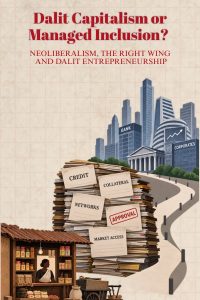
Dalit Capitalism or Managed Inclusion? Neoliberalism, the Right Wing and Dalit Entrepreneurship

Dr. Milind Kamble of the Dalit Indian Chamber of Commerce and Industry said in an interview, “Capital can break caste system… Market and money will defeat anti-capital Marx and Manu.”

His argument might seem attractive, but I disagree. Capital cannot break the caste system because the market is not casteless. It carries caste into every transaction that takes place before the consumer reaches the shop. Certainly, accumulation of capital can improve economic standing, especially among marginalised sections, but it absolutely will not defeat Manu or the caste system. Dr. Kamble is confusing individual economic mobility with the abolition of caste as a social and economic structure. His entrepreneurial agenda does not resolve the concerns that structure and constrain many lives. Who owns land? Who has collateral? Who can access networks? Who can survive a period without income? Who can get a loan without family wealth behind them? Who has the social connections to find suppliers, customers and contracts? And who is trusted when they walk into a bank, a business association or a potential partnership?

Although India, under the leadership of Dr. Manmohan Singh, entered a phase of economic reforms in 1991, opening its economy to liberalised and globalised economic spaces, the trajectory changed significantly since 2014. The post-2014 phase represents a particularly aggressive intensification of neoliberal policies combined with right-wing populist politics. This has manifested through the divestment of profitable stakes in publicly owned companies and their outright sale to private ownership. In post-2014 India, Dalits are being told, again and again, to become entrepreneurs. They are even invited into the market as borrowers, as start-up founders, as “self-made” men and women who can pull themselves up through grit and a bank loan. DICCI has given it a name, “Dalit Capitalism,” asserting that “caste and capital can never co-exist.” However, to assume that capital accumulation can dismantle caste is to ignore how contemporary markets articulate and weaponise pre-existing social hierarchies to maintain structural stratification.It produces hierarchical adverse inclusion, in which Dalits are brought into the market, yet the structures that keep them subordinate remain untouched. This inclusion works through a predatory sorting mechanism where the market invites Dalit actors as economic agents while it simultaneously locks them into asymmetric low-tier commercial arrangements. Such low margin supply roles cannot challenge the pre-existing monopoly of dominant caste. As a result, entrepreneurship functions less as a pathway to mobility and more as a mechanism that reproduces existing hierarchies. Only a small minority are able to move upward through episodic access to capital and networks.

The mix of neoliberal economic policy and right-wing Hindutva politics has reshaped Dalit entrepreneurial inclusion in three connected ways. First, it encourages Dalits to see themselves as entrepreneurial subjects without redistributing land, capital, or other assets. Second, it expands formal credit on paper while leaving caste-structured barriers like collateral, networks, documentation, and bias firmly in place. Third, it depoliticises caste inequality by wrapping it in the language of opportunity, merit and self-help. In this setting, credit and entrepreneurship schemes work less as tools of emancipation and more as mechanisms of managed inclusion within an order that remains deeply unequal.

There is a mutual relationship between right-wing politics and neoliberalism that produces a strong ideological hegemony. On one side, neoliberalism generates social and economic crises that produce grievances, job scarcity, and financial uncertainty, which right-wing populism mobilises politically. Populist politics reinforces neoliberalism by creating doubt and controversy around the causes of economic insecurity, while directing public attention towards cultural and political conflicts rather than the material failures of capitalism. Through this, it delegitimises progressive economic alternatives, framing structural challenges to the free market as corrupt, globalist, or anti-national threats. Pühringer and Ötsch (2018) conceptualised this as a loop that constructs a binary worldview, effectively reorganising societal conflicts by splitting them into two polarised groups. In India, those two groups are the Hindu majoritarian masses versus the progressive dissidents and minority outsiders. Under the Bharatiya Janata Party, a right-wing Hindutva government that fiercely encourages privatisation and entrepreneurship, it is crucial to understand exactly where Dalits stand in the political economic landscape of India. Because the state is pushing for Dalit entrepreneurship by reframing credit and start-ups as the ultimate pathways to empowerment, the populist discourse successfully depoliticises caste inequality, shifting the burden of survival from the state onto the isolated individual.

A central feature of India’s material economy is the unequal distribution of assets. Around 58.4% of rural Dalit households reportedly do not own agricultural land, while at the individual level, around 71% of Dalits work as landless agricultural labourers, cultivating land owned by the dominant caste. The concentration of landlessness is particularly severe in states such as Punjab, Bihar and Haryana, where more than 85% of Dalit households reportedly own no land. At the same time, under the neoliberal policy reforms by the BJP government, the public sector enterprises that historically provided secure jobs with SC/ST-focused affirmative action are being aggressively privatised, and Dalits are being shifted to informal employment. Dalits and Adivasis account for over 40% of seasonal migrants, despite making up just 25% of the total population. In India, short-term labour migration is seven times more common than permanent relocation, and this gap widens to 16 times for these specific communities. Furthermore, these workers are frequently forced into the most dangerous, physically demanding, and toxic jobs in the country.

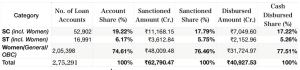
Over the years, the government has launched multiple schemes to provide credit through loans to SC/ST persons, focusing on entrepreneurial activities. For example, through Stand-Up India (2016), it aimed to provide loans of up to ₹ 1 crore to SC/ST and women entrepreneurs. National SC/ST Hubs were formed to give them market access, help with procurement, and training. A special credit-linked capital subsidy is also in place. However, official data presented by the Ministry of Finance compiled by SIDBI (Small Industries Development Bank of India) shows a contrasting view. While Stand-Up India has sanctioned over ₹ 62,000 crore in loans to around 2.75 lakh beneficiaries since 2016, only about 1/5th of these loans has reached SC/ST entrepreneurs with the majority going to general category women.

Table 1: Stand-Up India disbursements by social category, based on Department of Financial Services data.

From 2016 to 2025, around 22.49% of all money disbursed under the Stand-Up India scheme went to SC and ST entrepreneurs together. There are also high documentation requirements and margin requirements of up to 25%. This clearly indicates that even when formal credit is available, structural barriers like collateral, networks, and bureaucratic delays filter most vulnerable Dalit applicants out. Because of the lack of traditional collateral, 82% of Dalit borrowers rely on informal lenders and high-interest borrowing parties.

Furthermore, MUDRA Bank (Micro Units Development and Refinance Agency Bank), formally established in 2015, is a prominent credit scheme of the incumbent government, but the data exposes the structural limitations of the institution’s reality that the government does not want to focus on. Around 51% of MUDRA accounts belong to SC/ST/OBC categories. However, the way these accounts are divided is staggering. Over 70% to 80% of all MUDRA loans fall under the “Shishu” category (under ₹50,000). A loan of ₹30,000 or ₹40,000 cannot build a competitive, wealth-generating start-up. It can only buy a fruit cart, a sewing machine, or open a tiny roadside tea stall. Effectively, such amounts are more suited to small-scale livelihood activities than to building a competitive, wealth-generating enterprise. The state celebrating “start-up culture” is actually promoting necessity entrepreneurship, a term for entrepreneurship born out of an absolute absence of alternative employment options. A study by Jarwal and Kahal (2022) similarly finds that the growth of Dalit entrepreneurship as an impact of liberalisation policy can be positive; however, this has resulted in a proliferation of very small business units, which are mainly engaged in survival activities. The study further states that most Dalit-owned enterprises were established out of the necessity to survive. This is because their owners did not get employment opportunities, and had they received employment opportunities, they would have been earning more than what they are currently earning through necessity entrepreneurship. This necessity entrepreneurship keeps people alive at a subsistence level, but it does not generate institutional capital or challenge upper-caste corporate monopolies. According to official Economic Census Data analysed by the Economic and Political Weekly (2025), 89% of rural and 72% of urban Dalit-owned enterprises are OAEs (Own Account Enterprises). Most do not grow into larger firms; they function primarily as a substitute for daily wage employment and household income to keep the family fed. For many Dalit entrepreneurs, entry into the entrepreneurial market is shaped less by the pursuit of a profitable market opportunity than by the limited availability of secure employment. Entrepreneurship therefore becomes a strategy for economic survival rather than a straightforward pathway to wealth creation. Thus, as scholars have already shown, market inclusion alone is not an explanation of Dalit economic empowerment.

Such divergent scenarios between governmental schemes and Dalit economic conditions make the market an unequal playing field. Along with the unequal access to financial capital, there is also a profound social imbalance: private capital in India does not operate through a socially neutral field, as a mathematical principle unaffected by social forces. Its allocation is shaped by historically embedded caste structures and institutions, concentrated among predominantly Baniya and other mercantile castes. Avichal Dhiwar, founder of 20th March Venture Pvt Ltd, said in an interview, “Despite having complete paperwork, we faced a lot of problems getting loans from banks. They made it so tough for us that we eventually realised that they had no intention of extending us any loan.” This clearly shows the need for a mandatory public credit system to prevent systemic market exclusion of marginalised entrepreneurs. However, even necessary government loans and other forms of financial assistance reach only 10% of Scheduled Caste (SC) units, clearly indicating credit starvation. Furthermore, traditional business chambers, such as FICCI and CII, and trade networks have historically been dominated by these mercantile castes, who hold a monopoly over market trust and proudly flaunt it. When massive corporate monopolies run into billions of rupees in bad loans (Non-Performing Assets), the state steps in to bail them out, absorbing the damage; here, corporate risk is socialised. However, when a marginalised Dalit entrepreneur seeks a micro-loan, the state forces them to take on immense personal credit risk in a volatile market without any state security. Rather than providing security against the risks generated by market participation, right-wing neoliberal policy increasingly encourages historically excluded groups to become market participants and assume responsibility for navigating those risks themselves. For marginalised communities such a market means “competition among wolves and lambs“, as mentioned by Dr. Ambedkar in States and Minorities (1947). As Fischer (2020) argues, social policy under neoliberal restructuring does not necessarily remove structural inequality; instead, policies designed to promote inclusion can produce what he describes as hierarchical or adverse forms of inclusion, in which marginalised populations are incorporated into markets while remaining disadvantaged within them.

For Ambedkar, this distinction was fundamental. Economic reform could not be separated from social reform. Opening the market does not create equality when the social relations governing access to that market remain unequal. Credit can provide an opportunity to enter the market, but it also creates an obligation to repay within an environment where access to assets, networks and stable markets remains highly unequal. Without control over credit, markets will become a field of monopoly and exploitation. An increase in privatisation also results in the government abdicating its responsibility to safeguard its citizens.

In Annihilation of Caste (1936), Dr. Ambedkar said,“The problem of the Untouchables is a unique problem… You cannot have economic reform unless you pursue social reform. … The division of labour under the caste system is not a mere division of labour. It is a division of labourers.” In the private informal sector, Dalits often work as low-tier subcontractors for larger firms, which is not empowerment in any politically, socially, or economically meaningful sense. Here, inclusion into the market happens without dismantling the structural barriers, such as caste networks, which keep Dalit businesses at the periphery. Therefore, targeted entrepreneurial policies under the right-wing government does not dismantle caste-based economic exclusion, but primarily facilitates Dalit participation within markets whose underlying structures remain unequal. The right-wing government is therefore simultaneously promoting Dalit entrepreneurship while leaving many of the structural conditions that constrain Dalit entrepreneurship intact.

What can be done?

Rejecting market participation because caste structures already shape the market and the inability of the government to safeguard rights is not a feasible solution. While under neoliberalism, individual entrepreneurship can function as a form of economic mobility; enterprise can be re-signified as a potent tool for collective social emancipation. Crucially, this social emancipation is not achieved through isolated individuals taking on personal liabilities in a structurally unequal market. Rather, it becomes possible only when market participation is backed by stronger public regulation of credit markets and corporate concentration, along with the development of independent, community-owned institutional capacities.

The government is meant to play a crucial role in enforcing existing policies requiring corporations, such as the policy requiring public sector undertakings (PSUs) to procure 4% of their supplies from SC/ST-owned micro and small enterprises, and entrepreneurs. They are also expected to provide concessional loans through the Venture Capital Fund for Scheduled Castes, etc. However, trusting the right-wing neoliberal regime to implement these policies sincerely or effectively is not realistic. Doing so would directly contradict its ideological alliance with corporate capital. Therefore, there is a need for counter-hegemonic power, where Dalit communities stop acting merely as scattered voters or isolated market actors and instead use their collective leverage to disrupt the system. This can be done by moving from individual credit risk to structural social democracy and by aggregating thousands of small Dalit producers into a large cooperative, so they gain bargaining power to compete against corporate monopolies. Sustained institutional action and litigation can also be used to document state non-compliance with procurement obligations and seek appropriate judicial remedies, including through PILs, while RTIs can be used to obtain the relevant records.

Finally, the Dalit community must construct its own autonomous institutional capacity to provide Dalit entrepreneurs with finance, information, mentorship and bargaining power. It will be a community-led ecosystem that integrates community-owned credit cooperatives, independent capital funds and digital business directories that pool resources to guarantee internal markets. These institutions would be unlike DICCI, which operates primarily as a networking hub within the existing structures of caste capitalism.

Building autonomous Dalit institutions does not absolve the state of its responsibility to safeguard rights and provide social security. Micro-loans alone cannot produce emancipation if they merely manage poverty without changing the conditions under which Dalits participate in the market.


Mrunal Madhuri Milind Dupte is a development economics researcher, anti-caste writer and public speaker working on inequality, Dalit and Buddhist economics.

Why India Has No Second Ambedkar

Archival Note

Published in Dalit Voice (Vol. 1, Issue No. 17, 16 June 1982), this essay asks why India has failed to produce intellectuals who can challenge the ruling order rather than serve it. Rajshekar treats intellectual life as a political question, arguing that knowledge has little value when those who possess it refuse to confront power.

The essay places this argument alongside Dr. B.R. Ambedkar’s critique of the Brahminical character of India’s intellectual class. Rajshekar argues that when the intellectual class is tied to caste interests, it becomes an obstacle to the destruction of caste. He also attacks the pressures that push intellectuals towards careers, awards, money and proximity to power, while dissenters are branded as dangerous or “controversial”.

The essay then asks why India did not produce another Ambedkar after independence. Rajshekar connects this to the loss of the limited space he believed Ambedkar had found under British rule, arguing that Dalits and other oppressed communities were left without protection from the ruling order after independence. The essay’s central question is therefore about the political purpose of intellectual life: what happens to a society when those capable of challenging its dominant ideas choose accommodation instead?


The Role of Intellectuals in Society

Every society, every country in the world is shaped and led mainly by its intellectuals. All those who are remembered by history are mostly intellectuals. An intellectual may not get instant recognition by society when alive, but in course of time the person’s greatness will be recognised and recorded on the pages of history. Because an intellectual and intellectual alone can help bring about socio-economic changes.

The Buddha, Plato, Marx, Rousseau, Lenin, Abraham Lincoln, Maxim Gorky, Bernard Shaw, Mao, Thiruvallavar, Mahatma Phule were all great intellectuals. It is intellectuals who not only think but make others think.

After Dr. B. R. Ambedkar, M. N. Roy, Periyar E. V. Ramaswamy and Ram Manohar Lohia, we have hardly produced any intellectual giants in India. India’s Ruling Class has been systematically corrupting any up-and-coming intellectual, and if anyone dares to defy, he is mercilessly crushed. That is why rarely one wants to show originality, innovation. So much so, India has gone into total intellectual bankruptcy.

The very fact that India has not received a single Nobel Prize after it became independent proves that we are a country of mediocre dwarfs. But we are never tired of boasting that we have the second largest scientific manpower in the whole world. If so, what are they doing? Why not a single one has made an international mark?

The one agricultural scientist who received the Magsaysay Award was later found to have got it after making a false claim. But even this man has now taken up a cushy job outside India. This is the disease with our intellectuals. One social scientist, considered very distinguished, is seldom in India and even when at home never rubs the ruling class lest it may upset his lucrative income. Scientists like Khurana have settled down in the USA.

All this is because our society and our value system do not believe in encouraging and promoting intellectuals. India’s Ruling Class wants to make its people surrender their judgement to it. Every intellectual is a suspect. It looks upon him as a source of trouble.

Some of the finest budding, blooming flowers of our society were shot dead, dubbing them as Naxalites. Any person who does not fall in line and conform to the established thinking is considered a threat to society. Dissent is disliked, nay, dangerous. Truth should not be spoken. And those who speak the truth will be branded as “controversial” persons.

Any number of organisations, both govt. and non-govt., are set up to watch and weed out such “dangerous” persons. Innumerable State and private awards are instituted to win over any brilliant writer, scholar, to pocket if not corrupt him.

Courage is an essential prerequisite to become an intellectual. He has to suffer and sacrifice, pay for his commitment. That is why intellectuals and intellectuals alone can lead a society or a movement. An intellectual can lead as well as mislead. But in India, very often our intellectuals have been only misleading the society.

Nobody has painted such an Indian situation better than Dr. B. R. Ambedkar, and things have hardly changed since he wrote it:

“Whether you accept the theory of the great man as the maker of history or whether you do not, this much you will have to concede that in every country the intellectual class is the most influential class, if not the governing class. The intellectual class is the class which can foresee, it is the class which can advise and give lead. In no country does the mass of the people live the life of intelligent thought and action. It is largely imitative and follows the intellectual class.

There is no exaggeration in saying that the entire destiny of a country depends upon its Intellectual class. If the intellectual class is honest, independent and disinterested, it can be trusted to take the initiative and give a proper lead when a crisis arises.

It is true that intellect by itself is no virtue. It is only a means, and the use of means depends upon the ends which an intellectual person pursues. An intellectual man can be a good man but he can easily be a rogue. Similarly, an intellectual class may be a band of high-souled persons, ready to help, ready to emancipate erring humanity, or it may easily be a gang of crooks or a body of advocates of a narrow clique from which it draws its support.

You may think it a pity that the intellectual class in India is simply another name for the Brahmin caste. You may regret that the two are one, that the existence of the intellectual class should be bound with one single caste, that this intellectual class should share the interest & the aspirations of that Brahmin caste, which has regarded itself the custodian of interest of that caste, rather than of the interests of the country.

All this may be very regrettable. But the fact remains that the Brahmins form the intellectual class of the Hindus. It is not only an intellectual class but it is a class which is held in great reverence by the rest of the Hindus. The Hindus are taught that the Brahmins are Bhudevas (gods on earth). The Hindus are taught that Brahmins alone can be their teacher. Varnaram Brahmano Guru. Manu says, “If it be asked how it should be with respect to points of the Dharma which have not been specially mentioned, the answer is that which Brahmins who are Shishthas propound shall doubtless have legal force.”

When such an intellectual class, which holds the rest of the community in its grip, is opposed to the reform of Caste, the chances of success in a movement for break-up of the Caste System appear to me very, very remote.”

A film actor like Amitabh Bachchan or actress like Hema Malini may have millions of fans, but the glamour is temporary. The moment the youth fades, the star sinks. A cricketer or sportsman is adored till his capacity lasts. A wrestler, boxer or a King Kong will be feared until his body strength stays.

A politician like Indira Gandhi or Reagan is adored until the person is in power. Remember, people used to avoid Indira Gandhi like plague when she was defeated by the Janata. Those with money come and go. No Tata or Birla is remembered by history. A beauty queen is glorified till her skin fades.

There is nothing permanent with stars, sportsmen, body-builders, political personalities or wealthy tycoons. But that is not the case with an intellectual. He is respected not only in his lifetime but even after that.

Kalidasa was simply a poet under King Vikramaditya, but the king’s name has faded, but not that of Kalidasa, India’s greatest Sanskrit writer. Sometimes an intellectual is respected and recognised more after his death. Karl Marx’s name will be there as long as history is there. So too Plato, Jesus Christ, Mohamed Paigambar, Lenin, Mao, Martin Luther King.

Progress of any country depends only on its intellectuals. They alone can lead, but in India, alas, our intellectuals have been only misleading the society because they have been impotent and corrupt. That is why they compromise.

Look at the courage of J. B. S. Haldane. He subjected himself to great physical pain by himself becoming a guinea pig of his experiments. Have we produced a scientist of his calibre?

Our scientists are spending their time not in laboratories but in air-conditioned offices, busy pushing files. Intellectuals of India have not given evidence of their courage, their independence of thought and conviction, which are the indices to judge an intellectual.

They are not courageous, because they are so preoccupied with selfish interests. That is why they migrate to foreign countries in search of cushy jobs. Prime Minister Indira Gandhi on June 3 is reported to have expressed concern over “brain drain of scientific talent.” But this is not the first time she and other top leaders are expressing such a concern.

What is the use of a brain that allows itself to be drained? Better not have such brains. What we want is brains with hearts, and such brains will rarely allow itself to be drained. Heartless brains are more dangerous than brainless hearts. Therefore, let the heartless brains go. India will in no way become poorer.

A true intellectual will not sell himself. He can never be bought. He can never seek power and ambition. He will speak the truth, come what may, even at the cost of his life.

The evil has triumphed in India and the country is drifting because our intellectuals do not speak up. So much so, the country has grown sick and its sickness is affecting the outside world as well. But our intellectuals are unperturbed. To them, their caste and cash is more important than the eternal pursuit of truth.

What is the use of learning and knowledge when it does not bring cash or power? Popularity does not depend upon one’s ability but other factors. “Success in life” depends not on learning but on bank balance. In such a society, what use is learning or intellectual pursuits?

Intellectuals are laughed at, despised. Why should we strain the brain when money can be made without it? This is India today.

If our intellectuals are corrupt and spineless, the masses are dumb, deaf and blind because of poverty and illiteracy. The latter are illiterate because they are poor. When they are preoccupied all the time in an endless battle of the belly, where is the time for them to think, even if thinking is possible?

If this is the position of the poorest, what about the educated, employed people who come from this very same revolutionary section, Dalits and other persecuted minorities? The tragedy with this section is they have become easy-going, pleasure-seeking. Not only that. A considerable number of them, particularly the educated Untouchables, hide their identity and turn into bumlickers.

Yes, there are a tiny section of conscientious people among them who are angry. Who wants to rebel?

“The world owes much to rebels who would dare to argue in the face of the pontiff and insist that he is not infallible. I don’t care for the credit which every progressive society must give to its rebels.” (Dr. B. R. Ambedkar, preface to second edition of Annihilation of Caste.)

Ambedkar, however, lived up to the definition of a rebel, an intellectual giant. But such of the rebels are spotted out and finished at the very initial stage. Those who have managed to escape and build up their leadership are recruited by the ever-watchful political parties.

So there is an all-round famine. No ruling class will produce a revolutionary. On the other hand, the revolutionary section is starved to submission by the ruling class.

This answers the oft-repeated question: “Why India has not produced a second Ambedkar?”

Babasaheb lived a major part of his life when India was under the British, who were benevolent rulers. Not only they gave us education, denied to us by Brahmins, but even gave us modern, Western knowledge.

Not only that. If there was any “freedom struggle” and some leaders like Gandhi and Nehru were able to fight the British, it was because of the knowledge they gained from the very British education and the encouragement they gave to fight for liberty and fraternity.

But for the British rule, which in fact meant a Christian rule, India would not have been what it is today. So Ambedkar, despite his open criticism of the British Government, got all the encouragement from the British.

Nobody criticised the British right on their face as Ambedkar did. They gave him all the facilities and also protected him against his enemies. They gave all-out encouragement and built up his leadership.

Once the British were out, Dalits & the persecuted minorities of India had none to protect them. They were virtually thrown to wolves. The independence that India got on Aug. 15, 1947 was the independence given to the high castes to exploit, which they could not do earlier so freely.

The lambs are bound and bundled and handed to wolves on a silver platter. That is the reason why after independence India did not get a second Ambedkar.

No honest, dedicated leadership is tolerated by these ever-watchful headhunters. This is the heinous role played by India’s intellectual class.

CERD Flags State Violence and Systemic Discrimination Across India

The UN Committee on the Elimination of Racial Discrimination (CERD) has raised serious concerns over the treatment of some of India’s most marginalised communities, including Dalits, Adivasi and tribal peoples, Rohingya, Bengali-speaking Muslims, migrants and asylum-seekers. Its findings follow the first review of India by the Committee since 2007 and examine the country’s combined 20th and 21st periodic reports under the International Convention on the Elimination of All Forms of Racial Discrimination.

The findings were issued after CERD’s 118th session, which also examined Finland, Honduras and Kuwait. This was part of the Committee’s regular review of states that have signed the Convention. CERD’s concluding observations are not court judgments and do not have the force of law. They assess how governments are implementing their obligations under the Convention and identify areas where the Committee finds serious problems.

In India’s case, CERD raised concerns spanning caste, ethnicity, religion, citizenship and policing. One of its gravest concerns was the alleged conduct of law-enforcement agencies towards Indigenous and Tribal Peoples, Scheduled Tribes, Scheduled Castes, particularly Dalits, ethnic and ethno-religious groups and non-citizens. CERD recorded reports of excessive force, racially motivated violence, extrajudicial killings, arbitrary and prolonged detention, torture, ill-treatment and sexual violence. It called for prompt, thorough and impartial investigations, with accountability where violations are established.

The reference to Dalits and Scheduled Castes also brings an older disagreement into the review. The Indian government maintains that caste should not be treated as equivalent to race or “descent” for the purposes of CERD. Its submissions nevertheless contain information on Scheduled Castes and Scheduled Tribes and measures intended to address their disadvantages. CERD’s treatment of caste within its examination of descent and discrimination places caste exclusion within the scope of the Committee’s scrutiny, even as the Indian state rejects that equivalence.

CERD also drew particular attention to Rohingya, Bengali-speaking Muslims, migrants and asylum-seekers. It noted an increase in law-enforcement operations involving these groups, particularly after a 2017 Home Affairs order and the April 2025 Pahalgam attack. Reports of police stops and identity checks based on racial profiling allegedly resulted in arbitrary arrests and detention, torture and other mistreatment. The Committee also raised concerns about deportations and forcible returns involving people who may require international protection.

During the review, CERD Country Rapporteur Stamatia Stavrinaki referred to independent monitoring that recorded more than 1,300 anti-Muslim hate-speech incidents in 2025, including recurring rhetoric attributed to senior officials. India’s delegation responded that legislation enacted in 2023 criminalises acts amounting to hate speech and hate crimes, with additional protections applying when offences target Scheduled Castes and Scheduled Tribes. It also pointed to freedom of religion as a constitutional guarantee.

But CERD’s observations focused on what these protections mean in practice. Alongside the government’s account of its legal safeguards, the Committee recorded concerns about discrimination, hate speech, violence and the conduct of law-enforcement agencies. It called on India to address hate crimes against Rohingya, Bengali-speaking Muslims, migrants and asylum-seekers, refrain from collective expulsions and ensure access to international protection. This includes respecting non-refoulement, the principle that people should not be returned to a place where they face a serious risk of persecution or other grave harm.

The findings also address citizenship and documentation. CERD noted the absence of adequate disaggregated data on Indigenous and Tribal Peoples, ethnic and ethno-religious groups, migrants, refugees, asylum-seekers and stateless people. It highlighted the categorisation of Bengali-speaking Muslims as “non-original inhabitants” and reports that they face more stringent scrutiny during National Register of Citizens verification. The Committee also noted that much of India’s available data on Scheduled Castes, Scheduled Tribes and refugees still derives from the 2011 Census, while acknowledging the delayed 2026 Census and its proposed collection of caste data through self-identification.

The treatment of Bengali-speaking Muslims in the NRC process raises a broader question about how citizenship is administered. CERD’s concern is not simply that documentation is required, but that particular ethnic and religious groups are reportedly subjected to different levels of scrutiny. In a political environment where Muslims are repeatedly cast as outsiders or demographic threats, administrative categories such as “non-original inhabitants” can acquire consequences beyond paperwork. The NRC thus becomes part of a wider system in which belonging is subjected to heightened state verification.

The concerns around Rohingya also sit within a longer history of UN scrutiny. A 2025 communication by UN Special Procedures carried allegations that deportation operations against Muslims, including Rohingya, intensified after the Pahalgam attack, involving raids, arrests, ill-treatment and forcible returns. Those allegations came through a separate UN process and were not findings by CERD or a judicial determination.

India is not a party to the 1951 Refugee Convention or its 1967 Protocol and has no comprehensive national refugee law. UNHCR therefore carries out protection-related functions for refugees and asylum-seekers in the country. This absence has become more significant alongside changes to India’s citizenship and immigration regime.

The Citizenship (Amendment) Act, 2019 was defended by BJP ministers as addressing the unfinished business or “wrongs” of Partition. Yet the CAA was not a refugee law. It created a religion-based route to accelerated citizenship for specified non-Muslim communities from Pakistan, Bangladesh and Afghanistan. It did not establish a general system of refugee protection based on persecution or the risk of serious harm.

And in 2025, Parliament enacted the Immigration and Foreigners Act, replacing four earlier laws governing the entry and treatment of foreign nationals. The new law consolidated the state’s immigration powers without creating a corresponding refugee protection framework. CERD’s call for protection against collective expulsions and respect for non-refoulement therefore comes alongside a strengthened legal machinery for controlling and removing foreign nationals, while India still lacks a dedicated process for determining who requires refugee protection. For Rohingya and other asylum-seekers, that leaves a basic question: what domestic procedure requires the danger they may face after removal to be considered before the state deports them?

India’s delegation, led by Solicitor General Tushar Mehta, defended the country’s legal framework and its claims of pluralism and equality. The government reiterated its position that caste should not be equated with race or “descent” under the Convention and pointed to legislation addressing hate speech and protections for Scheduled Castes and Scheduled Tribes.

CERD’s findings place those claims alongside reports of how state institutions operate on the ground. The Committee’s concerns cover law-enforcement violence against Dalits and Adivasi and tribal communities, anti-Muslim hate speech, racial profiling of Bengali-speaking Muslims and Rohingya, and the treatment of people whose citizenship or immigration status is under scrutiny.

For Dalit and Adivasi communities, and for Muslims and other minorities whose belonging is increasingly subjected to state scrutiny, the findings also expose how Hindu nationalism operates through state power. Caste discrimination, communal targeting, citizenship enforcement and policing are often treated as separate questions, even as they converge in the lives of communities whose relationship with the state is shaped by unequal power. CERD’s observations bring these questions into the same examination of discrimination and direct attention towards the institutions through which unequal treatment is carried out.

Why Maharashtra Withdrew Its Temple Land Bill

By the time Maharashtra’s Revenue Minister Chandrashekhar Bawankule announced that the government was withdrawing the draft Maharashtra Devasthan Inam Abolition Act, 2026, the proposed legislation had spent barely a month in the public domain. Published on May 6 for comments and objections, it was presented as an attempt to address one of the state’s longest-running land disputes: nearly 5.5 lakh hectares of Devasthan Inam land, much of it under encroachment or contested occupation, and temple trusts that had struggled to recover property endowed over centuries. Within weeks, however, the government abandoned the draft and promised to begin again.

The reversal followed sustained opposition from temple trusts and organisations including the Maharashtra Mandir Mahasangh, the Vishwa Hindu Parishad and the Hindu Janajagruti Samiti. More than a thousand trustees reportedly joined the campaign, hundreds of representations were submitted to ministers and district officials, and delegations met Chief Minister Devendra Fadnavis, Deputy Chief Minister Eknath Shinde and other senior members of the government.

When the withdrawal was announced, temple organisations described it as the outcome of a collective struggle. The government, for its part, insisted that it was merely responding to concerns raised during the consultation process and that a fresh draft would be prepared after wider discussions.

According to the Revenue Department, the proposed law sought to create a statutory mechanism for recovering temple lands from illegal encroachments while protecting the rights of lawful occupants. Officials argued that temple trusts often lacked the administrative and legal capacity to reclaim endowed properties and that the state could provide a more effective framework. Bawankule repeatedly said that the proposal had been conceived on lines comparable to the legal framework governing Waqf properties, allowing the government to assist in protecting religious endowments rather than leaving trusts to pursue long and expensive litigation on their own.

Temple organisations read the draft very differently. The Maharashtra Mandir Mahasangh argued that provisions of the Bill would effectively abolish historical Devasthan Inam grants made by earlier rulers and weaken rather than strengthen temple ownership. It objected to clauses that it said recognised ownership claims of some long-term occupants, questioned restrictions on approaching civil courts, and criticised what it described as differential treatment between temple lands and Waqf properties.

Whether those objections reflected the actual legal consequences of the draft or apprehensions about how the law might eventually operate is a wholly different matter. The Hindu fold today perceives itself to be victimised in public discourse despite having been in power at the Centre for the last twelve years and mobilises moralised protest tactics that are often rooted in narratives of self-victimisation. Whatever the merits of those objections, they were enough to stop the Bill before it reached the Assembly.

The government never argued that temple lands should change hands. On the contrary, ministers repeatedly said the purpose of the Bill was to help temple trusts recover lands that had slipped into encroachment and to give those properties stronger legal protection. The resistance came from temple organisations that feared the proposed law would give the state greater control over how disputes were settled and how rights over Devasthan land would eventually be determined. Their objections were directed less at the objective than at the mechanism through which the government proposed to achieve it.

For all the talk of ideological unity, governing and movement politics do not always pull in the same direction. The Devasthan Bill became one of those moments when the seams briefly showed. Electoral alliances often make those differences easy to miss. Yet land has always been a source of authority as much as a form of property. Questions of who records land and who settles disputes have a way of exposing those tensions.

The BJP has spent much of the past decade presenting itself as the party of a strong, interventionist state. Governing through legislation inevitably extends the state’s reach into institutions that have long operated through inherited arrangements and local authority. Temple trusts may welcome stronger protection for their lands, but greater state involvement also means surrendering some control over how disputes are settled and property is administered. That is where governments and religious institutions can begin pulling in different directions. The fault lines are not entirely new. They surfaced publicly during the online battles between the so-called “raitas” and “trads” during the Bulli Bai app case, and the Devasthan Bill suggests that those disagreements extend well beyond social media into much wider political constituencies.

It is striking that the government defended the draft by invoking the legal framework surrounding Waqf properties. The comparison was meant to reassure temple trusts that similar protections could be extended to temple lands. Yet the politics around Waqf have unfolded very differently in recent years. Legislative changes affecting Muslim institutions have largely proceeded despite sustained objections from Muslim organisations. In Maharashtra, by contrast, the government withdrew its own proposal before it reached the legislature, reopened consultations and gave temple representatives a central role in rewriting the Bill.

Temple organisations opposed the draft before it entered the legislature, secured meetings with senior ministers, compelled the government to withdraw its own proposal and now have formal representation on the committee tasked with preparing a revised Bill. The committee, headed by Additional Chief Secretary Vikas Kharge, includes fifteen representatives from temple trusts alongside senior officials from the Revenue Department.

Governments routinely ask farmers’ organisations, workers’ unions, unemployed youth and communities affected by displacement to wait for departmental reviews or expert committees. Families pursuing justice after caste-based violence often confront years of administrative delay and prolonged litigation before receiving meaningful responses. Many Muslim organisations have found themselves responding to legislative changes only after they have already been enacted and have then faced criminalisation for protesting. Temple organisations, by contrast, intervened while the law was still being drafted and altered its course before it reached the legislature.

The debate has also left largely unexplored the people living on Devasthan Inam land. Public discussion has centred on temples, trusts and encroachments, while remarkably little attention has been paid to the social composition of those occupying or cultivating these lands. The category of “encroacher” can include very different histories: long-term agricultural tenancy, informal occupation, disputed ownership, commercial acquisition and settlement by landless households over several generations.

The Devasthan Bill was withdrawn after organisations within the broader Hindutva fold challenged a government that is often assumed to speak for them. The next draft of the Bill will answer some legal questions. It may also answer a political one: how much room the state still has to regulate institutions that are among its closest ideological allies.


DalitThinkerToday is an Chartered Accountant by profession from Sangli, Maharashtra who occasionally dabbles in thinking about politics when people in her oppressor caste majority office frustrate her. This is her pseudonym.

Why the Demand to Delist Christian Adivasis Matters

The demand to remove Christian Adivasis from the Scheduled Tribe list has moved from the margins of Hindutva advocacy toward the centre of national politics. On May 24, around 50,000 tribal persons gathered at Delhi’s Red Fort for a rally organised by the RSS-linked Janjati Suraksha Manch (JSM), where speakers called for the de-listing of Christian Adivasis from the Scheduled Tribe category. The presence of Union Home Minister Amit Shah transformed the event from an organisational mobilisation into a signal of political endorsement.

What was presented as a defence of tribal culture carries wider political implications. The campaign serves two connected functions. It assists the incorporation of tribal populations into a Hindutva political framework by constructing Christianity as a threat to tribal identity. At the same time, it weakens forms of Adivasi politics that have historically centred on land, forests, resources, self-governance and autonomy. The controversy over de-listing therefore reaches far beyond reservations. It concerns who gets to define Adivasi identity and what kinds of political claims can be made in its name.

This is not a new conflict. For decades, organisations associated with the Sangh Parivar have attempted to reshape the political vocabulary through which tribal communities are understood. The preference for the term “Vanvasi” over “Adivasi” is part of that project. Naming is never a neutral exercise. The term “Adivasi” became associated with political movements that understood tribal communities as possessing distinct histories, social formations and relationships to territory that cannot be reduced to the categories of the postcolonial Indian state. It also came to be linked with struggles over land, autonomy, self-representation and cultural rights. “Vanvasi,” by contrast, has been promoted by RSS-affiliated organisations as part of an effort to situate tribal communities within a broader Hindu civilisational framework. The dispute over terminology concerns who has the authority to define tribal identity and whether tribal politics will be articulated through its own historical experiences and political demands or incorporated into a larger majoritarian narrative.

The de-listing campaign emerges from this history. It seeks to make religious affiliation increasingly central to the way tribal identity is understood and recognised. Its supporters argue that conversion to Christianity severs individuals from tribal traditions and therefore undermines the basis on which constitutional protections were granted. Yet once religious affiliation becomes the basis for determining who is a legitimate member of the political community, the implications extend well beyond Christianity.

Across central and eastern India, the strongest currents within Adivasi politics have historically developed around struggles over land, displacement, mining, forests and self-governance. Whether in Jharkhand, Chhattisgarh, Odisha or Maharashtra, tribal movements have repeatedly confronted state institutions, extractive industries and dominant social groups over control of territory and resources. Opposition to mining projects and industrial land acquisition, struggles over the implementation of the Forest Rights Act and PESA, demands for a separate Sarna religious code, and movements against displacement have all shaped contemporary Adivasi politics. These mobilisations have generally been organised around questions of land, governance, cultural recognition and collective rights. The Fifth Schedule, PESA, forest rights legislation and movements against displacement emerged from these material struggles. They did not emerge from divisions between Christian and non-Christian Adivasis.

That is precisely what makes the current campaign politically consequential. It redirects attention away from conflicts over land, extraction and governance and toward conflicts within Adivasi communities themselves. Christian Adivasis become a separate political category whose claims can be isolated from those of the wider community. Such divisions weaken collective mobilisation against displacement, mining expansion, land alienation and other forms of dispossession. They also benefit those who have long sought a more fragmented and manageable Adivasi politics, whether in the service of electoral consolidation or the continued extraction of resources from tribal regions.

These concerns have been repeatedly voiced by Adivasi organisations across Jharkhand. More than one hundred tribal leaders, academics, activists and community organisations called for a boycott of the Delhi conclave before it took place. Their objections reflected a broader pattern. Campaigns around de-listing receive substantial organisational energy and political support, while struggles over land alienation, mining expansion, displacement and forest rights rarely attract comparable urgency from the same actors. That contrast raises an obvious question: why are religious differences within Adivasi communities relevant at all while ongoing conflicts over land, forests and resources are not?

The campaign also seeks to alter the constitutional terms through which tribal identity is recognised. Scheduled Tribe recognition was never designed as a reward for adherence to a particular religion. Article 342 contains no religious qualification, and Adivasi status does not disappear because an individual changes faith.

The constitutional histories of Scheduled Castes and Scheduled Tribes are different, but neither category was originally conceived as contingent on religious affiliation. Dalit Christians and Dalit Muslims continue to challenge their exclusion from Scheduled Caste status on the grounds that caste oppression survives conversion. Rather than correcting that injustice, the demand to de-list Christian Adivasis seeks to extend a similar logic of religious exclusion into a constitutional category where it has historically had no place. Recent judicial and political developments have made such efforts appear increasingly plausible, contributing to a broader perception that protections available to historically oppressed communities are open to reinterpretation through the language of religious belonging.

The de-listing campaign also reveals the conditions under which Hindutva is prepared to recognise tribal distinctiveness. Organisations associated with the Sangh Parivar have long sought to incorporate Adivasi communities into a broader Hindu civilisational framework while simultaneously acknowledging them as culturally distinct. The demand to remove Christian Adivasis from the Scheduled Tribe list narrows the space for that distinctiveness. Tribal identity remains legitimate so long as it can be accommodated within a majoritarian political project; conversion is treated as a point at which recognition becomes conditional.

Christianity has undoubtedly transformed many tribal societies over the past century, as have education, migration, urbanisation and countless other social processes. Those transformations do not erase histories of marginalisation, nor do they justify making religious affiliation the basis of constitutional recognition.

At stake in the controversy is more than the status of Christian Adivasis alone. The demand seeks to normalise the idea that constitutional protections can be conditioned by religious affiliation and that communities historically recognised because of marginalisation can be reorganised through the language of religious belonging. The immediate target may be Christian Adivasis, but the wider effect is the weakening of political traditions organised around land, resources, self-governance and collective rights. In regions where Adivasi communities continue to confront displacement, mining expansion and the erosion of democratic control over local resources, such fragmentation serves interests far more powerful than the communities being asked to embrace it.


Paresh Hate is a Bahujan queer researcher, writer, documenter and activist and the Lead Content Manager at Dalit Voice.

West Bengal’s Electoral Roll Purge and the Architecture of Disenfranchisement

In the run-up to polling, West Bengal isn’t just approaching an election. It is also seeing a redrawing of who gets to participate. Voting is set for April 23 and April 29, yet for millions the right to vote has already been taken away through administrative action. The Special Intensive Revision (SIR) of electoral rolls has operated in much the same way as its precursor in Bihar and its antecedent, the National Register of Citizens in Assam: as a tool of exclusion shaped by bureaucratic force, opaque technology, and nationalist ideological direction.

Between 9 and 9.1 million names, close to 12 percent of the electorate, have been removed ahead of the 2026 Assembly elections. Over 6 million were categorised as absent, shifted, deceased, or duplicate. The deeper problem sits with the remaining 2.7 million people whose status is still unresolved. Many of them submitted documents, established links to earlier rolls including the 2002 list, and yet found their voting rights in suspension. The election is proceeding even as their claims remain undecided.

The exercise has been presented as an attempt to produce a “pure electoral roll.” In practice, it signals a move away from inclusion towards filtration. An AI-assisted system has been used to identify what are described as “logical discrepancies” in voter data: minor spelling differences in names, age gaps within families, or several individuals linked to a single parent. In a context where documentation is often uneven and shaped by linguistic and clerical variation, these benchmarks turn ordinary inconsistencies into reasons for exclusion.

The pattern becomes clearer in the numbers. Muslims, who make up about 27 percent of West Bengal’s population, account for roughly 34 percent of those removed, around 3.11 million people. Districts such as Murshidabad and Malda have seen particularly high levels of deletion. Dalit Hindu communities, especially those with histories of migration like the Matua community, have also been heavily affected in districts such as North 24-Parganas and Nadia. The impact is spread across groups, but it consistently bears down on those who are already vulnerable, dependent on documents, and politically marginal.

In border districts adjoining Bangladesh, where narratives of migration and infiltration have long circulated, deletions are especially high. North 24-Parganas alone has lost more than 1.26 million voters. In parts of Kolkata, close to 30 percent of voters in certain constituencies have been removed. Some polling booths have seen more than half their electorate disappear from the rolls. Entire neighbourhoods have effectively been thinned out in the days before voting.

The process has moved quickly, concentrated in the immediate lead-up to the election. While appeal mechanisms exist on paper, they are limited in practice. Nineteen appellate tribunals were established to hear challenges, but access has been restricted, hearings limited, and even legal representation reportedly curtailed. Deadlines for inclusion in supplementary rolls leave little room for proper adjudication. The rolls were frozen on April 9, excluding those whose cases are still pending.

What emerges is a system in which rights are not formally denied but held in suspension. Voters are asked to appeal, yet the process does not conclude in time to restore their participation. Disenfranchisement takes shape through delay and procedure rather than through an explicit refusal.

The Election Commission has carried out the revision using methods that remain difficult to scrutinise. The algorithm used to identify discrepancies has not been fully explained, and the criteria themselves differ from earlier exercises at this scale. A process once associated with expanding the franchise now casts large numbers of voters as suspect. In both its design and its execution, the approach sits closer to a broader political direction than to an independent constitutional role.

On the ground, the disruption is uneven and immediate. Within the same household, some names remain while others are missing, often without explanation. Individuals with long-established records, including presence in earlier electoral rolls, have been excluded due to clerical inconsistencies that frequently originate in state documentation itself. Differences in dates of birth, variations in spelling, or changes over time are enough to trigger doubt. The burden of proof rests entirely on the individual, even when the discrepancy is administrative.

This is how bureaucratic violence works. It does not rely on overt force. Instead, it imposes procedural demands that many cannot meet within the time and access available to them. It requires documents, verification, and compliance under compressed timelines. The outcome may appear technical, but its consequences are clearly political.

West Bengal remains a central electoral focus for the Bharatiya Janata Party, which has sought to expand its presence in the state. Campaign language around “infiltrators” overlaps with the categories produced through the SIR process. Administrative labels such as “doubtful” voters sit alongside political claims about illegal migration, often directed at Muslims. In this alignment, the revision of electoral rolls becomes part of a wider effort to reshape the electorate before voting takes place.

What is being reshaped is not only a voter list. It is the basis on which political participation is granted. The right to vote is becoming conditional, dependent on continuous verification and open to withdrawal through processes that lack transparency and accountability. The creation of large categories of “doubtful” voters embeds that uncertainty.

This is not an abstract question of representation. It reflects a further narrowing of an already constrained democratic space. When millions are excluded from the electoral process through procedural means, the issue extends beyond electoral outcomes. It concerns who is recognised as part of the political community, and who can be removed from it without consequence.


Paresh Hate is a Bahujan queer researcher, writer, documenter and activist and the Lead Content Manager at Dalit Voice.

A Deep-rooted Post-Independence Conspiracy to Keep Oppressed Castes Oppressed: Anti-Conversion Laws Across Indian States

On 13 March 2026, the Freedom of Religion Bill was tabled in the Maharashtra State Assembly — the eleventh state that may have such legislation since independence. Ten similar laws in the states of Odisha, Madhya Pradesh, Gujarat, Chhattisgarh, Himachal Pradesh, Jharkhand, Uttarakhand, Uttar Pradesh, Karnataka, and Haryana have already been enacted; one in Tamil Nadu has been repealed. Two others in Arunachal Pradesh and Rajasthan were never enacted despite formulation. Home Minister Amit Shah has made an election promise that the law would be enacted in the State of Punjab as well. The stated purpose is a familiar trope: preventing conversions obtained through force, fraud, or inducement. The language is legal and respectable. The real targets are Dalits and other oppressed castes.

These laws have nothing to do with coercive religious practice. They are instruments designed to prevent the emancipation of oppressed castes from dominant castes’ hegemony — and to ensure that the dominant caste establishment’s social, economic, and civilizational hegemony, which that order has sustained for two millennia, remains intact.

Caste is not merely a social phenomenon. It is a religious system of control, encoded in the Manusmriti as a spiritual, social, and economic order and sanctified by Brahminical Hinduism for two millennia. It has structured every material dimension of life: occupation, property, education, marriage, and public space. Spiritual inequality was the foundational condition from which all socio-economic deprivation followed. The Dalit-Bahujan communities did not merely occupy the bottom of a social hierarchy — they were theologically assigned to it. Any faith that rejected that assignment was, therefore, not merely a spiritual alternative. It was a structural threat to those who benefited from the arrangement.

That is the context in which every anti-conversion law, which includes conversion to any faith, must be read.

The legislative history begins not in 1967, when Odisha enacted India’s first anti-conversion law, but in 1950, when the Presidential Order quietly excluded converts to minority faiths from the reservation protections established under Article 341 of the Constitution. The Constitution (Scheduled Castes) Order, 1950, originally limited SC status to those professing Hinduism, and later extended it to Sikhism and Buddhism. Converts to Christianity and Islam, which form the bulk of non-Buddhist converts, lose SC status under this order, as affirmed by recent Supreme Court interpretation citing the 1950 Presidential Order in a case pertaining to Andhra Pradesh, even as a petition concerning reservation benefits for Dalit Muslims and Christians has been pending before a three-member bench of the Supreme Court since January 2011.

In 1950, this was not debated. It was not declared. It was done quietly, and widely attributed to K. M. Munshi, a Constituent Assembly member with known Manuwadi leanings, who openly opposed extending reservations to those who left the Hindu fold. The purpose was malignant.

The most consequential test of that logic came six years later. On 14 October 1956, B. R. Ambedkar — the man who had written the Constitution those same dominant caste legislators are now subverting — converted to Buddhism along with approximately half a million of his followers in Nagpur. Ambedkar had spent decades arguing that caste could not be reformed from within Hinduism because it was not an aberration within Brahminical theology but its direct product. Conversion was not apostasy. It was the exercise of the precise freedom the Constitution guaranteed. The 1950 Presidential Order had already moved to penalise that choice economically. Had these state anti-conversion laws existed in 1956, Ambedkar’s event at Nagpur — the largest mass act of religious self-determination in modern Indian history — would have required prior government approval under the very constitutional order he had designed. The extension of SC status to Navayana Buddhism only happened in 1990 under the V. P. Singh government. That is not an irony, it is the point. These laws are aimed, in their structure and intent, at preventing socio-economic outcomes exactly like what Ambedkar fought for in that spiritual and social context.

Christianity’s presence in India is not a colonial imposition. St. Thomas arrived on the Malabar Coast in the first century AD. Catholicism spread along India’s western coast after the Portuguese conquest of Goa in 1510, and later inland, focusing on the emancipation of oppressed castes, even as they had their own interests in doing so. During colonial rule, Protestant missionaries added to the work Catholics were doing — running schools and hospitals where none existed and agitating against oppressive caste practices, among them the requirement in parts of South India that Dalit women leave their breasts uncovered as a mark of caste subordination. The tangible improvements these missions delivered to Dalits are documented. The Savarna response to those improvements has also been documented, including in the form of every anti-conversion law that followed.

The rhetorical device used to delegitimise this history is the accusation of “ricebag Christians” — the claim that conversions were purchased with food rather than chosen in conscience. When people are starving, providing food alongside a theology that affirms their equality before God is not inducement. It is the practical application of that theology that responds to social reality.

In 1956, the Madhya Pradesh government appointed a committee under Hindu nationalist former judge M. B. Niyogi to examine missionary activities in the state. The Committee was formed in response to the Bharatiya Jana Sangh’s “Anti-Foreign Missionary Week” protest. Set up by a Congress government, it recommended legally prohibiting conversions that were not fully voluntary, but the proposal was not implemented at the time, as it would have been difficult to enforce without violating constitutional religious freedoms. The Niyogi Report was not an inquiry. It was a brief for the prosecution, prepared in advance of charges not yet formally filed. It catalogued missionary schools, hospitals, orphanages, and social service institutions — and then attributed to all of it a calculated programme of conversion through inducement. It did not disprove the emancipatory value of these institutions to oppressed castes. It simply recast that value as evidence of conspiracy. The Niyogi Report provided the ideological and legislative scaffolding for the Odisha anti-conversion law of 1967, and its logic has been reproduced in every state law enacted since.

The constitutional foundation for these laws was established by the Supreme Court’s 1977 ruling in Rev. Stanislaus v. State of Madhya Pradesh, which held that the right to “propagate” religion under Article 25 does not include a right to convert another person. This distinction, applied carefully, is reasonable. Applied as it has been in practice, it is not. The right to convert another person was never what the church claimed.

By constructing its judgment around the prevention of an act that was not in dispute, the Court gave legislative cover to restrict the proclamation of faith itself — and since the state now determined what constitutes illegitimate persuasion, any message compelling enough to move oppressed caste persons toward a different understanding of their own worth can be prosecuted as inducement. The Allahabad High Court has recently reaffirmed the right to propagate and proclaim one’s faith, which amounts to an implicit rebuke of how the Stanislaus judgment has been operationalised.

With the BJP’s rise to national power in 1999 and its consolidation under Narendra Modi in 2014 — whose political formation within the Sangh Parivar is defined by the goal of a Hindu Rashtra, which implicitly requires the maintenance of the caste hierarchy that Brahminical Hinduism produced — seven additional states enacted anti-conversion laws. Each successive iteration grew more elaborate in its administrative requirements.

The most recent versions require prior government approval, inserting a state official between a citizen and a decision of personal conscience in direct tension with Article 21 of the Constitution. An oppressed caste person who wishes to leave the faith that theologically sanctions their subordination must now obtain permission from an apparatus largely controlled by the communities that have historically benefited from that subordination.

The Tamil Nadu precedent is sometimes cited to argue that anti-conversion legislation crosses party lines. In 2002, the AIADMK government enacted a similar law. This requires little explanation: the AIADMK was then a coalition partner in the BJP-led NDA government and enacted the law to sustain that alliance. Tamil Nadu has one of India’s oldest and most rooted Christian populations. The law was repealed in 2004 when the UPA came to power, under pressure from Christian communities — confirming that it had no independent political logic in the state and was adopted purely as a coalition obligation. Nonetheless, this signals the state’s willingness to compromise constitutional freedoms for political expediency.

When the complete sequence is examined together — the 1950 Presidential Order, the Niyogi Report, the Stanislaus judgment, and the cascade of state laws — the pattern is coherent and consistent. The RSS, Jana Sangh, Janata Party, and BJP share an unbroken ideological lineage rooted in a Brahminical Hindu nationalist vision, combining a project of social dominance over internal subaltern communities with a resistance to religious influences perceived as external threats.

Over seventy percent of India’s population — the Scheduled Castes, Scheduled Tribes, and Other Backward Classes combined — belong to communities that Christian social and educational institutions most consistently serve. It is precisely the emancipation of these communities — economic, educational, and spiritual — that strikes at the material interests of the Savarna establishment that has historically thrived on their exploitation. The Mandal Commission’s implementation dismantled the Savarna monopoly over state employment and political power. The Church in India, through civil society institutions, has been eroding their civilisational dominance for far longer. Anti-conversion laws are the establishment’s response to both.

The Church is not above scrutiny in this account. Caste has penetrated Christian institutions in India in ways that contradict the theology that made those institutions work for oppressed caste communities in the first place — separate cemeteries, separate seating, upper-caste dominance of church hierarchies still continue in diminishing measures, with Dalit theology now in vogue in seminaries, gradually dissipating these anomalies. That contradiction is real and must be named.

Yet this does not change the fact that the laws are designed not to reform Christian institutions from within, but to prevent oppressed caste communities from accessing them at all. The internal failures of the Church are a problem the Church must answer for. The anti-conversion laws are a problem the state must answer for. Conflating the two serves only those who drafted the legislation.

There is a reason no central anti-conversion law has been passed at the national level: it would face a full constitutional bench and would not survive the judicial test. The state laws function as instruments of attrition — they harass clerics and communities, deter others from exercising their rights, create a climate of legal uncertainty, and signal to oppressed castes that the price of emancipation will be as high as the state can make it. Their authors are not constitutionally naive. They know better than to invite a definitive national ruling.

The multiplication of these laws since 1999 is evidence that they are not impeding Christian emancipation efforts. If oppressed castes had stopped choosing emancipation, new laws would be unnecessary. If earlier laws had effectively blocked the exit, elaboration would be redundant. The inclusion of administrative approval requirements in the most recent iterations — including the Maharashtra Bill now passed in both the Houses and awaiting Governor Jishnu Dev Varma’s assent — confirms that those prosecuting this project are aware it is failing socially and are escalating in response. Escalation in the face of failure is not a sign of strength. It is a sign that the outcome they feared is continuing regardless.

A nation that directs its legislative energy toward preventing the emancipation of the majority of its population — the Scheduled Castes, Scheduled Tribes, and Other Backward Classes who together constitute over seventy percent of India’s people — in order to protect the privileges of numerically smaller Savarnas at the top cannot expect that arrangement to produce equitable development. The evidence is already visible in the widening gap between India’s claims to being the world’s fifth-largest economy and the material conditions of the oppressed castes whose labour has always underwritten that economy.

The courts will, hopefully, eventually confirm what the constitutional record already shows: these laws were not enacted with confidence in their constitutionality. They were enacted with confidence in political impunity to impede the emancipation of oppressed caste communities. That foundation is far more fragile than it appears.

The emancipation of oppressed castes is not a process that can be permanently arrested by administrative procedure. Ambedkar understood this. The six hundred thousand people who walked with him in Nagpur in 1956 understood it. The millions who have followed in the decades since understand it. History does not offer a single example of a project designed to lock human beings into inherited degradation that finally succeeded. The architects of this one will find no exception to that record.


Oliver D’Souza is a former journalist and an author.

Erasing Recognition: Maharashtra’s Ideological Withdrawal of the 5 Percent Muslim Quota

The Maharashtra government’s formal cancellation of the 5 percent reservation for socially and educationally backward Muslims has reopened a constitutional and political question that has lingered unresolved since 2014. The decision of the Social Justice Department in February 2026 to withdraw all resolutions and circulars linked to the earlier policy has now been challenged before the Bombay High Court. The petition argues that the state’s move is arbitrary, discriminatory, and constitutionally unsustainable. What is at stake is not simply a lapsed ordinance. It is the steady hollowing out of institutional mechanisms that once acknowledged the measurable backwardness of sections of the Muslim community in Maharashtra.

In 2014, the then Congress–NCP government introduced an ordinance granting 5 percent reservation to Muslims under a Special Backward Category referred to as SBC-A or SEBC for identified communities. The policy was not framed as a blanket religious quota. It was grounded in data identifying nearly fifty Muslim sub-communities as socially and educationally backward. Caste certificates and validity certificates were issued accordingly. The ordinance also granted 16 percent reservation to Marathas. When the matter reached the Bombay High Court in November 2014, the court stayed implementation. The ordinance subsequently lapsed in December 2014 because it was not converted into a statute within the constitutionally mandated timeframe.

The lapse of the ordinance did not erase the underlying findings regarding backwardness. Significantly, when examining the matter, the Bombay High Court had invalidated the Maratha quota but upheld the 5 percent reservation for Muslims in government and aided educational institutions, observing that quantifiable data justified inclusion of the identified Muslim sub-communities. The court also ensured that the reservation did not breach the Supreme Court’s 50 percent ceiling on total reservations. In other words, the judiciary did not reject the premise that sections of the Muslim community in Maharashtra were socially and educationally backward. It accepted that premise within constitutional limits.

What has now occurred is not a judicial reversal but an executive withdrawal. The current government led by Chief Minister Devendra Fadnavis has declared that all decisions and circulars linked to the 2014 ordinance stand cancelled. No new caste or validity certificates will be issued. No admissions will be granted under the 5 percent quota. The state’s position is that since the ordinance lapsed years ago, the matter is closed. Yet the petition before the Bombay High Court contends that such closure is neither automatic nor neutral. It demands that the state produce the quantified data relied upon to justify the cancellation and argues that no adverse finding was recorded by the State Backward Class Commission against the Muslim SEBC classification.

The core constitutional question is whether the executive can extinguish a policy recognizing demonstrable backwardness without fresh data, consultation, or reasoned justification. Reservations in India are not acts of charity. They are instruments flowing from Articles 14, 15, and 16 of the Constitution, aimed at substantive equality. When the state recognizes backwardness through data and then withdraws recognition without a comparable evidentiary exercise, it risks violating the very principle of non arbitrariness that undergirds Article 14. The petition asserts precisely this. It claims that the withdrawal lacks a factual foundation and disregards earlier judicial acknowledgement of backwardness among the specified Muslim communities.

The broader political context cannot be ignored. Since 2014, legal and administrative interventions affecting Muslims across India have rarely taken the form of dramatic constitutional amendments. Instead, they have unfolded through incremental executive decisions, procedural reinterpretations, and selective policy withdrawals. Each move is presented as routine governance. Taken together, they redraw the boundaries of belonging. In Maharashtra, the divergence is instructive. When Maratha reservations faced legal obstacles, the political system mobilized sustained legislative and legal energy to revive and defend them. No comparable urgency animated efforts to secure the Muslim quota framework after the ordinance lapsed. This difference in institutional will reveal how majoritarian priorities shape the afterlife of welfare policy.

The immediate impact of the cancellation is administrative, but its consequences are social. Recognition as a socially and educationally backward group is not merely symbolic. It determines eligibility for certificates, admissions, and recruitment processes that structure access to mobility. By halting issuance of caste and validity certificates and foreclosing admissions under the 5 percent category, the state effectively closes an acknowledged route into higher education and public employment. In a context where representation of Muslims in state services remains disproportionately low, such closure compounds rather than corrects inequality.

There is also a question of institutional consistency. The High Court had previously confined the Muslim quota to government and aided institutions and ensured that it did not breach the 50 percent ceiling mandated by the Supreme Court. The framework that survived judicial scrutiny was already limited and constitutionally trimmed. The present withdrawal does not respond to a judicial directive striking it down. It removes a scheme that had been partially upheld within constitutional parameters. That distinction matters because it underscores that the current shift originates in executive choice rather than constitutional compulsion.

Another dimension concerns reliance and expectation. For years after 2014, administrative processes acknowledged the classification through issuance of certificates. Students and families structured educational decisions around that recognition. Even if the ordinance formally lapsed, the state’s conduct created a practical regime. Abruptly extinguishing that regime without transitional safeguards disregards the principle that governance must account for legitimate expectations generated by its own actions. The Constitution does not treat citizens as passive recipients of fluctuating executive moods.

For Muslims in Maharashtra, the stakes are immediate and material. Access to government colleges and public employment is not a symbolic concession but one of the few constitutionally structured routes out of entrenched disadvantage. For the constitutional order, the implications are equally stark. The cancellation of the 5 percent reservation is therefore not a technical tidying up of a lapsed ordinance. It reflects an ideological choice about who merits structural support from the state and who must navigate inequality without it.


Paresh Hate is a Bahujan queer researcher, writer, documenter and activist and the Lead Content Manager at Dalit Voice.