
A Deep-rooted Post-Independence Conspiracy to Keep Oppressed Castes Oppressed: Anti-Conversion Laws Across Indian States

On 13 March 2026, the Freedom of Religion Bill was tabled in the Maharashtra State Assembly — the eleventh state that may have such legislation since independence. Ten similar laws in the states of Odisha, Madhya Pradesh, Gujarat, Chhattisgarh, Himachal Pradesh, Jharkhand, Uttarakhand, Uttar Pradesh, Karnataka, and Haryana have already been enacted; one in Tamil Nadu has been repealed. Two others in Arunachal Pradesh and Rajasthan were never enacted despite formulation. Home Minister Amit Shah has made an election promise that the law would be enacted in the State of Punjab as well. The stated purpose is a familiar trope: preventing conversions obtained through force, fraud, or inducement. The language is legal and respectable. The real targets are Dalits and other oppressed castes.

These laws have nothing to do with coercive religious practice. They are instruments designed to prevent the emancipation of oppressed castes from dominant castes’ hegemony — and to ensure that the dominant caste establishment’s social, economic, and civilizational hegemony, which that order has sustained for two millennia, remains intact.

Caste is not merely a social phenomenon. It is a religious system of control, encoded in the Manusmriti as a spiritual, social, and economic order and sanctified by Brahminical Hinduism for two millennia. It has structured every material dimension of life: occupation, property, education, marriage, and public space. Spiritual inequality was the foundational condition from which all socio-economic deprivation followed. The Dalit-Bahujan communities did not merely occupy the bottom of a social hierarchy — they were theologically assigned to it. Any faith that rejected that assignment was, therefore, not merely a spiritual alternative. It was a structural threat to those who benefited from the arrangement.

That is the context in which every anti-conversion law, which includes conversion to any faith, must be read.

The legislative history begins not in 1967, when Odisha enacted India’s first anti-conversion law, but in 1950, when the Presidential Order quietly excluded converts to minority faiths from the reservation protections established under Article 341 of the Constitution. The Constitution (Scheduled Castes) Order, 1950, originally limited SC status to those professing Hinduism, and later extended it to Sikhism and Buddhism. Converts to Christianity and Islam, which form the bulk of non-Buddhist converts, lose SC status under this order, as affirmed by recent Supreme Court interpretation citing the 1950 Presidential Order in a case pertaining to Andhra Pradesh, even as a petition concerning reservation benefits for Dalit Muslims and Christians has been pending before a three-member bench of the Supreme Court since January 2011.

In 1950, this was not debated. It was not declared. It was done quietly, and widely attributed to K. M. Munshi, a Constituent Assembly member with known Manuwadi leanings, who openly opposed extending reservations to those who left the Hindu fold. The purpose was malignant.

The most consequential test of that logic came six years later. On 14 October 1956, B. R. Ambedkar — the man who had written the Constitution those same dominant caste legislators are now subverting — converted to Buddhism along with approximately half a million of his followers in Nagpur. Ambedkar had spent decades arguing that caste could not be reformed from within Hinduism because it was not an aberration within Brahminical theology but its direct product. Conversion was not apostasy. It was the exercise of the precise freedom the Constitution guaranteed. The 1950 Presidential Order had already moved to penalise that choice economically. Had these state anti-conversion laws existed in 1956, Ambedkar’s event at Nagpur — the largest mass act of religious self-determination in modern Indian history — would have required prior government approval under the very constitutional order he had designed. The extension of SC status to Navayana Buddhism only happened in 1990 under the V. P. Singh government. That is not an irony, it is the point. These laws are aimed, in their structure and intent, at preventing socio-economic outcomes exactly like what Ambedkar fought for in that spiritual and social context.

Christianity’s presence in India is not a colonial imposition. St. Thomas arrived on the Malabar Coast in the first century AD. Catholicism spread along India’s western coast after the Portuguese conquest of Goa in 1510, and later inland, focusing on the emancipation of oppressed castes, even as they had their own interests in doing so. During colonial rule, Protestant missionaries added to the work Catholics were doing — running schools and hospitals where none existed and agitating against oppressive caste practices, among them the requirement in parts of South India that Dalit women leave their breasts uncovered as a mark of caste subordination. The tangible improvements these missions delivered to Dalits are documented. The Savarna response to those improvements has also been documented, including in the form of every anti-conversion law that followed.

The rhetorical device used to delegitimise this history is the accusation of “ricebag Christians” — the claim that conversions were purchased with food rather than chosen in conscience. When people are starving, providing food alongside a theology that affirms their equality before God is not inducement. It is the practical application of that theology that responds to social reality.

In 1956, the Madhya Pradesh government appointed a committee under Hindu nationalist former judge M. B. Niyogi to examine missionary activities in the state. The Committee was formed in response to the Bharatiya Jana Sangh’s “Anti-Foreign Missionary Week” protest. Set up by a Congress government, it recommended legally prohibiting conversions that were not fully voluntary, but the proposal was not implemented at the time, as it would have been difficult to enforce without violating constitutional religious freedoms. The Niyogi Report was not an inquiry. It was a brief for the prosecution, prepared in advance of charges not yet formally filed. It catalogued missionary schools, hospitals, orphanages, and social service institutions — and then attributed to all of it a calculated programme of conversion through inducement. It did not disprove the emancipatory value of these institutions to oppressed castes. It simply recast that value as evidence of conspiracy. The Niyogi Report provided the ideological and legislative scaffolding for the Odisha anti-conversion law of 1967, and its logic has been reproduced in every state law enacted since.

The constitutional foundation for these laws was established by the Supreme Court’s 1977 ruling in Rev. Stanislaus v. State of Madhya Pradesh, which held that the right to “propagate” religion under Article 25 does not include a right to convert another person. This distinction, applied carefully, is reasonable. Applied as it has been in practice, it is not. The right to convert another person was never what the church claimed.

By constructing its judgment around the prevention of an act that was not in dispute, the Court gave legislative cover to restrict the proclamation of faith itself — and since the state now determined what constitutes illegitimate persuasion, any message compelling enough to move oppressed caste persons toward a different understanding of their own worth can be prosecuted as inducement. The Allahabad High Court has recently reaffirmed the right to propagate and proclaim one’s faith, which amounts to an implicit rebuke of how the Stanislaus judgment has been operationalised.

With the BJP’s rise to national power in 1999 and its consolidation under Narendra Modi in 2014 — whose political formation within the Sangh Parivar is defined by the goal of a Hindu Rashtra, which implicitly requires the maintenance of the caste hierarchy that Brahminical Hinduism produced — seven additional states enacted anti-conversion laws. Each successive iteration grew more elaborate in its administrative requirements.

The most recent versions require prior government approval, inserting a state official between a citizen and a decision of personal conscience in direct tension with Article 21 of the Constitution. An oppressed caste person who wishes to leave the faith that theologically sanctions their subordination must now obtain permission from an apparatus largely controlled by the communities that have historically benefited from that subordination.

The Tamil Nadu precedent is sometimes cited to argue that anti-conversion legislation crosses party lines. In 2002, the AIADMK government enacted a similar law. This requires little explanation: the AIADMK was then a coalition partner in the BJP-led NDA government and enacted the law to sustain that alliance. Tamil Nadu has one of India’s oldest and most rooted Christian populations. The law was repealed in 2004 when the UPA came to power, under pressure from Christian communities — confirming that it had no independent political logic in the state and was adopted purely as a coalition obligation. Nonetheless, this signals the state’s willingness to compromise constitutional freedoms for political expediency.

When the complete sequence is examined together — the 1950 Presidential Order, the Niyogi Report, the Stanislaus judgment, and the cascade of state laws — the pattern is coherent and consistent. The RSS, Jana Sangh, Janata Party, and BJP share an unbroken ideological lineage rooted in a Brahminical Hindu nationalist vision, combining a project of social dominance over internal subaltern communities with a resistance to religious influences perceived as external threats.

Over seventy percent of India’s population — the Scheduled Castes, Scheduled Tribes, and Other Backward Classes combined — belong to communities that Christian social and educational institutions most consistently serve. It is precisely the emancipation of these communities — economic, educational, and spiritual — that strikes at the material interests of the Savarna establishment that has historically thrived on their exploitation. The Mandal Commission’s implementation dismantled the Savarna monopoly over state employment and political power. The Church in India, through civil society institutions, has been eroding their civilisational dominance for far longer. Anti-conversion laws are the establishment’s response to both.

The Church is not above scrutiny in this account. Caste has penetrated Christian institutions in India in ways that contradict the theology that made those institutions work for oppressed caste communities in the first place — separate cemeteries, separate seating, upper-caste dominance of church hierarchies still continue in diminishing measures, with Dalit theology now in vogue in seminaries, gradually dissipating these anomalies. That contradiction is real and must be named.

Yet this does not change the fact that the laws are designed not to reform Christian institutions from within, but to prevent oppressed caste communities from accessing them at all. The internal failures of the Church are a problem the Church must answer for. The anti-conversion laws are a problem the state must answer for. Conflating the two serves only those who drafted the legislation.

There is a reason no central anti-conversion law has been passed at the national level: it would face a full constitutional bench and would not survive the judicial test. The state laws function as instruments of attrition — they harass clerics and communities, deter others from exercising their rights, create a climate of legal uncertainty, and signal to oppressed castes that the price of emancipation will be as high as the state can make it. Their authors are not constitutionally naive. They know better than to invite a definitive national ruling.

The multiplication of these laws since 1999 is evidence that they are not impeding Christian emancipation efforts. If oppressed castes had stopped choosing emancipation, new laws would be unnecessary. If earlier laws had effectively blocked the exit, elaboration would be redundant. The inclusion of administrative approval requirements in the most recent iterations — including the Maharashtra Bill now passed in both the Houses and awaiting Governor Jishnu Dev Varma’s assent — confirms that those prosecuting this project are aware it is failing socially and are escalating in response. Escalation in the face of failure is not a sign of strength. It is a sign that the outcome they feared is continuing regardless.

A nation that directs its legislative energy toward preventing the emancipation of the majority of its population — the Scheduled Castes, Scheduled Tribes, and Other Backward Classes who together constitute over seventy percent of India’s people — in order to protect the privileges of numerically smaller Savarnas at the top cannot expect that arrangement to produce equitable development. The evidence is already visible in the widening gap between India’s claims to being the world’s fifth-largest economy and the material conditions of the oppressed castes whose labour has always underwritten that economy.

The courts will, hopefully, eventually confirm what the constitutional record already shows: these laws were not enacted with confidence in their constitutionality. They were enacted with confidence in political impunity to impede the emancipation of oppressed caste communities. That foundation is far more fragile than it appears.

The emancipation of oppressed castes is not a process that can be permanently arrested by administrative procedure. Ambedkar understood this. The six hundred thousand people who walked with him in Nagpur in 1956 understood it. The millions who have followed in the decades since understand it. History does not offer a single example of a project designed to lock human beings into inherited degradation that finally succeeded. The architects of this one will find no exception to that record.


Oliver D’Souza is a journalist and an award-winning author.
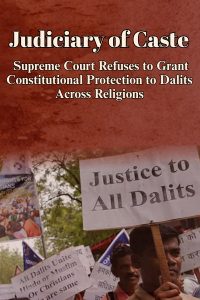
Judiciary of Caste: Supreme Court Refuses to Grant Constitutional Protection to Dalits Across Religions

On 24 March 2026, the Supreme Court of India delivered a judgment that appears, at first glance, to simply restate settled constitutional law. Scheduled Caste status, it held, is limited to Hindus, Sikhs, and Buddhists, and conversion to any other religion results in its “immediate and complete loss.” In doing so, the Court upheld an earlier Andhra Pradesh High Court ruling that denied a Christian pastor protection under the Scheduled Castes and Scheduled Tribes (Prevention of Atrocities) Act after he alleged caste abuse and threats to his life. The reasoning was categorical. Caste, for the purposes of constitutional protection, cannot survive religious conversion. Christianity, the Court asserted, does not recognise caste. The legal consequence is stark. A person born into caste oppression can lose the law’s recognition of that oppression simply by changing faith.

This judgment is not merely a technical reiteration of Clause 3 of the Constitution (Scheduled Castes) Order, 1950. It is a political act that redefines the relationship between caste, religion, and the state. It insists that caste is a bounded, religion-specific phenomenon rather than a pervasive social structure. It collapses the distinction between theology and lived reality, and in doing so, it weakens one of the most significant legal architectures available to confront caste violence in India.

Pastor Chintada Anand Paul approached the courts alleging casteist abuse and threats under the SC/ST (Prevention of Atrocities) Act. His argument was simple and empirically grounded. Caste is a matter of birth, social location, and historical disadvantage. Conversion does not erase stigma, occupation, or the violence that structures everyday life. The Court rejected this claim. It held that one cannot simultaneously profess Christianity and claim Scheduled Caste status, as the two are “mutually exclusive.” It further imposed a stringent burden on those who seek reconversion, demanding proof not just of religious change but of total dissociation from the prior faith and acceptance by the original caste community. The effect is to transform caste from a lived structure of oppression into a matter of formal religious identity. This move is conceptually flawed and politically dangerous.

Caste in India has never been reducible to theology. It is a system that organises labour, space, marriage, and dignity across centuries. It determines who cleans, who owns land, who is touched, who is excluded, and who is killed. Conversion may alter belief, but it does not alter these material conditions. A person who has historically been forced into sanitation work does not cease to be socially marked because they now pray in a church or a mosque. Their neighbours do not forget. Their employers do not forget. The state itself does not forget, as evidenced by the continued concentration of Dalit-origin communities, including Muslim and Christian groups, in sanitation labour.

We need a clearer understanding of what conversion has meant in anti-caste politics, particularly keeping in mind the legacy of B. R. Ambedkar, whose political choices have defined anti-caste possibilities for many of us. Conversion was never a naive belief that caste would simply disappear with a change of religion. It was a political act, a refusal of graded inequality, and an assertion of dignity against a system that denied it. What the present judgment reveals is not the failure of that strategy, but the persistence of caste as a social structure that exceeds religious boundaries, and the state’s refusal to recognise that persistence.

Empirical evidence across regions confirms this persistence. Studies of Muslim and Christian communities show entrenched hierarchies, occupational segregation, endogamy, and practices analogous to untouchability. Dalit Muslims report being denied access to shared burial grounds, segregated in schools, and excluded from social interaction by both Hindus and upper caste Muslims. Rural poverty and landlessness among these communities are significantly higher than among upper caste Muslims, placing them at the bottom of an already marginalised population. Similar patterns exist among Dalit Christians. The continuity is not accidental.

The Court’s assertion that Christianity does not recognise caste is therefore beside the point. The question is not whether religious texts endorse caste, but whether social life reproduces it. By privileging theology over sociology, the judgment adopts an abstract view of religion while ignoring empirical reality. It mistakes doctrine for practice and, in doing so, denies protection to those who continue to experience caste violence.

This denial has deep historical roots. The Constitution (Scheduled Castes) Order, 1950 restricted SC status to Hindus, later expanded in 1956 to include Sikhs and in 1990, under the V. P. Singh government, to include Navayana Buddhists. Muslims and Christians had been excluded since the beginning, with a petition seeking reservation benefits for Dalit Muslims and Christians pending before a three-judge bench of the Supreme Court since January 2011. This exclusion was not a neutral reflection of social reality, but a product of political choices that sought to contain caste within a “Hindu” frame. It allowed the state to acknowledge caste where it was unavoidable while maintaining the fiction of a casteless modernity elsewhere. The result has been a long-standing invisibilisation of caste among religious minorities.

This invisibilisation has served multiple purposes. It has enabled upper caste dominance within minority communities by suppressing internal hierarchies. It has allowed the state to deny the universality of caste oppression. And it has fractured anti-caste politics by creating differential access to legal recognition and protection.

A troubling dimension of this moment is the relative silence, and at times loud opposition, from sections of anti-caste movements themselves. This hesitation is often rooted in a politics of scarcity, where access to reservations and legal protections is treated as a finite resource to be defended rather than expanded. In this frame, the inclusion of Dalit Muslims and Dalit Christians is seen not as a necessary correction of historical injustice, but as a potential dilution of already inadequate entitlements. This logic mirrors, in unsettling ways, the very arguments long deployed by upper caste groups against reservations, where claims of merit, competition, and limited opportunity are mobilised to resist redistribution. When anti-caste politics adopts this grammar, it risks reproducing the exclusions it seeks to dismantle. Instead of challenging the state to expand its commitment to justice, it internalises constraint and turns marginalised communities into competitors, when the demands of justice should be deployed toward the state, which fails to adequately provide mechanisms of dignity for all. The consequence is a fragmented politics that weakens the collective force required to confront caste as a structural system, allowing decisions like this judgment to stand with far less resistance than they should provoke.

The present judgment intensifies this fragmentation. By insisting that caste is only related to Indic religions, it effectively tells Dalit Christians and Dalit Muslims that their oppression is either illusory or legally irrelevant. By denying them access to the SC/ST (Prevention of Atrocities) Act, it removes a crucial mechanism for addressing violence that is explicitly caste-based in nature.

This has serious consequences for anti-caste politics. The SC category has historically functioned as more than a system of reservations. It has been a framework through which the state acknowledges caste as a structural injustice. It provides what has been described as a minimum moral and legal vocabulary to name oppression. To restrict this framework along religious lines is to weaken its conceptual foundation. It suggests that caste is not a pervasive social system, but a bounded religious phenomenon. This undermines the possibility of building solidarities across communities that experience similar forms of violence.

The judgment also produces perverse incentives. It penalises those who sought escape from caste through conversion by stripping them of legal protections. It creates a situation where individuals must choose between religious freedom and access to justice. This is in direct tension with the constitutional guarantees of equality and freedom of religion. It also ignores the historical reality that many conversions were attempts to escape caste oppression, not evidence of its disappearance.

Further, the Court’s approach to Scheduled Tribes reveals the inconsistency of its reasoning. While SC status is treated as rigidly tied to religion, ST status is assessed through social and cultural criteria, including community recognition and continuity of practices. This distinction implicitly acknowledges that identity is not reducible to formal religious affiliation. Yet the same logic is denied to Scheduled Castes. The result is an incoherent framework that treats similar questions differently without sufficient justification.

The requirement of “unimpeachable proof” for reconversion further entrenches exclusion. It places an onerous burden on individuals to demonstrate not only a change in faith, but acceptance by caste communities that have historically excluded them. It effectively grants caste groups the power to determine who can re-enter, reinforcing the very hierarchies the law is supposed to dismantle.

At a broader level, the judgment reflects a deeper anxiety within the Indian state, which has more and more started resembling the ‘Republic of Caste’. Recognising caste across religions would require acknowledging its totalising presence in society. It would necessitate expanding the scope of affirmative action and anti-discrimination measures beyond what has been available since Ambedkar’s time. By maintaining the current framework, the state, lazily at best and maliciously at worst, avoids these challenges.

Caste is a system of graded inequality that structures life chances across communities. To deny its existence in certain contexts is to deny the experiences of those who live it daily. The Supreme Court had an opportunity to move beyond the limitations of a 1950 framework and align constitutional interpretation with these realities. Instead, it has reaffirmed a restrictive reading that privileges formal categories.

If anti-caste politics is to remain meaningful, it must resist this narrowing. We must insist that caste is a shared structure of oppression that cuts across religious boundaries. We must demand that legal frameworks reflect this reality. And we must challenge the idea that dignity and protection can be contingent on faith. The question, ultimately, is not whether caste exists within a particular religion. It is whether the state is willing to recognise and confront caste wherever it operates.


Paresh Hate is a Bahujan queer researcher, writer, documenter and activist and the Lead Content Manager at Dalit Voice.

Holy Against the Grain

Holi arrives each year with fire and colour. On the eve of the festival, bonfires commemorate the burning of Holika; the next day, colours create community, at least symbolically. Yet for many of us Dalit-Bahujan thinkers and activists, Holi is not merely a spring festival. It is also a reminder that myth is never innocent. Who is cast as demonic? Who is sanctified? And who gets to decide? Where do the borders of this community that are based on violence and trauma begin and end?

Religious and mythological reinterpretation has been a recurring strategy in anti-caste thought. Rather than cede the terrain of epics and Puranas to Brahminical authority, generations of thinkers have re-read these stories against the grain, recovering suppressed figures, unsettling canonical heroes, and exposing the moral grammar of caste society. These interventions are not uniform; they differ in clarity, force, and political consequence. But taken together, they reveal a long-standing struggle over cultural meaning.

A major intervention was articulated by Jyotirao Phule in Gulamgiri. Phule reinterpreted the story of King Bali and Vamana, the dwarf incarnation of Vishnu. In the orthodox account, Vamana subdues Bali and consigns him to the netherworld. Phule inverted the moral hierarchy: Bali became the just ruler of the Bahujans, while Vamana symbolised Aryan-Brahmin cunning and conquest. The myth was reframed as political allegory, an account of indigenous dispossession. Invocations of “Bali Raja” as a symbol of egalitarian rule continue to animate Bahujan imagination in parts of India.

Then we return to Holi. The dominant narrative commemorates the burning of Holika, who attempts to immolate the devout Prahlad and is herself consumed by fire. In several Dalit-Bahujan reinterpretations, Holika and other Asura figures are read not simply as embodiments of evil but as representatives of demonised lineages, figures whose defeat encodes the triumph of one social order over another. The bonfire, then, is not only purification; it is conquest ritualised. To question what is being burned, and why, is to interrupt the moral ease of celebration.

One of the most enduring examples centres on Shambuka in the Ramayana. In the orthodox narrative, Rama executes Shambuka, a Shudra ascetic, for performing penance deemed inappropriate to his varna. Anti-caste thinkers have repeatedly foregrounded this episode as an explicit theological defence of hierarchy. The killing is not incidental; it is justified as necessary to restore cosmic order. By elevating Shambuka as a symbol of aspiration punished by caste, Dalit-Bahujan readings transform the moral centre of the story. Dussehra, for some, becomes a day not of triumph but of mourning. This is reinterpretation with sharp political edges: it confronts scripture at the precise point where it sanctions graded inequality.

A fourth powerful example is the story of Ekalavya from the Mahabharata. Denied instruction by Dronacharya because of his birth, Ekalavya trains himself in archery before a clay image of the guru. When his talent threatens the Kshatriya monopoly, he is compelled to sever his thumb as guru dakshina. In Dalit-Bahujan discourse, Ekalavya has become a paradigmatic figure of merit thwarted by caste privilege. His mutilation is read as an allegory of exclusion from knowledge systems, an allegory that resonates in contemporary debates on education, institutional gatekeeping, and social mobility. The story’s clarity makes it difficult to dismiss: it names the wound and locates responsibility.

Fifth, the most systematic critique of scriptural authority in modern India came from B. R. Ambedkar. In Riddles in Hinduism, Ambedkar subjected revered deities and narratives to rational and ethical scrutiny, exposing contradictions and moral failures in the epics and Puranas. His interrogation of religious figures was not an exercise in inversion but in demolition; he refused the presumption that tradition is beyond question. Crucially, Ambedkar did not stop at reinterpretation. His turn to Navayana Buddhism in 1956 marked a decisive break, an effort to build new ethical and institutional foundations rather than endlessly contest old ones.

Taken together, these examples illustrate a spectrum of cultural politics. Some reinterpretations, like those of Shambuka and Ekalavya, and Ambedkar’s broader critique and deconstruction of religious texts, directly confront narratives that naturalise caste hierarchy. They target explicit moments where scripture disciplines the lower orders. In these cases, counter-reading is not decorative; it exposes the theological underpinnings of social exclusion.

Others, however, raise more complicated strategic questions.

The reimagining of Bali as a subaltern sovereign and the reframing of Holika Dahan as ritualised conquest are imaginative and often emotionally compelling. They assert dignity and refuse demonisation. Yet their political effects are less determinate. Both operate within the symbolic universe of the Puranas; both depend on reversing moral valence rather than escaping the frame.

In the case of Holi especially, there is an additional difficulty. The festival today is an expansive cultural production, embedded in neighbourhood ritual, cinema, advertising, and state spectacle. A radical reinterpretation of Holika may carry intellectual force, but it can easily be absorbed as background noise amid colour and commerce. Unlike the Shambuka episode, which directly encodes punishment for caste transgression, or the Ekalavya episode, which lays bare the calculated demand that the caste-oppressed mutilate their own talent to preserve upper-caste monopoly, the Holika narrative does not transparently legislate varna order. The critique risks appearing as hostility to festivity rather than confrontation with power.

This does not mean such reinterpretations are futile. Cultural humiliation leaves deep scars, and symbolic reclamation can be a form of healing. But strategy matters. If the goal is to dismantle caste hierarchy, one must ask where myth is doing active political work and where it functions more as inherited folklore.

There is also a broader transformation to consider. While many ritual and religious practices historically emerged within caste society, contemporary caste power often operates through bureaucratic, economic, and institutional channels: land relations, educational access, employment networks, labour dynamics, and matrimonial markets. Myth may provide background justification, but its influence can be epiphenomenal in daily governance. To focus on narrative inversion risks neglecting the material sites of domination within these festivities themselves.

The contrast with projects that build alternative institutions is instructive. Ambedkar’s embrace of Navayana Buddhism was not merely theological; it created new commemorations and community infrastructures. Similarly, congregational traditions around figures such as Guru Ravidas and Kabir have sustained distinct devotional and organisational forms that dilute Brahminical mediation. These moves shift the terrain from reinterpretation to reconstruction.

What, then, might be a way forward?

Perhaps the task is not to abandon mythological critique but to discriminate among its targets. Where stories explicitly justify hierarchy, as in Shambuka’s execution or Ekalavya’s mutilation, they warrant sustained confrontation. Where reinterpretation risks dissolving into aesthetic dissent, intellectual energy might be better directed elsewhere. At the same time, there may be ways to sharpen even the more tentative critiques. Rather than attacking Holi as a whole, one might ask how contemporary celebrations reproduce social exclusion: who organises, who participates safely, and whose labour sustains the spectacle. The argument would then hit more obvious instances of power, connecting cultural practice to present structures rather than ancient allegory.

Holi will continue to blaze and bloom each year. The question is not whether to celebrate or abstain, which caste Hindus will continue to do, but how to think and intervene. If anti-caste politics is to colour the future differently, it must decide when to contest the inherited story, when to build new ones, and when to move beyond the story altogether.


Divya Jadhav is a student of literature and politics.

Torture and Killings of Untouchables in India 

[Testimony to delegates to the Seventh Assembly of the Christian Conference of Asia held in Bangalore, from May 18, 1981 given by D.M. Thimmarayappa, Convener, Karnataka Dalit Action Committee, Bangalore, on behalf of the untouchables of India.]. 

Sisters and brothers,  

We represent the above organisation comprising mainly the untouchables. Ours is a militant group wedded to the philosophy of Dr. B. R. Ambedkar, not only the greatest leader of untouchables but the greatest Indian born in India after the Buddha, whose name is a household word in the whole of Asia.  

Ambedkar said untouchables are reduced to slaves in India because of Hindu religion and therefore, he quit Hinduism and became a Buddhist.  

Hundreds of untouchables all over India have got converted to Christianity. Buddhism and Islam, Sikhism, etc. because of this oppressive Hindu religion.  

CLOSELY GUARDED SECRET  

The problem of the untouchables, forming almost a third of India’s 800 million population, is not so simple as to state it in a note like this.  

There is no problem in the whole world more serious than the problem of the Indian Apartheid. However, it remains a closely guarded secret. Every day untouchables are kicked, killed, burnt, raped and their property destroyed all over India which prides itself as the largest democracy in the world-the land of Gandhi, non-violence and what not. But nobody talks about it in India. The ruling class keeps this as a closely guarded secret. The Hindu hypocrites make much of the racial discrimination in US., U.K., Africa, etc. ‘But the most naked form of race hatred is here in India. 

Caste war is spreading all over India and we are thinking of approaching the UNO and the Human Rights Commission to fight for our demands of separate homeland or Dalitasthan  

The entire wealth of the country is produced by this servant class. They carry the burden of the whole land as sweepers, scavengers, tanners, agricultural labourers.

Untouchability is born out of prejudice. Therefore, it is more dangerous than any other problem because it is invisible You cannot racially make out a person belonging to the untouchable class. Therefore, it is a problem born out of prejudice. And this mental prejudice has reduced a third of the Indian population to be economically the poorest, socially the lowest, physically the weakest, culturally the most deprived, mutually divided, totally illiterate, landless, dumb-driven cattle. A living dead-the largest persecuted minority in the world.  

THE POISON OF HINDUISM  

The poison of the Hindu religion has infected the untouchables as well. They are also divided into several sub-castes. There are untouchables among untouchables.  

Although the untouchables are the original inhabitants of India, before the Aryans invaded India and established Brahminism (Hinduism), they too got polluted by this religion and further degenerated themselves. Once kept out of the Hindu religion the Hindu revivalist (fascist) organisations are doing their best to ‘Hinduise’ the untouchables, so that they will not quit the Hindu fold and swell the ranks of Christianity and Islam.

It is these very same Hindu revivalist organisations who are now and then raising the bogey of conversion. The Christians are charged with “forcible” conversion The Hindu religion despises the untouchable and tortures him as long as he is inside the Hindu religion. But the moment he thinks of quitting because of this torture and seeks social respectability by getting converted, the “ruling class” of India punishes him by withdrawing “reservations” given to him in the Constitution.  

ROLE OF BRAHMINS  

Both ways the untouchable is punished. He can neither live nor die. It is a living death. Have you ever heard of a parallel to this in any part of the world?  

In other societies and cultures, the status of a person is decided on the basis of his qualification, scholarship, power he is enjoying, the bank balance he is holding. None will have all this right at birth. They are all acquired. But in Hindu India status comes right at the birth. It is the birth that decides the status The Hindu society divided into several castes-ascending order of reverence and descending order of contempt-has no respect for scholarship or intellect.  

Here in India, the status is decided not on the basis of one’s office. Even a Deputy Prime Minister of India (Jagjivan Ram) was once insulted by the high caste Brahmin boys because he was an untouchable. Status in Hindu India is decided on the basis of birth and caste. Have you ever heard about this anywhere? Even dogs and cats are allowed inside the houses but not untouchables. Humans have no value in Hindu India.  

We have animal-lovers club, tree-lovers club, bird-lovers club. But no human-lovers club. It is a vast desert where the milk of human kindness has dried up.  

The untouchables of India have hardly any friends inside the country. The Press is hostile, police are its main enemy, the Government is not bothered. Every opportunity is barred. Therefore, we have no other go but to seek friends outside.  

And if there is one section in India which is responsible for creating this world’s greatest mayhemed minority it is the Brahmins-India’s ruling class. Dr. B.R. Ambedkar, had come to this conclusion after years of research and practical experience.

There is no deprivation greater than cultural deprivation Brahmins have blown the brain out of the untouchables. The Brahmin religion of Hinduism has mesmerised the untouchables and emasculated them into the most culturally deprived race in the world Can there be a greater crime than this?  

CHURCH CRITICISED  

It is said that poverty breeds communism If so the entire lot of these wretched of the earth should have been in Communist parties They should have been the first to join the Communist parties. But alas, even the Indian Marxist leadership has double-crossed them.  

Because, the leadership of the parties is also in the hands of Brahmins and other high castes. That is the reason for India not having a revolution,  

From centuries, the high castes of India have used them as slaves and serfs. The creed of non-violence is solely intended to keep them disarmed, emasculated. The Hindu religion has drugged them with the opium of “Karma”-the destiny-fate. That is why they can’t even think of protest, let alone rebel. They do and die without ever questioning how and why.  

Therefore, the Christians owe a duty to save this wretched of the earth. We admit that nobody has done greater service to the untouchables of India as the Christians. That is why thousands of them have embraced this religion.  

But unfortunately, even after conversion, they continue to be untouchables. This is yet another tragedy. Christianity therefore, failed to fully liberate them-still in many parts of India, converted untouchables have separate churches, segregated graveyards Segregation continues even after conversion. It is here that the Christians should do some heart-searching and plain-speaking.  

The CCA must address itself to this grave problem. It must also give the highest priority to the liberation of untouchables by treating it as the world’s greatest problem needing the immediate attention of the Church.  

Liberation of untouchables should be the No. 1 item in the Christian agenda. And we assure our fullest co-operation in this most humanitarian task.  

[The speech was greeted with prolonged cheers and the chairman said they were deeply touched by the Apartheid in India and the church would do everything to liberate the untouchables.] 

Jagjivan Ram and Makwana Criticise Hinduism

Jagjivan Ram said in Agra that, “the Harijans who embraced Islam … had been left with no other option. He criticised the Hindu religion for denying rights to Harijans. If the Hindus do not accept the Harijans as Hindus, what is the point in their staying within the fold of that religion? (The Hindu, 30-6-8)

Pejawara Swami of Udupi said in Kurnool, (AP) that “caste Hindus were responsible for driving Harijans to the arm of other religions. The Swamiji spoke regretfully of the torment and humiliation that caste Hindus heap on Harijans. He agreed that caste Hindus treat Muslims and Christians with greater respect and tolerance than Harijans” (the Hindu, 30-6-81) 

Makwana, Union Minister of State for Home said in Madras that “conversion could not be done by lure of money or coercion … What was very clear was that the Harijans had been treated badly, humiliated and attacked and their property was looted and burnt. From newspaper reports, it was obvious that out of humiliation and anger they had converted to Islam … the Hindu religious leaders must, therefore, learn from history. (Hindu-24-6 81) 

“Makwana said the Harijans who embraced Christianity and Buddhism had found that casteism was being practiced in these religions also. Probably the intelligent Harijans of Tamil Nadu had chosen Islam which welcomed them with open arms”. (UNI reports in Deccan Herald, 26-6-81)

V.G. Prasad Rao, Times of India, Staff Correspondent at Madras, in a report says: – “It was not mere economic gain that drew the Harijans into the Mohammadan fold but rather a yearning for social equality. Another interesting fact is that some Christians have also become Musalmans. This is obviously to protest against the caste system imported into Christianity in the South”. (Times of India, 1-7-81)

Threat to Embrace Islam:

UNI reports from Salem that 70 untouchable families of Devarayapuram village in Namakkal taluk of Salem district have threatened to embrace Islam on Aug. 1,  if untouchability practiced against them by the Hindus is not ended by then. (Deccan Herald, 3-7-81)  

Untouchables Externed

P.R. Kuppuswamy, Advocate, Karur (T.N.) writes: About 600 untouchables are on bail with the condition to stay 200 to 250 miles away from Ramnad. They are starving.  

Makwana Visit to Meenakshipuram:

Union Minister of State for Home, Makwana, who had earlier made an appeal to the Shankaracharya of Kanchi, Kamakoti Peeta urging him to help stop conversion of untouchables to Islam, visited Meenakshipuram and other Tamil Nadu villages where mass conversions had taken place. Talking to newsmen on July 4 at Madurai after the visit, he said untouchables in Tamil Nadu were feeling insecure because of the rising criminal atrocities of Hindus. He said, “Utter neglect of the Harijans and insult and humiliation at the hands of caste Hindus were stated to be the reasons for the religious conversions which were reported only in Tamil Nadu”. He said the Harijans, who had embraced Islam, had told him that they had lost faith in Hindu leaders and Hindu society, as a whole. Those who had been converted felt they were treated with equality and respect by their co-religionists. Conversion is happening because of social injustice. Asked if he suspected involvent of foreign money, he said he was not in a position to say anything on it. The government “was investigating”. (Deccan Herald 5-7-81, quoting UNI report)

“Organizer” Editorial

The RSS official journal in an editorial under the headline: “From Meenakshipuram to Rehamat Nagar,” (5-7-81) says: “if the Harijans of Meenakshipuram had any grievances, they could have ventilated the same and sought redress. After all, ours is an open and democratic society and not an Islamic country where dissenters can be flogged or have their hands or feet cut. Why did anybody have to use their grievances to destroy them socially, culturally, emotionally? We are very sorry to say that what has happened in Meenakshipuram is not an outburst of local grievances but a small expression of an old conspiracy to destroy Hindus, Hinduism, and Hindustan”. The editorial further says: “the whole things is immoral … And in so far as it has excited Hindu-Muslim feelings, it has threatened public order”. It calls upon the government to protest to the Sri Lanka government for the misconduct of its Speaker. It also calls upon the Election Commission not to recognise the conversions, and demands a probe into the flow of foreign money into India.

Muslims and Christians’ Global Conspiracy to Subvert India-RSS Version of Conversions

Bangalore:

We are flooded with letters, reports, articles, statements and speeches on the Meenakshipuram mass conversion of untouchables to Islam. It is no longer a flood but a deluge. The epidemic is spreading to Karnataka, Andhra and U.P. Earthquake, as we declared in our previous issue. The Hindu communalists have raised it to the level of Armageddon. The untouchables have tasted the benefits of conversion and more and more of them appear to be rushing to embrace Islam which did produce miraculous results.

B.J. P. president Vajpayee visited Rahmat Nagar and later told the press at Madras on July 17 the RSS version of the conversion. The Deccan Herald report (18-7) says the conversions were “master-minded by certain notorious smugglers who would like to cover up their involvement with counterfeit currency cases. These unscrupulous elements have succeeded in roping in innocent Harijans who have been made to carry fake currency on the assurance that they will not be harassed by the police once they became Muslims”. Vajpayee raised questions of involvement of a foreign agency in printing fake notes, establishment of a technical training school which received Rs. 1.5 crore foreign aid and involvement of an Indian who became a Muslim in a gulf country but is now busy converting untouchables by using foreign money. But Vajpayee was careful not to mention names of the persons doing this conversion or the company that gave the machine to make currency notes or the Arab country from where the petrodollars are pouring. Why did he not give the names? Is he afraid or does he not have the information? The RSS has supplied him the information. But he did not like to repeat the RSS charge because he wants to become the Prime Minister. And he knows that nobody can become PM without the support of Dalits and Muslims. And in these conversions, unfortunately, the very two communities are involved. RSS wants to groom him for the Prime Minister but at the same time it cannot get out of its “caste character” which makes it hate these two persecuted minorities. This was Vajpayee’s dilemma when he visited Rahamat Nagar.

What is the RSS? In the July 18 issue of the ‘Organiser‘, under the headline “inside story of Meenakshipuram”, it says “Muslim priests and leaders are working to convert 1 lakh Harians living in 500 villages spread over 3 districts of Tamil Nadu”, The whole thing is described as a “Global conspiracy to subvert India”. It recollects the Times of India (21/3/81) front-page headlines in this connection. The annual report of the “South India Islam Society had said that 8,000 Harijans had been converted to Islam”. The facts, Organiser says, are: The first conversions took place in Korayur, Ramnad district, in Feb. 1980. The person responsible for these conversions is a Ramnad District Health Officer, Dr. Manoharan who became Dr Munnawar Khan and Dr. Jayaseelan, another local Harijan doctor At Meenakshipuram, the police unearthed a big counterfeiting activity in an estate. The counterfeiting was being done according to the police, by some Christian padris with the aim of a printing machine donated by Douglas Charity of America. This has been established by the confessions of the accused persons to the police. A Christian family residing in Tenkasi Taluk, is also running an orphanage aided by the Douglas Charity. The primary purpose of this orphanage is conversion of Harijans to Christianity. This orphanage abets several Harijans to create caste tensions between Harijans and nonpartisans in several villages, so as to create an atmosphere of alienation from the Hindu society, which is necessary for conversions. The family running the orphanage is also said to have made available the machinery for counterfeiting. According to the police, printing and distribution of counterfeit currency has been going on for several years. The modus operandi is that the printing is done by the Christians and the distribution outlets are the trade channels of Muslims. The Harijans are employed to carry the counterfeit currency. The Organiser says “one Thangaraj, a notorious local goonda, changed from Christianity to Islam and became Yusuf to save himself after eloping with a Thevar girl. This Thangaraj had link with the fake note racket. The two Thevar youths who discovered this connection were murdered. Police investigation revealed the fake note racket The police were harsh on SCs and the Muslims assured them that police would not dare touch them if they embraced Islam”.  

This is the RSS version of the whole story which Vajpayee repeated at Madras. The Organiser refers to the Tanjore district conversion led by Ambikapathi father-in-law of Thasi M. Karunanidhi, a DMK MP from Nagapattanam. He converted 20 other Dalits. A famous street is renamed Madina street. The Organiser gives the following details of conversion in Tamil Nadu: total is 1,369. The conversions have nothing to do with social reasons. “They have much to do with the feeling that there is money and power in being a Muslim”. The Organiser later propounds 12 bogus schemes to avert conversions and save “Harijans”. However, some Dalit friends have thrown a challenge: If the Arabs can pay Rs. 500 per convert, the RSS, the Shankaracharyas and the Birlas, who together can command crores of rupees, can offer Rs. 1,000 per head and reconvert them, but as Brahmins. They said they are ready.  

RSS leaders who became so nervous by these conversions have virtually started pissing in their pants. The national executive of the RSS met in Delhi for two days from July 11, Babasaheb Deoras presiding. The full text of the resolution passed at the meeting was published on the front page of the Organiser. We have carefully gone through the resolution and would like to tell our Dalit friends not to be deceived by these crocodile tears of this high caste fascist organisation. Except saying that caste distinction must be buried and the “pernicious practice of untouchability must be ended”, there is nothing concrete. We have had enough of these humbugs from the days of Gandhi. 

Panchama-Baiting in Tamil Nadu  

I wish to refer to the phenomenon of adoption of Islam by the Panchamas in Tamil Nadu which has been going on for more than 10 years, but made a government issue now by the anti-democratic and anti-secular elements of the Hindu Rashtra school. 

Varnashrama Dharma is a well-known tenet of Hinduism. Under this tenet, the panchamas are untouchables. To term the panchamas as Hindus is not correct. They are only unbonded, untouchable slaves of the Hindu.  

As such it is not surprising, with the slow penetration of modern education among the panchama castes and with the consciousness of their human dignity by the youths, some of them become rationalists or materialists. But the vast majority who are religious minded have been adopting Buddhism, Christianity or Islam. The process has been going on for hundreds of years.  

The Hindu clergy and the R.S.S. element are blowing up this phenomenon as part of a Muslim proselytization programme. The animosity existing between Hindus and Muslims in Tamil Nadu is exemplary. The Jamat-e-Islam in Tamil Nadu is very keen about not giving room for communal discord to develop in this part of India. So they are too reluctant to provide assistance for initiating the new-comers into their fold unless responsible Hindus consider it not as a calamity to their way of life but as liberation of the panchama from centuries of caste oppression.  

In such circumstances, I would request democrats to use their influence with the responsible Hindus, R.S.S., the govt. and religious leaders etc. to convince them about the need to desist from rousing communal passions on the issue and to create an atmosphere conducive to the free exercise of their human rights by the panchamas without government interference. The freedom of the Muslims to enfold into their brotherhood the ones who aspire to it without government interference and harassment by Hindu communalists is an an essential demand of secularism.  

This is not the first time in history that people reject the social tyranny of a particular religion and adopt a more rational and humanistic religion. But unfortunately, every Hindu – from the Prime Minister down to the police constable – is propping up the tyranny of Hindu social system on the victims of this tyranny, trouncing all principles to a secular polity. The Indira Congress has started Panchama baiting and Muslim-baiting. Here it has become imperative for democrats to intervene and work in defence of secularism as well as human rights to the Panchamas. We are planning to call a meeting of Panchamas and Muslims at Madurai to thrash out this matter which is so vital for democracy and secularism. Such a meeting should be held at the national level also. 

Hindu Leaders Have No Right to Interfere with Dalits 

Communal Hindus led by RSS are making a sort of war preparation over the mass conversion of untouchables to Islam in Meenakshipuram and other parts of Tamil Nadu, Pondicherry, Andhra, etc. A similar threat has come from Bangalore and Kanpur also. 

Reports by the special correspondents of the Hindu, Indian Express, Deccan Herald, Times of India, Statesman, other periodicals, PTI and UNI, apart from other impartial observers like the Regional Director of the SCs and STs of the Government of India have all gone to conclusively prove that the untouchables there have embraced Islam out of sheer desperation having been unable to bear the Hindu torture and barbarity.  

The converts have testified that after becoming Muslims they have gained self-respect and manhood. The very Hindus who used to keep them out have started respecting them. It is only the conscious and awakened Dalits who have taken this extreme step. Union Minister of State for Home, Makwana, after a visit to Meenakshipuram, had hailed their stand. Prof. Subramanian Swamy had also visited the place and came to this very same conclusio.

As regards the charge that untouchables were purchased by Muslims by using Arab money, we consider it a serious aspersion on the Dalits of India as a whole. We are not such a cheap people as to sell ourselves. Actually, it is the RSS that is trying to bribe them. The Hindu leaders and the RSS must stop making this charge which will only add insult to the injury. Press reports have said that in places where there has been a mere threat of conversion, the Government has immediately jumped and acted to redress their grievances. What the Dalits could not achieve in centuries has been accomplished by a mere threat. Such is the miracle brought by conversion. But the Hindus led by religious leaders like the Pejawara Swamy are creating all sorts of confusion by staging dramas. While they have not bothered to touch the basic social issues that brought about this suicide to Hinduism, these religious leaders are propping up non-issues and side-tracking the basic issues. We are afraid the religious frenzy and the war-like preparations by these people may lead to serious communal riots in Tamil Nadu.  

The Karnataka Dalit Action Committee, which will shortly send a team to Meenakshipuram and other areas to study the situation and also to reassure the converts, has been repeatedly urging the Dalits to quit Hinduism as directed by Dr. Ambedkar. During our recent protest demonstration on the Gujarat caste war, our main slogan was “Quit Hinduism”. We have even announced our plan to hold a massive “Quit Hinduism” conference in Bangalore. Dr. Ambedkar had said that untouchables will not get equal status as long as they remain as Hindus. That is why he vowed not to die a Hindu and embraced Buddhism.  

All over India, Dalits are quitting Hinduism after getting convinced that they cease to be untouchables once they get out of Hinduism. History has proved that they are right. Meenakshipuram is a standing monument to symbolise the graveyard of Hinduism, they are being killed and burnt, their property destroyed only because they are untouchables. Ambedkar has opened the floodgates. Not even a hundred Shankaracharyas and Pejawar Swamis can stop the flow now.  

Nor have they any right to demand that converts be deprived of reservations. If their plea is that reservations should not be given only to converts, why did they launch the Gujarat caste war on untouchables who were within Hinduism? Does it not prove that they will not tolerate reservations even to Hindu untouchables? That means as long as untouchables live within Hinduism they are tortured and the moment they quit; they are threatened with the punishment of withdrawing the reservations. But the Dalits shall not be cowed by these threats.

Reports said 200 more untouchables became Muslims on the July 27 Hindu conference for reconversions. Hindu leaders who want to woo back the converts to the Hindu fold could have at least offered a promotion to the reconverted. They could have assured to convert them as Brahmins. In the absence of any such assurance, it means that the Hindus are out to make them once again as untouchables.

Therefore, the Dalits will not be fooled any longer by these tricks. We can see through their game. False promises will no longer tempt us. Dalits will no longer be deceived by this sudden Hindu sympathy for “Harijans“. Their crocodile tears. How is it that now after 3,000 years they have suddenly realised that untouchables are also Hindus and they are humans. Too late.  

While congratulating the untouchables for quitting Hinduism and thus getting themselves liberated, we call upon Dalits all over India to observe Independence Day (Aug. 15) as “Quit Hinduism Day” and bid good-bye to suffocation and seek fresh air.