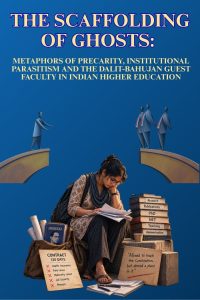
The Scaffolding of Ghosts: Metaphors of Precarity, Institutional Parasitism and the Dalit-Bahujan Guest Faculty in Indian Higher Education

“They take our sweat to cement the arches of their intellectual temples, but reserve the sanctuary for their own kin. We are allowed into the university only as day-laborers of the mind, expected to clean the dust of their theories and vanish before the sun sets.”

— Notes from an Unappointed Ad-Hoc Scholar


I. Introduction: The Ivory Plantation and the Underground Specters

The modern Indian university is not an agora of enlightenment; it is a meticulously landscaped plantation whose ivory towers are held upright by bamboo scaffolding made of invisible hands. If you walk through the marble corridors of Delhi University, the red-brick courtyards of Hyderabad, or the ancient stone arcades of state universities in Uttar Pradesh and Maharashtra, you will breathe an air thick with the incense of academic grandiosity. High-table seminars deliberate on post-colonial subalternity, international journals publish lavish treatises on “decolonizing the mind,” and vice-chancellors deliver pious speeches on national progress. Yet, step beneath the floorboards of this grand theater, into the subterranean basements where tutorial sheets are evaluated and attendance registers are marked, and you will encounter an army of specters. They are the Guest Faculty, the Ad-Hoc Scholars, the Temporary Lecturers—disproportionately hailing from Dalit, Bahujan, and Adivasi communities—who inhabit the university not as citizens of letters, but as unacknowledged day-laborers of the intellect.

To understand the crisis of the Dalit-Bahujan guest lecturer is to understand a sophisticated, modernized form of institutional untouchability. It is a system that does not banish the untouchable body from the temple of learning, but rather admits it on the condition that it remains eternally temporary, economically broken, and structurally voiceless. The old caste order barred the Shudra and Ati-Shudra from listening to the Vedas by pouring molten lead into their ears; the modern neoliberal-feudal university permits them to teach the Vedas, the Constitution, and Quantum Mechanics, but ensures that their monthly stipend of a few thousand rupees arrives six months late, without healthcare, without maternity leave, and with the permanent threat of instant dismissal at the end of every 120-day contract cycle.


IIA. The Reservation Bypass: How Public Universities Invented the “Academic Coolie”

For seven decades, the Indian Constitution guaranteed that public universities—the primary engines of social mobility for marginalized communities—would reflect the demographic reality of the nation through affirmative action (Reservation). However, the Savarna oligarchy that controls the levers of academic administration executed a masterstroke of systemic evasion. Rather than directly opposing reservations—which would invite constitutional penalties and street protest—they rendered the permanent faculty position an endangered species. By deliberately freezing regular recruitment for decades, university administrations created an artificial vacuum, which they then filled with temporary, contract, and guest faculty.

Consider the brutal arithmetic of this institutional fraud. When a university advertises a permanent Assistant Professor position, it is legally bound to apply the constitutional quota (15% SC, 7.5% ST, 27% OBC, alongside EWS). But when the university hires a “Guest Lecturer” or “Ad-hoc Teacher” to take the exact same classes, grade the exact same papers, and invigilate the exact same examinations, the reservation roster is blithely discarded under the legal pretext that guest teaching is “hourly engagement” or “contingent work.”


IIB. The Reservation Bypass: Institutional Anomie: Higher Education Disparity Data

  • 33%+ Sanctioned Faculty Vacancies Left unfilled across Central and State universities.
  • 50% Undergraduate Teaching Load Executed by guest, ad-hoc, and contract labor.
  • 4.2% SC/ST Full Professors Representation in premier institutions.

This is the Reservation Bypass Architecture. By shifting the bulk of teaching workloads onto unreserved, arbitrarily appointed guest arrangements, university syndicates have successfully preserved permanent professorships as exclusive fiefdoms of elite caste networks. The Dalit-Bahujan scholar who spent a decade earning a PhD from a premier central institution, publishing peer-reviewed papers, and passing the National Eligibility Test (NET), arrives at the university gates expecting the fulfillment of constitutional promises. Instead, they are directed to the guest room—a cramped closet under the stairs—and handed an hourly wage contract that pays less than the daily minimum wage of an industrial supervisor.


III. The Metaphor of the Academic Plantation: The Sugar Mill of the Mind

To capture the existential dread of the guest faculty, one must discard the sterile vocabulary of human resource management and turn to the literature of plantation economies. The guest scholar is the cane-cutter of the academic sugar mill. Every morning, they arrive at the campus with bundles of intellect harvested from nights of lamp-lit reading, only to feed them into the administrative crusher. The sweetness—the tuition fees paid by students, the accreditation scores (NAAC) awarded to the college, the university’s ranking metrics—is extracted by the administration to polish the institution’s facade. The leftover bagasse—the exhausted, underpaid, un-benefited human being—is swept out at the end of the term.

There is a cruel satire in how elite institutions market their commitment to social justice. A college will organize a national seminar on “Ambedkarite Hermeneutics” or “Post-Colonial Subalternity,” funded by public grants. The keynote speaker, a tenured professor enjoying a six-figure salary, housing allowances, and sabbatical privileges, will deliver an impassioned address on the plight of the marginalized. Meanwhile, the microphone is adjusted, the water glasses are refilled, and the attendance registers are compiled by a guest lecturer who holds a Doctorate in Marathi Literature, belongs to the Mahar or Matang community, and is wondering if their bank balance of ₹412 will stretch to cover next month’s room rent.

“We are asked to lecture on human rights in the morning and beg the clerk for our unpaid honorarium in the afternoon. The university teaches equality through our mouths while practicing feudalism on our throats.”

This paradox is structural rather than incidental. The tenured Savarna academic elite requires the guest faculty in the same way the Victorian aristocracy required domestic servants. The presence of a vast, desperate reserve army of unemployed and underemployed Dalit-Bahujan PhDs allows tenured professors to reduce their own teaching workloads, delegate tedious administrative drudgery, pursue prestigious foreign fellowships, and maintain an aura of Olympian intellectual detachment. The guest lecturer becomes the institutional sponge that absorbs all the friction, labor, and anxiety of the educational machine, allowing those above them to glide seamlessly through the realm of pure thought.


IV. The 120-Day Executioner: Contracts, Caste Privilege, and Psychological Castration

The contract structure of guest and ad-hoc appointments is designed with psychological precision to break the spirit of resistance. In many state and central universities, appointments are made for 120 days, 89 days, or purely on a “per-lecture” basis (capped at a paltry monthly maximum). At the end of every term, the guest faculty undergoes a symbolic execution: their contract terminates, their temporary library pass expires, and they are cast back into the abyss of non-existence.

To be re-appointed for the next term, the scholar must perform a ritual of submission. They must court the favor of Departmental Heads, College Principals, and Governing Body members. In a society where social capital is coterminous with caste networks, this ritual is deeply stacked against Dalit-Bahujan scholars. A Savarna candidate, connected through family ties, alumni networks, shared dietary habits, and cultural codes, effortlessly navigates the informal corridors of power. They engage in light banter over filter coffee or tea with the Principal, discussing shared acquaintances and theoretical inclinations. The Dalit-Bahujan candidate, lacking this inherited cultural currency, enters the administrative office carrying the heavy burden of historical exclusion, acutely aware that any slip of tongue, any display of political assertion, or even a lack of “servile deference” can result in immediate, unwritten blacklisting.

Satire turns into horror when one examines the “Interview Boards” for ad-hoc and guest panels. Every few months, thousands of scholars line up outside principal offices across university towns like cattle at an auction. They hold thick files containing books they have written, research articles published in Scopus-indexed journals, and certificates of national awards. They are called into the interview room for precisely 90 seconds. 90 seconds to justify ten years of doctoral labor. The committee members—often bored, scrolling through their smartphones—ask a superficial question, check the candidate’s last name (a transparent proxy for caste identity in the Indian context), and make a silent mark on their scorecards. The process is repeated term after term, year after year, converting vibrant young intellectuals into anxious, sycophantic mendicants.


V. The Political Economy of Silence: Why the Academic Subaltern Cannot Speak

Why do guest faculty not unionize and shut down the university until their demands for regularisation are met? The answer lies in the totalizing nature of their precarity. Tenured faculty can go on strike because their salaries are protected by civil service rules and UGC regulations. Permanent staff have trade unions, legal representation, and tenure protection. The guest lecturer has none of these shield walls.

If a guest teacher speaks out against administrative corruption, caste discrimination, or delayed payments, they are not served with a show-cause notice—they are simply not invited back next semester. No order is issued; no explanation is required. The phone simply stops ringing. Their name disappears from the timetable as quietly as a drop of water evaporating on a hot slate. This form of retaliation is clean, silent, and untraceable. It is the bureaucratic equivalent of an extra-judicial disappearance.

Furthermore, this precarious labor market actively fractures solidarity among the oppressed. When fifty Dalit-Bahujan PhD graduates are competing for two temporary guest slots paying a meager hourly wage, the university successfully pits victim against victim. Solidarity is replaced by a desperate, panicky competition for survival. The scholar who raises their voice against an unjust workload is instantly replaced by another scholar whose rent is due tomorrow and whose family is waiting for a remittance back in the village.


VI. A Personal Monologue: A Letter from the Shadows

Let me speak to you not as an abstract sociological voice, but as Mujammil Shahin Siraj Shaikh—a chronicler who has watched the brightest minds of my generation wither in the waiting rooms of higher education.

I have seen my friend—a man who spent six years translating obscure 19th-century anti-caste manuscripts, a scholar whose mind burns with the brilliance of a supernova—standing outside the account section of a state university in the scorching summer heat of June. He was not there to collect a research grant or a publication prize. He was begging a clerk, who was half-asleep under a whirring ceiling fan, to release his lecture fees for the previous semester—money that had been withheld for seven months because a signature on a voucher sheet was missing a middle initial. His mother in the village needed insulin; his landlord had threatened to lock his room by the weekend. In his pocket was a copy of Antonio Gramsci’s Hegemony and the Intellectuals, a book he had taught to fifty eager undergraduate students that very morning.

What does it do to a human soul to articulate theories of freedom, justice, and human dignity on the lectern, while living a personal reality of complete disenfranchisement? It creates a profound, tearing schizophrenia. The guest scholar lives in two worlds simultaneously: in the morning, they are “Doctor,” an authority figure guiding the next generation toward critical thought; in the evening, they are a pauper, calculating whether they can afford egg curry or must settle for plain rice to survive till the end of the month.

This humiliation is explicitly gendered and caste-coded. Bahujan women guest lecturers face a double furnace of oppression. They navigate not only the structural precarity of temporary contracts and caste bias but also the insidious sexual harassment and paternalistic condescension inherent in hierarchical university departments, where renewal of contracts is frequently dangled as a weapon of behavioral control by senior male academics.


VII. The Imperial Caste-Class Trap: Data, Statistics, and Structural Reality

The tragedy of the guest faculty is not a temporary glitch in an otherwise healthy educational system; it is the logical outcome of a neoliberal state colluding with a feudal social structure. Let us examine the national indicators that illustrate this structural betrayal:

  • Systemic Vacancies as Policy: According to official data presented in Parliament and AISHE reports, thousands of faculty positions remain vacant across Central Universities, IITs, and NITs. The vast majority of these unfilled posts belong to the reserved categories (SC, ST, OBC). By leaving these posts vacant under the pretext of “Non-Availability of Suitable Candidates” (NASC)—a notorious administrative euphemism used for decades to reject qualified Dalit-Bahujan applicants—universities fill the operational gap by hiring guest lecturers at a fraction of the cost.
  • The Economic Exploitation Ratio: A permanent Assistant Professor under the 7th Pay Commission earns a starting basic pay of approximately ₹57,700 plus allowances (totalling upwards of ₹85,000 to ₹1,000,000+ monthly). A Guest Faculty member teaching the exact same course load is capped at a maximum ceiling (often ₹50,000 in central norms, but frequently down to ₹12,000 – ₹20,000 in state universities), with zero pay during vacations, zero health insurance, zero Provident Fund, and zero annual increments. The university extracts 100% of the labor value while paying less than 20% of the cost.
  • The Psychological Toll: Studies on academic precarity show alarming rates of chronic anxiety, depression, and existential despair among ad-hoc and guest educators. When social identity (caste stigma) combines with economic instability, the result is an intolerable mental crucible. The tragic institutional suicides of scholars like Rohit Vemula and Payal Tadvi are merely the visible tip of an underwater iceberg of silent, slow-motion institutional violence inflicted on thousands of contract educators daily.


VIII. Reclaiming the Temple: A Call for Radical Academic Emancipation

We must strip away the romantic mythologies of the Indian university. The university is not a sanctuary of pure scholarship; it is a battleground of social power. As long as higher education relies on an underclass of disenfranchised, underpaid, and structurally vulnerable Dalit-Bahujan guest faculty, every degree awarded by these institutions is tainted by the sweat of unfree labor.

To dismantle this modern plantation system, we do not need incremental policy tweaks or patronizing sympathies from academic senates. We require radical structural restructuring:

  • Immediate Abolition of the “Guest/Ad-Hoc” Bypass: Higher education regulatory bodies (UGC, Ministry of Education) must mandate that any teaching position required for more than one academic term MUST be converted into a regular, permanent position subject to constitutional reservation rosters.
  • Equal Pay for Equal Work: Until regularisation is achieved, guest faculty performing identical teaching, evaluation, and administrative duties must receive equal hourly and monthly remuneration, along with full health coverage and seasonal pay continuity, in strict compliance with Supreme Court mandates on labor rights.
  • National Audit of Reservation Rosters: A high-powered, independent judicial commission comprising Dalit, Bahujan, and Adivasi jurists must audit the faculty recruitment records and vacancy distributions of all central and state universities to expose and penalize administrative manipulation of reservation panels.
  • Democratization of Departmental Governance: Departmental chairs and university committees must be stripped of arbitrary, unilateral power over contract renewals. Evaluation of teaching staff must be transparent, peer-reviewed, and protected against personal and caste-based bias.

Until these measures are implemented, the Dalit-Bahujan intellectual will remain a ghost in the machine—hired to teach the youth how to think, but forbidden from claiming a place to exist. But let the managers of the academic plantation take warning: ghosts do not remain silent forever. The scaffolding of precarity is rotting from within, and when it collapses, it will take the ivory tower down with it.


Mujammil Shahin Siraj Shaikh is a Pune-based independent researcher and prospective PhD scholar examining structural inequality, public policy and institutional power in modern India.


When the State Can Take Your Institution: FCRA and How the Civil Society Is Being Choked Financially

India’s Foreign Contribution (Regulation) Act was introduced in 1976, during the Emergency, to regulate foreign influence in Indian political life. The 2010 Act replaced that framework with a broader system for regulating foreign contributions to organisations and associations. Over time, FCRA has also given the state increasing power over whether organisations can access foreign funding and continue their work. The latest changes take that process further.

The Foreign Contribution (Regulation) Amendment Bill, 2026 was introduced in the Lok Sabha on 25 March and referred to a Joint Parliamentary Committee on 12 August. It is not law yet. The 2026 Rules, however, are already in force. Together, they significantly tighten the conditions under which organisations receiving foreign contributions can operate.

The Bill proposes a Designated Authority to supervise foreign contributions and assets after an organisation’s FCRA registration is cancelled, surrendered, expires or is not renewed. The Authority can take provisional custody of the foreign contribution and relevant assets. If the registration is not restored or renewed within the prescribed period, the assets can vest permanently in the Authority and subsequently be transferred or disposed of, with the proceeds going to the Consolidated Fund of India. The proposed framework also covers assets created partly from foreign contributions.

There is an important detail here. The principle of asset vesting is not entirely new. Section 15 of the existing FCRA already provides for the vesting of assets created out of foreign contribution when an organisation’s registration is cancelled or surrendered. What the 2026 Bill does is build a much more elaborate administrative machinery around that principle, giving the state greater control over what happens to those assets. And this matters because the state already has considerable power to make an organisation incapable of functioning long before anyone arrives to take possession of its assets.

The state does not need to seize an organisation’s property to make it unviable. The cancellation or non-renewal of an FCRA registration can cut off its access to foreign funding, while investigations and regulatory proceedings can tie up its finances and consume the administrative capacity needed to keep the organisation running. By the time an organisation is able to challenge such action, it may already have lost the ability to function as it once did.

The 2020 amendments established much of the architecture that made this possible. The ceiling on administrative expenditure was reduced from 50% to 20% of foreign contributions. That expenditure includes basic organisational costs such as personnel, salaries, travel and management. At the same time, organisations receiving foreign contributions were prohibited from transferring those funds to other organisations, effectively ending the sub-granting arrangements through which larger organisations had supported smaller grassroots groups.

The consequences for smaller organisations were particularly severe. A national organisation could previously receive foreign funding and pass some of it to a local group working in a remote district. After 2020, that channel was closed. The local organisation had to deal with the compliance burden itself, even when it lacked the staff, money or administrative capacity to do so.

The 2020 amendments also required foreign contributions to be received through an FCRA account at the State Bank of India’s New Delhi Main Branch on Sansad Marg. For organisations working in rural areas or distant states, even a basic banking requirement became another layer of centralised administrative control.

This has happened alongside a dramatic contraction in the number of active FCRA organisations. Thousands of registrations have been cancelled or allowed to lapse over the years. Organisations including Amnesty International India, Oxfam India and the Centre for Policy Research have faced cancellation, suspension or non-renewal.

The 2026 Rules add further conditions. Organisations must now identify the purposes for which they intend to use foreign contributions and the states or Union Territories in which they intend to operate. Their FCRA registration is consequently tied more closely to specified purposes and geographical areas. The Rules also expand disclosure requirements concerning activities, office bearers, publications and social media accounts. An organisation must demonstrate that it has undertaken “reasonable activity” by utilising at least ₹10 lakh in foreign contribution over the preceding two financial years. For organisations receiving foreign contributions in instalments under prior permission, the release of a subsequent instalment is tied to utilisation of at least 75% of the previous instalment and a field inquiry.

These requirements are presented as compliance measures. But compliance itself is a mechanism of control where the state has the power to decide whether an organisation has done enough, worked in the right place, spent enough money or remained within the purposes recorded on its certificate.

This is particularly useful to a government that wants to curb progressive work while abandoning its own responsibilities to the people. Organisations working with communities affected by caste violence, displacement, environmental destruction, poverty and state violence can be weakened through the same machinery that is supposed to regulate their funding. The state retreats from its public obligations while strengthening its ability to constrain those who organise in the spaces it leaves behind.

The implications extend beyond organisations conventionally described as NGOs into spaces that are squarely political. Civil society includes legal aid groups, research institutions, health organisations, women’s collectives, workers’ organisations, environmental groups, educational initiatives and organisations working with Dalit, Adivasi and minority communities. These institutions document violence, gather evidence, challenge government policy and provide services where state institutions are inaccessible or inadequate.

It also includes religious and minority institutions. The government has stressed that the 2026 Rules continue to permit specified faith-based welfare and religious activities, including religious education, maintenance of places of worship and charitable work. At the same time, the Rules place foreign-funded activities within increasingly specific categories and exclude proselytisation from the permissible religious purposes.

This is pertinent in a country where schools, hospitals, shelters and charitable institutions are run by religious and minority organisations, especially in a context where successive governments have failed to carry out their public and institutional duties effectively. Why should the state possess such extensive administrative power over institutions that provide social services while it fails to do the bare minimum?

As Azam Khan writes in Maktoob, the changes represent “a systematic attempt to control and subjugate the social fabric of India.” An independent organisation that researches caste violence, documents environmental destruction, provides legal aid to workers or challenges a government policy creates an institutional space from which the state can be questioned. That space matters precisely because it exists outside direct government control.

The history of FCRA shows how this power has accumulated. A law introduced to regulate foreign political influence has become a mechanism through which the state can determine which organisations receive foreign resources and how long they are allowed to operate with them. The 2020 amendments tightened the financial conditions. The 2026 Rules add further administrative requirements. The 2026 Bill extends state control to what can happen to an organisation’s assets after its FCRA registration ends.

The result is a civil society whose institutional survival is increasingly placed in the hands of the executive. Independent institutions create space for people to organise outside the state and produce knowledge that can challenge official accounts. When those institutions are weakened, the communities that depend on them lose some of their capacity to make their experiences visible and press their demands. And when that space shrinks, so does the space available for dissent.


DalitThinkerToday is a Chartered Accountant by profession from Sangli, Maharashtra, who occasionally dabbles in thinking about politics when people in her oppressor-caste-majority office frustrate her. This is her pseudonym.

Jason Arday, Merit and the Violence of Belonging

Jason Arday was a sociologist, a teacher, a writer, a son, a partner, a father, a brother and a man whose life had already contained extraordinary difficulties and achievements long before Cambridge made him a symbol. He was 41 when he was found dead at his home in south London on August 14, nine days after resigning from the University of Cambridge amid allegations concerning plagiarism, his academic record and aspects of the life story he had publicly told. The Metropolitan Police said his death was unexpected but not believed to be suspicious. An inquest is to determine the circumstances of his death.

His life was more than his Cambridge appointment, more than the allegations against him and certainly more than the controversy that consumed his final weeks. He had spoken about being diagnosed with autism and other developmental difficulties as a child, about remaining non-verbal until he was 11 and about his difficulties with reading and writing. He nevertheless went on to earn a PhD, teach across several British universities, write about race and education, and become Cambridge’s youngest Black professor in 2023.

The allegations against Arday were presented as a matter of academic misconduct without sufficient scrutiny of their origin and validity. What is disturbing about the Arday affair is the point at which scrutiny of an individual appeared to become a much larger argument about who deserves to occupy an elite institution.

NewsCord’s review counted 249 distinct articles about Arday across 15 British national outlets between July 24 and the evening of August 14. Of these, 188 appeared in the nine days after his resignation. That amounted to an average of 20.9 articles a day after he had already stepped down.

There was plainly a story to investigate. But the coverage did not remain confined to his academic work. His childhood, memoir, personal claims, sporting achievements and biography became subjects of repeated public examination. NewsCord’s account documents coverage that moved into ridicule, speculation and commentary about parts of his life that went far beyond the original academic allegations.

The most troubling context is that some of the controversy was explicitly connected to arguments about race and diversity. The academic who brought the plagiarism allegations to wider attention, Nathan Cofnas, has described himself as a “race realist” and has previously written about racial representation in elite professions in terms that explicitly invoke supposedly innate differences in ability. He has since said that his concern was with diversity, equity and inclusion rather than personal hostility towards Arday. Cofnas, now sacked from his institute, must nonetheless be held accountable for the chain of events he initiated. The positions and politics he espouses form part of the context in which Arday’s case was interpreted and circulated, and of a wider social order in which Black and other oppressed communities are made to experience institutions as spaces of conditional belonging.

What happened to Arday, then, cannot be understood only as a dispute over one academic’s work. The larger question is what happens when the presence of someone from a historically excluded community inside an elite institution is treated as something that must continually be justified.

For many of us in India, there is something painfully familiar in that question.

The specific histories are different. Arday was a Black British academic; caste is a different system from race, with its own history and mechanisms. But the experience of being treated as an exception whose presence requires explanation has recognisable parallels.

Think about the Dalit student who enters an elite university. The Dalit scholar who gets a faculty position. The first-generation student who enters medicine, the civil services or a prestigious professional institution. Their achievement is often not allowed to remain simply an achievement. A question enters the room before they do: Did they actually deserve this?

That question is rarely asked in isolation. It arrives carrying the weight of caste. Reservation makes that question explicit. “Merit” becomes the language through which caste privilege can present itself as a neutral achievement. We are seeing this today in India, where Delhi’s designated protest site has a sit-in by Reservation Hatao Andolan, a group of snowflake oppressor-caste members who cannot ask for structural change from the state and would rather espouse casteist statements of exclusion and degradation on camera while claiming victimhood.

The same logic that asks whether a Black professor really belongs at Cambridge can, in another context, ask whether a Dalit professor really belongs in a university at all. The language changes. The hierarchy does not.

This is why the mythology of merit matters. The mythology of merit depends on forgetting the conditions under which merit is produced. Before a person sits for an examination, submits a PhD application or interviews for an academic job, they have already travelled through a social world. Some people grow up with educated parents, private schooling, books, stable housing, English-language fluency, professional networks and the confidence that elite institutions are places where they naturally belong. Others encounter those institutions after crossing barriers that were never faced by their supposedly more “meritorious” peers.

Yet once the final credential is produced, all of that history disappears behind an apparently objective label: merit. Caste makes this contradiction impossible to ignore.

For generations, education and professional authority were overwhelmingly concentrated among particular castes. Property, literacy, institutional familiarity, social networks and cultural capital accumulated across families and communities. When the descendants of those histories arrive at elite universities, their inherited advantages are rarely described as an intervention into merit. They appear as merit itself. Reservation disrupts that story because it makes social exclusion visible.

That is why the rhetoric around merit can become so vicious. Merit is presented as a timeless measure of individual worth, when in practice institutions decide what counts as merit, how it will be measured and who gets the opportunity to demonstrate it.

The same baton is used to beat affirmative action in different contexts: DEI in the West and reservations in India. In both cases, policies intended to address historical exclusion are recast as threats to a supposedly neutral system that was never neutral to begin with.

Once this idea of merit is entertained, the presence of a Black professor or a Dalit professor can become suspicious before anything about their work is examined. Their success is treated as something requiring an explanation. Their mistakes become evidence of a larger failure. Their credentials become open to a level of scrutiny that their social position was already unlikely to protect them from.

This is what makes the racial invocation against Arday’s career so pernicious. The question moves from a basic inquiry, “Did this individual meet the standards?”, to “Why was someone like this here in the first place?”

The second question may present itself as a defence of objectivity, but it is not really interested in objectivity, real or imagined. It is about belonging. It is about who gets to occupy the public arena without having their presence continually explained, defended or justified.

And that is where Arday’s story speaks beyond itself. Because many people from historically oppressed communities recognise the particular pain of entering spaces that were not built with them in mind and then discovering that their right to be there remains permanently open to question.


Mangesh is a law student from Mumbai, Maharashtra.

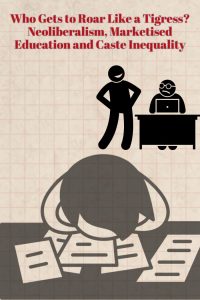
Who Gets to Roar Like a Tigress? Neoliberalism, Marketised Education and Caste Inequality

India has expanded education as a formal right while simultaneously allowing the conditions under which that right is exercised to become increasingly differentiated by market capacity. Because market capacity is structured by caste and class, the marketisation of education can undermine the equalising function that constitutional education rights were intended to serve.


Article 21A, inserted through the Constitution (Eighty-Sixth Amendment) Act, 2002, establishes free and compulsory education as a fundamental right for all children between six and fourteen years of age. The Right of Children to Free and Compulsory Education Act, 2009, provides the statutory framework for implementing this constitutional guarantee. This places an obligation on the government to ensure that free and compulsory education reaches children across the most disadvantaged sections of society.

However, there is an evident gap between what the Constitution proclaims education must be, namely, not a private commodity, and what is happening under a neoliberal economic structure. While the right to education is formally universal, as it should be, the quality and conditions under which that right is delivered remain deeply unequal, disproportionately affecting the most vulnerable sections of society, particularly students from SC/ST communities.

In India, there are broadly two types of institutional spaces that provide education and shape the kind of education, exposure, infrastructure, and social networks available to a child: private schools and public schools. Private schools operate through fees and market demand, with annual fees ranging from thousands to several lakhs of rupees, and reaching as high as ₹28–30 lakh in some elite schools. Their appeal is often associated not only with classroom teaching but also with advanced infrastructure, English-language education, extracurricular opportunities, technology, and claims of global exposure. Government schools, by contrast, depend substantially on public expenditure and government provision. A 2025 national survey indicates that average annual household expenditure per child in non-government schools was ₹25,002, compared with ₹2,863 in government schools, making household expenditure on non-government schooling nearly nine times higher.

The government budget for School Education and Literacy, as per the latest available Union Budget 2026–27, is ₹83,562 crore, of which around 70–80% goes towards salaries and administrative costs, leaving substantially less budget for infrastructure, school advancements, and labs. This substantially impacts the passing rate of students and the quality of education they receive.

When a private-educated student and a public-educated student enter a university, the field becomes unequal and highly disadvantageous for public-school students. It is within this unequal field that the neoliberal commodification of education becomes particularly important, as access to better educational opportunities increasingly depends on one’s ability to pay.

Neoliberalism places considerable emphasis on markets, competition, individual choice, and the withdrawal or restructuring of direct state provision. When applied to education, these principles can transform education from a predominantly public responsibility into a service increasingly mediated by market mechanisms. It drives the privatisation of government schools, turning education into a marketable commodity driven by competition, choice, and profit. This is what can be seen in the Indian education system.

Rather than increasing funding and upgrading public schools, the right-wing government has used policies to systematically transfer school ownership, management, or funding to private entities. This has resulted in the closure or merger of 94,000 government schools since 2014, as per a NITI Aayog report. That is 25 public schools per day. On the other hand, private unaided schools grew from 2.88 lakh to roughly 3.39 lakh.

This systematic institutional mobility of schools has resulted in two major shifts. First, the migration of public-school students towards private schools, numbering around 86 lakh. Second, those unable to transfer to or pay for private schools were denied their fundamental right to education.

Such consequences of this marketisation cannot be separated from India’s existing social structure. The ability to choose between schools is itself socially differentiated in India, as income, wealth, social capital, geography, and caste are already unequally distributed.

According to the UDISE+ (Unified District Information System for Education) school database system, around 68.7% of ST students and 62.4% of SC students rely on government schools. For them, public schools continue to function as a major educational lifeline.

A wealthy household facing declining public provision can respond by purchasing private education. A poor household may not have that option. The same policy therefore produces different consequences for different social groups. And therefore, when public education is weakened and monetised, the consequences are not distributed evenly across society, with SC and ST communities bearing a disproportionate share of the impediment.

Furthermore, the incumbent government has allocated just 4% of its GDP to education instead of the 6% recommended by NEP 2020. This gap in allocation, combined with the residual income gap among people, inadequate facilities, and caste domination in government schooling, provides a stark contrast between the constitutional right to formal educational inclusion and substantive equality in education.

In this class and caste divide, SC and ST students are among the most vulnerable. The inequality that begins with access to education continues into the opportunities available to students, eventually contributing to economic inequality. This creates a vicious circular system of unequal education.

unequal schooling → unequal educational attainment → unequal skills and credentials → unequal employment opportunities → reproduction of economic inequality.

Public schooling in India is not simply about education; it is also a political question. In India, neoliberal governance and right-wing politics are lovers, bound together in the making and remaking of the state’s approach to public education. Here, neoliberal restructuring can generate social and economic crises that produce grievances and uncertainty, which right-wing populism can then mobilise politically. In turn, right-wing populism can reinforce the same neoliberal restructuring by redirecting these grievances, generating doubt and distrust towards alternative political and economic narratives, and weakening challenges to the prevailing order.

The recent “School Thik Karo” movement by CJP provides a contemporary illustration of such a love story. The campaign involved visits to government schools, interaction with students, and demands for improvements in educational infrastructure and facilities. What government should fear a demand for better schools? However, rather than being understood simply as a demand for better schools, the campaign encountered political resistance, including restrictions on access to schools in Rajasthan and an FIR in Maharashtra.

This points to a broader tension: government schools are public institutions intended to deliver a constitutional right, yet demands for better infrastructure and greater accountability can become politically contentious. And once again, the consequences fall most heavily on those who have the fewest alternatives: SC and ST students.

Their inability to purchase education, or their household’s lack of the resources necessary to exercise that choice, is a systemic failure of neoliberalism. As neoliberal marketisation increasingly determines who can access quality education, the danger is that education itself, which is intended to enable social mobility, may instead reproduce the inequalities it was expected to overcome.

Dr. Babasaheb Ambedkar said, “Education is the milk of a tigress, and he who drinks it will not fail to roar.”

But what happens when that milk is filtered by income, caste, and market access? The milk is no longer the same for everyone. Some receive it diluted and adulterated, while others receive what allows them to roar. Who gets which kind of milk, and who decides?


Mrunal Madhuri Milind Dupte is a development economics researcher, anti-caste writer and public speaker working on inequality, Dalit and Buddhist economics.

Everything is an Opportunity

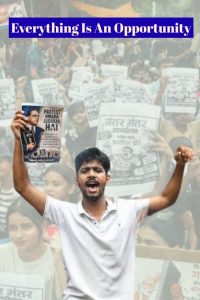
The protests against the irregularities and paper leak in the NEET examination brought thousands of students, parents and supporters onto the streets. The scale of participation, including the visible presence of sections of the middle classes, public figures and artists, reflected a growing willingness to challenge institutions that many increasingly perceive as opaque and unaccountable. That widening participation deserves recognition. It signals that concerns over public education are no longer confined to those who have historically borne the burden of institutional failures.

Yet the state’s response once again demonstrated a familiar pattern. Lathi charges, water cannons, tear gas, detentions, surveillance and criminal cases against protesters indicate that even peaceful demonstrations continue to be treated through the language of policing rather than democratic engagement, no matter how much the protesters try to facilitate dialogue. The violence of the state is not merely reactive to dissent; it is constitutive of its authority and often pre-emptive in its operation. By acting before grievances can acquire wider political legitimacy, it seeks to cast suspicion upon and diminish the credibility of citizens’ claims. Such responses are not isolated excesses but part of a broader tendency in which coercive measures take precedence over any meaningful assessment of public grievances. This pattern is all too familiar for the Muslims, Dalits, workers, and other oppressed communities in the country now. It is no wonder that many of them continue to remain skeptical of this movement even as they lend their solidarity.

The protests have also unfolded within a now routinised political script. Peaceful public mobilisation quickly became an opportunity for the mainstream Godi media to manufacture misinformation, while the state treated the moment as another justification for expanded policing. The original concerns were steadily displaced in newsrooms by manufactured debates over alleged anti-nationalism and public disorder, even as protesters have taken to social media to repeatedly redirect attention to the issues that first brought them to the streets.

Recognising this reality, however, also requires asking difficult questions of protest movements themselves. Large numbers are not only a measure of organisational success; they are also a political responsibility. Every mass mobilisation creates a temporary public capable of imagining new forms of solidarity and new political possibilities. Leadership therefore involves more than maintaining order or ensuring that a demonstration appears respectable. It also involves shaping how participants understand the broader structures within which their immediate grievance exists. But the organisers from CJP have recently shown a remarkable abdication of this responsibility, even as they may be doing so with sincere efforts to protect the movement.

Over the last decade, many protests have come to treat the expression of dissent as an end in itself. In a political climate where public assembly is increasingly surveilled and criminalised, simply occupying the streets and making disagreement visible has acquired democratic significance. That impulse should not be dismissed. But if protests are to aspire to more than bearing witness, they must also confront the difficult question of what political consequences their strategies are intended to produce. The NEET protests, however, did not appear content with symbolic dissent alone. The CJP seems to have approached the movement through a strategic lens, making choices that they believed would improve its chances of achieving concrete outcomes. That is a welcome departure.

The question is whether that strategic calculation expands or contracts the political horizon of the movement. The current strategy of CJP and other organisers does not merely reduce immediate risk; it also diminishes what that movement is capable of becoming. The logic of this strategy leads us towards an ever-receding political horizon, where each concession made in the name of prudence leaves less space for political imagination than the one before. This is where the limitations of a politics centred primarily on respectability become apparent. In the effort to appear reasonable, the strategic moderation may ultimately concede more ground than it preserves. The state does not necessarily refrain from coercion because a movement carefully disciplines itself. Recent history offers little evidence for such confidence.

Many of the choices made reflect a strategic calculation about what constituted acceptable dissent. Expressions of solidarity with incarcerated activists such as Umar Khalid and other Muslims facing prolonged imprisonment were rejected. Attempts to build common cause with other democratic movements such as farmers coming to Delhi on 22 July were resisted, with suggestions that different protests remain physically and politically separate. Participants were instructed on which slogans were permissible, even as some of the approved slogans drew upon nationalist idioms that have, over the last decade, become closely associated with Hindutva politics. The movement also declined to articulate a broader political critique of fascism and majoritarianism or the present government’s treatment of democratic dissent. This was not simply an omission of rhetoric; it marked a refusal to locate the immediate crisis within the wider political conditions that shape how public institutions function and how protests against them are received. Its demands also remained underdeveloped at the structural level. The crisis invited a broader interrogation of the National Testing Agency as an institution and of the direction of educational reforms under the National Education Policy by this government. Instead, the movement largely remained confined to the immediate failures surrounding the paper leak. Many of these suggestions have been made by leftist members of the movement who have been foregrounding these demands for years.

The movement’s current demands combine institutional accountability and immediate relief. They have called for the resignation or dismissal of Union Education Minister Dharmendra Pradhan, the immediate release of Sonam Wangchuk without restrictions on his movement, compensation of ₹1 crore for the families of NEET aspirants who died by suicide following the paper leak, and the withdrawal of all FIRs and legal action against those who participated in the July 20 protest. These are necessary demands, and each deserves to be pursued. But they cannot be mistaken for a sufficient response to the structural crisis of India’s education system. If these demands are achieved without an equally substantive agenda for what follows, the political leverage created by the protests risks dissipating before it can be translated into structural reform.

Equally troubling dynamics from the protest also must be interrogated. The willingness to hand over protesters deemed disruptive or excessively angry to the police without publicly articulating clear criteria for doing so is a decision that demands careful scrutiny. Any movement must protect participants from harassment and deliberate sabotage. But when those distinctions remain opaque, the police are effectively invited to regulate the boundaries of acceptable dissent within the protest itself. Expanding police discretion over who belongs and who does not, in a context of police violence, carries significant political consequences.

Similarly, symbolic gestures such as serving refreshments or showing kindness towards police personnel may reflect genuine human concern, and recognising the difficult conditions under which many lower-ranking officers work is neither unreasonable nor incompatible with criticism. Yet these gestures cannot obscure the structural reality that the police operate as instruments of state power and are institutionally equipped with resources and authority unavailable to ordinary citizens. Empathy for individual officers should not come at the cost of depoliticising the institution they serve.

None of this diminishes the importance of the NEET protests or the courage of those who participated in them, including the organisers, who transformed what began as a meme page into one of the country’s most significant student mobilisations in the recent past. On the contrary, their significance lies precisely in the possibility they opened. The question is whether that possibility ends with registering public anger or extends towards building broader democratic solidarities capable of confronting the structures that repeatedly produce such crises. Every protest is liable to become an opportunity for the police to exercise violence, for Godi media to manufacture misinformation, and for the government to expand its coercive powers. These are calculations movements cannot control. What they can control is whether their own strategies continually retreat before them, or instead expand the political imagination of those who have come together in hope.

Why Maharashtra Withdrew Its Temple Land Bill

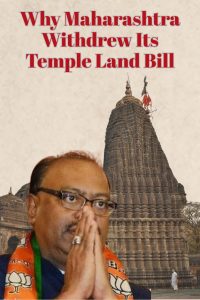
By the time Maharashtra’s Revenue Minister Chandrashekhar Bawankule announced that the government was withdrawing the draft Maharashtra Devasthan Inam Abolition Act, 2026, the proposed legislation had spent barely a month in the public domain. Published on May 6 for comments and objections, it was presented as an attempt to address one of the state’s longest-running land disputes: nearly 5.5 lakh hectares of Devasthan Inam land, much of it under encroachment or contested occupation, and temple trusts that had struggled to recover property endowed over centuries. Within weeks, however, the government abandoned the draft and promised to begin again.

The reversal followed sustained opposition from temple trusts and organisations including the Maharashtra Mandir Mahasangh, the Vishwa Hindu Parishad and the Hindu Janajagruti Samiti. More than a thousand trustees reportedly joined the campaign, hundreds of representations were submitted to ministers and district officials, and delegations met Chief Minister Devendra Fadnavis, Deputy Chief Minister Eknath Shinde and other senior members of the government.

When the withdrawal was announced, temple organisations described it as the outcome of a collective struggle. The government, for its part, insisted that it was merely responding to concerns raised during the consultation process and that a fresh draft would be prepared after wider discussions.

According to the Revenue Department, the proposed law sought to create a statutory mechanism for recovering temple lands from illegal encroachments while protecting the rights of lawful occupants. Officials argued that temple trusts often lacked the administrative and legal capacity to reclaim endowed properties and that the state could provide a more effective framework. Bawankule repeatedly said that the proposal had been conceived on lines comparable to the legal framework governing Waqf properties, allowing the government to assist in protecting religious endowments rather than leaving trusts to pursue long and expensive litigation on their own.

Temple organisations read the draft very differently. The Maharashtra Mandir Mahasangh argued that provisions of the Bill would effectively abolish historical Devasthan Inam grants made by earlier rulers and weaken rather than strengthen temple ownership. It objected to clauses that it said recognised ownership claims of some long-term occupants, questioned restrictions on approaching civil courts, and criticised what it described as differential treatment between temple lands and Waqf properties.

Whether those objections reflected the actual legal consequences of the draft or apprehensions about how the law might eventually operate is a wholly different matter. The Hindu fold today perceives itself to be victimised in public discourse despite having been in power at the Centre for the last twelve years and mobilises moralised protest tactics that are often rooted in narratives of self-victimisation. Whatever the merits of those objections, they were enough to stop the Bill before it reached the Assembly.

The government never argued that temple lands should change hands. On the contrary, ministers repeatedly said the purpose of the Bill was to help temple trusts recover lands that had slipped into encroachment and to give those properties stronger legal protection. The resistance came from temple organisations that feared the proposed law would give the state greater control over how disputes were settled and how rights over Devasthan land would eventually be determined. Their objections were directed less at the objective than at the mechanism through which the government proposed to achieve it.

For all the talk of ideological unity, governing and movement politics do not always pull in the same direction. The Devasthan Bill became one of those moments when the seams briefly showed. Electoral alliances often make those differences easy to miss. Yet land has always been a source of authority as much as a form of property. Questions of who records land and who settles disputes have a way of exposing those tensions.

The BJP has spent much of the past decade presenting itself as the party of a strong, interventionist state. Governing through legislation inevitably extends the state’s reach into institutions that have long operated through inherited arrangements and local authority. Temple trusts may welcome stronger protection for their lands, but greater state involvement also means surrendering some control over how disputes are settled and property is administered. That is where governments and religious institutions can begin pulling in different directions. The fault lines are not entirely new. They surfaced publicly during the online battles between the so-called “raitas” and “trads” during the Bulli Bai app case, and the Devasthan Bill suggests that those disagreements extend well beyond social media into much wider political constituencies.

It is striking that the government defended the draft by invoking the legal framework surrounding Waqf properties. The comparison was meant to reassure temple trusts that similar protections could be extended to temple lands. Yet the politics around Waqf have unfolded very differently in recent years. Legislative changes affecting Muslim institutions have largely proceeded despite sustained objections from Muslim organisations. In Maharashtra, by contrast, the government withdrew its own proposal before it reached the legislature, reopened consultations and gave temple representatives a central role in rewriting the Bill.

Temple organisations opposed the draft before it entered the legislature, secured meetings with senior ministers, compelled the government to withdraw its own proposal and now have formal representation on the committee tasked with preparing a revised Bill. The committee, headed by Additional Chief Secretary Vikas Kharge, includes fifteen representatives from temple trusts alongside senior officials from the Revenue Department.

Governments routinely ask farmers’ organisations, workers’ unions, unemployed youth and communities affected by displacement to wait for departmental reviews or expert committees. Families pursuing justice after caste-based violence often confront years of administrative delay and prolonged litigation before receiving meaningful responses. Many Muslim organisations have found themselves responding to legislative changes only after they have already been enacted and have then faced criminalisation for protesting. Temple organisations, by contrast, intervened while the law was still being drafted and altered its course before it reached the legislature.

The debate has also left largely unexplored the people living on Devasthan Inam land. Public discussion has centred on temples, trusts and encroachments, while remarkably little attention has been paid to the social composition of those occupying or cultivating these lands. The category of “encroacher” can include very different histories: long-term agricultural tenancy, informal occupation, disputed ownership, commercial acquisition and settlement by landless households over several generations.

The Devasthan Bill was withdrawn after organisations within the broader Hindutva fold challenged a government that is often assumed to speak for them. The next draft of the Bill will answer some legal questions. It may also answer a political one: how much room the state still has to regulate institutions that are among its closest ideological allies.


DalitThinkerToday is an Chartered Accountant by profession from Sangli, Maharashtra who occasionally dabbles in thinking about politics when people in her oppressor caste majority office frustrate her. This is her pseudonym.