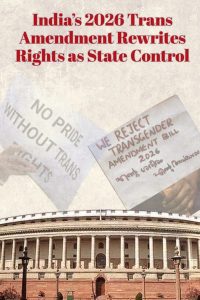
On March 25, 2026, the Rajya Sabha cleared the Transgender Persons (Protection of Rights) Amendment Bill, 2026, completing its swift passage through Parliament a day after it had been pushed through the Lok Sabha by voice vote amid an Opposition walkout. Introduced by Virendra Kumar and framed as a technical correction to an existing law, the legislation has in effect been rushed into force with extraordinary haste, amounting not merely to a statutory revision but to a profound and troubling reordering of how the Indian state understands gender, identity, and the limits of personal autonomy: a process that, in both its substance and its passage, underscores the travesty at the heart of this exercise.
To understand the scale of this shift, it is necessary to return to the constitutional baseline established in National Legal Services Authority v. Union of India. That judgment recognised gender identity as intrinsic to personhood and held that self-identification was not merely permissible but fundamental. It explicitly rejected any requirement that transgender persons undergo medical procedures in order to be legally recognised. The Transgender Persons (Protection of Rights) Act, 2019, imperfect as its scope and implementation have been, attempted to incorporate this principle by recognising self-perceived gender identity and providing a route to legal recognition without mandatory medicalisation.
The 2026 amendment dismantles that framework at every level. It does not merely adjust procedures. It replaces the underlying philosophy of the law. Where the earlier regime was premised, at least formally, on autonomy and self-identification, the new one is built on verification, restriction, and suspicion.
The most immediate transformation lies in the definition of who counts as a transgender person. The 2019 Act adopted a broad and inclusive definition. It explicitly included trans men, trans women irrespective of surgical status, genderqueer persons, and persons with intersex variations, alongside socio-cultural identities such as hijra, kinner, aravani, and jogti. The amendment replaces this with a sharply narrowed category. Recognition is now effectively limited to those who can be placed within specific socio-cultural identities (even as some identities such as nupi manbi, nupa manba, thirunangai, thirunambi, thirunar, khwaja sira, kothi, jenana, dhurani, etc. remain excluded) or those who can be medically classified under intersex variations, thereby strengthening models of cultural identity and pathologisation, both of which queer and trans activists have tirelessly fought against becoming dominant scripts. Trans men, many trans women, and non-binary or genderqueer persons disappear from the statutory language. This is not an omission that can be read down or interpreted away. It is an act of legislative exclusion.
This narrowing is reinforced by an explicit rejection of self-perceived identity as a basis for rights. The amendment deletes Section 4(2) of the 2019 Act, the provision that guaranteed the right to self-identified gender. In its place, the law constructs a system where identity must be externally validated. The shift is conceptual as much as legal. Gender is no longer treated as something one knows about oneself. It becomes something the state must confirm.
This transformation is institutionalised through the introduction of a medical “authority”. The amendment inserts a new definition that creates a medical board, headed by a Chief Medical Officer or equivalent, as a central actor in the recognition process. There was no such requirement in the 2019 Act. The Supreme Court in NALSA had explicitly rejected the idea that medical evaluation could be made a condition for recognition. The amendment not only introduces such a requirement but places it at the heart of the system.
The process that follows from this is deliberately layered and restrictive. To obtain a certificate of identity, an individual must first navigate medical certification, then approach the District Magistrate, who retains the discretion to seek further expert opinion. The structure distributes decision-making power across multiple institutions, each of which can act as a gatekeeper. The earlier framework, which at least formally relied on self-declaration, is replaced by a multi-stage system that is bureaucratic, discretionary, and exclusionary.
This is not merely a procedural inconvenience. It is a stark reconfiguration of power. Identity recognition is no longer an act of self-assertion but a negotiated outcome within state institutions. Access to recognition becomes contingent on the ability to navigate medical systems, administrative offices, and discretionary authority, without much room for autonomous choices. In a country where access to public healthcare is uneven and often inaccessible, this introduces class and geography as decisive factors in determining who can be legally recognised.
The amendment deepens this shift through changes to Section 7, now part of the new Section 5, which governs change of gender. What was previously optional is now mandatory. Any person who undergoes gender-affirming surgery must apply for a revised certificate. Medical institutions are required to report such procedures to the District Magistrate and the medical authority. At the same time, the law removes the earlier provision that protected the continuity of a person’s rights after such a change. The combination of mandatory reporting and removal of rights protection creates a regime where deeply personal medical decisions are subjected to state visibility while legal certainty is diminished.
The implications for privacy are immediate and profound. The reporting requirement effectively creates a database of gender-affirming procedures accessible to administrative authorities. This sits uneasily with the right to privacy recognised in K. S. Puttaswamy v. Union of India, which affirmed informational privacy and bodily autonomy as core constitutional values. The amendment does not attempt to reconcile this tension. It proceeds as if such concerns do not arise or exist.
This constitutional rupture is not merely a matter of activist critique; it has also been formally recognised within the judicial ecosystem. A Supreme Court-appointed Advisory Committee, led by former Delhi High Court judge Justice Asha Menon, has urged the Union government to withdraw the Transgender Persons (Protection of Rights) Amendment Bill, 2026, on the grounds that it undermines the principles laid down in the NALSA judgment, particularly the right to self-identify one’s gender. In its communication to Social Justice Minister Virendra Kumar, the panel flagged the removal of self-identification, the redefinition of “transgender person,” and the introduction of mandatory medical certification as measures that could reverse the limited progress made in integrating transgender persons into legal and social frameworks. It also raised concerns about privacy violations arising from provisions that require medical institutions to report gender-affirming procedures to state authorities, and noted that several of the Bill’s new criminal provisions overlap with existing laws such as the Bharatiya Nyaya Sanhita and the Juvenile Justice Act, 2015, without establishing a clear legislative necessity. The Committee has recommended that the Bill be withdrawn and subjected to wider stakeholder consultation before any further action.
Equally significant is the way the amendment restructures criminal law. The 2019 Act criminalised discrimination and violence against transgender persons but prescribed relatively low penalties. The amendment retains these provisions without strengthening them. At the same time, it introduces a new set of offences centred on the idea of “forced transgender identity”. These include kidnapping, abduction, and bodily harm with the intent to compel a person to assume or present a transgender identity, with punishments ranging from several years to life imprisonment.
On its face, this appears to address serious harms. In substance, it is built on a deeply problematic premise. It constructs transgender identity as something that can be imposed through coercion. It embeds within the law the suspicion that gender variance is not self-generated but externally induced, going back to suspicion of trans communities based in colonial governance. Neither are these speculations supported by available crime data. Existing offences such as kidnapping and trafficking are already comprehensively covered under the Bharatiya Nyaya Sanhita, so the amendment does not fill a clear legal gap. It only creates a new category that aligns with longstanding stereotypes about transgender communities, while adding more criminalisation in the law.
The consequences of this framing extend beyond criminal law. By centering coercion, the amendment places community structures under suspicion. Traditional kinship systems such as hijra households, as well as informal support networks and shelters, become vulnerable to being recast as sites of coercion. In a context where many transgender persons rely on such networks after being rejected by their families and without substantive protection of welfare, the law risks dismantling the very systems that sustain them.
Another critical dimension of the amendment is its treatment of intersex persons. The 2019 Act defined intersex variations separately. The amendment removes that definition and subsumes intersex persons within the definition of “transgender person”. This conflation collapses two distinct categories. Intersex variations relate to biological sex characteristics, while transgender identity concerns gender identity. By merging them, the law obscures the specific needs and rights of intersex persons, while simultaneously using biological variation as a basis to restrict transgender recognition. The result is conceptual confusion with material consequences.
All of these changes are not incidental. They are explicitly justified in the Statement of Objects and Reasons accompanying the Bill. That document lays out the government’s position with clarity. It states that the law is intended to protect only those who face severe social exclusion due to biological reasons beyond their control. It rejects the idea that rights should extend to all forms of gender identity, particularly those based on self-perception. It argues that the earlier definition was too broad and made it difficult to identify “genuine” beneficiaries. It insists that legal status cannot be based on characteristics that are “acquirable” or rooted in personal choice. The cis-sexual law introduces external gatekeeping of trans communities, which it neither has any business interfering in nor has the adequate understanding of.
This is the ideological core of the amendment. It replaces a framework based on autonomy with one based on eligibility. It introduces a hierarchy in which only those whose identities can be framed as biologically determined and involuntary are considered deserving of protection. It treats self-identification not as a right but as a problem to be managed. Precision, in this framework, is achieved through exclusion.
The Statement also attempts to justify the new penal provisions by asserting the existence of practices involving abduction, bodily harm, and forced gender transition. It claims that existing laws do not adequately address these harms in combination. Yet it does not provide empirical evidence demonstrating a gap that necessitates new offences. The effect is to legitimise a narrative that casts transgender identity as suspect, while expanding the reach of criminal law into community spaces.
The amendment includes a few procedural changes that appear positive on the surface, such as allowing name changes in official documents and adjusting the composition of the National Council for Transgender Persons. These are marginal improvements that operate within a framework that has already been fundamentally restricted. Access to these benefits is contingent on passing through the newly tightened certification process. They do not alter the underlying shift toward control.
The political response reflected broad-based opposition across the parliamentary spectrum. Parties including the Indian National Congress, the Dravida Munnetra Kazhagam, the Nationalist Congress Party (Sharad Pawar faction), the Samajwadi Party, the Trinamool Congress, Shiv Sena (UBT), the Vanchit Bahujan Aghadi, and Left formations such as the Communist Party of India (Marxist) opposed the Bill, collectively characterising it as regressive, violative of constitutional guarantees, and enacted without meaningful consultation. In contrast, the ruling Bharatiya Janata Party secured the support of key allies, including the Telugu Desam Party (TDP) and the Janata Dal (United), enabling the Bill’s smooth passage through Parliament.
These objections converge on a common understanding. The Bill does not simply fail to advance rights. It actively restructures them in a way that privileges state control over individual autonomy. It does not strengthen protections against violence. It expands mechanisms of surveillance and verification. It does not recognise the diversity of transgender experiences. It narrows them into administratively convenient categories.
What emerges, taken together, is a legal regime that transforms identity into a site of governance. This is why the amendment cannot be understood as a technical reform and must be opposed in toto. It is a redefinition of the relationship between the individual and the state. It signals a move away from the idea that rights attach to persons by virtue of their humanity, and toward the idea that rights are granted to those who can be classified, verified, and controlled.
The consequences of such a shift are not abstract. They will be felt in who is recognised and who is erased, in who can access documents and who is denied, in who can seek care without fear and who is exposed to scrutiny, which communities survive and which are dismantled. Legislative mandates already draw lines that are arbitrary and violent. This amendment redraws further in that direction, in ways that shrink the space for autonomy and expand the reach of the state toward a model of gender that is premised on cultural identity and pathology, sites that have been used to maim queer and trans lives across history.
At stake is not only the future of a single statute. It is the question of whether the principle established in NALSA, that identity is intrinsic and self-determined, will continue to shape our lives, or whether it will be replaced by a framework in which identity must be proven, approved, and constantly subject to review.
This is a line that cannot be crossed. A law that takes away the right of trans people to define themselves, that puts their identities under state control, is not reform, it is erasure. Trans lives are not conditional.
Paresh Hate is a Bahujan queer researcher, writer, documenter and activist and the Lead Content Manager at Dalit Voice.