
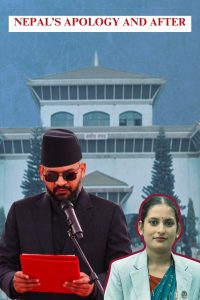
Nepal’s new government has done something no previous government was willing to do. In March 2026, it issued a formal apology to Dalits, acknowledging centuries of caste discrimination and exclusion. Soon after, Sita Badi became the first Dalit woman to hold a full cabinet position at the federal level, taking charge of the Ministry of Women, Children and Senior Citizens.
For a country where caste oppression has long been treated as a social problem rather than a political one, these developments carry weight. The Nepali state has publicly acknowledged that caste inequality was not simply a matter of social prejudice but a system sustained through institutions, laws and political power.
The apology, delivered in Parliament by Rabi Lamichhane, promised that no Nepali would again have to bow before caste hierarchy. Yet questions emerged almost immediately. The statement was expected to come from the President or Prime Minister as a formal act of the state. Instead, it came through the chairperson of the ruling party speaking on behalf of the government.
Dalit organisations have responded by focusing less on the language of recognition than on the machinery of reform. The Feminist Dalit Organisation (FEDO) has called for inclusive budgeting, stronger protections against violence, economic empowerment programmes, citizenship rights and greater participation in decision-making. It has also pushed for legislation to implement Article 40 of Nepal’s Constitution and for long-promised commitments on proportional representation. These demands are not new. Neither are most of the constitutional provisions involved.
The Nepali state did not discover caste discrimination in 2026. Dalit organisations, activists and movements have spent decades documenting exclusion, violence and underrepresentation. Constitutional guarantees already exist. National commissions already exist. Yet proportional representation remains incomplete, Article 40 remains only partially implemented, and Dalit organisations continue to press for reforms that have been discussed for years.
The government announced a 100-point reform agenda and promised key initiatives within 15 days. More than 55 days after the formation of the new Parliament, little progress had been made on many of those commitments.
Constitutional provisions can remain unimplemented for years even when legislatures are functioning. The deeper issue is political will. Successive governments have been willing to acknowledge caste discrimination, establish commissions and make commitments. They have been far less willing to spend political capital on reforms that would alter representation, budgeting priorities and institutional accountability.
Since the current parliamentary session began in May, lawmakers have spent weeks locked in disputes over Prime Minister Balendra Shah’s conduct, parliamentary procedure, dress codes, attendance and political remarks. Opposition parties have staged protests, boycotts and obstruction. Debates over the government’s policy programme and budget priorities have repeatedly been pushed aside. None of these disputes concern the constitutional reforms Dalit organisations continue to demand.
Nepal’s political class has found the language to acknowledge historical caste injustice while leaving many of the reforms demanded by Dalit organisations unresolved. Sita Badi’s appointment sits within the same political landscape. Her rise from the historically oppressed Badi community to the federal cabinet would have been difficult to imagine only a generation ago. For Dalit women in particular, her appointment breaks through a barrier that Nepal’s political establishment left standing for decades.
Civil society groups are now working with the National Dalit Commission to prepare a broader position paper on social justice, restoration and historical reconciliation. Nepal’s apology has opened a political opportunity. Dalit organisations have treated it as such. They have responded not with celebration alone but with demands, proposals and constitutional claims.
Paresh Hate is a Bahujan queer researcher, writer, documenter and activist and the Lead Content Manager at Dalit Voice.