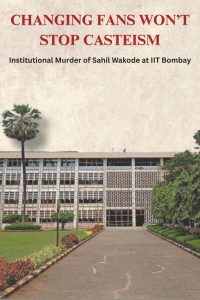
Changing Fans Won’t Stop Casteism: Institutional Murder of Sahil Wakode at IIT Bombay

There is a persistent, naive belief in India that premier engineering institutes are pristine spaces of pure meritocracy, immune to the social hierarchies of the world outside. The institutional murder of 22-year-old Sahil Ravindra Wakode at IIT Bombay violently shatters this myth. Sahil, a first-generation student from Yavatmal, entered IIT carrying the monumental hopes of his parents, who had endured lifelong socioeconomic deprivation. Academically stellar, with a category rank of 614 in JEE Advanced and an 8.5 CGPA in his first year, he was exactly the kind of brilliant mind these institutions claim to nurture. Yet, upon stepping into this elite campus, he encountered an environment engineered not for his intellectual growth but for his profound psychological alienation.


A Predictable Structural Output

What transpired on September 18, 2026, was not an isolated tragedy or an individual anomaly. It was the predictable output of a structurally casteist institution.

Data shared by IIT Bombay sociologist Prof. Suryakant Waghmore reveals a grim reality: between 2019 and 2023, of the students who dropped out of IITs, 56% were from the General Category, 25% OBC, 13% SC, and 5% ST. These disproportionate figures are the direct consequence of systematic, daily caste-based hostility. The mechanism of this exclusion is well-documented: marginalized students, often first-generation learners from rural or non-English medium backgrounds, are thrust into a hyper-competitive campus culture dominated by upper-caste privilege. A recent interim report by the National Task Force (NTF) explicitly noted that students from disadvantaged communities face severe isolation because they are routinely excluded from the dominant campus culture, failing arbitrary social “vibe checks” set by privileged peers. Ground reports reveal that Dalit and Adivasi students are frequently stigmatized as “reservation candidates,” alienated from informal peer study groups and subjected to constant indirect pressure and microaggressions from unsensitized faculty.

When academic struggles arise, this pre-existing environment of social boycott and lack of institutional mentorship compounds their stress into profound psychological trauma, ultimately forcing them to drop out simply to survive.

During a mid-term examination, Sahil was caught using his mobile phone to search for answers on ChatGPT. Under extreme academic stress, this is a disciplinary infraction that warrants standard administrative recourse. Instead, the invigilator, Prof. Suryanarayan Doolla, allegedly bypassed procedural norms, subjecting Sahil to profound public humiliation and threats of immediate expulsion. This hostility was not a sudden outburst. For three months prior, Sahil’s father alleged that Prof. Doolla had constantly taunted and humiliated Sahil over his caste.

This tragic pattern echoes the institutional deaths of Darshan Solanki (2023) and Aniket Ambhore (2014), where internal mechanisms ultimately operated to shield the administration, and there is little reason yet to expect a different outcome this time.  In Solanki’s case, the 12-member internal committee headed by Prof. Nand Kishore shamelessly blamed his death on ‘poor academic performance’ and ‘aloofness,’ deliberately ignoring multiple testimonies and prior SC/ST Cell surveys that documented severe caste-based alienation on campus. Similarly, after Aniket Ambhore fell to his death, the A.K. Suresh Committee report recorded that professors had humiliated him for being a ‘category student’ and suggested he belonged in a ‘normal’ engineering college. Rather than penalizing the offending faculty, the institutional response minimized this overt casteist violence as mere ‘academic pressure,’ protecting the institution’s reputation at the direct expense of truth and accountability.


Administrative Deflection: Individualizing the Systemic

The administration’s immediate reflex was to criminalize Sahil, reducing a systemic failure to a singular moment of student misconduct. Within hours of his death, IIT Bombay hastily issued a statement explicitly accusing him of copying via AI, feeding a convenient “cheating” narrative to the media. When student outrage erupted over this blatant lack of empathy, the administration deleted the statement, only to issue an apology days later on X (formerly Twitter) which admitted it was ‘inappropriate’ to characterize details before investigations concluded, stripped of any meaningful accountability.

CCTV footage from the exam hall and hostel lobby entered the public record as part of the investigation. A source described the footage: between 12:30 and 12:45 PM, just minutes before the exam was to end at 1 pm, Sahil was seen bending and checking something in his pocket, after which Prof. Doolla was seen questioning him and taking him aside, away from other students. The same source said Wakode was then seen leaving the hall and, by around 1:25 pm, entering his hostel room, after which he did not leave again before he was found dead.

This timeline, once public, kept the story anchored to the exam-hall infraction: a student caught peeping at his phone, confronted by his invigilator, entering his room forty minutes later. What it does not show, and cannot show, is the three months of alleged caste-based taunting that preceded it. By foregrounding a visual record of the “cheating” moment while offering no equivalent documentation of the harassment the family alleges, the timeline reinforces the same individualizing frame as the administration’s original statement: it locates the cause of Sahil’s death in a single infraction rather than in a pattern of institutional hostility building for months.


The Crisis of Representation and Profound Isolation

The root cause of this unchecked harassment is the glaring absence of marginalized communities in positions of academic power. Out of 6,000 professors across IITs in the country, only 149 belong to Scheduled Castes (SC) and 21 to Scheduled Tribes (ST). This meager 2.8 percent vividly illustrates a reality of academic apartheid. Representation is an active structural antidote to institutional violence. When campuses lack Dalit, Adivasi, and Bahujan faculty, marginalized students are cut off from organic mentors who can decode their unique sociological realities and intervene before distress turns fatal. Without such allies in academic and administrative bodies, grievances of casteism inevitably hit a brick wall of apathy erected by an overwhelmingly upper-caste establishment, one that routinely lacks the sociological vocabulary to perceive caste violence, dismissing it as ‘individual merit failure.’ True representation breaks this cycle because faculty from oppressed backgrounds possess the institutional legitimacy to challenge biased disciplinary actions and dismantle the discriminatory peer dynamics and psychological isolation that force first-generation learners to internalize their trauma.

The systemic closing of ranks to protect upper-caste faculty is horrifying. Following protests by nearly 6,000 students, IIT Bombay merely removed Prof. Doolla from his post as Dean of Administrative Affairs, flatly refusing to suspend him from his active professorship. This distinction is a deeply sinister protection racket. By retaining his teaching, research, and departmental evaluation roles, the administration ensures that an individual accused of severe caste-based intimidation continues to wield life-and-death academic power over students in the very classrooms where these abuses occur. It signals to the campus that an accused upper-caste professor can be temporarily shuffled out of the public eye to defuse protests, while his systemic authority to grade, pass, or fail vulnerable students remains completely untouched. This ongoing structural proximity to power leaves marginalized learners utterly defenseless, trapped under the authority of the very educator accused of driving their peers to the edge.

In response to the criminal FIR filed under the SC/ST (Prevention of Atrocities) Act against Prof. Doolla, the ‘IIT Bombay Faculty Forum’ and the ‘IIT Delhi Faculty Forum’ rushed to issue coordinated defensive statements, framing Doolla as an educator ‘discharging his academic duties’ against a student accused of ‘academic malpractice.’ The IIT Delhi Faculty Forum audaciously condemned the massive student-led demonstrations, warning against what it termed ‘mob-driven behaviour’ that supposedly pressured the administration into taking action. This rhetorical framing is a cynical, institutional inversion of reality: it pathologizes student solidarity and legitimate political outrage as a ‘mob,’ criminalizing accountability while shielding an upper-caste professor from legal scrutiny. This collective closing of ranks exposes an ugly, protective arrogance: the system will ruthlessly safeguard its own elite status and shield its perpetrators at the direct expense of marginalized student lives.


Performative Gestures vs. Structural Remedies

Despite four students losing their lives under the tenure of the current Director, Prof. Shirish Kedare, the administration’s most heavily publicized “solution” to this crisis was a cynical architectural modification: removing ceiling fans from hostel rooms and installing wall-mounted ones. This administrative reflex lays bare a profound moral bankruptcy and an evasion of institutional responsibility. This shows a lack of comprehensive and considerate thinking toward student welfare. In the presence case, too, modifying ceiling fans treats only the final, terminal physical symptom of unbearable psychological distress, while leaving the actual, rotting disease, institutional casteism and unchecked faculty harassment, entirely untouched. This intervention operates on a perverse and absurd logic: it assumes that removing a mechanism of self-harm eliminates the profound despair that causes it, ignoring the toxic, hostile environment engineered by upper-caste hegemony that drives these brilliant minds to the edge. It is a hollow, paternalistic cosmetic fix designed solely to insulate the administration from legal liability and public outrage, substituting genuine, structural accountability with superficial tinkering that treats human lives as mere logistical inconveniences.

Nationwide, a staggering 171 students have committed suicide in IITs over the last 20 years. Altering the method of death while leaving the toxic environment intact is an insult to the lives lost. Real remedy cannot be found in performative, procedural gestures. The solutions must be structural and uncompromising:

Mandatory Anti-Caste Sensitization: Professors and administrators must undergo rigorous, mandatory anti-caste education to dismantle centuries-old biases, moving far beyond superficial paper compliance. This demand is a direct corrective necessitated by Prof. Doolla’s alleged conduct and the elite institutional immunity that protected him. Had rigorous anti-caste training been mandatory, the months of alleged casteist taunts, public humiliation in the exam hall, and the subsequent closing of ranks by faculty forums would have been treated as structural crimes rather than routine disciplinary exercises. Sensitization must dismantle the upper-caste impunity that allows figures in power to weaponize academic rules against marginalized students without administrative consequence.

Independent Investigations & Accountability: Internal inquiries are historically biased. Investigations into student deaths and allegations of caste discrimination must involve independent committees with external democratic representatives to ensure transparency, able to investigate faculty conduct and administrative attempts to shield those accused of misconduct. Their findings must lead to clear institutional action rather than being buried in internal procedures. No faculty body or administrative office should be allowed to investigate itself when students’ lives and allegations of caste discrimination are at stake.

Robust Mental Health Infrastructure: The emotional bankruptcy of these institutions must end. As demanded by the protesting students, there must be an independent audit of the Student Wellness Centre, the appointment of at least one counselor per hostel (or per 250 students), and 24/7 availability of trained psychiatrists equipped to understand the sociological realities of caste trauma. Students must be able to seek help without being treated as the problem or fearing consequences within the institution. Mental health support must recognise caste humiliation and discrimination as sources of distress rather than reducing every crisis to academic pressure.

True Representation: Aggressive and inclusive faculty recruitment policies must be enforced to bridge the 2.8% representation gap, bringing Dalit, Adivasi, and Bahujan voices into positions of academic authority. This cannot mean a few token appointments while decision-making remains dominated by the same social groups. Reserved positions must be filled and representation must extend to committees and positions with real institutional authority. Students should not have to navigate institutions where almost no one in a position of power shares or understands their social experience.

Until this arrogant system of so-called ‘merit’ acknowledges that its campuses function as exclusionary spaces for the marginalized, institutions like IIT Bombay will continue to fail their students. Accountability must be demanded, and the structural roots of casteism must be dismantled, so that no more students are driven to the edge by the very institutions meant to educate them.


Mujammil Shahin Siraj Shaikh is a Pune-based independent researcher and prospective PhD scholar examining structural inequality, public policy, and institutional power in modern India.
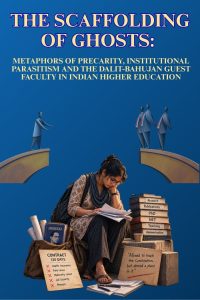
The Scaffolding of Ghosts: Metaphors of Precarity, Institutional Parasitism and the Dalit-Bahujan Guest Faculty in Indian Higher Education

“They take our sweat to cement the arches of their intellectual temples, but reserve the sanctuary for their own kin. We are allowed into the university only as day-laborers of the mind, expected to clean the dust of their theories and vanish before the sun sets.”

— Notes from an Unappointed Ad-Hoc Scholar


I. Introduction: The Ivory Plantation and the Underground Specters

The modern Indian university is not an agora of enlightenment; it is a meticulously landscaped plantation whose ivory towers are held upright by bamboo scaffolding made of invisible hands. If you walk through the marble corridors of Delhi University, the red-brick courtyards of Hyderabad, or the ancient stone arcades of state universities in Uttar Pradesh and Maharashtra, you will breathe an air thick with the incense of academic grandiosity. High-table seminars deliberate on post-colonial subalternity, international journals publish lavish treatises on “decolonizing the mind,” and vice-chancellors deliver pious speeches on national progress. Yet, step beneath the floorboards of this grand theater, into the subterranean basements where tutorial sheets are evaluated and attendance registers are marked, and you will encounter an army of specters. They are the Guest Faculty, the Ad-Hoc Scholars, the Temporary Lecturers—disproportionately hailing from Dalit, Bahujan, and Adivasi communities—who inhabit the university not as citizens of letters, but as unacknowledged day-laborers of the intellect.

To understand the crisis of the Dalit-Bahujan guest lecturer is to understand a sophisticated, modernized form of institutional untouchability. It is a system that does not banish the untouchable body from the temple of learning, but rather admits it on the condition that it remains eternally temporary, economically broken, and structurally voiceless. The old caste order barred the Shudra and Ati-Shudra from listening to the Vedas by pouring molten lead into their ears; the modern neoliberal-feudal university permits them to teach the Vedas, the Constitution, and Quantum Mechanics, but ensures that their monthly stipend of a few thousand rupees arrives six months late, without healthcare, without maternity leave, and with the permanent threat of instant dismissal at the end of every 120-day contract cycle.


IIA. The Reservation Bypass: How Public Universities Invented the “Academic Coolie”

For seven decades, the Indian Constitution guaranteed that public universities—the primary engines of social mobility for marginalized communities—would reflect the demographic reality of the nation through affirmative action (Reservation). However, the Savarna oligarchy that controls the levers of academic administration executed a masterstroke of systemic evasion. Rather than directly opposing reservations—which would invite constitutional penalties and street protest—they rendered the permanent faculty position an endangered species. By deliberately freezing regular recruitment for decades, university administrations created an artificial vacuum, which they then filled with temporary, contract, and guest faculty.

Consider the brutal arithmetic of this institutional fraud. When a university advertises a permanent Assistant Professor position, it is legally bound to apply the constitutional quota (15% SC, 7.5% ST, 27% OBC, alongside EWS). But when the university hires a “Guest Lecturer” or “Ad-hoc Teacher” to take the exact same classes, grade the exact same papers, and invigilate the exact same examinations, the reservation roster is blithely discarded under the legal pretext that guest teaching is “hourly engagement” or “contingent work.”


IIB. The Reservation Bypass: Institutional Anomie: Higher Education Disparity Data

  • 33%+ Sanctioned Faculty Vacancies Left unfilled across Central and State universities.
  • 50% Undergraduate Teaching Load Executed by guest, ad-hoc, and contract labor.
  • 4.2% SC/ST Full Professors Representation in premier institutions.

This is the Reservation Bypass Architecture. By shifting the bulk of teaching workloads onto unreserved, arbitrarily appointed guest arrangements, university syndicates have successfully preserved permanent professorships as exclusive fiefdoms of elite caste networks. The Dalit-Bahujan scholar who spent a decade earning a PhD from a premier central institution, publishing peer-reviewed papers, and passing the National Eligibility Test (NET), arrives at the university gates expecting the fulfillment of constitutional promises. Instead, they are directed to the guest room—a cramped closet under the stairs—and handed an hourly wage contract that pays less than the daily minimum wage of an industrial supervisor.


III. The Metaphor of the Academic Plantation: The Sugar Mill of the Mind

To capture the existential dread of the guest faculty, one must discard the sterile vocabulary of human resource management and turn to the literature of plantation economies. The guest scholar is the cane-cutter of the academic sugar mill. Every morning, they arrive at the campus with bundles of intellect harvested from nights of lamp-lit reading, only to feed them into the administrative crusher. The sweetness—the tuition fees paid by students, the accreditation scores (NAAC) awarded to the college, the university’s ranking metrics—is extracted by the administration to polish the institution’s facade. The leftover bagasse—the exhausted, underpaid, un-benefited human being—is swept out at the end of the term.

There is a cruel satire in how elite institutions market their commitment to social justice. A college will organize a national seminar on “Ambedkarite Hermeneutics” or “Post-Colonial Subalternity,” funded by public grants. The keynote speaker, a tenured professor enjoying a six-figure salary, housing allowances, and sabbatical privileges, will deliver an impassioned address on the plight of the marginalized. Meanwhile, the microphone is adjusted, the water glasses are refilled, and the attendance registers are compiled by a guest lecturer who holds a Doctorate in Marathi Literature, belongs to the Mahar or Matang community, and is wondering if their bank balance of ₹412 will stretch to cover next month’s room rent.

“We are asked to lecture on human rights in the morning and beg the clerk for our unpaid honorarium in the afternoon. The university teaches equality through our mouths while practicing feudalism on our throats.”

This paradox is structural rather than incidental. The tenured Savarna academic elite requires the guest faculty in the same way the Victorian aristocracy required domestic servants. The presence of a vast, desperate reserve army of unemployed and underemployed Dalit-Bahujan PhDs allows tenured professors to reduce their own teaching workloads, delegate tedious administrative drudgery, pursue prestigious foreign fellowships, and maintain an aura of Olympian intellectual detachment. The guest lecturer becomes the institutional sponge that absorbs all the friction, labor, and anxiety of the educational machine, allowing those above them to glide seamlessly through the realm of pure thought.


IV. The 120-Day Executioner: Contracts, Caste Privilege, and Psychological Castration

The contract structure of guest and ad-hoc appointments is designed with psychological precision to break the spirit of resistance. In many state and central universities, appointments are made for 120 days, 89 days, or purely on a “per-lecture” basis (capped at a paltry monthly maximum). At the end of every term, the guest faculty undergoes a symbolic execution: their contract terminates, their temporary library pass expires, and they are cast back into the abyss of non-existence.

To be re-appointed for the next term, the scholar must perform a ritual of submission. They must court the favor of Departmental Heads, College Principals, and Governing Body members. In a society where social capital is coterminous with caste networks, this ritual is deeply stacked against Dalit-Bahujan scholars. A Savarna candidate, connected through family ties, alumni networks, shared dietary habits, and cultural codes, effortlessly navigates the informal corridors of power. They engage in light banter over filter coffee or tea with the Principal, discussing shared acquaintances and theoretical inclinations. The Dalit-Bahujan candidate, lacking this inherited cultural currency, enters the administrative office carrying the heavy burden of historical exclusion, acutely aware that any slip of tongue, any display of political assertion, or even a lack of “servile deference” can result in immediate, unwritten blacklisting.

Satire turns into horror when one examines the “Interview Boards” for ad-hoc and guest panels. Every few months, thousands of scholars line up outside principal offices across university towns like cattle at an auction. They hold thick files containing books they have written, research articles published in Scopus-indexed journals, and certificates of national awards. They are called into the interview room for precisely 90 seconds. 90 seconds to justify ten years of doctoral labor. The committee members—often bored, scrolling through their smartphones—ask a superficial question, check the candidate’s last name (a transparent proxy for caste identity in the Indian context), and make a silent mark on their scorecards. The process is repeated term after term, year after year, converting vibrant young intellectuals into anxious, sycophantic mendicants.


V. The Political Economy of Silence: Why the Academic Subaltern Cannot Speak

Why do guest faculty not unionize and shut down the university until their demands for regularisation are met? The answer lies in the totalizing nature of their precarity. Tenured faculty can go on strike because their salaries are protected by civil service rules and UGC regulations. Permanent staff have trade unions, legal representation, and tenure protection. The guest lecturer has none of these shield walls.

If a guest teacher speaks out against administrative corruption, caste discrimination, or delayed payments, they are not served with a show-cause notice—they are simply not invited back next semester. No order is issued; no explanation is required. The phone simply stops ringing. Their name disappears from the timetable as quietly as a drop of water evaporating on a hot slate. This form of retaliation is clean, silent, and untraceable. It is the bureaucratic equivalent of an extra-judicial disappearance.

Furthermore, this precarious labor market actively fractures solidarity among the oppressed. When fifty Dalit-Bahujan PhD graduates are competing for two temporary guest slots paying a meager hourly wage, the university successfully pits victim against victim. Solidarity is replaced by a desperate, panicky competition for survival. The scholar who raises their voice against an unjust workload is instantly replaced by another scholar whose rent is due tomorrow and whose family is waiting for a remittance back in the village.


VI. A Personal Monologue: A Letter from the Shadows

Let me speak to you not as an abstract sociological voice, but as Mujammil Shahin Siraj Shaikh—a chronicler who has watched the brightest minds of my generation wither in the waiting rooms of higher education.

I have seen my friend—a man who spent six years translating obscure 19th-century anti-caste manuscripts, a scholar whose mind burns with the brilliance of a supernova—standing outside the account section of a state university in the scorching summer heat of June. He was not there to collect a research grant or a publication prize. He was begging a clerk, who was half-asleep under a whirring ceiling fan, to release his lecture fees for the previous semester—money that had been withheld for seven months because a signature on a voucher sheet was missing a middle initial. His mother in the village needed insulin; his landlord had threatened to lock his room by the weekend. In his pocket was a copy of Antonio Gramsci’s Hegemony and the Intellectuals, a book he had taught to fifty eager undergraduate students that very morning.

What does it do to a human soul to articulate theories of freedom, justice, and human dignity on the lectern, while living a personal reality of complete disenfranchisement? It creates a profound, tearing schizophrenia. The guest scholar lives in two worlds simultaneously: in the morning, they are “Doctor,” an authority figure guiding the next generation toward critical thought; in the evening, they are a pauper, calculating whether they can afford egg curry or must settle for plain rice to survive till the end of the month.

This humiliation is explicitly gendered and caste-coded. Bahujan women guest lecturers face a double furnace of oppression. They navigate not only the structural precarity of temporary contracts and caste bias but also the insidious sexual harassment and paternalistic condescension inherent in hierarchical university departments, where renewal of contracts is frequently dangled as a weapon of behavioral control by senior male academics.


VII. The Imperial Caste-Class Trap: Data, Statistics, and Structural Reality

The tragedy of the guest faculty is not a temporary glitch in an otherwise healthy educational system; it is the logical outcome of a neoliberal state colluding with a feudal social structure. Let us examine the national indicators that illustrate this structural betrayal:

  • Systemic Vacancies as Policy: According to official data presented in Parliament and AISHE reports, thousands of faculty positions remain vacant across Central Universities, IITs, and NITs. The vast majority of these unfilled posts belong to the reserved categories (SC, ST, OBC). By leaving these posts vacant under the pretext of “Non-Availability of Suitable Candidates” (NASC)—a notorious administrative euphemism used for decades to reject qualified Dalit-Bahujan applicants—universities fill the operational gap by hiring guest lecturers at a fraction of the cost.
  • The Economic Exploitation Ratio: A permanent Assistant Professor under the 7th Pay Commission earns a starting basic pay of approximately ₹57,700 plus allowances (totalling upwards of ₹85,000 to ₹1,000,000+ monthly). A Guest Faculty member teaching the exact same course load is capped at a maximum ceiling (often ₹50,000 in central norms, but frequently down to ₹12,000 – ₹20,000 in state universities), with zero pay during vacations, zero health insurance, zero Provident Fund, and zero annual increments. The university extracts 100% of the labor value while paying less than 20% of the cost.
  • The Psychological Toll: Studies on academic precarity show alarming rates of chronic anxiety, depression, and existential despair among ad-hoc and guest educators. When social identity (caste stigma) combines with economic instability, the result is an intolerable mental crucible. The tragic institutional suicides of scholars like Rohit Vemula and Payal Tadvi are merely the visible tip of an underwater iceberg of silent, slow-motion institutional violence inflicted on thousands of contract educators daily.


VIII. Reclaiming the Temple: A Call for Radical Academic Emancipation

We must strip away the romantic mythologies of the Indian university. The university is not a sanctuary of pure scholarship; it is a battleground of social power. As long as higher education relies on an underclass of disenfranchised, underpaid, and structurally vulnerable Dalit-Bahujan guest faculty, every degree awarded by these institutions is tainted by the sweat of unfree labor.

To dismantle this modern plantation system, we do not need incremental policy tweaks or patronizing sympathies from academic senates. We require radical structural restructuring:

  • Immediate Abolition of the “Guest/Ad-Hoc” Bypass: Higher education regulatory bodies (UGC, Ministry of Education) must mandate that any teaching position required for more than one academic term MUST be converted into a regular, permanent position subject to constitutional reservation rosters.
  • Equal Pay for Equal Work: Until regularisation is achieved, guest faculty performing identical teaching, evaluation, and administrative duties must receive equal hourly and monthly remuneration, along with full health coverage and seasonal pay continuity, in strict compliance with Supreme Court mandates on labor rights.
  • National Audit of Reservation Rosters: A high-powered, independent judicial commission comprising Dalit, Bahujan, and Adivasi jurists must audit the faculty recruitment records and vacancy distributions of all central and state universities to expose and penalize administrative manipulation of reservation panels.
  • Democratization of Departmental Governance: Departmental chairs and university committees must be stripped of arbitrary, unilateral power over contract renewals. Evaluation of teaching staff must be transparent, peer-reviewed, and protected against personal and caste-based bias.

Until these measures are implemented, the Dalit-Bahujan intellectual will remain a ghost in the machine—hired to teach the youth how to think, but forbidden from claiming a place to exist. But let the managers of the academic plantation take warning: ghosts do not remain silent forever. The scaffolding of precarity is rotting from within, and when it collapses, it will take the ivory tower down with it.


Mujammil Shahin Siraj Shaikh is a Pune-based independent researcher and prospective PhD scholar examining structural inequality, public policy and institutional power in modern India.
Who Gets to Roar Like a Tigress? Neoliberalism, Marketised Education and Caste Inequality

India has expanded education as a formal right while simultaneously allowing the conditions under which that right is exercised to become increasingly differentiated by market capacity. Because market capacity is structured by caste and class, the marketisation of education can undermine the equalising function that constitutional education rights were intended to serve.


Article 21A, inserted through the Constitution (Eighty-Sixth Amendment) Act, 2002, establishes free and compulsory education as a fundamental right for all children between six and fourteen years of age. The Right of Children to Free and Compulsory Education Act, 2009, provides the statutory framework for implementing this constitutional guarantee. This places an obligation on the government to ensure that free and compulsory education reaches children across the most disadvantaged sections of society.

However, there is an evident gap between what the Constitution proclaims education must be, namely, not a private commodity, and what is happening under a neoliberal economic structure. While the right to education is formally universal, as it should be, the quality and conditions under which that right is delivered remain deeply unequal, disproportionately affecting the most vulnerable sections of society, particularly students from SC/ST communities.

In India, there are broadly two types of institutional spaces that provide education and shape the kind of education, exposure, infrastructure, and social networks available to a child: private schools and public schools. Private schools operate through fees and market demand, with annual fees ranging from thousands to several lakhs of rupees, and reaching as high as ₹28–30 lakh in some elite schools. Their appeal is often associated not only with classroom teaching but also with advanced infrastructure, English-language education, extracurricular opportunities, technology, and claims of global exposure. Government schools, by contrast, depend substantially on public expenditure and government provision. A 2025 national survey indicates that average annual household expenditure per child in non-government schools was ₹25,002, compared with ₹2,863 in government schools, making household expenditure on non-government schooling nearly nine times higher.

The government budget for School Education and Literacy, as per the latest available Union Budget 2026–27, is ₹83,562 crore, of which around 70–80% goes towards salaries and administrative costs, leaving substantially less budget for infrastructure, school advancements, and labs. This substantially impacts the passing rate of students and the quality of education they receive.

When a private-educated student and a public-educated student enter a university, the field becomes unequal and highly disadvantageous for public-school students. It is within this unequal field that the neoliberal commodification of education becomes particularly important, as access to better educational opportunities increasingly depends on one’s ability to pay.

Neoliberalism places considerable emphasis on markets, competition, individual choice, and the withdrawal or restructuring of direct state provision. When applied to education, these principles can transform education from a predominantly public responsibility into a service increasingly mediated by market mechanisms. It drives the privatisation of government schools, turning education into a marketable commodity driven by competition, choice, and profit. This is what can be seen in the Indian education system.

Rather than increasing funding and upgrading public schools, the right-wing government has used policies to systematically transfer school ownership, management, or funding to private entities. This has resulted in the closure or merger of 94,000 government schools since 2014, as per a NITI Aayog report. That is 25 public schools per day. On the other hand, private unaided schools grew from 2.88 lakh to roughly 3.39 lakh.

This systematic institutional mobility of schools has resulted in two major shifts. First, the migration of public-school students towards private schools, numbering around 86 lakh. Second, those unable to transfer to or pay for private schools were denied their fundamental right to education.

Such consequences of this marketisation cannot be separated from India’s existing social structure. The ability to choose between schools is itself socially differentiated in India, as income, wealth, social capital, geography, and caste are already unequally distributed.

According to the UDISE+ (Unified District Information System for Education) school database system, around 68.7% of ST students and 62.4% of SC students rely on government schools. For them, public schools continue to function as a major educational lifeline.

A wealthy household facing declining public provision can respond by purchasing private education. A poor household may not have that option. The same policy therefore produces different consequences for different social groups. And therefore, when public education is weakened and monetised, the consequences are not distributed evenly across society, with SC and ST communities bearing a disproportionate share of the impediment.

Furthermore, the incumbent government has allocated just 4% of its GDP to education instead of the 6% recommended by NEP 2020. This gap in allocation, combined with the residual income gap among people, inadequate facilities, and caste domination in government schooling, provides a stark contrast between the constitutional right to formal educational inclusion and substantive equality in education.

In this class and caste divide, SC and ST students are among the most vulnerable. The inequality that begins with access to education continues into the opportunities available to students, eventually contributing to economic inequality. This creates a vicious circular system of unequal education.

unequal schooling → unequal educational attainment → unequal skills and credentials → unequal employment opportunities → reproduction of economic inequality.

Public schooling in India is not simply about education; it is also a political question. In India, neoliberal governance and right-wing politics are lovers, bound together in the making and remaking of the state’s approach to public education. Here, neoliberal restructuring can generate social and economic crises that produce grievances and uncertainty, which right-wing populism can then mobilise politically. In turn, right-wing populism can reinforce the same neoliberal restructuring by redirecting these grievances, generating doubt and distrust towards alternative political and economic narratives, and weakening challenges to the prevailing order.

The recent “School Thik Karo” movement by CJP provides a contemporary illustration of such a love story. The campaign involved visits to government schools, interaction with students, and demands for improvements in educational infrastructure and facilities. What government should fear a demand for better schools? However, rather than being understood simply as a demand for better schools, the campaign encountered political resistance, including restrictions on access to schools in Rajasthan and an FIR in Maharashtra.

This points to a broader tension: government schools are public institutions intended to deliver a constitutional right, yet demands for better infrastructure and greater accountability can become politically contentious. And once again, the consequences fall most heavily on those who have the fewest alternatives: SC and ST students.

Their inability to purchase education, or their household’s lack of the resources necessary to exercise that choice, is a systemic failure of neoliberalism. As neoliberal marketisation increasingly determines who can access quality education, the danger is that education itself, which is intended to enable social mobility, may instead reproduce the inequalities it was expected to overcome.

Dr. Babasaheb Ambedkar said, “Education is the milk of a tigress, and he who drinks it will not fail to roar.”

But what happens when that milk is filtered by income, caste, and market access? The milk is no longer the same for everyone. Some receive it diluted and adulterated, while others receive what allows them to roar. Who gets which kind of milk, and who decides?


Mrunal Madhuri Milind Dupte is a development economics researcher, anti-caste writer and public speaker working on inequality, Dalit and Buddhist economics.

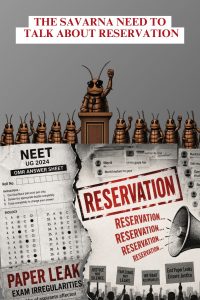
The Savarna Need to Talk About Reservation

Say what you will about the CJP protests against the NEET paper leak, everyone has already said that the immediate demands are not enough to change the education system. Education scholars are more likely to tell you about the 5-point charter submitted by the CJP to the Government of India. But one class of discourse generators is rattled by the protests themselves, or has been looking for an opportunity to vent its pre-existing frustrations or biases and has now found the perfect one . This is the oppressed castes’ general status and their tiresome, repeated, annoying rant against reservation.

This includes someone fabricating a fake post by actor Vijay Varma about his one non-reserved category friend suffering in some educational institution, which the pro-protest actor quickly said he had never posted. His acting in the anti-Mandal movement film Hurdang alongside Sunny Kaushal, however, may not have made his supposed stance difficult to believe had the post been genuine. Whether he posted it or not, and whether he believes the logic underneath that post, are different questions.

Mrunal Thakur, another actor, apparently posted a story on her Instagram account suggesting that the key moment that changed the game for everyone during these protests was NEET aspirant Harsh Dubey questioning the dominant narrative around the protests, arguing that the focus on the paper leak has overshadowed other longstanding issues in medical admissions. This was apparently a clip from a conversation with NDTV’s Shiv Aroor, where Dubey said questions around reservation policy and the difficulties faced by general category students also deserve public attention. Whether Mrunal Thakur will also come out and deny posting this is a matter of no one’s concern. Bollywood celebrities have shown their political illiteracy and general inhumanity more than once.

But this idea that neither the BJP nor the CJP wants to touch reservation, and that this is what led to the compromise, is one of those Savarna delusions burdened with so many argumentative flaws that a sane mind can hardly engage with it. To begin with, despite its classist and meritocratic articulation of the protests, the CJP does not appear to be opposed to reservation, partly reflected in its use of Ambedkarite symbolism, whether sincere or strategic. One also forgets that the BJP is a heterogeneous party with multiple caste groups and not simply Brahmins and other general category persons. There is no consensus on this question even within the Hindutva fold, something evident from the raita vs. trad debates that have long existed within their own ideological circles. To treat a single interview, one that merely regurgitates the most banal opinion circulating on the Savarna reactionary internet, as having played any pivotal role in shaping the protests is fantasy writing in its purest form.

But what is up with the casteist Savarnas? In a protest that brought together people from the non-protesting middle classes and celebrities, wherein status and privilege are also disproportionately held by oppressor castes, what has made the casteist Savarnas launch into their regular rant with great vigour? Are Savarnas simply waiting for any needle to move so they can carry their anti-reservation agenda? Are they simply incapable of shutting up for once?

Why, then, does every major public mobilisation touching education or even employment seem to invite an anti-reservation chorus from casteist Savarnas? The answer is not that reservation is secretly the central issue every time, like the Dubeys make it out to be. It is that reservation has become the preferred language through which sections of the Savarna public interpret almost every institutional crisis. Whenever a crisis emerges in education or public recruitment, reservation is summoned as the familiar explanation, even when it has little to do with the event itself. It is less a response to the facts before them than a political reflex.

This reflex performs an ideological function. It redirects public anger away from institutions and towards beneficiaries of affirmative action. A paper leak points towards failures of governance, regulation, corruption, examination agencies, and political accountability. None of these explanations preserve the moral authority of the existing Brahminical social order. Reservation, on the other hand, offers an already available narrative; and if Savarna public discourse has shown anything, it is that they love readily available labour, intellectual and otherwise. The next generation of casteists also lack imagination and will rely on the intellectual dis-labour of their Savarna forefathers.

These complaints are very vapid. They transform a structural failure into a grievance against redistributive and representational justice. Instead of asking why an examination system repeatedly fails millions of students, they ask who supposedly enjoys unfair advantages, even though the empirical facts reveal it is they who do. The institution escapes scrutiny because caste once again becomes framed as the problem only when it attempts to correct itself.

There is another reason why these moments are politically useful. Large protests produce so much uncertainty. They reopen public debate and create the possibility that questions long considered settled may be discussed again, especially now that social media has permitted everyone to have an opinion, for good and bad alike. For anti-reservation voices, this is an opportunity to attach their long-standing campaign to a movement that was never organised around their demands. They seek legitimacy through proximity of discourse. If enough people begin associating educational injustice with reservation rather than with state failure, the moment gets a new meaning.

This explains why Harsh Dubey’s interview came to acquire symbolic importance far beyond its actual place in the protests. It offered something many casteist Savarnas had been waiting for: an apparently articulate voice on national television through which they could restate arguments that have circulated for decades. Reservation disrupts the comforting belief that educational success reflects individual merit alone. Every conversation about admissions threatens to reopen the history of caste privilege that made merit appear natural in the first place. It is therefore unsurprising that even a movement against examination malpractice becomes, for some, another occasion to defend inherited advantages while presenting themselves as victims of an unjust system. The anti-reservation discourse surrounding the NEET protests tells us less about the movement than about the persistence of Savarna political common sense.


DalitThinkerToday is a Chartered Accountant by profession from Sangli, Maharashtra, who occasionally dabbles in thinking about politics when people in her oppressor-caste-majority office frustrate her. This is her pseudonym.