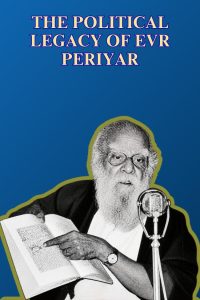
The Political Legacy of EVR Periyar

Archival Note

Published in Dalit Voice (Vol. 24, Issue No. 5, 1 March 2005), this essay by Rajendra of Ambedkar Pratishthana defends Periyar E.V. Ramaswamy against attempts to portray him as anti-Dalit. The essay recalls Periyar’s role in the anti-caste struggle, his break with the Congress and his relationship with Dr. B.R. Ambedkar. It asks the present generation to remember Periyar alongside Phule, Ambedkar and Shyam Sunder as part of the history of the anti-caste struggle.

The essay places particular emphasis on Periyar’s relationship with Ambedkar. It recalls Periyar’s efforts to bring Ambedkar into the Jat-Pat-Todak Mandal conference and the mutual respect between the two leaders. For Rajendra, Periyar’s importance lies in a politics of self-respect that directly challenged Brahminical social authority. He also presents Periyar within a wider Bahujan politics, arguing that Dalits and Backward Castes have a shared stake in fighting Brahminism. This makes the essay an important record of a political tradition that saw Ambedkar and Periyar as connected figures in the anti-caste movement rather than as representatives of opposing camps.

Published in September, the month of Periyar’s birth anniversary, the essay speaks to a contemporary tendency to divide anti-caste politics between Ambedkarite and Periyarist traditions, particularly in Tamil Nadu. That division can obscure the historical connections between the two movements and the different ways in which they confronted caste. Periyar’s emphasis on self-respect remains important because it locates caste oppression in the social relations and cultural authority that make hierarchy appear natural. His work also shows why anti-caste politics must challenge the ideas and institutions through which caste reproduces itself, alongside the struggle for political and legal rights. Revisiting Periyar through this history helps recover a broader anti-caste tradition in which his contribution and Ambedkar’s can be understood together without treating them as interchangeable.


Periyar E.V.R. As Champion Of Dalits

Periyar E.V. Ramaswamy is a leader of international repute and is hailed as a great thinker, reformer, revolutionary and humanist. The United Nations itself recognised this during his lifetime.

So any discussion on his sterling qualities and services to the oppressed people, victims of Brahminism, is ridiculous. Some Dalits under Brahminical influence have lately started branding Periyar as anti-Dalit. They should not be ungrateful to the extent of falsifying history itself. Dr. Ambedkar wanted his children to be sincere and truthful.

The present generation should know the history of their progress and the services and sacrifices of elders like Phule, Periyar, Babasaheb and Shyam Sunder.

Vaikom struggle: Periyar’s self-respect movement began in an aggressive way at Vaikom, in the present Kerala. It was on behalf of the Untouchable castes who were not allowed even to walk on a street right before a temple. Periyar rushed there and fought on their behalf.

This historic agitation led by Periyar attracted Muslim leader E.V.K. Abdulla and Christian leader Gorge Joseph. Gandhi, as a true Hindu, criticized Periyar for supporting the Untouchables. Sikhs came from Punjab and ran the free kitchen (langar). This will establish the truth of Periyar’s universal leadership.

Periyar was then arrested by the Trivancore state police and kept in prison for this agitation. Yet the agitation continued. Finally, the Untouchables won the right to walk on the road. This may not be a material gain, but a self-respect achievement for Untouchables. The agitation became famous as “Vaikom struggle”. Dr. Ambedkar wrote an Editorial about this historic achievement in his journal, Mooka Nayak.

Declaration to destroy Congress: The Congress, the original Brahmin party of India, passed a resolution in 1917 showing its concern for the welfare of Untouchables. M.K. Gandhi, the dictator of the Congress, claimed credit for this action of the Brahmin party. But the truth is Gandhi came to know about the British giving recognition to Untouchables and providing political rights based on the census of 1911, for which Prince Agha Khan was responsible.

From that day onwards, Congress started discussing social reforms in its sessions. But even such discussions were stopped when the Brahmins set fire to the Congress session pandal in Maharashtra. At the Madras session of the Congress, Periyar Ramaswamy, who was then an active worker of the Congress, forced a discussion on social problems, mainly Untouchability.

Rowdies engaged by Brahmins then dragged Periyar out of the pandal and thrashed him. Periyar declared on the spot that he would destroy the Congress in Tamil Nadu and he did it. The Congress is wiped out in Tamil Nadu.

Dr. Ambedkar respected Periyar: Dr. Ambedkar had great respect for Periyar and Periyar had respect for Dr. Ambedkar. It was Periyar who advised the organizers of Jat-Pat-Todak Mandal of Lahore, when they invited him to the conference, to invite Dr. Ambedkar, being a better person, well read, better informed and able to speak English.

Jat-Pat-Todak Mandal approached Dr. Ambedkar, who agreed and prepared a speech for the conference. But Gandhi planned his usual trick, which resulted in Dr. Ambedkar cancelling his engagement.

Later, Dr. Ambedkar got his speech published as a book, titled Annihilation of Caste.

Three greatest personalities: Some Dalit leaders are critical of Periyar just because he belonged to a Backward Caste. They also quote and misquote Dr. Ambedkar on the subject. They know only the title of this book. But they do not know the history behind this book.

Dr. Ambedkar always made it a point to meet Periyar when he visited Madras. One such visit was when Jinnah attended the Muslim League meeting at Madras. On this occasion, all the three greatest personalities of the day, Dr. Ambedkar, Jinnah and Periyar, met and discussed the Indian caste problem. A photo with these three taken during that meeting of the great statesmen is in my possession. Another important photo with me is of Periyar with the great Bheem Sena leader Shyam Sunder.

Birthday celebration in UP: Kanshi Ram is another great revolutionary of India. He organised the Bahujan Samaj Party which came to power in UP and celebrated Periyar’s birth anniversary.

Kanshi Ram knows who is who among the Bahujans. If Periyar had been anti-Dalit, as made out by some Dalits in Tamil Nadu, would India’s topmost Dalit leader praise Periyar? Similarly, our Editor has assigned the No.2 place to Periyar among the three greatest revolutionaries of “independent” India.

With all these facts, why do some Dalits call Periyar anti-Dalit? The mistake is not of Dalits but of the Backward Castes. It is easy to call it Brahminism.

The pity is the Backward Castes are the agents and foot-soldiers of Brahmins.

They ill-treated Dalits all over India, including Tamil Nadu, pushing Dalits to Islam at Meenakshi Puram 25 years ago. The BCs must mend their attitude towards Dalits, Muslims and Christians.

Dalits are duty bound to lead the entire Bahujan Samaj. That can be fulfilled only when BCs, at least the Most Backward Castes (MBC) like the barber, dhobi, potter, blacksmith etc., understand the importance of building Bahujan Samaj. Muslims and Christians also are distancing themselves from BCs. As an Ambedkarite, I call upon the BCs to join Dalits to fight Brahminism.

Periyar spent his whole life in this work for over half a century.
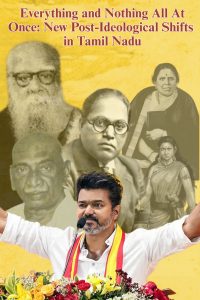
Everything and Nothing All At Once: New Post-Ideological Shifts in Tamil Nadu

You are most likely to understand Vijay’s Tamizhaga Vetri Kazhagam (TVK) if you have had a friend who is a people pleaser. At Vijay’s first maanadu (political conference) in 2024, soon after the launch of his party, it was revealed that the five figures whose ideologies were going to guide TVK’s ways were Ambedkar, Periyar, Kamaraj, Anjalai Ammal and Velu Nachiyar; a confusing bunch and a perfect example of too many cooks spoiling the broth. What they all have in common, except broadly overlapping progressive leanings and four out of five of them living around the same time, is beyond me. This was perhaps the earliest public hint of a personality that wants to cover all his bases and make everybody happy.

The logical conclusion of aiming for universal appeal is the strange cocktail that is Vijay’s cabinet. We have CTR Nirmal Kumar, who is TVK’s Deputy General Secretary (IT and Social Media Wing) and the Minister of Energy Resources and Law, who previously served as the President of the State IT and Social Media Wing of the BJP between 2019 and 2023. He has/continues to have affiliations with the RSS and was very strategically (rather cunningly) made to contest in the Thiruparankundram Assembly Constituency, where the centuries-old conflict between a temple and a dargah in close proximity escalated last year into full-blown communal riots. The conflict is likely to resurface in November 2026 during the annual festival of lights (Karthigai Deepam), when the Hindus will once again ask that their deepam be lit 50 metres away from the dargah. And Nirmal Kumar, as the MLA of the constituency, will oversee it all.

The party’s treasurer and Minister for Food and Civil Supplies, P. Venkataramanan, is a Brahmin candidate fielded in the constituency synonymous with Brahminism itself – Mylapore. He has famously called anti-Brahminism an “old ideology” that “does not exist now” and is “not necessary in today’s society”. Beyond the venom in his words lies some valid grouse with a century-old anti-caste movement that is solely concerned with anti-Brahminism. It is evidence of no real or meaningful effort at caste eradication by any of the Dravidian parties at the helm of power for 60+ years. Even within the last 5 years of M.K. Stalin’s reign, the murder of Dalit men in cases of inter-caste marriages, the murder of K. Armstrong – the state President of the Bahujan Samaj Party; and, where caste and labour are intrinsically linked, the sanitation workers’ protest and the Samsung workers’ strike, were not handled by the DMK with the same care they use to craft their words. That both DMK and AIADMK consistently reduce their voters to their caste identity every election cycle, with their adamance about only allowing every region’s oppressor-caste candidates to contest in their respective constituencies, is an open secret. Unsurprisingly, the one group that is unanimously and vocally happy about TVK’s victory are the Brahmins.

The foundation of people-pleasing is deliberately allowing many different meanings to be read onto you. So Vijay’s cabinet also has someone like Aadhav Arjuna, the Minister for Public Works and Sports Development, who was briefly the Deputy General Secretary of a party as strong in its Dalit liberation ideology as the Viduthalai Chiruthaigal Katchi (VCK), formerly known as the Dalit Panthers of India. Ex-YouTuber Rajmohan, the state’s Education Minister, was sworn in along with 4 women, 7 Christian, 1 Muslim and 6 other Dalit ministers, making the cabinet one with the highest number of Dalit ministers in the state so far. It is unsurprising that Vijay’s anti-casteness is accepted without much scrutiny when he has openly campaigned with the photos of Dr. Ambedkar and visited the statues of Periyar and Iyothee Thaasar after coming to power. The support of prominent figures in the anti-caste movement, such as Pa. Ranjith, only helps this narrative spread liberally. But if we are to believe the support from all sides, then we have on our hands an anti-caste party that makes Dalit people and Brahmins equally happy.

TVK is a party that is willing, nay, eager to collaborate with the BJP government. Vijay’s first official statement after being declared victorious responded to Modi’s congratulations. When the governor repeatedly delayed inviting him to form the government, he did not unleash his anger in public, an act he seems to reserve solely for the DMK. Despite backlash at the Sanskrit Vande Maataram preceding Tamil Thai Vaazhthu at his swearing-in ceremony, he repeated the sequence of events when his ministers were sworn in. The relationship between Tamil Nadu and the Union Government is strained by multiple conflicts in the realms of taxation, the Union Budget, delimitation and Keezhadi, to name a few. Vijay’s stances on all of them are unclear.

The most crucial disagreement perhaps lies in the field of education, where the state has been demanding the abolition of NEET and resisting the National Education Policy. While Raj Mohan has declared that TVK will make no compromises on the two-language policy, ABVP representatives who met Vijay on the same day as this declaration have come back with half of their demands met. People-pleasing, it turns out, is not as harmless as it looks, for it consistently sides with power when conflict emerges. At the time of writing this, Vijay has not met the press directly even once; he has perhaps realised that emulating this behaviour has no consequence.

The default Hinduism that Vijay personally subscribes to, he is unafraid to bring to the public arena. Before the election results were announced (and for some part of his campaign), Vijay was seen visiting mosques, churches and temples with a secularism that took the tone of one eager to ease Hindu anxieties. Joseph Vijay, the first Christian Chief Minister and first chief minister from a religious minority in Tamil Nadu, is constantly seen wearing an arakaja pottu, a marker that cannot be read as anything but Hindu. On his second day in office, he appointed his personal astrologer, Rickey Pandit, as his Officer on Special Duty, proof of his complete disconnection from any sense of rationalism, a move he was made to retract within 24 hours in the face of harsh criticism on the assembly floor.

Despite its history with atheism and rationalism, Tamil Nadu continues to be a deeply religious place, and one needs a figure in the state that can absorb this. A decade ago, this was J. Jayalalithaa. Post her demise and the gradual dilapidation of the AIADMK, Vijay comes as a replacement. Whether this figure is a wall or a door is yet to be seen. The stakes of holding this position are obviously very different now than they were in 2016.

The BJP winning just 1 seat in 2026 compared to 4 seats in 2021 is evidence of their irrelevance in Tamil Nadu. But the rise of Hindutva is going to look very different here than it does in the rest of the country, for the overtness of the phenomenon cannot be the sole proof of its occurrence. The widespread success of films such as Amaran, Thai Kilavi and the latest Karuppu are indicative of the fact that Hindutva will be nurtured here, as long as its references are regional.

But the road against the fascism now simmering in the state is not paved by walking on eggshells. You stand against nothing when you stand for everything, and the pandering is bound to make cracks for the BJP to make its long-attempted entry. And this will be possible not because Vijay was foaming at the mouth with hate – the opposite is in fact true – but because he was too busy running an anti-caste, secular party that is willing to collaborate with the BJP and pleases Sanghis, Brahmins and everyone in between equally.


Kavipriya is a writer from Tamil Nadu who likes to research, read and write and is informed by anti-caste, feminist, socialist thought.