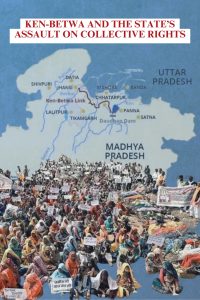
The protests against the Ken-Betwa Link Project in Madhya Pradesh emerged from long-standing concerns about the displacement of affected communities and the manner in which one of India’s largest river-linking schemes was being implemented. The Union and Madhya Pradesh governments have presented the Ken-Betwa Link Project as a nationally significant initiative to address chronic water scarcity in the drought-prone Bundelkhand region, arguing that it would strengthen irrigation while improving drinking water availability and power generation. Adivasis in the region have challenged this developmentalist narrative that is often built by ignoring the costs of implementation, which tramples their constitutional rights and livelihoods. The latest phase of the movement began on 3 July 2026 along the Barana River near Kupi village in Chhatarpur district and became one of the most visible mobilisations against the project. Protesters combined forms of civil disobedience with demands that rehabilitation be carried out according to the spirit of the law.
Led largely by Adivasi women and project-affected families, the agitation centred on the Ken-Betwa Link Project as well as the Majhgaon and Runjh irrigation projects. Protesters organised a series of symbolic demonstrations including jal satyagraha (standing in water as a form of protest), chita andolan (lying on funeral pyres) and a symbolic faansi satyagraha, presenting them as expressions of communities being pushed towards “social death” through displacement. Movement leader Amit Bhatnagar also undertook an indefinite hunger strike that lasted nearly two weeks until the protests were forcefully cleared. Protest leaders have maintained that authorities should implement the projects in accordance with existing laws governing land acquisition and environmental protection while respecting the constitutional rights of affected communities which prioritize rehabilitation. The administration has also failed to honour assurances reportedly made during discussions held in April 2026 before the protests came to this intense point. Bhatnagar has pointed to a ₹400-crore corruption scandal linked to the project, which shows massive irregularities in land acquisition and rehabilitation.
Displacement in this case has extended far beyond the loss of land. The affected families stand to lose access to forests, access to water resources, livelihood opportunities and more. Some residents have faced false criminal cases, illegal evictions, electricity disconnections and the demolition of schools as intimidation tactics and extra-legal punishment for participating in the protests. In this context, the protests called for transparent identification of all project-affected families and insisted that rehabilitation precede any displacement. The protests were also occurring within broader demands for an end to coercive administrative practices, especially when it comes to extractive displacement under the banner of development, conveniently marketed as pro-people and welfarist. Given the history of these practices, the movement is not simply a dispute over compensation but one in the long line of political struggles for democratic accountability and constitutional protections for Adivasi and rural communities.
Before dawn on 19 July 2026, a large police contingent cleared the protest site, citing public safety concerns because demonstrators were gathered beneath an under-construction bridge and along the river. While the administration has rejected allegations of wrongdoing and maintained that all legal procedures were being followed, multiple videos show the heavy-handed use of violence in ending the protests. Authorities stated that protesters were transported back to their villages rather than arrested. Bhatnagar was taken to hospital after his health deteriorated during the prolonged fast. However, this is a clear sign of forcible suppression of the movement, with protestors alleging mass detentions and the use of force to prevent Bhatnagar from addressing the media.
The agitation reflects wider debates surrounding the Ken-Betwa Link Project. As India’s first river-linking project under the National Perspective Plan, it occupies a central place in the government’s broader river interlinking agenda, with an estimated cost of ₹44,605 crore. Environmental groups, hydrologists and rural and Adivasi communities who have been affected have questioned the project’s ecological viability. They dispute the assumption that the Ken basin has surplus water and warn of its impact on forests and the Panna Tiger Reserve. Extensive deforestation and inadequate rehabilitation weaken the project’s developmental claims, while many have already pointed to decentralised water conservation which offers less destructive alternatives that states are reluctant to explore.
The legal framework governing such projects already recognises that displacement extends beyond the acquisition of privately owned land. The Right to Fair Compensation and Transparency in Land Acquisition, Rehabilitation and Resettlement Act, 2013 (LARR Act) defines project-affected families and provides for rehabilitation and resettlement alongside compensation. Apart from the generic failure of implementation in the Ken-Batwa case, the statutory application has repeatedly been criticised for excluding people whose livelihoods depend on forests, rivers and other common resources or who lack formal land titles, leaving many of those most affected outside its protections. This accountability gap is underscored by the Ministry of Tribal Affairs’ press release, “Rehabilitation of Displaced Tribals” (31 July 2025), which stated that the Union government does not centrally maintain data on displaced or project-affected families, even as it continues to promote large infrastructure projects across the country.
But it is clear that the questions raised here cannot be answered simply by demanding due process in compensatory practices. For decades, scholars of displacement, including Walter Fernandes, have argued that the framework governing displacement requires a more expansive rethinking. Yet policy institutions have largely failed to address these concerns, while successive governments have continued to pursue different forms of displacement through both public and private infrastructure initiatives. Fernandes argues that compensation cannot be confined to the market value of acquired land because displacement disrupts livelihoods rather than simply transferring property. He contends that rehabilitation should recognise all project-affected persons, including those dependent on common resources without formal legal ownership, and enable them to rebuild their lives instead of treating compensation as a one-time financial payment.
Although legislation such as the LARR Act is frequently criticised by corporate interests as placing excessive constraints on land acquisition, the Ken-Betwa experience suggests a different problem. Since the introduction of the Act, human right activists have pointed to the limited procedural and substantive protections that the Act provides. But even the minimal formal recognition and rights seem to be rendered ineffective when the state itself becomes the principal agent of acquisition. As Sanjoy Chakravorty argues in his formulation of the “taking state”, the concentration of acquisition powers within the state enables it to overcome legal safeguards through administrative practice. The struggle over Ken-Betwa is therefore also a struggle over whether constitutional and statutory protections can meaningfully constrain state-led development when the communities bearing its costs are Adivasi and rural populations.
The July protests also represent more than a local struggle over rehabilitation. They also highlight a wider contest over how large infrastructure projects should proceed when they affect the rights of tribal communities and fragile ecosystems. Not only is the Indian state continuously engaged in authoritarian extractivism, but has effectively framed its biddings under the PR of welfare while continuously trampling the civil liberties and the right to dissent of people affected. The events unfolding at Ken-Betwa over the last few days reaffirm that struggles against displacement cannot be left to affected communities alone, but require broader democratic solidarity across movements.
Paresh Hate is a Bahujan queer researcher, writer, documenter and activist and the Lead Content Manager at Dalit Voice.