
Archival Note
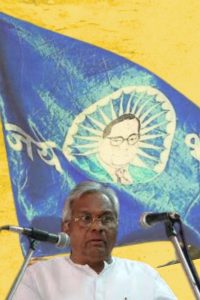
Delivered at a BAMCEF state convention in Gulbarga (now Kalaburagi) in November 2009, this speech reflects V.T. Rajshekhar’s thinking at a particular moment in the history of the anti-caste movement. While some of its references and political judgments are rooted in that context, its central argument continues to provoke debate: what enables oppressed communities to build lasting power?
The version reproduced below has been abridged for contemporary readers. The overall argument and structure have been retained, while passages closely tied to the political context of 2009, repeated arguments, and material of primarily historical interest have been omitted. The focus remains on the speech’s two central themes: the responsibility of educated Bahujans to strengthen collective institutions, and the argument that electoral success alone cannot sustain social transformation without intellectual, organisational, and cultural power.
The complete, unabridged speech is available in the Dalit Voice archives: https://dalitvoice.net/two-serious-mistakes-that-killed-dalit-movement/
Two Serious Mistakes That Killed the Dalit Movement
Abridged from a speech delivered at the BAMCEF Karnataka State Convention, Gulbarga, November 22, 2009
Brother Waman Meshram and brothers and sisters of the Bahujan Samaj,
Thank you for inviting me to inaugurate the first Karnataka state convention of BAMCEF at Gulbarga.
We have watched the steady growth of BAMCEF under the leadership of Brother Waman Meshram. Organising educated employees is never easy, yet BAMCEF has emerged as one of the country’s most significant Bahujan organisations. It is fitting that this convention is being held in Gulbarga, a region associated with the legacy of Shyam Sundar, whose work left a lasting mark on anti-caste politics.
Today I wish to speak about two questions that I believe have deeply affected the Bahujan movement.
The first concerns the educated Dalits who have benefited from constitutional safeguards and reservations.
The second concerns the widespread belief that political power alone can transform society.
The First Mistake
Reservations opened opportunities that were denied to our people for generations. But education and employment were never meant to be ends in themselves. Babasaheb Ambedkar saw them as instruments for the emancipation of the entire community.
Over the years, however, I have watched with concern as many educated Dalits achieved personal success but drifted away from the larger movement. Babasaheb himself warned that educated Dalits should not forget the people from whom they came.
Our communities need educated people who build institutions, mentor younger generations, strengthen organisations, write, teach, and remain accountable to society. Without that commitment, education risks becoming only a means of individual advancement.
This is why BAMCEF matters. Organising educated Bahujans into a socially conscious force is difficult, but it is indispensable if education is to become a source of collective strength rather than individual mobility.
The Second Mistake
Much has been said about political power being the key to social progress. Electoral representation is important, but we must ask whether elections alone are sufficient to transform deeply unequal social structures.
Political office without organised social strength is fragile. Governments come and go. Lasting change requires a society that is organised, politically conscious, and capable of sustaining its own institutions.
Those who dominate society do not rely only on elections. They exercise influence through education, the media, the bureaucracy, finance, and other institutions. If we neglect these spheres while concentrating only on electoral politics, our victories will remain temporary.
Political power is not given but taken. To secure it requires strength—not merely physical strength, but intellectual strength.
This is why independent Bahujan media is not a luxury but a necessity. A movement that depends entirely on others to tell its story cannot shape its own future.
What is needed first is intellectual strength. We must produce honest intellectuals, strengthen our organisations, build institutions, and develop leadership that remains rooted in the community.
Political power becomes meaningful only when it rests upon an organised and self-confident society.
That is the challenge before us.
Thank you.
Jai Bhim!