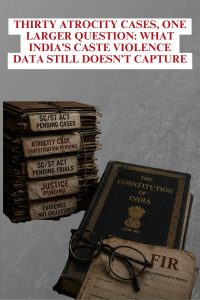
Thirty Atrocity Cases, One Larger Question: What India’s Caste Violence Data Still Doesn’t Capture

A complaint submitted to the National Commission for Scheduled Castats (NCSC) has brought together 30 reported cases of violence against Dalits from nine states, once again exposing the gap between constitutional safeguards and their enforcement on the ground.

Filed under Article 338(5) of the Constitution, the complaint by the Citizens for Justice and Peace (CJP) asks the Commission to investigate incidents reported between April and June 2025 in Uttar Pradesh, Bihar, Madhya Pradesh, Rajasthan, Gujarat, Andhra Pradesh, Himachal Pradesh, Karnataka and Maharashtra. The cases include rape, murder, assault, public humiliation, denial of access to temples and cremation grounds, and attacks on Dalit wedding processions. It also seeks action against public officials accused of failing to discharge their duties under the Scheduled Castes and Scheduled Tribes (Prevention of Atrocities) Act, 1989.

None of these forms of violence are unfamiliar. They have appeared repeatedly in atrocity reports, court records and fact-finding exercises for decades. What changes are the names of the victims and the districts in which the crimes occur.

The complaint cites cases such as the alleged rape of a deaf and mute Dalit girl in Rampur, the murder of a 10-year-old Dalit boy in Etah, and the assault of a Dalit groom in Agra who was allegedly forced off his horse because dominant-caste residents objected to the procession. Other incidents involve denial of cremation rights, restrictions on temple entry and caste-based abuse in public.

The incidents span states governed by different political parties. That is significant because it points to a problem that survives electoral change. The SC/ST (Prevention of Atrocities) Act has been in force for more than three decades, yet its implementation continues to depend on the willingness of local police, district administrations and prosecutors to invoke it properly. Delays in registering FIRs, omission of relevant provisions of the Act, weak investigations and failures to prosecute public officials who neglect their statutory duties remain recurring complaints in atrocity cases.

The need to strengthen implementation has also found expression outside courtrooms. At a recent community vigilance training programme organised by the Dalit Bahujan Shramik Union in Andhra Pradesh, government officials, lawyers and activists stressed that awareness of the SC/ST (Prevention of Atrocities) Act remains inadequate even as untouchability, social discrimination and caste violence continue. Advocate P. Chittibabu called for quicker filing of charge sheets so that cases under the Act do not languish in the courts, while participants highlighted the continuing vulnerability of Dalit women and children. The discussion reflected a familiar reality: India has a strong legal framework on paper, but access to justice continues to depend on how consistently that framework is implemented.

Official crime statistics capture only part of this picture. The complaint refers to National Crime Records Bureau data showing tens of thousands of pending investigations and more than 2.6 lakh pending trials involving atrocities against Scheduled Castes, with conviction rates remaining below 40 percent. Those figures indicate that access to justice remains slow even after a case enters the criminal justice system.

They do not, however, capture the full scale of caste violence. The SC/ST (Prevention of Atrocities) Act applies to members of Scheduled Castes recognised under the Constitution. Dalits who have converted to Christianity or Islam are excluded from the Scheduled Caste category under the Constitution (Scheduled Castes) Order, 1950, and therefore cannot invoke the Act. Where caste motivates violence against Dalit Christians or Dalit Muslims, such cases are generally prosecuted under ordinary criminal law. As a result, violence rooted in caste often disappears from official atrocity statistics despite the caste motive remaining central to the offence.

The question of implementation has acquired another dimension in recent years. Several incidents involving the custodial torture or death of Dalits have drawn attention to the difficulty of enforcing the PoA Act when the alleged perpetrators are police personnel themselves. In such cases, the institutions responsible for registering offences and conducting investigations are also the institutions facing allegations of abuse. The recent Tamil Nadu trial court judgment sentencing nine police personnel to death for the custodial torture and deaths of P. Jayaraj and J. Benicks during the COVID-19 lockdown is a rare instance of accountability. Yet such outcomes remain exceptional and do little to address the institutional conditions that allow custodial violence to persist.

At the same time, the Supreme Court has reiterated that the SC/ST (Prevention of Atrocities) Act cannot be invoked mechanically. In Keshaw Mahto @ Keshaw Kumar Mahto v. State of Bihar (2026), the Court held that merely abusing or threatening a person who belongs to a Scheduled Caste does not automatically attract Sections 3(1)(r) or 3(1)(s) of the Act. The prosecution must establish that the insult or intimidation was intentionally directed at humiliating the complainant because of their caste. The ruling, which builds on the Court’s earlier decision in Shajan Skaria v. State of Kerala, emphasises that caste identity alone cannot substitute for proof that the alleged conduct was motivated by caste.

Read alongside the complaint before the NCSC, the Keshaw Mahto ruling highlights a different challenge. While the Supreme Court has reiterated that the PoA Act cannot be invoked mechanically without establishing the statutory ingredients of a caste offence, rights groups continue to document delays in registering FIRs, omission of relevant provisions of the Act and weak investigations even in cases where caste is central to the violence. The issue, therefore, is not simply one of implementation, but of whether the law and its interpretation are adequately equipped to capture the varied and often indirect ways in which caste operates today. If caste discrimination increasingly manifests through readily provable intent, the question is whether the existing legal architecture is sufficient to respond to these evolving forms of caste power.

The complaint asks the NCSC to direct state governments to ensure prompt registration of FIRs, monitor investigations, initiate disciplinary proceedings against officials who neglect their duties, secure compensation and rehabilitation for survivors, and identify atrocity-prone areas requiring sustained monitoring.

Whether the Commission acts on these requests remains to be seen. Similar demands have accompanied previous compilations of caste atrocities, while concerns over delayed investigations, weak prosecutions and official inaction have continued.

The 30 incidents documented in the complaint are spread across different regions and involve different forms of violence. They also expose the limits of how caste violence is officially recorded and addressed. Until implementation of the SC/ST (Prevention of Atrocities) Act becomes more consistent—and until caste violence against Dalit Christians, Dalit Muslims and victims of custodial abuse is recognised within the wider conversation on caste justice—official numbers will continue to tell only part of the story.


Mangesh is a law student from Mumbai, Maharashtra.
Custody, Caste, and the Persistence of Police Violence in Tamil Nadu

The death of 26-year-old Dalit youth Akash Denison in police custody in Sivaganga district has once again forced Tamil Nadu to confront a recurring contradiction. A state that prides itself on a legacy of social justice continues to witness a pattern of custodial deaths that disproportionately claim the lives of the poor and the marginalized, including Dalits.

Akash Denison’s death on March 8 at the Government Rajaji Hospital in Madurai has triggered protests, political demands for an inquiry, and renewed scrutiny of police conduct in the state. Yet for activists and anti-caste organisations, the case is not an aberration. It is another entry in a long list of custodial deaths that expose systemic violence embedded within the criminal justice system.


The death of Akash Denison

Akash Denison, an engineering graduate from Krishnapuram Colony in Manamadurai, was arrested on March 6 along with another youth in connection with a sickle attack on two individuals in Zion Nagar the previous day. According to the Tamil Nadu police, the assault followed a petty quarrel and was captured on CCTV footage.

Police sources stated that Denison was a “history-sheeter” with several pending cases, including one for attempted murder. The official version claims that he sustained serious injuries while trying to escape arrest, allegedly falling from a bridge. He was initially treated at Sivaganga Government Medical College Hospital before being remanded to judicial custody until March 18 by a magistrate. He was then transferred to the convict ward at the Government Rajaji Hospital in Madurai.

On the morning of March 8, Denison reportedly developed breathing difficulties around 5:45 am. Despite attempts by doctors to revive him, he died shortly thereafter. Police have suggested that complications from his injuries, possibly fat embolism caused by fractures, could have led to the death, though post-mortem confirmation is awaited.

The family disputes this account entirely. Denison’s father, Rajesh Kannan, alleges that his son was brutally assaulted in custody. According to the family, police officers took him to a secluded area near Sivaganga, placed stones on his legs, and beat him until his bones were shattered. The father also claims that officers hurled caste slurs during the assault. His mother, Anandhi, has alleged that police had earlier threatened to kill her son if he was ever caught.

Before his death, Denison reportedly told his parents that he had been assaulted by the police. The family has demanded that the case be registered under the Scheduled Castes and Scheduled Tribes (Prevention of Atrocities) Act and that those responsible be prosecuted. The body remains in the hospital mortuary pending further proceedings and a magisterial inquiry.


Political and civil society response

The death has drawn strong reactions from Dalit organisations and political leaders. Thol. Thirumavalavan, leader of the Viduthalai Chiruthaigal Katchi, demanded a thorough investigation into the custodial death. He stated that Denison had informed his family about police assault and caste abuse before he died. Thirumavalavan questioned the circumstances of the death and asked why a detainee under state custody died while being treated in hospital. If police officers were responsible, he said, strict action must be taken and justice ensured for the victim’s family.

Human rights activist Henri Tiphagne of People’s Watch called the incident the 26th custodial death in Tamil Nadu in recent years and urged the Madras High Court to take suo motu cognisance of the case. He also stressed that the post-mortem must follow Supreme Court guidelines for custodial death investigations. Meanwhile, local protests erupted in Manamadurai, with residents blocking roads and demanding accountability.


A pattern that refuses to disappear

Denison’s death cannot be understood in isolation. Tamil Nadu has seen a troubling number of custodial deaths in recent years, many of them involving individuals from marginalised backgrounds and arising from arrests for relatively minor offences.

Data compiled by People’s Watch shows that 32 custodial deaths occurred during the tenure of the current state government between May 2021 and August 2025. In an analysis of 27 of these deaths over the past four years, nearly 40 percent of the victims belonged to Scheduled Castes or Scheduled Tribes.

The pattern cuts across the state but is particularly pronounced in the southern police zone, which includes Madurai, Ramanathapuram, Tirunelveli, and Sivaganga districts. In most cases, the police have attributed the deaths to illness or sudden medical conditions such as seizures or chest pain. Yet post-mortem reports, family testimonies, and FIRs often reveal extensive injuries suggesting custodial torture.

One of the most widely known custodial deaths in Tamil Nadu was the 2020 killing of P. Jayaraj and his son J. Bennix in Sathankulam, which sparked nationwide outrage. The two were arrested for allegedly violating pandemic lockdown regulations and were later found to have suffered severe torture while in police custody. The case remains under judicial process.

More recently, in June 2025, temple security guard Ajith Kumar died in police custody in Sivaganga district after being detained for questioning in a theft case. His death, too, triggered allegations of brutal assault by police.

Other cases reflect similar patterns. Baskar, a Dalit man arrested in Cuddalore in 2024 for allegedly selling tobacco, died after being remanded to jail; his family said his body showed signs of torture. Seventeen-year-old Gokul Sree died in a juvenile correction facility in Chengalpattu in 2022, with 96 injuries found during the post-mortem. In another case, tribal man P. Marimuthu died in 2025 while in custody of the forest department after being accused of possessing leopard teeth.

Across these cases, the victims were overwhelmingly from poor families and were frequently arrested for petty crimes such as theft, minor altercations, or illicit liquor brewing.


Marginalisation and vulnerability

The demographic pattern is difficult to ignore. Among the 27 custodial deaths examined by researchers, nine victims were from Scheduled Castes and two were from Scheduled Tribes. Many of the others were from economically vulnerable communities or were daily wage labourers.

For activists, this concentration reflects deeper structural inequalities. The Lokniti-CSDS report State of Policing 2025 adds another disturbing dimension. According to the study, 56 percent of police personnel in Tamil Nadu expressed strong support for the idea that violence is sometimes necessary to obtain information from suspects.

Institutional accountability has also remained weak. Data from the National Crime Records Bureau indicates that only one police officer has been convicted for custodial violence in Tamil Nadu between 2011 and 2022.


The contradiction of social justice politics

Tamil Nadu’s political culture is deeply shaped by the anti-caste and rationalist movements associated with figures like Periyar E. V. Ramasamy. The state’s dominant political parties frequently invoke this legacy to emphasise commitments to equality and social justice. Yet activists argue that the persistence of custodial deaths exposes a gap between rhetoric and institutional practice.

Several Dalit organisations have pointed out that the criminal justice system, particularly the police, continues to reproduce caste hierarchies even within a political environment that publicly rejects them. Allegations of caste-based abuse, such as those made by Denison’s family, are therefore not isolated claims but part of a broader critique of structural discrimination. Without meaningful accountability, the promise of social justice risks becoming symbolic rather than substantive.


The struggle for accountability

In many custodial death cases, legal proceedings stretch for years, and evidence often disappears. Activists say police stations frequently claim that CCTV footage was automatically deleted within weeks, making independent verification difficult. Even in high-profile cases such as the Sathankulam deaths, final judgments have taken years to materialise.

For families like that of Akash Denison, the struggle is immediate and intensely personal. His parents have refused to accept the official explanation for his death and have demanded a transparent investigation. Their demand echoes a larger question confronting the state: whether the cycle of custodial violence can finally be broken.

For now, Denison’s death stands as another reminder that the distance between the ideals of social justice and the realities of policing in Tamil Nadu remains painfully wide.

What makes Akash Denison’s death particularly troubling is not only the allegation of brutality but the familiarity of the pattern it fits into. Custodial deaths in Tamil Nadu have repeatedly revealed how the weight of policing falls most heavily on those already pushed to the margins, where poverty, caste, and criminalisation intersect. Each case prompts outrage, promises of inquiry, and temporary administrative action, yet the underlying culture of impunity rarely changes. If the state’s commitment to social justice is to mean anything beyond political vocabulary, it must confront the violence embedded within its own institutions. That requires more than compensation or isolated suspensions. It requires transparent investigations, swift prosecutions, and structural reform of policing practices. Until then, the death of Akash Denison will remain not an exception but a grim reminder of how fragile constitutional protections become when they collide with caste prejudice and unchecked state power.


Paresh Hate is a Bahujan queer researcher, writer, documenter and activist and the Lead Content Manager at Dalit Voice.