
A complaint submitted to the National Commission for Scheduled Castats (NCSC) has brought together 30 reported cases of violence against Dalits from nine states, once again exposing the gap between constitutional safeguards and their enforcement on the ground.
Filed under Article 338(5) of the Constitution, the complaint by the Citizens for Justice and Peace (CJP) asks the Commission to investigate incidents reported between April and June 2025 in Uttar Pradesh, Bihar, Madhya Pradesh, Rajasthan, Gujarat, Andhra Pradesh, Himachal Pradesh, Karnataka and Maharashtra. The cases include rape, murder, assault, public humiliation, denial of access to temples and cremation grounds, and attacks on Dalit wedding processions. It also seeks action against public officials accused of failing to discharge their duties under the Scheduled Castes and Scheduled Tribes (Prevention of Atrocities) Act, 1989.
None of these forms of violence are unfamiliar. They have appeared repeatedly in atrocity reports, court records and fact-finding exercises for decades. What changes are the names of the victims and the districts in which the crimes occur.
The complaint cites cases such as the alleged rape of a deaf and mute Dalit girl in Rampur, the murder of a 10-year-old Dalit boy in Etah, and the assault of a Dalit groom in Agra who was allegedly forced off his horse because dominant-caste residents objected to the procession. Other incidents involve denial of cremation rights, restrictions on temple entry and caste-based abuse in public.
The incidents span states governed by different political parties. That is significant because it points to a problem that survives electoral change. The SC/ST (Prevention of Atrocities) Act has been in force for more than three decades, yet its implementation continues to depend on the willingness of local police, district administrations and prosecutors to invoke it properly. Delays in registering FIRs, omission of relevant provisions of the Act, weak investigations and failures to prosecute public officials who neglect their statutory duties remain recurring complaints in atrocity cases.
The need to strengthen implementation has also found expression outside courtrooms. At a recent community vigilance training programme organised by the Dalit Bahujan Shramik Union in Andhra Pradesh, government officials, lawyers and activists stressed that awareness of the SC/ST (Prevention of Atrocities) Act remains inadequate even as untouchability, social discrimination and caste violence continue. Advocate P. Chittibabu called for quicker filing of charge sheets so that cases under the Act do not languish in the courts, while participants highlighted the continuing vulnerability of Dalit women and children. The discussion reflected a familiar reality: India has a strong legal framework on paper, but access to justice continues to depend on how consistently that framework is implemented.
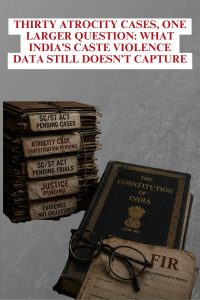
Official crime statistics capture only part of this picture. The complaint refers to National Crime Records Bureau data showing tens of thousands of pending investigations and more than 2.6 lakh pending trials involving atrocities against Scheduled Castes, with conviction rates remaining below 40 percent. Those figures indicate that access to justice remains slow even after a case enters the criminal justice system.
They do not, however, capture the full scale of caste violence. The SC/ST (Prevention of Atrocities) Act applies to members of Scheduled Castes recognised under the Constitution. Dalits who have converted to Christianity or Islam are excluded from the Scheduled Caste category under the Constitution (Scheduled Castes) Order, 1950, and therefore cannot invoke the Act. Where caste motivates violence against Dalit Christians or Dalit Muslims, such cases are generally prosecuted under ordinary criminal law. As a result, violence rooted in caste often disappears from official atrocity statistics despite the caste motive remaining central to the offence.
The question of implementation has acquired another dimension in recent years. Several incidents involving the custodial torture or death of Dalits have drawn attention to the difficulty of enforcing the PoA Act when the alleged perpetrators are police personnel themselves. In such cases, the institutions responsible for registering offences and conducting investigations are also the institutions facing allegations of abuse. The recent Tamil Nadu trial court judgment sentencing nine police personnel to death for the custodial torture and deaths of P. Jayaraj and J. Benicks during the COVID-19 lockdown is a rare instance of accountability. Yet such outcomes remain exceptional and do little to address the institutional conditions that allow custodial violence to persist.
At the same time, the Supreme Court has reiterated that the SC/ST (Prevention of Atrocities) Act cannot be invoked mechanically. In Keshaw Mahto @ Keshaw Kumar Mahto v. State of Bihar (2026), the Court held that merely abusing or threatening a person who belongs to a Scheduled Caste does not automatically attract Sections 3(1)(r) or 3(1)(s) of the Act. The prosecution must establish that the insult or intimidation was intentionally directed at humiliating the complainant because of their caste. The ruling, which builds on the Court’s earlier decision in Shajan Skaria v. State of Kerala, emphasises that caste identity alone cannot substitute for proof that the alleged conduct was motivated by caste.
Read alongside the complaint before the NCSC, the Keshaw Mahto ruling highlights a different challenge. While the Supreme Court has reiterated that the PoA Act cannot be invoked mechanically without establishing the statutory ingredients of a caste offence, rights groups continue to document delays in registering FIRs, omission of relevant provisions of the Act and weak investigations even in cases where caste is central to the violence. The issue, therefore, is not simply one of implementation, but of whether the law and its interpretation are adequately equipped to capture the varied and often indirect ways in which caste operates today. If caste discrimination increasingly manifests through readily provable intent, the question is whether the existing legal architecture is sufficient to respond to these evolving forms of caste power.
The complaint asks the NCSC to direct state governments to ensure prompt registration of FIRs, monitor investigations, initiate disciplinary proceedings against officials who neglect their duties, secure compensation and rehabilitation for survivors, and identify atrocity-prone areas requiring sustained monitoring.
Whether the Commission acts on these requests remains to be seen. Similar demands have accompanied previous compilations of caste atrocities, while concerns over delayed investigations, weak prosecutions and official inaction have continued.
The 30 incidents documented in the complaint are spread across different regions and involve different forms of violence. They also expose the limits of how caste violence is officially recorded and addressed. Until implementation of the SC/ST (Prevention of Atrocities) Act becomes more consistent—and until caste violence against Dalit Christians, Dalit Muslims and victims of custodial abuse is recognised within the wider conversation on caste justice—official numbers will continue to tell only part of the story.
Mangesh is a law student from Mumbai, Maharashtra.