
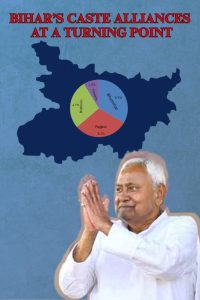
Nitish Kumar has filed his nomination for the Rajya Sabha, a move that effectively ends his nearly two-decade-long tenure as Bihar’s chief minister and opens the way for a chief minister from the Bharatiya Janata Party for the first time in the state’s history. The decision comes just four months after Kumar took oath for his tenth term in November. While the timing has surprised observers, leaders within the ruling coalition say the shift has been under discussion for some time. The move would allow the 75-year-old Janata Dal (United) leader to transition to Parliament while maintaining the alliance between the Janata Dal (United) and the BJP in Bihar. The development is likely to reshape the state’s political balance, not only because of the leadership change but also because of what Kumar’s departure from the chief minister’s post represents in the longer trajectory of Bihar’s caste politics.
Speculation about Kumar’s future had intensified in recent months after several public appearances in which he appeared visibly fatigued circulated widely on social media. Opposition leaders from the Rashtriya Janata Dal, including Tejashwi Yadav, repeatedly questioned whether the chief minister was physically able to continue in office. Within the ruling coalition, moving Kumar to the Rajya Sabha appears to be a way to ease the pressure created by those questions while keeping him within the national political structure.
The shift also fulfils a long-standing personal milestone. Kumar has previously served in the Bihar legislative assembly, the legislative council and the Lok Sabha. A Rajya Sabha term would make him one of the few leaders from Bihar to have served in all four legislative houses, a distinction already held by figures such as Lalu Prasad Yadav and the late Sushil Kumar Modi.
Kumar’s exit from the chief minister’s post marks the closing of a political chapter that began in the 1990s, when backward-caste leaders began to dominate Bihar’s electoral landscape. Born into a Kurmi family in Nalanda district, Kumar’s political career developed within the socialist movements that drew heavily from the ideas of Ram Manohar Lohia and the anti-Emergency mobilisations of the 1970s. These movements encouraged greater political participation by Other Backward Classes, many of whom had historically been excluded from positions of power in the state. Alongside leaders such as Lalu Prasad Yadav and Ram Vilas Paswan, Kumar emerged from that period as part of a generation that reconfigured Bihar’s social coalitions. Their rise marked a shift away from the earlier dominance of upper-caste political elites.
However, backward-caste politics in Bihar was never a single unified bloc. Rivalries between dominant OBC communities often shaped political competition. While Lalu Prasad Yadav’s base rested largely among Yadav voters, Kumar’s support historically drew more from Kurmi and other non-Yadav OBC groups. This fragmentation created space for different political formations to assemble caste alliances in distinct ways.
One of Kumar’s most significant political strategies during his years as chief minister was the attempt to build a broader coalition among smaller caste groups that had limited representation in state politics. His government placed particular emphasis on communities categorised as Extremely Backward Classes, or EBCs, a grouping that includes dozens of smaller OBC communities that historically lacked the electoral strength of dominant castes such as Yadavs or Kurmis. The administration also introduced the category of “Mahadalits”, identifying the most marginalised Scheduled Caste communities and designing targeted welfare programmes for them. All Scheduled Castes except the Paswan community were included in this classification. These policies were framed as attempts to direct state welfare towards the most marginalised communities, but they also had clear political implications. By building support among EBC and Mahadalit groups, Kumar created a support base that could counterbalance the influence of the RJD’s traditional Yadav-Muslim coalition.
Election studies by the Centre for the Study of Developing Societies have repeatedly shown how caste blocs in Bihar align with particular political parties. Upper-caste voters have historically leaned strongly towards the BJP, while the JD(U) has often drawn support from EBC communities and segments of the OBC electorate.
Kumar’s tenure also revealed the limits and tensions within caste-based representation in the state. In 2014, after the JD(U)’s poor performance in the parliamentary elections, Kumar stepped down as chief minister and appointed the Dalit leader Jitan Ram Manjhi as his successor. The decision was initially seen as a significant moment for Dalit representation in Bihar’s executive leadership. However, Manjhi later accused Kumar of continuing to control the government from behind the scenes. The conflict between the two leaders eventually led to Manjhi’s removal and Kumar’s return to the chief minister’s post. The episode illustrated the complicated dynamics of caste representation within party structures, where symbolic leadership positions can still operate within established political hierarchies.
If Kumar steps aside as expected, the BJP will lead the state government for the first time despite having been part of ruling coalitions in Bihar for several years. Several names are being discussed as potential successors. These include deputy chief minister Samrat Choudhary, union minister Nityanand Rai and senior BJP leader Dilip Kumar Jaiswal. Party leaders, however, have not publicly indicated a final choice. Each of these leaders represents different caste constituencies within the BJP’s support base, highlighting the continuing importance of caste arithmetic in leadership decisions.
The BJP’s growth in Bihar over the past decade has depended heavily on consolidating upper-caste voters while expanding its reach among sections of OBC and EBC communities. A chief minister from the party could further alter the balance within the ruling alliance, where Kumar’s JD(U) has historically held the top position despite being the smaller partner in electoral terms.
Kumar’s move to the Rajya Sabha does not necessarily mean an immediate withdrawal from active politics. Even from Parliament, he may continue to influence the direction of his party and its alliance with the BJP. At the same time, the shift symbolises a generational change in Bihar’s leadership. With Kumar stepping away from the chief minister’s office, that phase of Bihar’s political history appears to be drawing to a close.
What replaces it will depend on how the state’s evolving caste coalitions are reorganised in the coming years. Even as new leaders emerge, the underlying structures of representation that shaped Bihar’s politics for decades, alliances among OBC, EBC and Dalit communities, are likely to remain central to its electoral contests.
The transition therefore raises questions about how the caste coalitions that shaped Bihar’s politics over the past three decades will evolve in the coming years. Kumar’s political strategy rested on carefully balancing multiple social blocs: the Kurmi–Koeri alliance often referred to as the “Luv-Kush” combine, support from Extremely Backward Classes, and welfare outreach to Mahadalit communities. Maintaining that equilibrium will be central to the BJP’s calculations as it moves to lead the government. Political observers note that preserving this social coalition will likely influence both the choice of chief minister and the broader composition of the cabinet. Any disruption to this balance risks unsettling a political arrangement that has allowed the JD(U)–BJP alliance to remain competitive against the Rashtriya Janata Dal’s Yadav-Muslim base.
At the same time, the transition is likely to sharpen questions within Bihar’s anti-caste movements about the limits of representation within electoral politics. While the post-Mandal period significantly expanded the presence of OBC leaders in government, political power has often remained concentrated among a few dominant caste blocs. Many smaller OBC groups, Dalit communities outside established political bases, and landless labouring populations continue to rely on shifting alliances for visibility within party structures. With Nitish Kumar stepping aside after nearly two decades as chief minister, the moment may prompt renewed debate about whether Bihar’s politics can move beyond managing caste coalitions toward broader and more substantive forms of social representation.
Praveen Kumar is an Ambedkarite political observer from Bihar.