Dr. Milind Kamble of the Dalit Indian Chamber of Commerce and Industry said in an interview, “Capital can break caste system… Market and money will defeat anti-capital Marx and Manu.”
His argument might seem attractive, but I disagree. Capital cannot break the caste system because the market is not casteless. It carries caste into every transaction that takes place before the consumer reaches the shop. Certainly, accumulation of capital can improve economic standing, especially among marginalised sections, but it absolutely will not defeat Manu or the caste system. Dr. Kamble is confusing individual economic mobility with the abolition of caste as a social and economic structure. His entrepreneurial agenda does not resolve the concerns that structure and constrain many lives. Who owns land? Who has collateral? Who can access networks? Who can survive a period without income? Who can get a loan without family wealth behind them? Who has the social connections to find suppliers, customers and contracts? And who is trusted when they walk into a bank, a business association or a potential partnership?
Although India, under the leadership of Dr. Manmohan Singh, entered a phase of economic reforms in 1991, opening its economy to liberalised and globalised economic spaces, the trajectory changed significantly since 2014. The post-2014 phase represents a particularly aggressive intensification of neoliberal policies combined with right-wing populist politics. This has manifested through the divestment of profitable stakes in publicly owned companies and their outright sale to private ownership. In post-2014 India, Dalits are being told, again and again, to become entrepreneurs. They are even invited into the market as borrowers, as start-up founders, as “self-made” men and women who can pull themselves up through grit and a bank loan. DICCI has given it a name, “Dalit Capitalism,” asserting that “caste and capital can never co-exist.” However, to assume that capital accumulation can dismantle caste is to ignore how contemporary markets articulate and weaponise pre-existing social hierarchies to maintain structural stratification.It produces hierarchical adverse inclusion, in which Dalits are brought into the market, yet the structures that keep them subordinate remain untouched. This inclusion works through a predatory sorting mechanism where the market invites Dalit actors as economic agents while it simultaneously locks them into asymmetric low-tier commercial arrangements. Such low margin supply roles cannot challenge the pre-existing monopoly of dominant caste. As a result, entrepreneurship functions less as a pathway to mobility and more as a mechanism that reproduces existing hierarchies. Only a small minority are able to move upward through episodic access to capital and networks.
The mix of neoliberal economic policy and right-wing Hindutva politics has reshaped Dalit entrepreneurial inclusion in three connected ways. First, it encourages Dalits to see themselves as entrepreneurial subjects without redistributing land, capital, or other assets. Second, it expands formal credit on paper while leaving caste-structured barriers like collateral, networks, documentation, and bias firmly in place. Third, it depoliticises caste inequality by wrapping it in the language of opportunity, merit and self-help. In this setting, credit and entrepreneurship schemes work less as tools of emancipation and more as mechanisms of managed inclusion within an order that remains deeply unequal.
There is a mutual relationship between right-wing politics and neoliberalism that produces a strong ideological hegemony. On one side, neoliberalism generates social and economic crises that produce grievances, job scarcity, and financial uncertainty, which right-wing populism mobilises politically. Populist politics reinforces neoliberalism by creating doubt and controversy around the causes of economic insecurity, while directing public attention towards cultural and political conflicts rather than the material failures of capitalism. Through this, it delegitimises progressive economic alternatives, framing structural challenges to the free market as corrupt, globalist, or anti-national threats. Pühringer and Ötsch (2018) conceptualised this as a loop that constructs a binary worldview, effectively reorganising societal conflicts by splitting them into two polarised groups. In India, those two groups are the Hindu majoritarian masses versus the progressive dissidents and minority outsiders. Under the Bharatiya Janata Party, a right-wing Hindutva government that fiercely encourages privatisation and entrepreneurship, it is crucial to understand exactly where Dalits stand in the political economic landscape of India. Because the state is pushing for Dalit entrepreneurship by reframing credit and start-ups as the ultimate pathways to empowerment, the populist discourse successfully depoliticises caste inequality, shifting the burden of survival from the state onto the isolated individual.
A central feature of India’s material economy is the unequal distribution of assets. Around 58.4% of rural Dalit households reportedly do not own agricultural land, while at the individual level, around 71% of Dalits work as landless agricultural labourers, cultivating land owned by the dominant caste. The concentration of landlessness is particularly severe in states such as Punjab, Bihar and Haryana, where more than 85% of Dalit households reportedly own no land. At the same time, under the neoliberal policy reforms by the BJP government, the public sector enterprises that historically provided secure jobs with SC/ST-focused affirmative action are being aggressively privatised, and Dalits are being shifted to informal employment. Dalits and Adivasis account for over 40% of seasonal migrants, despite making up just 25% of the total population. In India, short-term labour migration is seven times more common than permanent relocation, and this gap widens to 16 times for these specific communities. Furthermore, these workers are frequently forced into the most dangerous, physically demanding, and toxic jobs in the country.
Over the years, the government has launched multiple schemes to provide credit through loans to SC/ST persons, focusing on entrepreneurial activities. For example, through Stand-Up India (2016), it aimed to provide loans of up to ₹ 1 crore to SC/ST and women entrepreneurs. National SC/ST Hubs were formed to give them market access, help with procurement, and training. A special credit-linked capital subsidy is also in place. However, official data presented by the Ministry of Finance compiled by SIDBI (Small Industries Development Bank of India) shows a contrasting view. While Stand-Up India has sanctioned over ₹ 62,000 crore in loans to around 2.75 lakh beneficiaries since 2016, only about 1/5th of these loans has reached SC/ST entrepreneurs with the majority going to general category women.
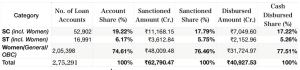
Table 1: Stand-Up India disbursements by social category, based on Department of Financial Services data.
From 2016 to 2025, around 22.49% of all money disbursed under the Stand-Up India scheme went to SC and ST entrepreneurs together. There are also high documentation requirements and margin requirements of up to 25%. This clearly indicates that even when formal credit is available, structural barriers like collateral, networks, and bureaucratic delays filter most vulnerable Dalit applicants out. Because of the lack of traditional collateral, 82% of Dalit borrowers rely on informal lenders and high-interest borrowing parties.
Furthermore, MUDRA Bank (Micro Units Development and Refinance Agency Bank), formally established in 2015, is a prominent credit scheme of the incumbent government, but the data exposes the structural limitations of the institution’s reality that the government does not want to focus on. Around 51% of MUDRA accounts belong to SC/ST/OBC categories. However, the way these accounts are divided is staggering. Over 70% to 80% of all MUDRA loans fall under the “Shishu” category (under ₹50,000). A loan of ₹30,000 or ₹40,000 cannot build a competitive, wealth-generating start-up. It can only buy a fruit cart, a sewing machine, or open a tiny roadside tea stall. Effectively, such amounts are more suited to small-scale livelihood activities than to building a competitive, wealth-generating enterprise. The state celebrating “start-up culture” is actually promoting necessity entrepreneurship, a term for entrepreneurship born out of an absolute absence of alternative employment options. A study by Jarwal and Kahal (2022) similarly finds that the growth of Dalit entrepreneurship as an impact of liberalisation policy can be positive; however, this has resulted in a proliferation of very small business units, which are mainly engaged in survival activities. The study further states that most Dalit-owned enterprises were established out of the necessity to survive. This is because their owners did not get employment opportunities, and had they received employment opportunities, they would have been earning more than what they are currently earning through necessity entrepreneurship. This necessity entrepreneurship keeps people alive at a subsistence level, but it does not generate institutional capital or challenge upper-caste corporate monopolies. According to official Economic Census Data analysed by the Economic and Political Weekly (2025), 89% of rural and 72% of urban Dalit-owned enterprises are OAEs (Own Account Enterprises). Most do not grow into larger firms; they function primarily as a substitute for daily wage employment and household income to keep the family fed. For many Dalit entrepreneurs, entry into the entrepreneurial market is shaped less by the pursuit of a profitable market opportunity than by the limited availability of secure employment. Entrepreneurship therefore becomes a strategy for economic survival rather than a straightforward pathway to wealth creation. Thus, as scholars have already shown, market inclusion alone is not an explanation of Dalit economic empowerment.
Such divergent scenarios between governmental schemes and Dalit economic conditions make the market an unequal playing field. Along with the unequal access to financial capital, there is also a profound social imbalance: private capital in India does not operate through a socially neutral field, as a mathematical principle unaffected by social forces. Its allocation is shaped by historically embedded caste structures and institutions, concentrated among predominantly Baniya and other mercantile castes. Avichal Dhiwar, founder of 20th March Venture Pvt Ltd, said in an interview, “Despite having complete paperwork, we faced a lot of problems getting loans from banks. They made it so tough for us that we eventually realised that they had no intention of extending us any loan.” This clearly shows the need for a mandatory public credit system to prevent systemic market exclusion of marginalised entrepreneurs. However, even necessary government loans and other forms of financial assistance reach only 10% of Scheduled Caste (SC) units, clearly indicating credit starvation. Furthermore, traditional business chambers, such as FICCI and CII, and trade networks have historically been dominated by these mercantile castes, who hold a monopoly over market trust and proudly flaunt it. When massive corporate monopolies run into billions of rupees in bad loans (Non-Performing Assets), the state steps in to bail them out, absorbing the damage; here, corporate risk is socialised. However, when a marginalised Dalit entrepreneur seeks a micro-loan, the state forces them to take on immense personal credit risk in a volatile market without any state security. Rather than providing security against the risks generated by market participation, right-wing neoliberal policy increasingly encourages historically excluded groups to become market participants and assume responsibility for navigating those risks themselves. For marginalised communities such a market means “competition among wolves and lambs“, as mentioned by Dr. Ambedkar in States and Minorities (1947). As Fischer (2020) argues, social policy under neoliberal restructuring does not necessarily remove structural inequality; instead, policies designed to promote inclusion can produce what he describes as hierarchical or adverse forms of inclusion, in which marginalised populations are incorporated into markets while remaining disadvantaged within them.
For Ambedkar, this distinction was fundamental. Economic reform could not be separated from social reform. Opening the market does not create equality when the social relations governing access to that market remain unequal. Credit can provide an opportunity to enter the market, but it also creates an obligation to repay within an environment where access to assets, networks and stable markets remains highly unequal. Without control over credit, markets will become a field of monopoly and exploitation. An increase in privatisation also results in the government abdicating its responsibility to safeguard its citizens.
In Annihilation of Caste (1936), Dr. Ambedkar said,“The problem of the Untouchables is a unique problem… You cannot have economic reform unless you pursue social reform. … The division of labour under the caste system is not a mere division of labour. It is a division of labourers.” In the private informal sector, Dalits often work as low-tier subcontractors for larger firms, which is not empowerment in any politically, socially, or economically meaningful sense. Here, inclusion into the market happens without dismantling the structural barriers, such as caste networks, which keep Dalit businesses at the periphery. Therefore, targeted entrepreneurial policies under the right-wing government does not dismantle caste-based economic exclusion, but primarily facilitates Dalit participation within markets whose underlying structures remain unequal. The right-wing government is therefore simultaneously promoting Dalit entrepreneurship while leaving many of the structural conditions that constrain Dalit entrepreneurship intact.
What can be done?
Rejecting market participation because caste structures already shape the market and the inability of the government to safeguard rights is not a feasible solution. While under neoliberalism, individual entrepreneurship can function as a form of economic mobility; enterprise can be re-signified as a potent tool for collective social emancipation. Crucially, this social emancipation is not achieved through isolated individuals taking on personal liabilities in a structurally unequal market. Rather, it becomes possible only when market participation is backed by stronger public regulation of credit markets and corporate concentration, along with the development of independent, community-owned institutional capacities.
The government is meant to play a crucial role in enforcing existing policies requiring corporations, such as the policy requiring public sector undertakings (PSUs) to procure 4% of their supplies from SC/ST-owned micro and small enterprises, and entrepreneurs. They are also expected to provide concessional loans through the Venture Capital Fund for Scheduled Castes, etc. However, trusting the right-wing neoliberal regime to implement these policies sincerely or effectively is not realistic. Doing so would directly contradict its ideological alliance with corporate capital. Therefore, there is a need for counter-hegemonic power, where Dalit communities stop acting merely as scattered voters or isolated market actors and instead use their collective leverage to disrupt the system. This can be done by moving from individual credit risk to structural social democracy and by aggregating thousands of small Dalit producers into a large cooperative, so they gain bargaining power to compete against corporate monopolies. Sustained institutional action and litigation can also be used to document state non-compliance with procurement obligations and seek appropriate judicial remedies, including through PILs, while RTIs can be used to obtain the relevant records.
Finally, the Dalit community must construct its own autonomous institutional capacity to provide Dalit entrepreneurs with finance, information, mentorship and bargaining power. It will be a community-led ecosystem that integrates community-owned credit cooperatives, independent capital funds and digital business directories that pool resources to guarantee internal markets. These institutions would be unlike DICCI, which operates primarily as a networking hub within the existing structures of caste capitalism.
Building autonomous Dalit institutions does not absolve the state of its responsibility to safeguard rights and provide social security. Micro-loans alone cannot produce emancipation if they merely manage poverty without changing the conditions under which Dalits participate in the market.
Mrunal Madhuri Milind Dupte is a development economics researcher, anti-caste writer and public speaker working on inequality, Dalit and Buddhist economics.