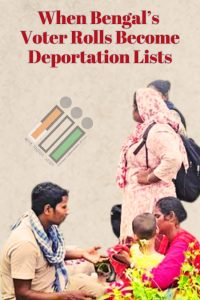
A report by Human Rights Watch has accused Indian authorities of forcibly expelling ethnic Bengali residents—predominantly Muslims—from West Bengal into Bangladesh without due process, leaving families stranded for days between the border forces of the two countries. According to the report, the Border Security Force (BSF) has, since early June, repeatedly attempted to push groups of people across the border, only for Bangladesh’s Border Guard (BGB) to refuse entry because no process of nationality verification had taken place. Families, including children and pregnant women, were reportedly left in the “zero line” between the two countries before some were eventually taken back by Indian authorities.
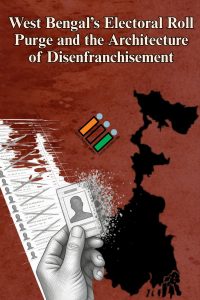
Several of those identified in the report were not recent entrants into India. They reportedly possessed Aadhaar cards, had lived in the country for decades and had participated in previous elections. Their detention followed the deletion of their names from West Bengal’s revised electoral rolls after the controversial voter-list revision that preceded the Bharatiya Janata Party’s victory in the state elections. In several reported cases, exclusion from the electoral rolls appears to have become the basis for detention and attempted deportation.
Over the last decade, citizenship has increasingly been determined through documentation rather than constitutional status alone. West Bengal is not the beginning of this story. The National Register of Citizens (NRC) exercise in Assam excluded nearly two million people from the final register, leaving thousands in prolonged legal uncertainty. Detention centres, foreigners’ tribunals and endless documentary verification, alongside the ethno-nationalist zeal with which these practices have been defended, have transformed citizenship from an assumed legal status into something that must be repeatedly established before the state. This is not to suggest that the pre-NRC order was free of structural violence, but the contemporary mutations mark a significant escalation in how citizenship itself is administered and contested. The current developments suggest that this administrative logic is no longer confined to Assam but is increasingly shaping citizenship practices elsewhere in India.
The political language surrounding these exercises follows a template that the Bharatiya Janata Party has steadily developed since the 1990s, drawing on older nationalist anxieties around borders. In West Bengal, where a shared Bengali identity historically complicated such narratives, that vocabulary has nevertheless gained political ground. Chief Minister Suvendu Adhikari has openly defended a policy of “detect, delete and deport”, claiming that thousands of alleged Bangladeshi “infiltrators” have already been sent back, even as both the legality of these actions and the official figures cited remain open to serious question.
The Human Rights Watch report also raises questions about the apparent bypassing of established repatriation procedures between India and Bangladesh. Dhaka has repeatedly maintained that it will not accept individuals pushed across the border outside agreed processes of nationality verification. The consequence has been families stranded for days between two states, each refusing immediate responsibility for people whose legal status remains contested.
These events expose a larger weakness in India’s legal framework governing migration and displacement. India remains outside the 1951 Refugee Convention and its 1967 Protocol and has no comprehensive refugee or asylum law. The principle of non-refoulement—the obligation not to return a person to a territory where they face persecution or other serious harm—therefore does not exist as a comprehensive statutory guarantee. Indian courts have, in some cases, extended Article 21 protections to non-citizens. Even so, refugee protection continues to depend largely on executive policy and judicial interpretation rather than a coherent legislative framework.
The people described in the Human Rights Watch report are not necessarily refugees in the legal sense. Many are individuals whose nationality itself is disputed. Ideally, constitutional safeguards and judicial oversight would protect such vulnerable populations. Instead, the higher judiciary has, over the years, increasingly retreated from that role in matters of citizenship, at times reinforcing rather than restraining the state’s exclusionary powers. Yet the absence of a clear legal framework leaves similar questions to executive discretion: who is heard, who is detained, who is deported and what procedural safeguards apply before those decisions are made.
The law says little about undocumented migrants whose labour sustains agriculture, construction, brick kilns, domestic work, manufacturing and much of the informal economy. Their work is absorbed into the economy while their precarious legal status leaves them vulnerable to wage theft, coercion, detention and deportation. Their labour is needed; their rights remain contingent.
The implications also extend to caste. Documentary citizenship has never operated on a socially level field. Landlessness, forced migration, displacement, informal labour and unequal access to education and state institutions have meant that documentary histories are themselves unevenly distributed. Communities historically pushed to the margins—including Dalits, Adivasis, denotified and nomadic tribes, migrant workers and many borderland populations—are often least equipped to satisfy expanding bureaucratic demands for proof. Administrative neutrality can therefore reproduce deeply unequal social outcomes without ever invoking caste explicitly.
That is why the current moment should not be viewed simply as a border issue or a dispute over illegal immigration. The expulsions are the endpoint of a much longer administrative process through which citizenship itself becomes uncertain. The border merely reveals a process that begins much earlier—in electoral rolls, identity databases, police verification, citizenship registers and executive discretion.
The expulsions at the India-Bangladesh border are not an isolated border episode. They reveal how questions of citizenship are increasingly being settled through administrative action before they are settled in law. Once belonging itself becomes contingent on documents that can be revised, withdrawn or disputed, the Constitution ceases to function as a guarantee and instead becomes something that citizens must repeatedly prove themselves entitled to.
Paresh Hate is a Bahujan queer researcher, writer, documenter and activist and the Lead Content Manager at Dalit Voice.