
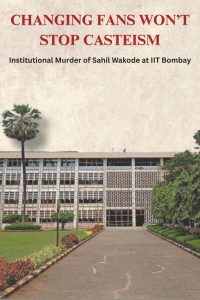
There is a persistent, naive belief in India that premier engineering institutes are pristine spaces of pure meritocracy, immune to the social hierarchies of the world outside. The institutional murder of 22-year-old Sahil Ravindra Wakode at IIT Bombay violently shatters this myth. Sahil, a first-generation student from Yavatmal, entered IIT carrying the monumental hopes of his parents, who had endured lifelong socioeconomic deprivation. Academically stellar, with a category rank of 614 in JEE Advanced and an 8.5 CGPA in his first year, he was exactly the kind of brilliant mind these institutions claim to nurture. Yet, upon stepping into this elite campus, he encountered an environment engineered not for his intellectual growth but for his profound psychological alienation.
A Predictable Structural Output
What transpired on September 18, 2026, was not an isolated tragedy or an individual anomaly. It was the predictable output of a structurally casteist institution.
Data shared by IIT Bombay sociologist Prof. Suryakant Waghmore reveals a grim reality: between 2019 and 2023, of the students who dropped out of IITs, 56% were from the General Category, 25% OBC, 13% SC, and 5% ST. These disproportionate figures are the direct consequence of systematic, daily caste-based hostility. The mechanism of this exclusion is well-documented: marginalized students, often first-generation learners from rural or non-English medium backgrounds, are thrust into a hyper-competitive campus culture dominated by upper-caste privilege. A recent interim report by the National Task Force (NTF) explicitly noted that students from disadvantaged communities face severe isolation because they are routinely excluded from the dominant campus culture, failing arbitrary social “vibe checks” set by privileged peers. Ground reports reveal that Dalit and Adivasi students are frequently stigmatized as “reservation candidates,” alienated from informal peer study groups and subjected to constant indirect pressure and microaggressions from unsensitized faculty.
When academic struggles arise, this pre-existing environment of social boycott and lack of institutional mentorship compounds their stress into profound psychological trauma, ultimately forcing them to drop out simply to survive.
During a mid-term examination, Sahil was caught using his mobile phone to search for answers on ChatGPT. Under extreme academic stress, this is a disciplinary infraction that warrants standard administrative recourse. Instead, the invigilator, Prof. Suryanarayan Doolla, allegedly bypassed procedural norms, subjecting Sahil to profound public humiliation and threats of immediate expulsion. This hostility was not a sudden outburst. For three months prior, Sahil’s father alleged that Prof. Doolla had constantly taunted and humiliated Sahil over his caste.
This tragic pattern echoes the institutional deaths of Darshan Solanki (2023) and Aniket Ambhore (2014), where internal mechanisms ultimately operated to shield the administration, and there is little reason yet to expect a different outcome this time. In Solanki’s case, the 12-member internal committee headed by Prof. Nand Kishore shamelessly blamed his death on ‘poor academic performance’ and ‘aloofness,’ deliberately ignoring multiple testimonies and prior SC/ST Cell surveys that documented severe caste-based alienation on campus. Similarly, after Aniket Ambhore fell to his death, the A.K. Suresh Committee report recorded that professors had humiliated him for being a ‘category student’ and suggested he belonged in a ‘normal’ engineering college. Rather than penalizing the offending faculty, the institutional response minimized this overt casteist violence as mere ‘academic pressure,’ protecting the institution’s reputation at the direct expense of truth and accountability.
Administrative Deflection: Individualizing the Systemic
The administration’s immediate reflex was to criminalize Sahil, reducing a systemic failure to a singular moment of student misconduct. Within hours of his death, IIT Bombay hastily issued a statement explicitly accusing him of copying via AI, feeding a convenient “cheating” narrative to the media. When student outrage erupted over this blatant lack of empathy, the administration deleted the statement, only to issue an apology days later on X (formerly Twitter) which admitted it was ‘inappropriate’ to characterize details before investigations concluded, stripped of any meaningful accountability.
CCTV footage from the exam hall and hostel lobby entered the public record as part of the investigation. A source described the footage: between 12:30 and 12:45 PM, just minutes before the exam was to end at 1 pm, Sahil was seen bending and checking something in his pocket, after which Prof. Doolla was seen questioning him and taking him aside, away from other students. The same source said Wakode was then seen leaving the hall and, by around 1:25 pm, entering his hostel room, after which he did not leave again before he was found dead.
This timeline, once public, kept the story anchored to the exam-hall infraction: a student caught peeping at his phone, confronted by his invigilator, entering his room forty minutes later. What it does not show, and cannot show, is the three months of alleged caste-based taunting that preceded it. By foregrounding a visual record of the “cheating” moment while offering no equivalent documentation of the harassment the family alleges, the timeline reinforces the same individualizing frame as the administration’s original statement: it locates the cause of Sahil’s death in a single infraction rather than in a pattern of institutional hostility building for months.
The Crisis of Representation and Profound Isolation
The root cause of this unchecked harassment is the glaring absence of marginalized communities in positions of academic power. Out of 6,000 professors across IITs in the country, only 149 belong to Scheduled Castes (SC) and 21 to Scheduled Tribes (ST). This meager 2.8 percent vividly illustrates a reality of academic apartheid. Representation is an active structural antidote to institutional violence. When campuses lack Dalit, Adivasi, and Bahujan faculty, marginalized students are cut off from organic mentors who can decode their unique sociological realities and intervene before distress turns fatal. Without such allies in academic and administrative bodies, grievances of casteism inevitably hit a brick wall of apathy erected by an overwhelmingly upper-caste establishment, one that routinely lacks the sociological vocabulary to perceive caste violence, dismissing it as ‘individual merit failure.’ True representation breaks this cycle because faculty from oppressed backgrounds possess the institutional legitimacy to challenge biased disciplinary actions and dismantle the discriminatory peer dynamics and psychological isolation that force first-generation learners to internalize their trauma.
The systemic closing of ranks to protect upper-caste faculty is horrifying. Following protests by nearly 6,000 students, IIT Bombay merely removed Prof. Doolla from his post as Dean of Administrative Affairs, flatly refusing to suspend him from his active professorship. This distinction is a deeply sinister protection racket. By retaining his teaching, research, and departmental evaluation roles, the administration ensures that an individual accused of severe caste-based intimidation continues to wield life-and-death academic power over students in the very classrooms where these abuses occur. It signals to the campus that an accused upper-caste professor can be temporarily shuffled out of the public eye to defuse protests, while his systemic authority to grade, pass, or fail vulnerable students remains completely untouched. This ongoing structural proximity to power leaves marginalized learners utterly defenseless, trapped under the authority of the very educator accused of driving their peers to the edge.
In response to the criminal FIR filed under the SC/ST (Prevention of Atrocities) Act against Prof. Doolla, the ‘IIT Bombay Faculty Forum’ and the ‘IIT Delhi Faculty Forum’ rushed to issue coordinated defensive statements, framing Doolla as an educator ‘discharging his academic duties’ against a student accused of ‘academic malpractice.’ The IIT Delhi Faculty Forum audaciously condemned the massive student-led demonstrations, warning against what it termed ‘mob-driven behaviour’ that supposedly pressured the administration into taking action. This rhetorical framing is a cynical, institutional inversion of reality: it pathologizes student solidarity and legitimate political outrage as a ‘mob,’ criminalizing accountability while shielding an upper-caste professor from legal scrutiny. This collective closing of ranks exposes an ugly, protective arrogance: the system will ruthlessly safeguard its own elite status and shield its perpetrators at the direct expense of marginalized student lives.
Performative Gestures vs. Structural Remedies
Despite four students losing their lives under the tenure of the current Director, Prof. Shirish Kedare, the administration’s most heavily publicized “solution” to this crisis was a cynical architectural modification: removing ceiling fans from hostel rooms and installing wall-mounted ones. This administrative reflex lays bare a profound moral bankruptcy and an evasion of institutional responsibility. This shows a lack of comprehensive and considerate thinking toward student welfare. In the presence case, too, modifying ceiling fans treats only the final, terminal physical symptom of unbearable psychological distress, while leaving the actual, rotting disease, institutional casteism and unchecked faculty harassment, entirely untouched. This intervention operates on a perverse and absurd logic: it assumes that removing a mechanism of self-harm eliminates the profound despair that causes it, ignoring the toxic, hostile environment engineered by upper-caste hegemony that drives these brilliant minds to the edge. It is a hollow, paternalistic cosmetic fix designed solely to insulate the administration from legal liability and public outrage, substituting genuine, structural accountability with superficial tinkering that treats human lives as mere logistical inconveniences.
Nationwide, a staggering 171 students have committed suicide in IITs over the last 20 years. Altering the method of death while leaving the toxic environment intact is an insult to the lives lost. Real remedy cannot be found in performative, procedural gestures. The solutions must be structural and uncompromising:
Mandatory Anti-Caste Sensitization: Professors and administrators must undergo rigorous, mandatory anti-caste education to dismantle centuries-old biases, moving far beyond superficial paper compliance. This demand is a direct corrective necessitated by Prof. Doolla’s alleged conduct and the elite institutional immunity that protected him. Had rigorous anti-caste training been mandatory, the months of alleged casteist taunts, public humiliation in the exam hall, and the subsequent closing of ranks by faculty forums would have been treated as structural crimes rather than routine disciplinary exercises. Sensitization must dismantle the upper-caste impunity that allows figures in power to weaponize academic rules against marginalized students without administrative consequence.
Independent Investigations & Accountability: Internal inquiries are historically biased. Investigations into student deaths and allegations of caste discrimination must involve independent committees with external democratic representatives to ensure transparency, able to investigate faculty conduct and administrative attempts to shield those accused of misconduct. Their findings must lead to clear institutional action rather than being buried in internal procedures. No faculty body or administrative office should be allowed to investigate itself when students’ lives and allegations of caste discrimination are at stake.
Robust Mental Health Infrastructure: The emotional bankruptcy of these institutions must end. As demanded by the protesting students, there must be an independent audit of the Student Wellness Centre, the appointment of at least one counselor per hostel (or per 250 students), and 24/7 availability of trained psychiatrists equipped to understand the sociological realities of caste trauma. Students must be able to seek help without being treated as the problem or fearing consequences within the institution. Mental health support must recognise caste humiliation and discrimination as sources of distress rather than reducing every crisis to academic pressure.
True Representation: Aggressive and inclusive faculty recruitment policies must be enforced to bridge the 2.8% representation gap, bringing Dalit, Adivasi, and Bahujan voices into positions of academic authority. This cannot mean a few token appointments while decision-making remains dominated by the same social groups. Reserved positions must be filled and representation must extend to committees and positions with real institutional authority. Students should not have to navigate institutions where almost no one in a position of power shares or understands their social experience.
Until this arrogant system of so-called ‘merit’ acknowledges that its campuses function as exclusionary spaces for the marginalized, institutions like IIT Bombay will continue to fail their students. Accountability must be demanded, and the structural roots of casteism must be dismantled, so that no more students are driven to the edge by the very institutions meant to educate them.
Mujammil Shahin Siraj Shaikh is a Pune-based independent researcher and prospective PhD scholar examining structural inequality, public policy, and institutional power in modern India.
