
When the State Can Take Your Institution: FCRA and How the Civil Society Is Being Choked Financially

India’s Foreign Contribution (Regulation) Act was introduced in 1976, during the Emergency, to regulate foreign influence in Indian political life. The 2010 Act replaced that framework with a broader system for regulating foreign contributions to organisations and associations. Over time, FCRA has also given the state increasing power over whether organisations can access foreign funding and continue their work. The latest changes take that process further.

The Foreign Contribution (Regulation) Amendment Bill, 2026 was introduced in the Lok Sabha on 25 March and referred to a Joint Parliamentary Committee on 12 August. It is not law yet. The 2026 Rules, however, are already in force. Together, they significantly tighten the conditions under which organisations receiving foreign contributions can operate.

The Bill proposes a Designated Authority to supervise foreign contributions and assets after an organisation’s FCRA registration is cancelled, surrendered, expires or is not renewed. The Authority can take provisional custody of the foreign contribution and relevant assets. If the registration is not restored or renewed within the prescribed period, the assets can vest permanently in the Authority and subsequently be transferred or disposed of, with the proceeds going to the Consolidated Fund of India. The proposed framework also covers assets created partly from foreign contributions.

There is an important detail here. The principle of asset vesting is not entirely new. Section 15 of the existing FCRA already provides for the vesting of assets created out of foreign contribution when an organisation’s registration is cancelled or surrendered. What the 2026 Bill does is build a much more elaborate administrative machinery around that principle, giving the state greater control over what happens to those assets. And this matters because the state already has considerable power to make an organisation incapable of functioning long before anyone arrives to take possession of its assets.

The state does not need to seize an organisation’s property to make it unviable. The cancellation or non-renewal of an FCRA registration can cut off its access to foreign funding, while investigations and regulatory proceedings can tie up its finances and consume the administrative capacity needed to keep the organisation running. By the time an organisation is able to challenge such action, it may already have lost the ability to function as it once did.

The 2020 amendments established much of the architecture that made this possible. The ceiling on administrative expenditure was reduced from 50% to 20% of foreign contributions. That expenditure includes basic organisational costs such as personnel, salaries, travel and management. At the same time, organisations receiving foreign contributions were prohibited from transferring those funds to other organisations, effectively ending the sub-granting arrangements through which larger organisations had supported smaller grassroots groups.

The consequences for smaller organisations were particularly severe. A national organisation could previously receive foreign funding and pass some of it to a local group working in a remote district. After 2020, that channel was closed. The local organisation had to deal with the compliance burden itself, even when it lacked the staff, money or administrative capacity to do so.

The 2020 amendments also required foreign contributions to be received through an FCRA account at the State Bank of India’s New Delhi Main Branch on Sansad Marg. For organisations working in rural areas or distant states, even a basic banking requirement became another layer of centralised administrative control.

This has happened alongside a dramatic contraction in the number of active FCRA organisations. Thousands of registrations have been cancelled or allowed to lapse over the years. Organisations including Amnesty International India, Oxfam India and the Centre for Policy Research have faced cancellation, suspension or non-renewal.

The 2026 Rules add further conditions. Organisations must now identify the purposes for which they intend to use foreign contributions and the states or Union Territories in which they intend to operate. Their FCRA registration is consequently tied more closely to specified purposes and geographical areas. The Rules also expand disclosure requirements concerning activities, office bearers, publications and social media accounts. An organisation must demonstrate that it has undertaken “reasonable activity” by utilising at least ₹10 lakh in foreign contribution over the preceding two financial years. For organisations receiving foreign contributions in instalments under prior permission, the release of a subsequent instalment is tied to utilisation of at least 75% of the previous instalment and a field inquiry.

These requirements are presented as compliance measures. But compliance itself is a mechanism of control where the state has the power to decide whether an organisation has done enough, worked in the right place, spent enough money or remained within the purposes recorded on its certificate.

This is particularly useful to a government that wants to curb progressive work while abandoning its own responsibilities to the people. Organisations working with communities affected by caste violence, displacement, environmental destruction, poverty and state violence can be weakened through the same machinery that is supposed to regulate their funding. The state retreats from its public obligations while strengthening its ability to constrain those who organise in the spaces it leaves behind.

The implications extend beyond organisations conventionally described as NGOs into spaces that are squarely political. Civil society includes legal aid groups, research institutions, health organisations, women’s collectives, workers’ organisations, environmental groups, educational initiatives and organisations working with Dalit, Adivasi and minority communities. These institutions document violence, gather evidence, challenge government policy and provide services where state institutions are inaccessible or inadequate.

It also includes religious and minority institutions. The government has stressed that the 2026 Rules continue to permit specified faith-based welfare and religious activities, including religious education, maintenance of places of worship and charitable work. At the same time, the Rules place foreign-funded activities within increasingly specific categories and exclude proselytisation from the permissible religious purposes.

This is pertinent in a country where schools, hospitals, shelters and charitable institutions are run by religious and minority organisations, especially in a context where successive governments have failed to carry out their public and institutional duties effectively. Why should the state possess such extensive administrative power over institutions that provide social services while it fails to do the bare minimum?

As Azam Khan writes in Maktoob, the changes represent “a systematic attempt to control and subjugate the social fabric of India.” An independent organisation that researches caste violence, documents environmental destruction, provides legal aid to workers or challenges a government policy creates an institutional space from which the state can be questioned. That space matters precisely because it exists outside direct government control.

The history of FCRA shows how this power has accumulated. A law introduced to regulate foreign political influence has become a mechanism through which the state can determine which organisations receive foreign resources and how long they are allowed to operate with them. The 2020 amendments tightened the financial conditions. The 2026 Rules add further administrative requirements. The 2026 Bill extends state control to what can happen to an organisation’s assets after its FCRA registration ends.

The result is a civil society whose institutional survival is increasingly placed in the hands of the executive. Independent institutions create space for people to organise outside the state and produce knowledge that can challenge official accounts. When those institutions are weakened, the communities that depend on them lose some of their capacity to make their experiences visible and press their demands. And when that space shrinks, so does the space available for dissent.


DalitThinkerToday is a Chartered Accountant by profession from Sangli, Maharashtra, who occasionally dabbles in thinking about politics when people in her oppressor-caste-majority office frustrate her. This is her pseudonym.
Who Gets to Roar Like a Tigress? Neoliberalism, Marketised Education and Caste Inequality

India has expanded education as a formal right while simultaneously allowing the conditions under which that right is exercised to become increasingly differentiated by market capacity. Because market capacity is structured by caste and class, the marketisation of education can undermine the equalising function that constitutional education rights were intended to serve.


Article 21A, inserted through the Constitution (Eighty-Sixth Amendment) Act, 2002, establishes free and compulsory education as a fundamental right for all children between six and fourteen years of age. The Right of Children to Free and Compulsory Education Act, 2009, provides the statutory framework for implementing this constitutional guarantee. This places an obligation on the government to ensure that free and compulsory education reaches children across the most disadvantaged sections of society.

However, there is an evident gap between what the Constitution proclaims education must be, namely, not a private commodity, and what is happening under a neoliberal economic structure. While the right to education is formally universal, as it should be, the quality and conditions under which that right is delivered remain deeply unequal, disproportionately affecting the most vulnerable sections of society, particularly students from SC/ST communities.

In India, there are broadly two types of institutional spaces that provide education and shape the kind of education, exposure, infrastructure, and social networks available to a child: private schools and public schools. Private schools operate through fees and market demand, with annual fees ranging from thousands to several lakhs of rupees, and reaching as high as ₹28–30 lakh in some elite schools. Their appeal is often associated not only with classroom teaching but also with advanced infrastructure, English-language education, extracurricular opportunities, technology, and claims of global exposure. Government schools, by contrast, depend substantially on public expenditure and government provision. A 2025 national survey indicates that average annual household expenditure per child in non-government schools was ₹25,002, compared with ₹2,863 in government schools, making household expenditure on non-government schooling nearly nine times higher.

The government budget for School Education and Literacy, as per the latest available Union Budget 2026–27, is ₹83,562 crore, of which around 70–80% goes towards salaries and administrative costs, leaving substantially less budget for infrastructure, school advancements, and labs. This substantially impacts the passing rate of students and the quality of education they receive.

When a private-educated student and a public-educated student enter a university, the field becomes unequal and highly disadvantageous for public-school students. It is within this unequal field that the neoliberal commodification of education becomes particularly important, as access to better educational opportunities increasingly depends on one’s ability to pay.

Neoliberalism places considerable emphasis on markets, competition, individual choice, and the withdrawal or restructuring of direct state provision. When applied to education, these principles can transform education from a predominantly public responsibility into a service increasingly mediated by market mechanisms. It drives the privatisation of government schools, turning education into a marketable commodity driven by competition, choice, and profit. This is what can be seen in the Indian education system.

Rather than increasing funding and upgrading public schools, the right-wing government has used policies to systematically transfer school ownership, management, or funding to private entities. This has resulted in the closure or merger of 94,000 government schools since 2014, as per a NITI Aayog report. That is 25 public schools per day. On the other hand, private unaided schools grew from 2.88 lakh to roughly 3.39 lakh.

This systematic institutional mobility of schools has resulted in two major shifts. First, the migration of public-school students towards private schools, numbering around 86 lakh. Second, those unable to transfer to or pay for private schools were denied their fundamental right to education.

Such consequences of this marketisation cannot be separated from India’s existing social structure. The ability to choose between schools is itself socially differentiated in India, as income, wealth, social capital, geography, and caste are already unequally distributed.

According to the UDISE+ (Unified District Information System for Education) school database system, around 68.7% of ST students and 62.4% of SC students rely on government schools. For them, public schools continue to function as a major educational lifeline.

A wealthy household facing declining public provision can respond by purchasing private education. A poor household may not have that option. The same policy therefore produces different consequences for different social groups. And therefore, when public education is weakened and monetised, the consequences are not distributed evenly across society, with SC and ST communities bearing a disproportionate share of the impediment.

Furthermore, the incumbent government has allocated just 4% of its GDP to education instead of the 6% recommended by NEP 2020. This gap in allocation, combined with the residual income gap among people, inadequate facilities, and caste domination in government schooling, provides a stark contrast between the constitutional right to formal educational inclusion and substantive equality in education.

In this class and caste divide, SC and ST students are among the most vulnerable. The inequality that begins with access to education continues into the opportunities available to students, eventually contributing to economic inequality. This creates a vicious circular system of unequal education.

unequal schooling → unequal educational attainment → unequal skills and credentials → unequal employment opportunities → reproduction of economic inequality.

Public schooling in India is not simply about education; it is also a political question. In India, neoliberal governance and right-wing politics are lovers, bound together in the making and remaking of the state’s approach to public education. Here, neoliberal restructuring can generate social and economic crises that produce grievances and uncertainty, which right-wing populism can then mobilise politically. In turn, right-wing populism can reinforce the same neoliberal restructuring by redirecting these grievances, generating doubt and distrust towards alternative political and economic narratives, and weakening challenges to the prevailing order.

The recent “School Thik Karo” movement by CJP provides a contemporary illustration of such a love story. The campaign involved visits to government schools, interaction with students, and demands for improvements in educational infrastructure and facilities. What government should fear a demand for better schools? However, rather than being understood simply as a demand for better schools, the campaign encountered political resistance, including restrictions on access to schools in Rajasthan and an FIR in Maharashtra.

This points to a broader tension: government schools are public institutions intended to deliver a constitutional right, yet demands for better infrastructure and greater accountability can become politically contentious. And once again, the consequences fall most heavily on those who have the fewest alternatives: SC and ST students.

Their inability to purchase education, or their household’s lack of the resources necessary to exercise that choice, is a systemic failure of neoliberalism. As neoliberal marketisation increasingly determines who can access quality education, the danger is that education itself, which is intended to enable social mobility, may instead reproduce the inequalities it was expected to overcome.

Dr. Babasaheb Ambedkar said, “Education is the milk of a tigress, and he who drinks it will not fail to roar.”

But what happens when that milk is filtered by income, caste, and market access? The milk is no longer the same for everyone. Some receive it diluted and adulterated, while others receive what allows them to roar. Who gets which kind of milk, and who decides?


Mrunal Madhuri Milind Dupte is a development economics researcher, anti-caste writer and public speaker working on inequality, Dalit and Buddhist economics.

Why Maharashtra Withdrew Its Temple Land Bill

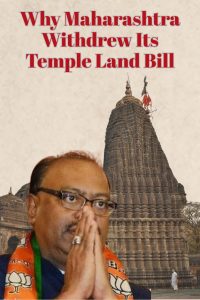
By the time Maharashtra’s Revenue Minister Chandrashekhar Bawankule announced that the government was withdrawing the draft Maharashtra Devasthan Inam Abolition Act, 2026, the proposed legislation had spent barely a month in the public domain. Published on May 6 for comments and objections, it was presented as an attempt to address one of the state’s longest-running land disputes: nearly 5.5 lakh hectares of Devasthan Inam land, much of it under encroachment or contested occupation, and temple trusts that had struggled to recover property endowed over centuries. Within weeks, however, the government abandoned the draft and promised to begin again.

The reversal followed sustained opposition from temple trusts and organisations including the Maharashtra Mandir Mahasangh, the Vishwa Hindu Parishad and the Hindu Janajagruti Samiti. More than a thousand trustees reportedly joined the campaign, hundreds of representations were submitted to ministers and district officials, and delegations met Chief Minister Devendra Fadnavis, Deputy Chief Minister Eknath Shinde and other senior members of the government.

When the withdrawal was announced, temple organisations described it as the outcome of a collective struggle. The government, for its part, insisted that it was merely responding to concerns raised during the consultation process and that a fresh draft would be prepared after wider discussions.

According to the Revenue Department, the proposed law sought to create a statutory mechanism for recovering temple lands from illegal encroachments while protecting the rights of lawful occupants. Officials argued that temple trusts often lacked the administrative and legal capacity to reclaim endowed properties and that the state could provide a more effective framework. Bawankule repeatedly said that the proposal had been conceived on lines comparable to the legal framework governing Waqf properties, allowing the government to assist in protecting religious endowments rather than leaving trusts to pursue long and expensive litigation on their own.

Temple organisations read the draft very differently. The Maharashtra Mandir Mahasangh argued that provisions of the Bill would effectively abolish historical Devasthan Inam grants made by earlier rulers and weaken rather than strengthen temple ownership. It objected to clauses that it said recognised ownership claims of some long-term occupants, questioned restrictions on approaching civil courts, and criticised what it described as differential treatment between temple lands and Waqf properties.

Whether those objections reflected the actual legal consequences of the draft or apprehensions about how the law might eventually operate is a wholly different matter. The Hindu fold today perceives itself to be victimised in public discourse despite having been in power at the Centre for the last twelve years and mobilises moralised protest tactics that are often rooted in narratives of self-victimisation. Whatever the merits of those objections, they were enough to stop the Bill before it reached the Assembly.

The government never argued that temple lands should change hands. On the contrary, ministers repeatedly said the purpose of the Bill was to help temple trusts recover lands that had slipped into encroachment and to give those properties stronger legal protection. The resistance came from temple organisations that feared the proposed law would give the state greater control over how disputes were settled and how rights over Devasthan land would eventually be determined. Their objections were directed less at the objective than at the mechanism through which the government proposed to achieve it.

For all the talk of ideological unity, governing and movement politics do not always pull in the same direction. The Devasthan Bill became one of those moments when the seams briefly showed. Electoral alliances often make those differences easy to miss. Yet land has always been a source of authority as much as a form of property. Questions of who records land and who settles disputes have a way of exposing those tensions.

The BJP has spent much of the past decade presenting itself as the party of a strong, interventionist state. Governing through legislation inevitably extends the state’s reach into institutions that have long operated through inherited arrangements and local authority. Temple trusts may welcome stronger protection for their lands, but greater state involvement also means surrendering some control over how disputes are settled and property is administered. That is where governments and religious institutions can begin pulling in different directions. The fault lines are not entirely new. They surfaced publicly during the online battles between the so-called “raitas” and “trads” during the Bulli Bai app case, and the Devasthan Bill suggests that those disagreements extend well beyond social media into much wider political constituencies.

It is striking that the government defended the draft by invoking the legal framework surrounding Waqf properties. The comparison was meant to reassure temple trusts that similar protections could be extended to temple lands. Yet the politics around Waqf have unfolded very differently in recent years. Legislative changes affecting Muslim institutions have largely proceeded despite sustained objections from Muslim organisations. In Maharashtra, by contrast, the government withdrew its own proposal before it reached the legislature, reopened consultations and gave temple representatives a central role in rewriting the Bill.

Temple organisations opposed the draft before it entered the legislature, secured meetings with senior ministers, compelled the government to withdraw its own proposal and now have formal representation on the committee tasked with preparing a revised Bill. The committee, headed by Additional Chief Secretary Vikas Kharge, includes fifteen representatives from temple trusts alongside senior officials from the Revenue Department.

Governments routinely ask farmers’ organisations, workers’ unions, unemployed youth and communities affected by displacement to wait for departmental reviews or expert committees. Families pursuing justice after caste-based violence often confront years of administrative delay and prolonged litigation before receiving meaningful responses. Many Muslim organisations have found themselves responding to legislative changes only after they have already been enacted and have then faced criminalisation for protesting. Temple organisations, by contrast, intervened while the law was still being drafted and altered its course before it reached the legislature.

The debate has also left largely unexplored the people living on Devasthan Inam land. Public discussion has centred on temples, trusts and encroachments, while remarkably little attention has been paid to the social composition of those occupying or cultivating these lands. The category of “encroacher” can include very different histories: long-term agricultural tenancy, informal occupation, disputed ownership, commercial acquisition and settlement by landless households over several generations.

The Devasthan Bill was withdrawn after organisations within the broader Hindutva fold challenged a government that is often assumed to speak for them. The next draft of the Bill will answer some legal questions. It may also answer a political one: how much room the state still has to regulate institutions that are among its closest ideological allies.


DalitThinkerToday is an Chartered Accountant by profession from Sangli, Maharashtra who occasionally dabbles in thinking about politics when people in her oppressor caste majority office frustrate her. This is her pseudonym.
Everything and Nothing All At Once: New Post-Ideological Shifts in Tamil Nadu

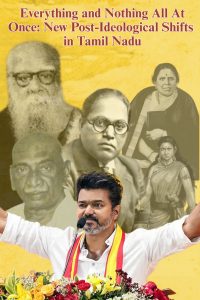
You are most likely to understand Vijay’s Tamizhaga Vetri Kazhagam (TVK) if you have had a friend who is a people pleaser. At Vijay’s first maanadu (political conference) in 2024, soon after the launch of his party, it was revealed that the five figures whose ideologies were going to guide TVK’s ways were Ambedkar, Periyar, Kamaraj, Anjalai Ammal and Velu Nachiyar; a confusing bunch and a perfect example of too many cooks spoiling the broth. What they all have in common, except broadly overlapping progressive leanings and four out of five of them living around the same time, is beyond me. This was perhaps the earliest public hint of a personality that wants to cover all his bases and make everybody happy.

The logical conclusion of aiming for universal appeal is the strange cocktail that is Vijay’s cabinet. We have CTR Nirmal Kumar, who is TVK’s Deputy General Secretary (IT and Social Media Wing) and the Minister of Energy Resources and Law, who previously served as the President of the State IT and Social Media Wing of the BJP between 2019 and 2023. He has/continues to have affiliations with the RSS and was very strategically (rather cunningly) made to contest in the Thiruparankundram Assembly Constituency, where the centuries-old conflict between a temple and a dargah in close proximity escalated last year into full-blown communal riots. The conflict is likely to resurface in November 2026 during the annual festival of lights (Karthigai Deepam), when the Hindus will once again ask that their deepam be lit 50 metres away from the dargah. And Nirmal Kumar, as the MLA of the constituency, will oversee it all.

The party’s treasurer and Minister for Food and Civil Supplies, P. Venkataramanan, is a Brahmin candidate fielded in the constituency synonymous with Brahminism itself – Mylapore. He has famously called anti-Brahminism an “old ideology” that “does not exist now” and is “not necessary in today’s society”. Beyond the venom in his words lies some valid grouse with a century-old anti-caste movement that is solely concerned with anti-Brahminism. It is evidence of no real or meaningful effort at caste eradication by any of the Dravidian parties at the helm of power for 60+ years. Even within the last 5 years of M.K. Stalin’s reign, the murder of Dalit men in cases of inter-caste marriages, the murder of K. Armstrong – the state President of the Bahujan Samaj Party; and, where caste and labour are intrinsically linked, the sanitation workers’ protest and the Samsung workers’ strike, were not handled by the DMK with the same care they use to craft their words. That both DMK and AIADMK consistently reduce their voters to their caste identity every election cycle, with their adamance about only allowing every region’s oppressor-caste candidates to contest in their respective constituencies, is an open secret. Unsurprisingly, the one group that is unanimously and vocally happy about TVK’s victory are the Brahmins.

The foundation of people-pleasing is deliberately allowing many different meanings to be read onto you. So Vijay’s cabinet also has someone like Aadhav Arjuna, the Minister for Public Works and Sports Development, who was briefly the Deputy General Secretary of a party as strong in its Dalit liberation ideology as the Viduthalai Chiruthaigal Katchi (VCK), formerly known as the Dalit Panthers of India. Ex-YouTuber Rajmohan, the state’s Education Minister, was sworn in along with 4 women, 7 Christian, 1 Muslim and 6 other Dalit ministers, making the cabinet one with the highest number of Dalit ministers in the state so far. It is unsurprising that Vijay’s anti-casteness is accepted without much scrutiny when he has openly campaigned with the photos of Dr. Ambedkar and visited the statues of Periyar and Iyothee Thaasar after coming to power. The support of prominent figures in the anti-caste movement, such as Pa. Ranjith, only helps this narrative spread liberally. But if we are to believe the support from all sides, then we have on our hands an anti-caste party that makes Dalit people and Brahmins equally happy.

TVK is a party that is willing, nay, eager to collaborate with the BJP government. Vijay’s first official statement after being declared victorious responded to Modi’s congratulations. When the governor repeatedly delayed inviting him to form the government, he did not unleash his anger in public, an act he seems to reserve solely for the DMK. Despite backlash at the Sanskrit Vande Maataram preceding Tamil Thai Vaazhthu at his swearing-in ceremony, he repeated the sequence of events when his ministers were sworn in. The relationship between Tamil Nadu and the Union Government is strained by multiple conflicts in the realms of taxation, the Union Budget, delimitation and Keezhadi, to name a few. Vijay’s stances on all of them are unclear.

The most crucial disagreement perhaps lies in the field of education, where the state has been demanding the abolition of NEET and resisting the National Education Policy. While Raj Mohan has declared that TVK will make no compromises on the two-language policy, ABVP representatives who met Vijay on the same day as this declaration have come back with half of their demands met. People-pleasing, it turns out, is not as harmless as it looks, for it consistently sides with power when conflict emerges. At the time of writing this, Vijay has not met the press directly even once; he has perhaps realised that emulating this behaviour has no consequence.

The default Hinduism that Vijay personally subscribes to, he is unafraid to bring to the public arena. Before the election results were announced (and for some part of his campaign), Vijay was seen visiting mosques, churches and temples with a secularism that took the tone of one eager to ease Hindu anxieties. Joseph Vijay, the first Christian Chief Minister and first chief minister from a religious minority in Tamil Nadu, is constantly seen wearing an arakaja pottu, a marker that cannot be read as anything but Hindu. On his second day in office, he appointed his personal astrologer, Rickey Pandit, as his Officer on Special Duty, proof of his complete disconnection from any sense of rationalism, a move he was made to retract within 24 hours in the face of harsh criticism on the assembly floor.

Despite its history with atheism and rationalism, Tamil Nadu continues to be a deeply religious place, and one needs a figure in the state that can absorb this. A decade ago, this was J. Jayalalithaa. Post her demise and the gradual dilapidation of the AIADMK, Vijay comes as a replacement. Whether this figure is a wall or a door is yet to be seen. The stakes of holding this position are obviously very different now than they were in 2016.

The BJP winning just 1 seat in 2026 compared to 4 seats in 2021 is evidence of their irrelevance in Tamil Nadu. But the rise of Hindutva is going to look very different here than it does in the rest of the country, for the overtness of the phenomenon cannot be the sole proof of its occurrence. The widespread success of films such as Amaran, Thai Kilavi and the latest Karuppu are indicative of the fact that Hindutva will be nurtured here, as long as its references are regional.

But the road against the fascism now simmering in the state is not paved by walking on eggshells. You stand against nothing when you stand for everything, and the pandering is bound to make cracks for the BJP to make its long-attempted entry. And this will be possible not because Vijay was foaming at the mouth with hate – the opposite is in fact true – but because he was too busy running an anti-caste, secular party that is willing to collaborate with the BJP and pleases Sanghis, Brahmins and everyone in between equally.


Kavipriya is a writer from Tamil Nadu who likes to research, read and write and is informed by anti-caste, feminist, socialist thought.

Conversions Voluntary: Swamy

Madras: RSS leaders are not unanimous in their opinion on Meenakshipuram. Subramanian Swamy, who hates Vajpayee and who in an article in the “Sunday” (10-5-81) criticised Vajpayee for his “fondness for girls and drink”, says untouchables became Muslims in Meenakshipuram as they were tortured by the Hindus.

The Janata Party general secretary disagreed with BJP leader Vajpayee’s views that money played a role in the Meenakshipuram conversion. He said they were voluntary. Such conversions may take place anywhere in the country, he told pressmen here on July 17. Swami, who visited Meenakshipuram earlier said what had happened there was the result of a complex sociological process and politicians should act to correct snags which led to such conversion. Subramanian Swami said in the Courtallam a series of incidents over a number of years culminated in the conversion. (Hindu 18-7-81).