
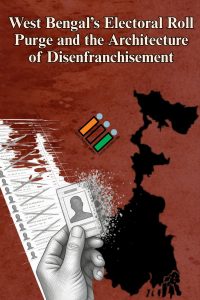
In the run-up to polling, West Bengal isn’t just approaching an election. It is also seeing a redrawing of who gets to participate. Voting is set for April 23 and April 29, yet for millions the right to vote has already been taken away through administrative action. The Special Intensive Revision (SIR) of electoral rolls has operated in much the same way as its precursor in Bihar and its antecedent, the National Register of Citizens in Assam: as a tool of exclusion shaped by bureaucratic force, opaque technology, and nationalist ideological direction.
Between 9 and 9.1 million names, close to 12 percent of the electorate, have been removed ahead of the 2026 Assembly elections. Over 6 million were categorised as absent, shifted, deceased, or duplicate. The deeper problem sits with the remaining 2.7 million people whose status is still unresolved. Many of them submitted documents, established links to earlier rolls including the 2002 list, and yet found their voting rights in suspension. The election is proceeding even as their claims remain undecided.
The exercise has been presented as an attempt to produce a “pure electoral roll.” In practice, it signals a move away from inclusion towards filtration. An AI-assisted system has been used to identify what are described as “logical discrepancies” in voter data: minor spelling differences in names, age gaps within families, or several individuals linked to a single parent. In a context where documentation is often uneven and shaped by linguistic and clerical variation, these benchmarks turn ordinary inconsistencies into reasons for exclusion.
The pattern becomes clearer in the numbers. Muslims, who make up about 27 percent of West Bengal’s population, account for roughly 34 percent of those removed, around 3.11 million people. Districts such as Murshidabad and Malda have seen particularly high levels of deletion. Dalit Hindu communities, especially those with histories of migration like the Matua community, have also been heavily affected in districts such as North 24-Parganas and Nadia. The impact is spread across groups, but it consistently bears down on those who are already vulnerable, dependent on documents, and politically marginal.
In border districts adjoining Bangladesh, where narratives of migration and infiltration have long circulated, deletions are especially high. North 24-Parganas alone has lost more than 1.26 million voters. In parts of Kolkata, close to 30 percent of voters in certain constituencies have been removed. Some polling booths have seen more than half their electorate disappear from the rolls. Entire neighbourhoods have effectively been thinned out in the days before voting.
The process has moved quickly, concentrated in the immediate lead-up to the election. While appeal mechanisms exist on paper, they are limited in practice. Nineteen appellate tribunals were established to hear challenges, but access has been restricted, hearings limited, and even legal representation reportedly curtailed. Deadlines for inclusion in supplementary rolls leave little room for proper adjudication. The rolls were frozen on April 9, excluding those whose cases are still pending.
What emerges is a system in which rights are not formally denied but held in suspension. Voters are asked to appeal, yet the process does not conclude in time to restore their participation. Disenfranchisement takes shape through delay and procedure rather than through an explicit refusal.
The Election Commission has carried out the revision using methods that remain difficult to scrutinise. The algorithm used to identify discrepancies has not been fully explained, and the criteria themselves differ from earlier exercises at this scale. A process once associated with expanding the franchise now casts large numbers of voters as suspect. In both its design and its execution, the approach sits closer to a broader political direction than to an independent constitutional role.
On the ground, the disruption is uneven and immediate. Within the same household, some names remain while others are missing, often without explanation. Individuals with long-established records, including presence in earlier electoral rolls, have been excluded due to clerical inconsistencies that frequently originate in state documentation itself. Differences in dates of birth, variations in spelling, or changes over time are enough to trigger doubt. The burden of proof rests entirely on the individual, even when the discrepancy is administrative.
This is how bureaucratic violence works. It does not rely on overt force. Instead, it imposes procedural demands that many cannot meet within the time and access available to them. It requires documents, verification, and compliance under compressed timelines. The outcome may appear technical, but its consequences are clearly political.
West Bengal remains a central electoral focus for the Bharatiya Janata Party, which has sought to expand its presence in the state. Campaign language around “infiltrators” overlaps with the categories produced through the SIR process. Administrative labels such as “doubtful” voters sit alongside political claims about illegal migration, often directed at Muslims. In this alignment, the revision of electoral rolls becomes part of a wider effort to reshape the electorate before voting takes place.
What is being reshaped is not only a voter list. It is the basis on which political participation is granted. The right to vote is becoming conditional, dependent on continuous verification and open to withdrawal through processes that lack transparency and accountability. The creation of large categories of “doubtful” voters embeds that uncertainty.
This is not an abstract question of representation. It reflects a further narrowing of an already constrained democratic space. When millions are excluded from the electoral process through procedural means, the issue extends beyond electoral outcomes. It concerns who is recognised as part of the political community, and who can be removed from it without consequence.
Paresh Hate is a Bahujan queer researcher, writer, documenter and activist and the Lead Content Manager at Dalit Voice.