
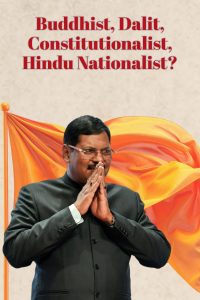
The first Buddhist—and only the second Dalit—to serve as Chief Justice of India, B. R. Gavai held office from 14 May to 23 November 2025. On 20 April 2026, he was seen inside Bageshwar Dham. He offered prayers before Balaji, then sat down with Dhirendra Krishna Shastri. A photograph of the deity was presented to him. The meeting ran for roughly half an hour, touching—at least on the surface—on spirituality, social work, and the Gurukulam project. It was not his first visit.
But neither the setting nor the company was neutral.
In early November 2025, the same figure he met had led a travelling mobilisation across Delhi, Uttar Pradesh, and Haryana. It was introduced as a padyatra for unity: a call to end caste divisions, a call for Hindu consolidation. It also demanded that India be declared a Hindu Rashtra. Over hundreds of stops, the rhetoric sharpened. “Love jihad.” “Land jihad.” Warnings of demographic collapse. Calls for economic boycott, for expulsion. Violence, reframed as vigilance. This was not Dhirendra Shastri’s first stint at genocidal bigotry and hate speech. He is popular across the internet for precisely this.
The distance between a constitutional court and such mobilisation is supposed to be absolute. Not only in law, but in conduct. When that distance contracts into a ritual visit—followed by an easy, cordial exchange—the issue is no longer personal belief. It is alignment, made visible.
The speeches delivered during that padyatra did not stay within the realm of faith. Minorities were named as demographic threats. There were suggestions that property would be taken over. Warnings that unless Hindus united, violence would spread “in every gali.” Questions about why “these people” become terrorists. Partition invoked to justify future consolidation. The idea that dissenters should leave the country was normalised. Economic segregation was not just implied; it was openly urged. Citizenship itself was recast in religious terms.
This is where context begins to matter. Because the visit does not stand alone. During his tenure, the former Chief Justice spoke of a “swadeshi” jurisprudence—one that consciously stepped away from foreign precedent. Around the same time, the Prime Minister called for India to shed its colonial mindset. Right-wing decolonization is in fashion these days, applied to laws across the board and the former Chief Justice did not want to be clearly left behind.
For many Ambedkarite and anti-caste activists, none of this comes as a surprise. The criticism did not begin with this visit; it has a longer lineage. Figures like R. S. Gavai, the former Chief Justice’s father, have often been criticised for moving away from grassroots mobilisation, for aligning too closely with dominant political formations, and for reducing anti-caste politics to symbolic presence within state structures. The outcome, critics argue, is not transformation but accommodation. Similar apprehensions resurfaced when his son assumed the office of Chief Justice.
The six-month tenure of Gavai itself offers a broader frame. Established conventions were set aside. The power of the roster was used not merely to assign cases but, at times, to shape outcomes. Precedents were revisited—sometimes sidestepped—through procedural manoeuvre. The boundary between administrative authority and judicial intervention grew less distinct. What emerged was a concentration of power in the office of the Chief Justice, with fewer visible constraints. Again and again, institutional limits appeared negotiable, with outcomes that often aligned with what the central executive stood to gain.
The consequences were uneven but telling. Constitutional challenges to executive action lingered, sometimes until they lost relevance altogether. At the same time, other matters moved with striking urgency. The pattern is familiar: delay in one direction, speed in another. The effect is anything but neutral. It stabilises certain outcomes while postponing others. Alongside this, opacity deepened. The collegium drifted further from public scrutiny, decisions were issued without recorded reasons, and even internal dissent rarely surfaced.
There were also moments when the Court’s interventions more directly expanded executive advantage. The creation of a pathway through Presidential Reference effectively offered the central executive a second chance to revisit decisions it found unfavourable. It was not framed as a privilege. In practice, it functioned as one.
Taken together, these are not isolated developments. They trace a pattern of judiciary’s growing subservience to a Hindu nationalist government. Seen against that background, the visit to Bageshwar Dham acquires a different meaning. It stops looking like a personal act. It begins to read as part of a larger alignment between institutional conduct and an expanding ideological environment. It does not matter that Gavai no longer holds the office. Like many ex-CJIs, he too will continue to dazzle in the limelight for a while, especially due to the hanging out in the corridors of this government.
The meeting itself was small. Thirty minutes. A ritual, a conversation, a photograph. But politics doesn’t always depend on scale. It also moves through signals. And this one was unmistakable.
Paresh Hate is a Bahujan queer researcher, writer, documenter and activist and the Lead Content Manager at Dalit Voice.