India Continues Displacement of Tribals

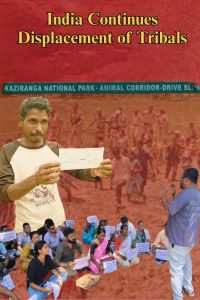
The demolition of homes belonging to Adivasi tea-tribe families in Hatikhuli Bagicha near Kaziranga marks the latest escalation in a dispute over land acquired for a proposed five-star luxury hotel and cultural centre backed by the Assam Tourism Development Corporation (ATDC). According to campaigners, the demolitions have displaced families who had long lived and cultivated the area, bringing into effect a project that has faced sustained opposition from local residents, land rights groups and environmental activists.

The dispute centres on land at Ingleng Pathar and Hatikhuli, adjacent to Kaziranga National Park. Local organisations maintain that many families have cultivated the land for generations, continued to pay land revenue, and possess raiyati records or periodic pattas despite the land being classified as government land. In June, the Assam Chah Mazdoor Sangha (ACMS) demanded a high-level inquiry into the land allotment, alleging that the land had been reclassified and transferred to a hospitality company without consulting the communities dependent on it. The union also stated that residents had resisted eviction attempts for four to five years while seeking formal recognition of their land rights.

The controversy deepened after the Assam government signed an agreement with Hyatt Hotels in September 2023 to develop a luxury hotel near Kaziranga’s central range. The proposed project affects land cultivated by more than forty farming families, most of them from tea-tribe communities. Protesters have argued that the project would displace long-settled residents while further expanding hospitality infrastructure in an ecologically sensitive landscape used by wildlife moving between Kaziranga and the Karbi Anglong hills during the annual floods. Environmental groups have similarly raised concerns about the impact of construction on wildlife corridors and habitat connectivity.

Public opposition intensified through demonstrations in June and July, following which indigenous rights activist Pranab Doley and several others were arrested on charges including unlawful assembly, criminal conspiracy and rioting. Police alleged that protesters entered the project site and obstructed construction, while Doley and land rights organisations described the arrests as an attempt to criminalise resistance to displacement. Soon after, a group of UN experts expressed concern over the detention of five indigenous rights activists, warning that the arrests could have a chilling effect on civic space and undermine the ability of indigenous communities to defend their rights. They called for the release of any activists detained solely for the peaceful exercise of their rights and urged the suspension of land acquisition and development until affected communities had been meaningfully consulted and their free, prior and informed consent obtained.

The developments at Kaziranga reflect a pattern that extends well beyond Assam. From the Ken-Betwa river-linking project in central India to the Great Nicobar Island Development Project, large-scale projects justified in the name of development have repeatedly advanced despite concerns over ecological integrity and the destruction of longstanding human habitats. Whether the issue is the displacement of Adivasi cultivators, the future of the Nicobarese community and the survival of the Shompen, or the loss of forest commons, the concerns of affected communities are repeatedly set aside in favour of state-backed commercial and strategic priorities.

When Bengal’s Voter Rolls Become Deportation Lists

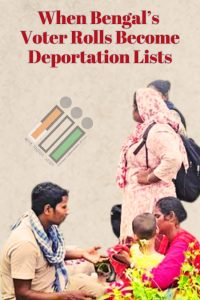
A report by Human Rights Watch has accused Indian authorities of forcibly expelling ethnic Bengali residents—predominantly Muslims—from West Bengal into Bangladesh without due process, leaving families stranded for days between the border forces of the two countries. According to the report, the Border Security Force (BSF) has, since early June, repeatedly attempted to push groups of people across the border, only for Bangladesh’s Border Guard (BGB) to refuse entry because no process of nationality verification had taken place. Families, including children and pregnant women, were reportedly left in the “zero line” between the two countries before some were eventually taken back by Indian authorities.

Several of those identified in the report were not recent entrants into India. They reportedly possessed Aadhaar cards, had lived in the country for decades and had participated in previous elections. Their detention followed the deletion of their names from West Bengal’s revised electoral rolls after the controversial voter-list revision that preceded the Bharatiya Janata Party’s victory in the state elections. In several reported cases, exclusion from the electoral rolls appears to have become the basis for detention and attempted deportation.

Over the last decade, citizenship has increasingly been determined through documentation rather than constitutional status alone. West Bengal is not the beginning of this story. The National Register of Citizens (NRC) exercise in Assam excluded nearly two million people from the final register, leaving thousands in prolonged legal uncertainty. Detention centres, foreigners’ tribunals and endless documentary verification, alongside the ethno-nationalist zeal with which these practices have been defended, have transformed citizenship from an assumed legal status into something that must be repeatedly established before the state. This is not to suggest that the pre-NRC order was free of structural violence, but the contemporary mutations mark a significant escalation in how citizenship itself is administered and contested. The current developments suggest that this administrative logic is no longer confined to Assam but is increasingly shaping citizenship practices elsewhere in India.

The political language surrounding these exercises follows a template that the Bharatiya Janata Party has steadily developed since the 1990s, drawing on older nationalist anxieties around borders. In West Bengal, where a shared Bengali identity historically complicated such narratives, that vocabulary has nevertheless gained political ground. Chief Minister Suvendu Adhikari has openly defended a policy of “detect, delete and deport”, claiming that thousands of alleged Bangladeshi “infiltrators” have already been sent back, even as both the legality of these actions and the official figures cited remain open to serious question.

The Human Rights Watch report also raises questions about the apparent bypassing of established repatriation procedures between India and Bangladesh. Dhaka has repeatedly maintained that it will not accept individuals pushed across the border outside agreed processes of nationality verification. The consequence has been families stranded for days between two states, each refusing immediate responsibility for people whose legal status remains contested.

These events expose a larger weakness in India’s legal framework governing migration and displacement. India remains outside the 1951 Refugee Convention and its 1967 Protocol and has no comprehensive refugee or asylum law. The principle of non-refoulement—the obligation not to return a person to a territory where they face persecution or other serious harm—therefore does not exist as a comprehensive statutory guarantee. Indian courts have, in some cases, extended Article 21 protections to non-citizens. Even so, refugee protection continues to depend largely on executive policy and judicial interpretation rather than a coherent legislative framework.

The people described in the Human Rights Watch report are not necessarily refugees in the legal sense. Many are individuals whose nationality itself is disputed. Ideally, constitutional safeguards and judicial oversight would protect such vulnerable populations. Instead, the higher judiciary has, over the years, increasingly retreated from that role in matters of citizenship, at times reinforcing rather than restraining the state’s exclusionary powers. Yet the absence of a clear legal framework leaves similar questions to executive discretion: who is heard, who is detained, who is deported and what procedural safeguards apply before those decisions are made.

The law says little about undocumented migrants whose labour sustains agriculture, construction, brick kilns, domestic work, manufacturing and much of the informal economy. Their work is absorbed into the economy while their precarious legal status leaves them vulnerable to wage theft, coercion, detention and deportation. Their labour is needed; their rights remain contingent.

The implications also extend to caste. Documentary citizenship has never operated on a socially level field. Landlessness, forced migration, displacement, informal labour and unequal access to education and state institutions have meant that documentary histories are themselves unevenly distributed. Communities historically pushed to the margins—including Dalits, Adivasis, denotified and nomadic tribes, migrant workers and many borderland populations—are often least equipped to satisfy expanding bureaucratic demands for proof. Administrative neutrality can therefore reproduce deeply unequal social outcomes without ever invoking caste explicitly.

That is why the current moment should not be viewed simply as a border issue or a dispute over illegal immigration. The expulsions are the endpoint of a much longer administrative process through which citizenship itself becomes uncertain. The border merely reveals a process that begins much earlier—in electoral rolls, identity databases, police verification, citizenship registers and executive discretion.

The expulsions at the India-Bangladesh border are not an isolated border episode. They reveal how questions of citizenship are increasingly being settled through administrative action before they are settled in law. Once belonging itself becomes contingent on documents that can be revised, withdrawn or disputed, the Constitution ceases to function as a guarantee and instead becomes something that citizens must repeatedly prove themselves entitled to.


Paresh Hate is a Bahujan queer researcher, writer, documenter and activist and the Lead Content Manager at Dalit Voice.

Why the Demand to Delist Christian Adivasis Matters

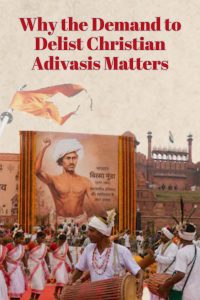
The demand to remove Christian Adivasis from the Scheduled Tribe list has moved from the margins of Hindutva advocacy toward the centre of national politics. On May 24, around 50,000 tribal persons gathered at Delhi’s Red Fort for a rally organised by the RSS-linked Janjati Suraksha Manch (JSM), where speakers called for the de-listing of Christian Adivasis from the Scheduled Tribe category. The presence of Union Home Minister Amit Shah transformed the event from an organisational mobilisation into a signal of political endorsement.

What was presented as a defence of tribal culture carries wider political implications. The campaign serves two connected functions. It assists the incorporation of tribal populations into a Hindutva political framework by constructing Christianity as a threat to tribal identity. At the same time, it weakens forms of Adivasi politics that have historically centred on land, forests, resources, self-governance and autonomy. The controversy over de-listing therefore reaches far beyond reservations. It concerns who gets to define Adivasi identity and what kinds of political claims can be made in its name.

This is not a new conflict. For decades, organisations associated with the Sangh Parivar have attempted to reshape the political vocabulary through which tribal communities are understood. The preference for the term “Vanvasi” over “Adivasi” is part of that project. Naming is never a neutral exercise. The term “Adivasi” became associated with political movements that understood tribal communities as possessing distinct histories, social formations and relationships to territory that cannot be reduced to the categories of the postcolonial Indian state. It also came to be linked with struggles over land, autonomy, self-representation and cultural rights. “Vanvasi,” by contrast, has been promoted by RSS-affiliated organisations as part of an effort to situate tribal communities within a broader Hindu civilisational framework. The dispute over terminology concerns who has the authority to define tribal identity and whether tribal politics will be articulated through its own historical experiences and political demands or incorporated into a larger majoritarian narrative.

The de-listing campaign emerges from this history. It seeks to make religious affiliation increasingly central to the way tribal identity is understood and recognised. Its supporters argue that conversion to Christianity severs individuals from tribal traditions and therefore undermines the basis on which constitutional protections were granted. Yet once religious affiliation becomes the basis for determining who is a legitimate member of the political community, the implications extend well beyond Christianity.

Across central and eastern India, the strongest currents within Adivasi politics have historically developed around struggles over land, displacement, mining, forests and self-governance. Whether in Jharkhand, Chhattisgarh, Odisha or Maharashtra, tribal movements have repeatedly confronted state institutions, extractive industries and dominant social groups over control of territory and resources. Opposition to mining projects and industrial land acquisition, struggles over the implementation of the Forest Rights Act and PESA, demands for a separate Sarna religious code, and movements against displacement have all shaped contemporary Adivasi politics. These mobilisations have generally been organised around questions of land, governance, cultural recognition and collective rights. The Fifth Schedule, PESA, forest rights legislation and movements against displacement emerged from these material struggles. They did not emerge from divisions between Christian and non-Christian Adivasis.

That is precisely what makes the current campaign politically consequential. It redirects attention away from conflicts over land, extraction and governance and toward conflicts within Adivasi communities themselves. Christian Adivasis become a separate political category whose claims can be isolated from those of the wider community. Such divisions weaken collective mobilisation against displacement, mining expansion, land alienation and other forms of dispossession. They also benefit those who have long sought a more fragmented and manageable Adivasi politics, whether in the service of electoral consolidation or the continued extraction of resources from tribal regions.

These concerns have been repeatedly voiced by Adivasi organisations across Jharkhand. More than one hundred tribal leaders, academics, activists and community organisations called for a boycott of the Delhi conclave before it took place. Their objections reflected a broader pattern. Campaigns around de-listing receive substantial organisational energy and political support, while struggles over land alienation, mining expansion, displacement and forest rights rarely attract comparable urgency from the same actors. That contrast raises an obvious question: why are religious differences within Adivasi communities relevant at all while ongoing conflicts over land, forests and resources are not?

The campaign also seeks to alter the constitutional terms through which tribal identity is recognised. Scheduled Tribe recognition was never designed as a reward for adherence to a particular religion. Article 342 contains no religious qualification, and Adivasi status does not disappear because an individual changes faith.

The constitutional histories of Scheduled Castes and Scheduled Tribes are different, but neither category was originally conceived as contingent on religious affiliation. Dalit Christians and Dalit Muslims continue to challenge their exclusion from Scheduled Caste status on the grounds that caste oppression survives conversion. Rather than correcting that injustice, the demand to de-list Christian Adivasis seeks to extend a similar logic of religious exclusion into a constitutional category where it has historically had no place. Recent judicial and political developments have made such efforts appear increasingly plausible, contributing to a broader perception that protections available to historically oppressed communities are open to reinterpretation through the language of religious belonging.

The de-listing campaign also reveals the conditions under which Hindutva is prepared to recognise tribal distinctiveness. Organisations associated with the Sangh Parivar have long sought to incorporate Adivasi communities into a broader Hindu civilisational framework while simultaneously acknowledging them as culturally distinct. The demand to remove Christian Adivasis from the Scheduled Tribe list narrows the space for that distinctiveness. Tribal identity remains legitimate so long as it can be accommodated within a majoritarian political project; conversion is treated as a point at which recognition becomes conditional.

Christianity has undoubtedly transformed many tribal societies over the past century, as have education, migration, urbanisation and countless other social processes. Those transformations do not erase histories of marginalisation, nor do they justify making religious affiliation the basis of constitutional recognition.

At stake in the controversy is more than the status of Christian Adivasis alone. The demand seeks to normalise the idea that constitutional protections can be conditioned by religious affiliation and that communities historically recognised because of marginalisation can be reorganised through the language of religious belonging. The immediate target may be Christian Adivasis, but the wider effect is the weakening of political traditions organised around land, resources, self-governance and collective rights. In regions where Adivasi communities continue to confront displacement, mining expansion and the erosion of democratic control over local resources, such fragmentation serves interests far more powerful than the communities being asked to embrace it.


Paresh Hate is a Bahujan queer researcher, writer, documenter and activist and the Lead Content Manager at Dalit Voice.