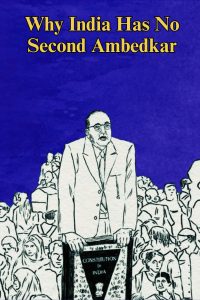
Why India Has No Second Ambedkar

Archival Note

Published in Dalit Voice (Vol. 1, Issue No. 17, 16 June 1982), this essay asks why India has failed to produce intellectuals who can challenge the ruling order rather than serve it. Rajshekar treats intellectual life as a political question, arguing that knowledge has little value when those who possess it refuse to confront power.

The essay places this argument alongside Dr. B.R. Ambedkar’s critique of the Brahminical character of India’s intellectual class. Rajshekar argues that when the intellectual class is tied to caste interests, it becomes an obstacle to the destruction of caste. He also attacks the pressures that push intellectuals towards careers, awards, money and proximity to power, while dissenters are branded as dangerous or “controversial”.

The essay then asks why India did not produce another Ambedkar after independence. Rajshekar connects this to the loss of the limited space he believed Ambedkar had found under British rule, arguing that Dalits and other oppressed communities were left without protection from the ruling order after independence. The essay’s central question is therefore about the political purpose of intellectual life: what happens to a society when those capable of challenging its dominant ideas choose accommodation instead?


The Role of Intellectuals in Society

Every society, every country in the world is shaped and led mainly by its intellectuals. All those who are remembered by history are mostly intellectuals. An intellectual may not get instant recognition by society when alive, but in course of time the person’s greatness will be recognised and recorded on the pages of history. Because an intellectual and intellectual alone can help bring about socio-economic changes.

The Buddha, Plato, Marx, Rousseau, Lenin, Abraham Lincoln, Maxim Gorky, Bernard Shaw, Mao, Thiruvallavar, Mahatma Phule were all great intellectuals. It is intellectuals who not only think but make others think.

After Dr. B. R. Ambedkar, M. N. Roy, Periyar E. V. Ramaswamy and Ram Manohar Lohia, we have hardly produced any intellectual giants in India. India’s Ruling Class has been systematically corrupting any up-and-coming intellectual, and if anyone dares to defy, he is mercilessly crushed. That is why rarely one wants to show originality, innovation. So much so, India has gone into total intellectual bankruptcy.

The very fact that India has not received a single Nobel Prize after it became independent proves that we are a country of mediocre dwarfs. But we are never tired of boasting that we have the second largest scientific manpower in the whole world. If so, what are they doing? Why not a single one has made an international mark?

The one agricultural scientist who received the Magsaysay Award was later found to have got it after making a false claim. But even this man has now taken up a cushy job outside India. This is the disease with our intellectuals. One social scientist, considered very distinguished, is seldom in India and even when at home never rubs the ruling class lest it may upset his lucrative income. Scientists like Khurana have settled down in the USA.

All this is because our society and our value system do not believe in encouraging and promoting intellectuals. India’s Ruling Class wants to make its people surrender their judgement to it. Every intellectual is a suspect. It looks upon him as a source of trouble.

Some of the finest budding, blooming flowers of our society were shot dead, dubbing them as Naxalites. Any person who does not fall in line and conform to the established thinking is considered a threat to society. Dissent is disliked, nay, dangerous. Truth should not be spoken. And those who speak the truth will be branded as “controversial” persons.

Any number of organisations, both govt. and non-govt., are set up to watch and weed out such “dangerous” persons. Innumerable State and private awards are instituted to win over any brilliant writer, scholar, to pocket if not corrupt him.

Courage is an essential prerequisite to become an intellectual. He has to suffer and sacrifice, pay for his commitment. That is why intellectuals and intellectuals alone can lead a society or a movement. An intellectual can lead as well as mislead. But in India, very often our intellectuals have been only misleading the society.

Nobody has painted such an Indian situation better than Dr. B. R. Ambedkar, and things have hardly changed since he wrote it:

“Whether you accept the theory of the great man as the maker of history or whether you do not, this much you will have to concede that in every country the intellectual class is the most influential class, if not the governing class. The intellectual class is the class which can foresee, it is the class which can advise and give lead. In no country does the mass of the people live the life of intelligent thought and action. It is largely imitative and follows the intellectual class.

There is no exaggeration in saying that the entire destiny of a country depends upon its Intellectual class. If the intellectual class is honest, independent and disinterested, it can be trusted to take the initiative and give a proper lead when a crisis arises.

It is true that intellect by itself is no virtue. It is only a means, and the use of means depends upon the ends which an intellectual person pursues. An intellectual man can be a good man but he can easily be a rogue. Similarly, an intellectual class may be a band of high-souled persons, ready to help, ready to emancipate erring humanity, or it may easily be a gang of crooks or a body of advocates of a narrow clique from which it draws its support.

You may think it a pity that the intellectual class in India is simply another name for the Brahmin caste. You may regret that the two are one, that the existence of the intellectual class should be bound with one single caste, that this intellectual class should share the interest & the aspirations of that Brahmin caste, which has regarded itself the custodian of interest of that caste, rather than of the interests of the country.

All this may be very regrettable. But the fact remains that the Brahmins form the intellectual class of the Hindus. It is not only an intellectual class but it is a class which is held in great reverence by the rest of the Hindus. The Hindus are taught that the Brahmins are Bhudevas (gods on earth). The Hindus are taught that Brahmins alone can be their teacher. Varnaram Brahmano Guru. Manu says, “If it be asked how it should be with respect to points of the Dharma which have not been specially mentioned, the answer is that which Brahmins who are Shishthas propound shall doubtless have legal force.”

When such an intellectual class, which holds the rest of the community in its grip, is opposed to the reform of Caste, the chances of success in a movement for break-up of the Caste System appear to me very, very remote.”

A film actor like Amitabh Bachchan or actress like Hema Malini may have millions of fans, but the glamour is temporary. The moment the youth fades, the star sinks. A cricketer or sportsman is adored till his capacity lasts. A wrestler, boxer or a King Kong will be feared until his body strength stays.

A politician like Indira Gandhi or Reagan is adored until the person is in power. Remember, people used to avoid Indira Gandhi like plague when she was defeated by the Janata. Those with money come and go. No Tata or Birla is remembered by history. A beauty queen is glorified till her skin fades.

There is nothing permanent with stars, sportsmen, body-builders, political personalities or wealthy tycoons. But that is not the case with an intellectual. He is respected not only in his lifetime but even after that.

Kalidasa was simply a poet under King Vikramaditya, but the king’s name has faded, but not that of Kalidasa, India’s greatest Sanskrit writer. Sometimes an intellectual is respected and recognised more after his death. Karl Marx’s name will be there as long as history is there. So too Plato, Jesus Christ, Mohamed Paigambar, Lenin, Mao, Martin Luther King.

Progress of any country depends only on its intellectuals. They alone can lead, but in India, alas, our intellectuals have been only misleading the society because they have been impotent and corrupt. That is why they compromise.

Look at the courage of J. B. S. Haldane. He subjected himself to great physical pain by himself becoming a guinea pig of his experiments. Have we produced a scientist of his calibre?

Our scientists are spending their time not in laboratories but in air-conditioned offices, busy pushing files. Intellectuals of India have not given evidence of their courage, their independence of thought and conviction, which are the indices to judge an intellectual.

They are not courageous, because they are so preoccupied with selfish interests. That is why they migrate to foreign countries in search of cushy jobs. Prime Minister Indira Gandhi on June 3 is reported to have expressed concern over “brain drain of scientific talent.” But this is not the first time she and other top leaders are expressing such a concern.

What is the use of a brain that allows itself to be drained? Better not have such brains. What we want is brains with hearts, and such brains will rarely allow itself to be drained. Heartless brains are more dangerous than brainless hearts. Therefore, let the heartless brains go. India will in no way become poorer.

A true intellectual will not sell himself. He can never be bought. He can never seek power and ambition. He will speak the truth, come what may, even at the cost of his life.

The evil has triumphed in India and the country is drifting because our intellectuals do not speak up. So much so, the country has grown sick and its sickness is affecting the outside world as well. But our intellectuals are unperturbed. To them, their caste and cash is more important than the eternal pursuit of truth.

What is the use of learning and knowledge when it does not bring cash or power? Popularity does not depend upon one’s ability but other factors. “Success in life” depends not on learning but on bank balance. In such a society, what use is learning or intellectual pursuits?

Intellectuals are laughed at, despised. Why should we strain the brain when money can be made without it? This is India today.

If our intellectuals are corrupt and spineless, the masses are dumb, deaf and blind because of poverty and illiteracy. The latter are illiterate because they are poor. When they are preoccupied all the time in an endless battle of the belly, where is the time for them to think, even if thinking is possible?

If this is the position of the poorest, what about the educated, employed people who come from this very same revolutionary section, Dalits and other persecuted minorities? The tragedy with this section is they have become easy-going, pleasure-seeking. Not only that. A considerable number of them, particularly the educated Untouchables, hide their identity and turn into bumlickers.

Yes, there are a tiny section of conscientious people among them who are angry. Who wants to rebel?

“The world owes much to rebels who would dare to argue in the face of the pontiff and insist that he is not infallible. I don’t care for the credit which every progressive society must give to its rebels.” (Dr. B. R. Ambedkar, preface to second edition of Annihilation of Caste.)

Ambedkar, however, lived up to the definition of a rebel, an intellectual giant. But such of the rebels are spotted out and finished at the very initial stage. Those who have managed to escape and build up their leadership are recruited by the ever-watchful political parties.

So there is an all-round famine. No ruling class will produce a revolutionary. On the other hand, the revolutionary section is starved to submission by the ruling class.

This answers the oft-repeated question: “Why India has not produced a second Ambedkar?”

Babasaheb lived a major part of his life when India was under the British, who were benevolent rulers. Not only they gave us education, denied to us by Brahmins, but even gave us modern, Western knowledge.

Not only that. If there was any “freedom struggle” and some leaders like Gandhi and Nehru were able to fight the British, it was because of the knowledge they gained from the very British education and the encouragement they gave to fight for liberty and fraternity.

But for the British rule, which in fact meant a Christian rule, India would not have been what it is today. So Ambedkar, despite his open criticism of the British Government, got all the encouragement from the British.

Nobody criticised the British right on their face as Ambedkar did. They gave him all the facilities and also protected him against his enemies. They gave all-out encouragement and built up his leadership.

Once the British were out, Dalits & the persecuted minorities of India had none to protect them. They were virtually thrown to wolves. The independence that India got on Aug. 15, 1947 was the independence given to the high castes to exploit, which they could not do earlier so freely.

The lambs are bound and bundled and handed to wolves on a silver platter. That is the reason why after independence India did not get a second Ambedkar.

No honest, dedicated leadership is tolerated by these ever-watchful headhunters. This is the heinous role played by India’s intellectual class.
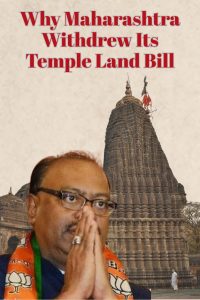
Why Maharashtra Withdrew Its Temple Land Bill

By the time Maharashtra’s Revenue Minister Chandrashekhar Bawankule announced that the government was withdrawing the draft Maharashtra Devasthan Inam Abolition Act, 2026, the proposed legislation had spent barely a month in the public domain. Published on May 6 for comments and objections, it was presented as an attempt to address one of the state’s longest-running land disputes: nearly 5.5 lakh hectares of Devasthan Inam land, much of it under encroachment or contested occupation, and temple trusts that had struggled to recover property endowed over centuries. Within weeks, however, the government abandoned the draft and promised to begin again.

The reversal followed sustained opposition from temple trusts and organisations including the Maharashtra Mandir Mahasangh, the Vishwa Hindu Parishad and the Hindu Janajagruti Samiti. More than a thousand trustees reportedly joined the campaign, hundreds of representations were submitted to ministers and district officials, and delegations met Chief Minister Devendra Fadnavis, Deputy Chief Minister Eknath Shinde and other senior members of the government.

When the withdrawal was announced, temple organisations described it as the outcome of a collective struggle. The government, for its part, insisted that it was merely responding to concerns raised during the consultation process and that a fresh draft would be prepared after wider discussions.

According to the Revenue Department, the proposed law sought to create a statutory mechanism for recovering temple lands from illegal encroachments while protecting the rights of lawful occupants. Officials argued that temple trusts often lacked the administrative and legal capacity to reclaim endowed properties and that the state could provide a more effective framework. Bawankule repeatedly said that the proposal had been conceived on lines comparable to the legal framework governing Waqf properties, allowing the government to assist in protecting religious endowments rather than leaving trusts to pursue long and expensive litigation on their own.

Temple organisations read the draft very differently. The Maharashtra Mandir Mahasangh argued that provisions of the Bill would effectively abolish historical Devasthan Inam grants made by earlier rulers and weaken rather than strengthen temple ownership. It objected to clauses that it said recognised ownership claims of some long-term occupants, questioned restrictions on approaching civil courts, and criticised what it described as differential treatment between temple lands and Waqf properties.

Whether those objections reflected the actual legal consequences of the draft or apprehensions about how the law might eventually operate is a wholly different matter. The Hindu fold today perceives itself to be victimised in public discourse despite having been in power at the Centre for the last twelve years and mobilises moralised protest tactics that are often rooted in narratives of self-victimisation. Whatever the merits of those objections, they were enough to stop the Bill before it reached the Assembly.

The government never argued that temple lands should change hands. On the contrary, ministers repeatedly said the purpose of the Bill was to help temple trusts recover lands that had slipped into encroachment and to give those properties stronger legal protection. The resistance came from temple organisations that feared the proposed law would give the state greater control over how disputes were settled and how rights over Devasthan land would eventually be determined. Their objections were directed less at the objective than at the mechanism through which the government proposed to achieve it.

For all the talk of ideological unity, governing and movement politics do not always pull in the same direction. The Devasthan Bill became one of those moments when the seams briefly showed. Electoral alliances often make those differences easy to miss. Yet land has always been a source of authority as much as a form of property. Questions of who records land and who settles disputes have a way of exposing those tensions.

The BJP has spent much of the past decade presenting itself as the party of a strong, interventionist state. Governing through legislation inevitably extends the state’s reach into institutions that have long operated through inherited arrangements and local authority. Temple trusts may welcome stronger protection for their lands, but greater state involvement also means surrendering some control over how disputes are settled and property is administered. That is where governments and religious institutions can begin pulling in different directions. The fault lines are not entirely new. They surfaced publicly during the online battles between the so-called “raitas” and “trads” during the Bulli Bai app case, and the Devasthan Bill suggests that those disagreements extend well beyond social media into much wider political constituencies.

It is striking that the government defended the draft by invoking the legal framework surrounding Waqf properties. The comparison was meant to reassure temple trusts that similar protections could be extended to temple lands. Yet the politics around Waqf have unfolded very differently in recent years. Legislative changes affecting Muslim institutions have largely proceeded despite sustained objections from Muslim organisations. In Maharashtra, by contrast, the government withdrew its own proposal before it reached the legislature, reopened consultations and gave temple representatives a central role in rewriting the Bill.

Temple organisations opposed the draft before it entered the legislature, secured meetings with senior ministers, compelled the government to withdraw its own proposal and now have formal representation on the committee tasked with preparing a revised Bill. The committee, headed by Additional Chief Secretary Vikas Kharge, includes fifteen representatives from temple trusts alongside senior officials from the Revenue Department.

Governments routinely ask farmers’ organisations, workers’ unions, unemployed youth and communities affected by displacement to wait for departmental reviews or expert committees. Families pursuing justice after caste-based violence often confront years of administrative delay and prolonged litigation before receiving meaningful responses. Many Muslim organisations have found themselves responding to legislative changes only after they have already been enacted and have then faced criminalisation for protesting. Temple organisations, by contrast, intervened while the law was still being drafted and altered its course before it reached the legislature.

The debate has also left largely unexplored the people living on Devasthan Inam land. Public discussion has centred on temples, trusts and encroachments, while remarkably little attention has been paid to the social composition of those occupying or cultivating these lands. The category of “encroacher” can include very different histories: long-term agricultural tenancy, informal occupation, disputed ownership, commercial acquisition and settlement by landless households over several generations.

The Devasthan Bill was withdrawn after organisations within the broader Hindutva fold challenged a government that is often assumed to speak for them. The next draft of the Bill will answer some legal questions. It may also answer a political one: how much room the state still has to regulate institutions that are among its closest ideological allies.


DalitThinkerToday is an Chartered Accountant by profession from Sangli, Maharashtra who occasionally dabbles in thinking about politics when people in her oppressor caste majority office frustrate her. This is her pseudonym.

Two Serious Mistakes That Killed the Dalit Movement

Archival Note

Delivered at a BAMCEF state convention in Gulbarga (now Kalaburagi) in November 2009, this speech reflects V.T. Rajshekhar’s thinking at a particular moment in the history of the anti-caste movement. While some of its references and political judgments are rooted in that context, its central argument continues to provoke debate: what enables oppressed communities to build lasting power?

The version reproduced below has been abridged for contemporary readers. The overall argument and structure have been retained, while passages closely tied to the political context of 2009, repeated arguments, and material of primarily historical interest have been omitted. The focus remains on the speech’s two central themes: the responsibility of educated Bahujans to strengthen collective institutions, and the argument that electoral success alone cannot sustain social transformation without intellectual, organisational, and cultural power.

The complete, unabridged speech is available in the Dalit Voice archives: https://dalitvoice.net/two-serious-mistakes-that-killed-dalit-movement/


Two Serious Mistakes That Killed the Dalit Movement

Abridged from a speech delivered at the BAMCEF Karnataka State Convention, Gulbarga, November 22, 2009

Brother Waman Meshram and brothers and sisters of the Bahujan Samaj,

Thank you for inviting me to inaugurate the first Karnataka state convention of BAMCEF at Gulbarga.

We have watched the steady growth of BAMCEF under the leadership of Brother Waman Meshram. Organising educated employees is never easy, yet BAMCEF has emerged as one of the country’s most significant Bahujan organisations. It is fitting that this convention is being held in Gulbarga, a region associated with the legacy of Shyam Sundar, whose work left a lasting mark on anti-caste politics.

Today I wish to speak about two questions that I believe have deeply affected the Bahujan movement.

The first concerns the educated Dalits who have benefited from constitutional safeguards and reservations.

The second concerns the widespread belief that political power alone can transform society.

The First Mistake

Reservations opened opportunities that were denied to our people for generations. But education and employment were never meant to be ends in themselves. Babasaheb Ambedkar saw them as instruments for the emancipation of the entire community.

Over the years, however, I have watched with concern as many educated Dalits achieved personal success but drifted away from the larger movement. Babasaheb himself warned that educated Dalits should not forget the people from whom they came.

Our communities need educated people who build institutions, mentor younger generations, strengthen organisations, write, teach, and remain accountable to society. Without that commitment, education risks becoming only a means of individual advancement.

This is why BAMCEF matters. Organising educated Bahujans into a socially conscious force is difficult, but it is indispensable if education is to become a source of collective strength rather than individual mobility.

The Second Mistake

Much has been said about political power being the key to social progress. Electoral representation is important, but we must ask whether elections alone are sufficient to transform deeply unequal social structures.

Political office without organised social strength is fragile. Governments come and go. Lasting change requires a society that is organised, politically conscious, and capable of sustaining its own institutions.

Those who dominate society do not rely only on elections. They exercise influence through education, the media, the bureaucracy, finance, and other institutions. If we neglect these spheres while concentrating only on electoral politics, our victories will remain temporary.

Political power is not given but taken. To secure it requires strength—not merely physical strength, but intellectual strength.

This is why independent Bahujan media is not a luxury but a necessity. A movement that depends entirely on others to tell its story cannot shape its own future.

What is needed first is intellectual strength. We must produce honest intellectuals, strengthen our organisations, build institutions, and develop leadership that remains rooted in the community.

Political power becomes meaningful only when it rests upon an organised and self-confident society.

That is the challenge before us.

Thank you.

Jai Bhim!

Political power as master-key is OK, but where is the lock?

The Editor has rightly quoted Babasaheb’s 1948 speech at Lucknow (DV Jan. 1, 2010 p.25) pointing the significance of political power as a master-key. The Editor has also mentioned that was the only occasion when Babasaheb spoke about the indispensability of political power in a democratic polity to be captured by Scheduled Castes.

I have been an insider of Kanshi Ram’s Bahujan movement since 1981 and one of his great admirers. I have even written a book on Kanshi Ram and contributed articles in his monthly journal, The Oppressed Indian, during 1981-88 about BAMCEF, DS-4 and BSP. After the journal was closed down, I began writing about his movement in Dalit Voice. But to be frank, after Kanshi Ram’s demise I have become suspicious and disillusioned about the politics of BSP.

TOTAL MOVEMENT ABANDONED

Let us accept the fact that Kanshi Ram discarded the total Ambedkarite movement in favor of only a political party. We are completely at loss to know why he landed himself in this situation. In his private conversations with his cadre, he used to air this anxiety and used to say, “I can see BSP everywhere but where is the mission? I don’t see it?” Kanshi Ram has rightly projected that totality of Ambedkarite mission through the organisations BAMCEF, DS-4, and BSP. In the constitution of BAMCEF he had included ten different fronts through which the organization was to work. Similar was the structure of DS-4 catering to different sections of the caste-based Indian society to be awakened for agitations. In fact the structure of BAMCEF and DS-4 was highly scientific and comprehensive. Had this model of total movement been implemented by him, it could surely have resulted in taking the Bahujan masses by storm. But, alas, we don’t know what went wrong and the father himself abandoned BAMCEF and DS-4 and concentrated all his energy on politics and BSP.

OVERPLAY OF POLITICAL POWER

After discarding BAMCEF and DS- 4 non-political outfits for awakening and agitations – the only task left with Kanshi Ram was to emphasize and overplay the importance of political power. By 1986-87 both the non-political organizations were taken off from the movement and the significance of political power was drawn out of proportion to project and propagate BSP. The political instability in Delhi resulted in frequent mid-term elections and all his time was consumed by electioneering. Even his health got affected by this stupendous task.

INTEGRITY OF KANSHI RAM

He used to speak about bringing cultural change through political power without any cultural organization and used to exhort the mass through his speeches by saying, “The India of my dream will be the India of Samrat Ashoka”. He also spoke about Buddhist mass conversion in North India in 2006 in which, he said, he would convert minimum 3 crore people.

We cannot doubt the integrity and credibility of Kanshi Ram. He was such a selfless and visionary leader. He could have brought the mass conversion not through BSP but by rejuvenating Budhist Research Centre floated by him in 1973-74. But one thing was certain that after down playing the non-political outfits like BAMCEF and DS-4, he overplayed the role of political power and BSP, forgetting that his non-political activities were solely responsible for bringing political success in UP along with “caste identity” politics. After Kanshi Ram, Mayawati declared in one of her speeches at Nagpur that the project of Budhist mass conversion would be taken up after she became the PM.

BABASAHEB’S MODEL

Babasaheb, during his life-time had himself constructed a model of his total movement. As per this model, we cannot deny the fact that Babasaheb ran the movement by forming three front organizations:

(1) Samata Sainik Dal (for social programs). (2) Scheduled Caste Federation (for political programs) and (3) Buddhist Society of India (for cultural activities.
As he was the mother of these fronts he had nourished them with great care and saw that these fronts co- ordinated and co-operated with each other just like siblings. That was the reason why Babasaheb was able to launch successfully the mega-agitations like Mahad, Kala Ram, Parvati and others. He had not kept these fronts watertight compartments. There was a lot of resilience within the fronts. All these fronts worked like biological system of Ambedkarite thought, providing energy and life to the total movement
We can see clearly that Babasaheb had not given undue Importance to political power at the cost of other fronts and he had made politics only as a part of totality of the movement.
At Nagpur, in 1956 at the time of the historic Buddhist conversion his followers, more interested in 1957 elections, had asked Babasaheb to postpone the conversion ceremony. But he did not agree with them. This event glaringly tells us that Babasaheb had materialized the Buddhist conversion without political power.

FIGHT AGAINST BRAHMINISM ABANDONED

The analysis and evaluation of post-Ambedkarite movement in Maharashtra and elsewhere clearly reveals that Babasaheb’s model of total Ambedkarite movement has been cruelly battered in favor of political power.

Except Dadasaheb Gaikwad’s mass agitation of 1964 – of landless Dalits we don’t come across any meaningful agitation. This is the only silver line in the history of RPI founded in 1957. But immediately after the wrangle for leadership broke out and the other fronts were either isolated or buried deep. And then followed the RPI breakup.

Samata Sainik Dal and Buddhist Society of India were entirely isolated, functioning normally. resulting in complete lack of coalescence between the three fronts.

How could a movement of STRUGGLE against the mightiest opponent, called Brahminism, could succeed with the help of half-baked, factionalized RPI and its self- centered, dishonest leaders?

Instead of developing the model of total Ambedkarite movement further and making it more comprehensive it has been splintered and strangled to death in Maharashtra and outside. During 1970-80, Dalit Panthers came on the scene as a social organisation but resorted to abusing the RPI, adding to another cleavage in the already splintered Ambedkarite masses. How could you expect to win a game when the teammates quarrel like mad dogs? As a result of this, the Ambedkarite masses have been taken for a ride by Manuwadi upper castes. After 1980 Kanshi Ram strove very hard to salvage the movement and had succeeded to a great extent. But he too after a while threw the e-t baby in favor of the bathwater. As a result of all these misdealings there is no movement as such on any front except the shrill noises of political drums.

HOW TO REJUVENATE THE MISSION

First of all we should regard Ambedkarite movement as a mission which only missionaries can take ahead. Secondly, we should have an organic (biological) interpretation and definition of the mission. Ambedkarite thought is an organic body having different organs-having a biological entity. In short, the thought is pregnant with different aspects which constitute its organs.

During his life time Babasaheb had used a metaphor to describe his movement the metaphor of a chariot. We know that a chariot is not a monolithic object. On the contrary it is made of different parts -big and small. If we expect a dynamic and efficient run from the chariot all its parts require to be intact however big and small they may be. If we try to explain the metaphor further we will have to regard each part of the chariot as an organ of Ambedkarite thought.

BABASAHEB’S CHARIOT ABANDONED

We will have to conclude that unless each part is assembled and activated properly the chariot will not move and run. In his life time Babasaheb himself provided physical and mental energy to the chariot as he himself was the mother. But after his demise the chariot has been dismantled with all its parts dislocated. What is the way-out?

We Ambedkarites are aware of the fact that Babasaheb the mother of the mission is no more with us. But we also know that through the model of his movement and through his colossal corpus of writings and speeches he has left behind an explosive ideological (mental) fuel which is more than sufficient to rebuild the mission. Anybody, who studies carefully his model of the movement and his literature, can come across many more fronts (aspects) than were activated during his life time.

MOTHER ORGANISATION NEEDED

So, apart from social, political, cultural fronts we will have to activate economic, educational, literary, labor, journalistic, ladies, youth and agitational fronts to be activated to form a totality of Ambedkarite mission. To serve as a mother, we will have to have a mother organization, which will serve as a controlling unit providing programs and ideological logistics. To this mother organization we will have to attach various fronts providing physical energy to the mission through their field work. This only can bring totality to Ambedkarite mission. The mother organization and the front organizations will have to work with organic unity i.e. there should be complete co-ordination, co-operation and coalescence between the mother and front organizations. Between different fronts also there needs to be co-ordination and resilience. This model needs to work as an organic whole as it happened during the life time of Babasaheb. Only missionaries can steer ahead this model of the mission.