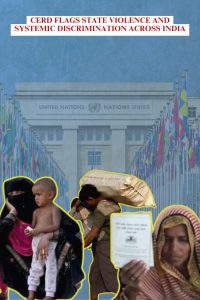
CERD Flags State Violence and Systemic Discrimination Across India

The UN Committee on the Elimination of Racial Discrimination (CERD) has raised serious concerns over the treatment of some of India’s most marginalised communities, including Dalits, Adivasi and tribal peoples, Rohingya, Bengali-speaking Muslims, migrants and asylum-seekers. Its findings follow the first review of India by the Committee since 2007 and examine the country’s combined 20th and 21st periodic reports under the International Convention on the Elimination of All Forms of Racial Discrimination.

The findings were issued after CERD’s 118th session, which also examined Finland, Honduras and Kuwait. This was part of the Committee’s regular review of states that have signed the Convention. CERD’s concluding observations are not court judgments and do not have the force of law. They assess how governments are implementing their obligations under the Convention and identify areas where the Committee finds serious problems.

In India’s case, CERD raised concerns spanning caste, ethnicity, religion, citizenship and policing. One of its gravest concerns was the alleged conduct of law-enforcement agencies towards Indigenous and Tribal Peoples, Scheduled Tribes, Scheduled Castes, particularly Dalits, ethnic and ethno-religious groups and non-citizens. CERD recorded reports of excessive force, racially motivated violence, extrajudicial killings, arbitrary and prolonged detention, torture, ill-treatment and sexual violence. It called for prompt, thorough and impartial investigations, with accountability where violations are established.

The reference to Dalits and Scheduled Castes also brings an older disagreement into the review. The Indian government maintains that caste should not be treated as equivalent to race or “descent” for the purposes of CERD. Its submissions nevertheless contain information on Scheduled Castes and Scheduled Tribes and measures intended to address their disadvantages. CERD’s treatment of caste within its examination of descent and discrimination places caste exclusion within the scope of the Committee’s scrutiny, even as the Indian state rejects that equivalence.

CERD also drew particular attention to Rohingya, Bengali-speaking Muslims, migrants and asylum-seekers. It noted an increase in law-enforcement operations involving these groups, particularly after a 2017 Home Affairs order and the April 2025 Pahalgam attack. Reports of police stops and identity checks based on racial profiling allegedly resulted in arbitrary arrests and detention, torture and other mistreatment. The Committee also raised concerns about deportations and forcible returns involving people who may require international protection.

During the review, CERD Country Rapporteur Stamatia Stavrinaki referred to independent monitoring that recorded more than 1,300 anti-Muslim hate-speech incidents in 2025, including recurring rhetoric attributed to senior officials. India’s delegation responded that legislation enacted in 2023 criminalises acts amounting to hate speech and hate crimes, with additional protections applying when offences target Scheduled Castes and Scheduled Tribes. It also pointed to freedom of religion as a constitutional guarantee.

But CERD’s observations focused on what these protections mean in practice. Alongside the government’s account of its legal safeguards, the Committee recorded concerns about discrimination, hate speech, violence and the conduct of law-enforcement agencies. It called on India to address hate crimes against Rohingya, Bengali-speaking Muslims, migrants and asylum-seekers, refrain from collective expulsions and ensure access to international protection. This includes respecting non-refoulement, the principle that people should not be returned to a place where they face a serious risk of persecution or other grave harm.

The findings also address citizenship and documentation. CERD noted the absence of adequate disaggregated data on Indigenous and Tribal Peoples, ethnic and ethno-religious groups, migrants, refugees, asylum-seekers and stateless people. It highlighted the categorisation of Bengali-speaking Muslims as “non-original inhabitants” and reports that they face more stringent scrutiny during National Register of Citizens verification. The Committee also noted that much of India’s available data on Scheduled Castes, Scheduled Tribes and refugees still derives from the 2011 Census, while acknowledging the delayed 2026 Census and its proposed collection of caste data through self-identification.

The treatment of Bengali-speaking Muslims in the NRC process raises a broader question about how citizenship is administered. CERD’s concern is not simply that documentation is required, but that particular ethnic and religious groups are reportedly subjected to different levels of scrutiny. In a political environment where Muslims are repeatedly cast as outsiders or demographic threats, administrative categories such as “non-original inhabitants” can acquire consequences beyond paperwork. The NRC thus becomes part of a wider system in which belonging is subjected to heightened state verification.

The concerns around Rohingya also sit within a longer history of UN scrutiny. A 2025 communication by UN Special Procedures carried allegations that deportation operations against Muslims, including Rohingya, intensified after the Pahalgam attack, involving raids, arrests, ill-treatment and forcible returns. Those allegations came through a separate UN process and were not findings by CERD or a judicial determination.

India is not a party to the 1951 Refugee Convention or its 1967 Protocol and has no comprehensive national refugee law. UNHCR therefore carries out protection-related functions for refugees and asylum-seekers in the country. This absence has become more significant alongside changes to India’s citizenship and immigration regime.

The Citizenship (Amendment) Act, 2019 was defended by BJP ministers as addressing the unfinished business or “wrongs” of Partition. Yet the CAA was not a refugee law. It created a religion-based route to accelerated citizenship for specified non-Muslim communities from Pakistan, Bangladesh and Afghanistan. It did not establish a general system of refugee protection based on persecution or the risk of serious harm.

And in 2025, Parliament enacted the Immigration and Foreigners Act, replacing four earlier laws governing the entry and treatment of foreign nationals. The new law consolidated the state’s immigration powers without creating a corresponding refugee protection framework. CERD’s call for protection against collective expulsions and respect for non-refoulement therefore comes alongside a strengthened legal machinery for controlling and removing foreign nationals, while India still lacks a dedicated process for determining who requires refugee protection. For Rohingya and other asylum-seekers, that leaves a basic question: what domestic procedure requires the danger they may face after removal to be considered before the state deports them?

India’s delegation, led by Solicitor General Tushar Mehta, defended the country’s legal framework and its claims of pluralism and equality. The government reiterated its position that caste should not be equated with race or “descent” under the Convention and pointed to legislation addressing hate speech and protections for Scheduled Castes and Scheduled Tribes.

CERD’s findings place those claims alongside reports of how state institutions operate on the ground. The Committee’s concerns cover law-enforcement violence against Dalits and Adivasi and tribal communities, anti-Muslim hate speech, racial profiling of Bengali-speaking Muslims and Rohingya, and the treatment of people whose citizenship or immigration status is under scrutiny.

For Dalit and Adivasi communities, and for Muslims and other minorities whose belonging is increasingly subjected to state scrutiny, the findings also expose how Hindu nationalism operates through state power. Caste discrimination, communal targeting, citizenship enforcement and policing are often treated as separate questions, even as they converge in the lives of communities whose relationship with the state is shaped by unequal power. CERD’s observations bring these questions into the same examination of discrimination and direct attention towards the institutions through which unequal treatment is carried out.

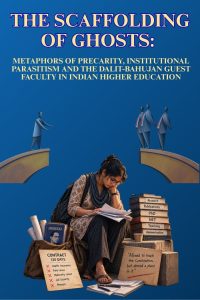
The Scaffolding of Ghosts: Metaphors of Precarity, Institutional Parasitism and the Dalit-Bahujan Guest Faculty in Indian Higher Education

“They take our sweat to cement the arches of their intellectual temples, but reserve the sanctuary for their own kin. We are allowed into the university only as day-laborers of the mind, expected to clean the dust of their theories and vanish before the sun sets.”

— Notes from an Unappointed Ad-Hoc Scholar


I. Introduction: The Ivory Plantation and the Underground Specters

The modern Indian university is not an agora of enlightenment; it is a meticulously landscaped plantation whose ivory towers are held upright by bamboo scaffolding made of invisible hands. If you walk through the marble corridors of Delhi University, the red-brick courtyards of Hyderabad, or the ancient stone arcades of state universities in Uttar Pradesh and Maharashtra, you will breathe an air thick with the incense of academic grandiosity. High-table seminars deliberate on post-colonial subalternity, international journals publish lavish treatises on “decolonizing the mind,” and vice-chancellors deliver pious speeches on national progress. Yet, step beneath the floorboards of this grand theater, into the subterranean basements where tutorial sheets are evaluated and attendance registers are marked, and you will encounter an army of specters. They are the Guest Faculty, the Ad-Hoc Scholars, the Temporary Lecturers—disproportionately hailing from Dalit, Bahujan, and Adivasi communities—who inhabit the university not as citizens of letters, but as unacknowledged day-laborers of the intellect.

To understand the crisis of the Dalit-Bahujan guest lecturer is to understand a sophisticated, modernized form of institutional untouchability. It is a system that does not banish the untouchable body from the temple of learning, but rather admits it on the condition that it remains eternally temporary, economically broken, and structurally voiceless. The old caste order barred the Shudra and Ati-Shudra from listening to the Vedas by pouring molten lead into their ears; the modern neoliberal-feudal university permits them to teach the Vedas, the Constitution, and Quantum Mechanics, but ensures that their monthly stipend of a few thousand rupees arrives six months late, without healthcare, without maternity leave, and with the permanent threat of instant dismissal at the end of every 120-day contract cycle.


IIA. The Reservation Bypass: How Public Universities Invented the “Academic Coolie”

For seven decades, the Indian Constitution guaranteed that public universities—the primary engines of social mobility for marginalized communities—would reflect the demographic reality of the nation through affirmative action (Reservation). However, the Savarna oligarchy that controls the levers of academic administration executed a masterstroke of systemic evasion. Rather than directly opposing reservations—which would invite constitutional penalties and street protest—they rendered the permanent faculty position an endangered species. By deliberately freezing regular recruitment for decades, university administrations created an artificial vacuum, which they then filled with temporary, contract, and guest faculty.

Consider the brutal arithmetic of this institutional fraud. When a university advertises a permanent Assistant Professor position, it is legally bound to apply the constitutional quota (15% SC, 7.5% ST, 27% OBC, alongside EWS). But when the university hires a “Guest Lecturer” or “Ad-hoc Teacher” to take the exact same classes, grade the exact same papers, and invigilate the exact same examinations, the reservation roster is blithely discarded under the legal pretext that guest teaching is “hourly engagement” or “contingent work.”


IIB. The Reservation Bypass: Institutional Anomie: Higher Education Disparity Data

  • 33%+ Sanctioned Faculty Vacancies Left unfilled across Central and State universities.
  • 50% Undergraduate Teaching Load Executed by guest, ad-hoc, and contract labor.
  • 4.2% SC/ST Full Professors Representation in premier institutions.

This is the Reservation Bypass Architecture. By shifting the bulk of teaching workloads onto unreserved, arbitrarily appointed guest arrangements, university syndicates have successfully preserved permanent professorships as exclusive fiefdoms of elite caste networks. The Dalit-Bahujan scholar who spent a decade earning a PhD from a premier central institution, publishing peer-reviewed papers, and passing the National Eligibility Test (NET), arrives at the university gates expecting the fulfillment of constitutional promises. Instead, they are directed to the guest room—a cramped closet under the stairs—and handed an hourly wage contract that pays less than the daily minimum wage of an industrial supervisor.


III. The Metaphor of the Academic Plantation: The Sugar Mill of the Mind

To capture the existential dread of the guest faculty, one must discard the sterile vocabulary of human resource management and turn to the literature of plantation economies. The guest scholar is the cane-cutter of the academic sugar mill. Every morning, they arrive at the campus with bundles of intellect harvested from nights of lamp-lit reading, only to feed them into the administrative crusher. The sweetness—the tuition fees paid by students, the accreditation scores (NAAC) awarded to the college, the university’s ranking metrics—is extracted by the administration to polish the institution’s facade. The leftover bagasse—the exhausted, underpaid, un-benefited human being—is swept out at the end of the term.

There is a cruel satire in how elite institutions market their commitment to social justice. A college will organize a national seminar on “Ambedkarite Hermeneutics” or “Post-Colonial Subalternity,” funded by public grants. The keynote speaker, a tenured professor enjoying a six-figure salary, housing allowances, and sabbatical privileges, will deliver an impassioned address on the plight of the marginalized. Meanwhile, the microphone is adjusted, the water glasses are refilled, and the attendance registers are compiled by a guest lecturer who holds a Doctorate in Marathi Literature, belongs to the Mahar or Matang community, and is wondering if their bank balance of ₹412 will stretch to cover next month’s room rent.

“We are asked to lecture on human rights in the morning and beg the clerk for our unpaid honorarium in the afternoon. The university teaches equality through our mouths while practicing feudalism on our throats.”

This paradox is structural rather than incidental. The tenured Savarna academic elite requires the guest faculty in the same way the Victorian aristocracy required domestic servants. The presence of a vast, desperate reserve army of unemployed and underemployed Dalit-Bahujan PhDs allows tenured professors to reduce their own teaching workloads, delegate tedious administrative drudgery, pursue prestigious foreign fellowships, and maintain an aura of Olympian intellectual detachment. The guest lecturer becomes the institutional sponge that absorbs all the friction, labor, and anxiety of the educational machine, allowing those above them to glide seamlessly through the realm of pure thought.


IV. The 120-Day Executioner: Contracts, Caste Privilege, and Psychological Castration

The contract structure of guest and ad-hoc appointments is designed with psychological precision to break the spirit of resistance. In many state and central universities, appointments are made for 120 days, 89 days, or purely on a “per-lecture” basis (capped at a paltry monthly maximum). At the end of every term, the guest faculty undergoes a symbolic execution: their contract terminates, their temporary library pass expires, and they are cast back into the abyss of non-existence.

To be re-appointed for the next term, the scholar must perform a ritual of submission. They must court the favor of Departmental Heads, College Principals, and Governing Body members. In a society where social capital is coterminous with caste networks, this ritual is deeply stacked against Dalit-Bahujan scholars. A Savarna candidate, connected through family ties, alumni networks, shared dietary habits, and cultural codes, effortlessly navigates the informal corridors of power. They engage in light banter over filter coffee or tea with the Principal, discussing shared acquaintances and theoretical inclinations. The Dalit-Bahujan candidate, lacking this inherited cultural currency, enters the administrative office carrying the heavy burden of historical exclusion, acutely aware that any slip of tongue, any display of political assertion, or even a lack of “servile deference” can result in immediate, unwritten blacklisting.

Satire turns into horror when one examines the “Interview Boards” for ad-hoc and guest panels. Every few months, thousands of scholars line up outside principal offices across university towns like cattle at an auction. They hold thick files containing books they have written, research articles published in Scopus-indexed journals, and certificates of national awards. They are called into the interview room for precisely 90 seconds. 90 seconds to justify ten years of doctoral labor. The committee members—often bored, scrolling through their smartphones—ask a superficial question, check the candidate’s last name (a transparent proxy for caste identity in the Indian context), and make a silent mark on their scorecards. The process is repeated term after term, year after year, converting vibrant young intellectuals into anxious, sycophantic mendicants.


V. The Political Economy of Silence: Why the Academic Subaltern Cannot Speak

Why do guest faculty not unionize and shut down the university until their demands for regularisation are met? The answer lies in the totalizing nature of their precarity. Tenured faculty can go on strike because their salaries are protected by civil service rules and UGC regulations. Permanent staff have trade unions, legal representation, and tenure protection. The guest lecturer has none of these shield walls.

If a guest teacher speaks out against administrative corruption, caste discrimination, or delayed payments, they are not served with a show-cause notice—they are simply not invited back next semester. No order is issued; no explanation is required. The phone simply stops ringing. Their name disappears from the timetable as quietly as a drop of water evaporating on a hot slate. This form of retaliation is clean, silent, and untraceable. It is the bureaucratic equivalent of an extra-judicial disappearance.

Furthermore, this precarious labor market actively fractures solidarity among the oppressed. When fifty Dalit-Bahujan PhD graduates are competing for two temporary guest slots paying a meager hourly wage, the university successfully pits victim against victim. Solidarity is replaced by a desperate, panicky competition for survival. The scholar who raises their voice against an unjust workload is instantly replaced by another scholar whose rent is due tomorrow and whose family is waiting for a remittance back in the village.


VI. A Personal Monologue: A Letter from the Shadows

Let me speak to you not as an abstract sociological voice, but as Mujammil Shahin Siraj Shaikh—a chronicler who has watched the brightest minds of my generation wither in the waiting rooms of higher education.

I have seen my friend—a man who spent six years translating obscure 19th-century anti-caste manuscripts, a scholar whose mind burns with the brilliance of a supernova—standing outside the account section of a state university in the scorching summer heat of June. He was not there to collect a research grant or a publication prize. He was begging a clerk, who was half-asleep under a whirring ceiling fan, to release his lecture fees for the previous semester—money that had been withheld for seven months because a signature on a voucher sheet was missing a middle initial. His mother in the village needed insulin; his landlord had threatened to lock his room by the weekend. In his pocket was a copy of Antonio Gramsci’s Hegemony and the Intellectuals, a book he had taught to fifty eager undergraduate students that very morning.

What does it do to a human soul to articulate theories of freedom, justice, and human dignity on the lectern, while living a personal reality of complete disenfranchisement? It creates a profound, tearing schizophrenia. The guest scholar lives in two worlds simultaneously: in the morning, they are “Doctor,” an authority figure guiding the next generation toward critical thought; in the evening, they are a pauper, calculating whether they can afford egg curry or must settle for plain rice to survive till the end of the month.

This humiliation is explicitly gendered and caste-coded. Bahujan women guest lecturers face a double furnace of oppression. They navigate not only the structural precarity of temporary contracts and caste bias but also the insidious sexual harassment and paternalistic condescension inherent in hierarchical university departments, where renewal of contracts is frequently dangled as a weapon of behavioral control by senior male academics.


VII. The Imperial Caste-Class Trap: Data, Statistics, and Structural Reality

The tragedy of the guest faculty is not a temporary glitch in an otherwise healthy educational system; it is the logical outcome of a neoliberal state colluding with a feudal social structure. Let us examine the national indicators that illustrate this structural betrayal:

  • Systemic Vacancies as Policy: According to official data presented in Parliament and AISHE reports, thousands of faculty positions remain vacant across Central Universities, IITs, and NITs. The vast majority of these unfilled posts belong to the reserved categories (SC, ST, OBC). By leaving these posts vacant under the pretext of “Non-Availability of Suitable Candidates” (NASC)—a notorious administrative euphemism used for decades to reject qualified Dalit-Bahujan applicants—universities fill the operational gap by hiring guest lecturers at a fraction of the cost.
  • The Economic Exploitation Ratio: A permanent Assistant Professor under the 7th Pay Commission earns a starting basic pay of approximately ₹57,700 plus allowances (totalling upwards of ₹85,000 to ₹1,000,000+ monthly). A Guest Faculty member teaching the exact same course load is capped at a maximum ceiling (often ₹50,000 in central norms, but frequently down to ₹12,000 – ₹20,000 in state universities), with zero pay during vacations, zero health insurance, zero Provident Fund, and zero annual increments. The university extracts 100% of the labor value while paying less than 20% of the cost.
  • The Psychological Toll: Studies on academic precarity show alarming rates of chronic anxiety, depression, and existential despair among ad-hoc and guest educators. When social identity (caste stigma) combines with economic instability, the result is an intolerable mental crucible. The tragic institutional suicides of scholars like Rohit Vemula and Payal Tadvi are merely the visible tip of an underwater iceberg of silent, slow-motion institutional violence inflicted on thousands of contract educators daily.


VIII. Reclaiming the Temple: A Call for Radical Academic Emancipation

We must strip away the romantic mythologies of the Indian university. The university is not a sanctuary of pure scholarship; it is a battleground of social power. As long as higher education relies on an underclass of disenfranchised, underpaid, and structurally vulnerable Dalit-Bahujan guest faculty, every degree awarded by these institutions is tainted by the sweat of unfree labor.

To dismantle this modern plantation system, we do not need incremental policy tweaks or patronizing sympathies from academic senates. We require radical structural restructuring:

  • Immediate Abolition of the “Guest/Ad-Hoc” Bypass: Higher education regulatory bodies (UGC, Ministry of Education) must mandate that any teaching position required for more than one academic term MUST be converted into a regular, permanent position subject to constitutional reservation rosters.
  • Equal Pay for Equal Work: Until regularisation is achieved, guest faculty performing identical teaching, evaluation, and administrative duties must receive equal hourly and monthly remuneration, along with full health coverage and seasonal pay continuity, in strict compliance with Supreme Court mandates on labor rights.
  • National Audit of Reservation Rosters: A high-powered, independent judicial commission comprising Dalit, Bahujan, and Adivasi jurists must audit the faculty recruitment records and vacancy distributions of all central and state universities to expose and penalize administrative manipulation of reservation panels.
  • Democratization of Departmental Governance: Departmental chairs and university committees must be stripped of arbitrary, unilateral power over contract renewals. Evaluation of teaching staff must be transparent, peer-reviewed, and protected against personal and caste-based bias.

Until these measures are implemented, the Dalit-Bahujan intellectual will remain a ghost in the machine—hired to teach the youth how to think, but forbidden from claiming a place to exist. But let the managers of the academic plantation take warning: ghosts do not remain silent forever. The scaffolding of precarity is rotting from within, and when it collapses, it will take the ivory tower down with it.


Mujammil Shahin Siraj Shaikh is a Pune-based independent researcher and prospective PhD scholar examining structural inequality, public policy and institutional power in modern India.

When the State Can Take Your Institution: FCRA and How the Civil Society Is Being Choked Financially

India’s Foreign Contribution (Regulation) Act was introduced in 1976, during the Emergency, to regulate foreign influence in Indian political life. The 2010 Act replaced that framework with a broader system for regulating foreign contributions to organisations and associations. Over time, FCRA has also given the state increasing power over whether organisations can access foreign funding and continue their work. The latest changes take that process further.

The Foreign Contribution (Regulation) Amendment Bill, 2026 was introduced in the Lok Sabha on 25 March and referred to a Joint Parliamentary Committee on 12 August. It is not law yet. The 2026 Rules, however, are already in force. Together, they significantly tighten the conditions under which organisations receiving foreign contributions can operate.

The Bill proposes a Designated Authority to supervise foreign contributions and assets after an organisation’s FCRA registration is cancelled, surrendered, expires or is not renewed. The Authority can take provisional custody of the foreign contribution and relevant assets. If the registration is not restored or renewed within the prescribed period, the assets can vest permanently in the Authority and subsequently be transferred or disposed of, with the proceeds going to the Consolidated Fund of India. The proposed framework also covers assets created partly from foreign contributions.

There is an important detail here. The principle of asset vesting is not entirely new. Section 15 of the existing FCRA already provides for the vesting of assets created out of foreign contribution when an organisation’s registration is cancelled or surrendered. What the 2026 Bill does is build a much more elaborate administrative machinery around that principle, giving the state greater control over what happens to those assets. And this matters because the state already has considerable power to make an organisation incapable of functioning long before anyone arrives to take possession of its assets.

The state does not need to seize an organisation’s property to make it unviable. The cancellation or non-renewal of an FCRA registration can cut off its access to foreign funding, while investigations and regulatory proceedings can tie up its finances and consume the administrative capacity needed to keep the organisation running. By the time an organisation is able to challenge such action, it may already have lost the ability to function as it once did.

The 2020 amendments established much of the architecture that made this possible. The ceiling on administrative expenditure was reduced from 50% to 20% of foreign contributions. That expenditure includes basic organisational costs such as personnel, salaries, travel and management. At the same time, organisations receiving foreign contributions were prohibited from transferring those funds to other organisations, effectively ending the sub-granting arrangements through which larger organisations had supported smaller grassroots groups.

The consequences for smaller organisations were particularly severe. A national organisation could previously receive foreign funding and pass some of it to a local group working in a remote district. After 2020, that channel was closed. The local organisation had to deal with the compliance burden itself, even when it lacked the staff, money or administrative capacity to do so.

The 2020 amendments also required foreign contributions to be received through an FCRA account at the State Bank of India’s New Delhi Main Branch on Sansad Marg. For organisations working in rural areas or distant states, even a basic banking requirement became another layer of centralised administrative control.

This has happened alongside a dramatic contraction in the number of active FCRA organisations. Thousands of registrations have been cancelled or allowed to lapse over the years. Organisations including Amnesty International India, Oxfam India and the Centre for Policy Research have faced cancellation, suspension or non-renewal.

The 2026 Rules add further conditions. Organisations must now identify the purposes for which they intend to use foreign contributions and the states or Union Territories in which they intend to operate. Their FCRA registration is consequently tied more closely to specified purposes and geographical areas. The Rules also expand disclosure requirements concerning activities, office bearers, publications and social media accounts. An organisation must demonstrate that it has undertaken “reasonable activity” by utilising at least ₹10 lakh in foreign contribution over the preceding two financial years. For organisations receiving foreign contributions in instalments under prior permission, the release of a subsequent instalment is tied to utilisation of at least 75% of the previous instalment and a field inquiry.

These requirements are presented as compliance measures. But compliance itself is a mechanism of control where the state has the power to decide whether an organisation has done enough, worked in the right place, spent enough money or remained within the purposes recorded on its certificate.

This is particularly useful to a government that wants to curb progressive work while abandoning its own responsibilities to the people. Organisations working with communities affected by caste violence, displacement, environmental destruction, poverty and state violence can be weakened through the same machinery that is supposed to regulate their funding. The state retreats from its public obligations while strengthening its ability to constrain those who organise in the spaces it leaves behind.

The implications extend beyond organisations conventionally described as NGOs into spaces that are squarely political. Civil society includes legal aid groups, research institutions, health organisations, women’s collectives, workers’ organisations, environmental groups, educational initiatives and organisations working with Dalit, Adivasi and minority communities. These institutions document violence, gather evidence, challenge government policy and provide services where state institutions are inaccessible or inadequate.

It also includes religious and minority institutions. The government has stressed that the 2026 Rules continue to permit specified faith-based welfare and religious activities, including religious education, maintenance of places of worship and charitable work. At the same time, the Rules place foreign-funded activities within increasingly specific categories and exclude proselytisation from the permissible religious purposes.

This is pertinent in a country where schools, hospitals, shelters and charitable institutions are run by religious and minority organisations, especially in a context where successive governments have failed to carry out their public and institutional duties effectively. Why should the state possess such extensive administrative power over institutions that provide social services while it fails to do the bare minimum?

As Azam Khan writes in Maktoob, the changes represent “a systematic attempt to control and subjugate the social fabric of India.” An independent organisation that researches caste violence, documents environmental destruction, provides legal aid to workers or challenges a government policy creates an institutional space from which the state can be questioned. That space matters precisely because it exists outside direct government control.

The history of FCRA shows how this power has accumulated. A law introduced to regulate foreign political influence has become a mechanism through which the state can determine which organisations receive foreign resources and how long they are allowed to operate with them. The 2020 amendments tightened the financial conditions. The 2026 Rules add further administrative requirements. The 2026 Bill extends state control to what can happen to an organisation’s assets after its FCRA registration ends.

The result is a civil society whose institutional survival is increasingly placed in the hands of the executive. Independent institutions create space for people to organise outside the state and produce knowledge that can challenge official accounts. When those institutions are weakened, the communities that depend on them lose some of their capacity to make their experiences visible and press their demands. And when that space shrinks, so does the space available for dissent.


DalitThinkerToday is a Chartered Accountant by profession from Sangli, Maharashtra, who occasionally dabbles in thinking about politics when people in her oppressor-caste-majority office frustrate her. This is her pseudonym.

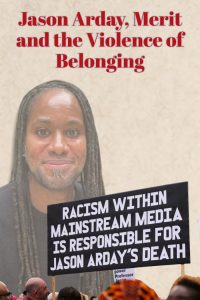
Jason Arday, Merit and the Violence of Belonging

Jason Arday was a sociologist, a teacher, a writer, a son, a partner, a father, a brother and a man whose life had already contained extraordinary difficulties and achievements long before Cambridge made him a symbol. He was 41 when he was found dead at his home in south London on August 14, nine days after resigning from the University of Cambridge amid allegations concerning plagiarism, his academic record and aspects of the life story he had publicly told. The Metropolitan Police said his death was unexpected but not believed to be suspicious. An inquest is to determine the circumstances of his death.

His life was more than his Cambridge appointment, more than the allegations against him and certainly more than the controversy that consumed his final weeks. He had spoken about being diagnosed with autism and other developmental difficulties as a child, about remaining non-verbal until he was 11 and about his difficulties with reading and writing. He nevertheless went on to earn a PhD, teach across several British universities, write about race and education, and become Cambridge’s youngest Black professor in 2023.

The allegations against Arday were presented as a matter of academic misconduct without sufficient scrutiny of their origin and validity. What is disturbing about the Arday affair is the point at which scrutiny of an individual appeared to become a much larger argument about who deserves to occupy an elite institution.

NewsCord’s review counted 249 distinct articles about Arday across 15 British national outlets between July 24 and the evening of August 14. Of these, 188 appeared in the nine days after his resignation. That amounted to an average of 20.9 articles a day after he had already stepped down.

There was plainly a story to investigate. But the coverage did not remain confined to his academic work. His childhood, memoir, personal claims, sporting achievements and biography became subjects of repeated public examination. NewsCord’s account documents coverage that moved into ridicule, speculation and commentary about parts of his life that went far beyond the original academic allegations.

The most troubling context is that some of the controversy was explicitly connected to arguments about race and diversity. The academic who brought the plagiarism allegations to wider attention, Nathan Cofnas, has described himself as a “race realist” and has previously written about racial representation in elite professions in terms that explicitly invoke supposedly innate differences in ability. He has since said that his concern was with diversity, equity and inclusion rather than personal hostility towards Arday. Cofnas, now sacked from his institute, must nonetheless be held accountable for the chain of events he initiated. The positions and politics he espouses form part of the context in which Arday’s case was interpreted and circulated, and of a wider social order in which Black and other oppressed communities are made to experience institutions as spaces of conditional belonging.

What happened to Arday, then, cannot be understood only as a dispute over one academic’s work. The larger question is what happens when the presence of someone from a historically excluded community inside an elite institution is treated as something that must continually be justified.

For many of us in India, there is something painfully familiar in that question.

The specific histories are different. Arday was a Black British academic; caste is a different system from race, with its own history and mechanisms. But the experience of being treated as an exception whose presence requires explanation has recognisable parallels.

Think about the Dalit student who enters an elite university. The Dalit scholar who gets a faculty position. The first-generation student who enters medicine, the civil services or a prestigious professional institution. Their achievement is often not allowed to remain simply an achievement. A question enters the room before they do: Did they actually deserve this?

That question is rarely asked in isolation. It arrives carrying the weight of caste. Reservation makes that question explicit. “Merit” becomes the language through which caste privilege can present itself as a neutral achievement. We are seeing this today in India, where Delhi’s designated protest site has a sit-in by Reservation Hatao Andolan, a group of snowflake oppressor-caste members who cannot ask for structural change from the state and would rather espouse casteist statements of exclusion and degradation on camera while claiming victimhood.

The same logic that asks whether a Black professor really belongs at Cambridge can, in another context, ask whether a Dalit professor really belongs in a university at all. The language changes. The hierarchy does not.

This is why the mythology of merit matters. The mythology of merit depends on forgetting the conditions under which merit is produced. Before a person sits for an examination, submits a PhD application or interviews for an academic job, they have already travelled through a social world. Some people grow up with educated parents, private schooling, books, stable housing, English-language fluency, professional networks and the confidence that elite institutions are places where they naturally belong. Others encounter those institutions after crossing barriers that were never faced by their supposedly more “meritorious” peers.

Yet once the final credential is produced, all of that history disappears behind an apparently objective label: merit. Caste makes this contradiction impossible to ignore.

For generations, education and professional authority were overwhelmingly concentrated among particular castes. Property, literacy, institutional familiarity, social networks and cultural capital accumulated across families and communities. When the descendants of those histories arrive at elite universities, their inherited advantages are rarely described as an intervention into merit. They appear as merit itself. Reservation disrupts that story because it makes social exclusion visible.

That is why the rhetoric around merit can become so vicious. Merit is presented as a timeless measure of individual worth, when in practice institutions decide what counts as merit, how it will be measured and who gets the opportunity to demonstrate it.

The same baton is used to beat affirmative action in different contexts: DEI in the West and reservations in India. In both cases, policies intended to address historical exclusion are recast as threats to a supposedly neutral system that was never neutral to begin with.

Once this idea of merit is entertained, the presence of a Black professor or a Dalit professor can become suspicious before anything about their work is examined. Their success is treated as something requiring an explanation. Their mistakes become evidence of a larger failure. Their credentials become open to a level of scrutiny that their social position was already unlikely to protect them from.

This is what makes the racial invocation against Arday’s career so pernicious. The question moves from a basic inquiry, “Did this individual meet the standards?”, to “Why was someone like this here in the first place?”

The second question may present itself as a defence of objectivity, but it is not really interested in objectivity, real or imagined. It is about belonging. It is about who gets to occupy the public arena without having their presence continually explained, defended or justified.

And that is where Arday’s story speaks beyond itself. Because many people from historically oppressed communities recognise the particular pain of entering spaces that were not built with them in mind and then discovering that their right to be there remains permanently open to question.


Mangesh is a law student from Mumbai, Maharashtra.

Who Gets to Roar Like a Tigress? Neoliberalism, Marketised Education and Caste Inequality

India has expanded education as a formal right while simultaneously allowing the conditions under which that right is exercised to become increasingly differentiated by market capacity. Because market capacity is structured by caste and class, the marketisation of education can undermine the equalising function that constitutional education rights were intended to serve.


Article 21A, inserted through the Constitution (Eighty-Sixth Amendment) Act, 2002, establishes free and compulsory education as a fundamental right for all children between six and fourteen years of age. The Right of Children to Free and Compulsory Education Act, 2009, provides the statutory framework for implementing this constitutional guarantee. This places an obligation on the government to ensure that free and compulsory education reaches children across the most disadvantaged sections of society.

However, there is an evident gap between what the Constitution proclaims education must be, namely, not a private commodity, and what is happening under a neoliberal economic structure. While the right to education is formally universal, as it should be, the quality and conditions under which that right is delivered remain deeply unequal, disproportionately affecting the most vulnerable sections of society, particularly students from SC/ST communities.

In India, there are broadly two types of institutional spaces that provide education and shape the kind of education, exposure, infrastructure, and social networks available to a child: private schools and public schools. Private schools operate through fees and market demand, with annual fees ranging from thousands to several lakhs of rupees, and reaching as high as ₹28–30 lakh in some elite schools. Their appeal is often associated not only with classroom teaching but also with advanced infrastructure, English-language education, extracurricular opportunities, technology, and claims of global exposure. Government schools, by contrast, depend substantially on public expenditure and government provision. A 2025 national survey indicates that average annual household expenditure per child in non-government schools was ₹25,002, compared with ₹2,863 in government schools, making household expenditure on non-government schooling nearly nine times higher.

The government budget for School Education and Literacy, as per the latest available Union Budget 2026–27, is ₹83,562 crore, of which around 70–80% goes towards salaries and administrative costs, leaving substantially less budget for infrastructure, school advancements, and labs. This substantially impacts the passing rate of students and the quality of education they receive.

When a private-educated student and a public-educated student enter a university, the field becomes unequal and highly disadvantageous for public-school students. It is within this unequal field that the neoliberal commodification of education becomes particularly important, as access to better educational opportunities increasingly depends on one’s ability to pay.

Neoliberalism places considerable emphasis on markets, competition, individual choice, and the withdrawal or restructuring of direct state provision. When applied to education, these principles can transform education from a predominantly public responsibility into a service increasingly mediated by market mechanisms. It drives the privatisation of government schools, turning education into a marketable commodity driven by competition, choice, and profit. This is what can be seen in the Indian education system.

Rather than increasing funding and upgrading public schools, the right-wing government has used policies to systematically transfer school ownership, management, or funding to private entities. This has resulted in the closure or merger of 94,000 government schools since 2014, as per a NITI Aayog report. That is 25 public schools per day. On the other hand, private unaided schools grew from 2.88 lakh to roughly 3.39 lakh.

This systematic institutional mobility of schools has resulted in two major shifts. First, the migration of public-school students towards private schools, numbering around 86 lakh. Second, those unable to transfer to or pay for private schools were denied their fundamental right to education.

Such consequences of this marketisation cannot be separated from India’s existing social structure. The ability to choose between schools is itself socially differentiated in India, as income, wealth, social capital, geography, and caste are already unequally distributed.

According to the UDISE+ (Unified District Information System for Education) school database system, around 68.7% of ST students and 62.4% of SC students rely on government schools. For them, public schools continue to function as a major educational lifeline.

A wealthy household facing declining public provision can respond by purchasing private education. A poor household may not have that option. The same policy therefore produces different consequences for different social groups. And therefore, when public education is weakened and monetised, the consequences are not distributed evenly across society, with SC and ST communities bearing a disproportionate share of the impediment.

Furthermore, the incumbent government has allocated just 4% of its GDP to education instead of the 6% recommended by NEP 2020. This gap in allocation, combined with the residual income gap among people, inadequate facilities, and caste domination in government schooling, provides a stark contrast between the constitutional right to formal educational inclusion and substantive equality in education.

In this class and caste divide, SC and ST students are among the most vulnerable. The inequality that begins with access to education continues into the opportunities available to students, eventually contributing to economic inequality. This creates a vicious circular system of unequal education.

unequal schooling → unequal educational attainment → unequal skills and credentials → unequal employment opportunities → reproduction of economic inequality.

Public schooling in India is not simply about education; it is also a political question. In India, neoliberal governance and right-wing politics are lovers, bound together in the making and remaking of the state’s approach to public education. Here, neoliberal restructuring can generate social and economic crises that produce grievances and uncertainty, which right-wing populism can then mobilise politically. In turn, right-wing populism can reinforce the same neoliberal restructuring by redirecting these grievances, generating doubt and distrust towards alternative political and economic narratives, and weakening challenges to the prevailing order.

The recent “School Thik Karo” movement by CJP provides a contemporary illustration of such a love story. The campaign involved visits to government schools, interaction with students, and demands for improvements in educational infrastructure and facilities. What government should fear a demand for better schools? However, rather than being understood simply as a demand for better schools, the campaign encountered political resistance, including restrictions on access to schools in Rajasthan and an FIR in Maharashtra.

This points to a broader tension: government schools are public institutions intended to deliver a constitutional right, yet demands for better infrastructure and greater accountability can become politically contentious. And once again, the consequences fall most heavily on those who have the fewest alternatives: SC and ST students.

Their inability to purchase education, or their household’s lack of the resources necessary to exercise that choice, is a systemic failure of neoliberalism. As neoliberal marketisation increasingly determines who can access quality education, the danger is that education itself, which is intended to enable social mobility, may instead reproduce the inequalities it was expected to overcome.

Dr. Babasaheb Ambedkar said, “Education is the milk of a tigress, and he who drinks it will not fail to roar.”

But what happens when that milk is filtered by income, caste, and market access? The milk is no longer the same for everyone. Some receive it diluted and adulterated, while others receive what allows them to roar. Who gets which kind of milk, and who decides?


Mrunal Madhuri Milind Dupte is a development economics researcher, anti-caste writer and public speaker working on inequality, Dalit and Buddhist economics.

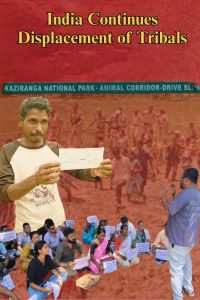
India Continues Displacement of Tribals

The demolition of homes belonging to Adivasi tea-tribe families in Hatikhuli Bagicha near Kaziranga marks the latest escalation in a dispute over land acquired for a proposed five-star luxury hotel and cultural centre backed by the Assam Tourism Development Corporation (ATDC). According to campaigners, the demolitions have displaced families who had long lived and cultivated the area, bringing into effect a project that has faced sustained opposition from local residents, land rights groups and environmental activists.

The dispute centres on land at Ingleng Pathar and Hatikhuli, adjacent to Kaziranga National Park. Local organisations maintain that many families have cultivated the land for generations, continued to pay land revenue, and possess raiyati records or periodic pattas despite the land being classified as government land. In June, the Assam Chah Mazdoor Sangha (ACMS) demanded a high-level inquiry into the land allotment, alleging that the land had been reclassified and transferred to a hospitality company without consulting the communities dependent on it. The union also stated that residents had resisted eviction attempts for four to five years while seeking formal recognition of their land rights.

The controversy deepened after the Assam government signed an agreement with Hyatt Hotels in September 2023 to develop a luxury hotel near Kaziranga’s central range. The proposed project affects land cultivated by more than forty farming families, most of them from tea-tribe communities. Protesters have argued that the project would displace long-settled residents while further expanding hospitality infrastructure in an ecologically sensitive landscape used by wildlife moving between Kaziranga and the Karbi Anglong hills during the annual floods. Environmental groups have similarly raised concerns about the impact of construction on wildlife corridors and habitat connectivity.

Public opposition intensified through demonstrations in June and July, following which indigenous rights activist Pranab Doley and several others were arrested on charges including unlawful assembly, criminal conspiracy and rioting. Police alleged that protesters entered the project site and obstructed construction, while Doley and land rights organisations described the arrests as an attempt to criminalise resistance to displacement. Soon after, a group of UN experts expressed concern over the detention of five indigenous rights activists, warning that the arrests could have a chilling effect on civic space and undermine the ability of indigenous communities to defend their rights. They called for the release of any activists detained solely for the peaceful exercise of their rights and urged the suspension of land acquisition and development until affected communities had been meaningfully consulted and their free, prior and informed consent obtained.

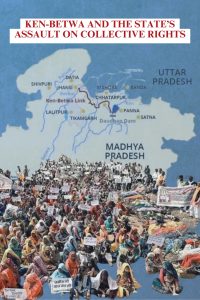
The developments at Kaziranga reflect a pattern that extends well beyond Assam. From the Ken-Betwa river-linking project in central India to the Great Nicobar Island Development Project, large-scale projects justified in the name of development have repeatedly advanced despite concerns over ecological integrity and the destruction of longstanding human habitats. Whether the issue is the displacement of Adivasi cultivators, the future of the Nicobarese community and the survival of the Shompen, or the loss of forest commons, the concerns of affected communities are repeatedly set aside in favour of state-backed commercial and strategic priorities.

Ken-Betwa and the State’s Assault on Collective Rights

The protests against the Ken-Betwa Link Project in Madhya Pradesh emerged from long-standing concerns about the displacement of affected communities and the manner in which one of India’s largest river-linking schemes was being implemented. The Union and Madhya Pradesh governments have presented the Ken-Betwa Link Project as a nationally significant initiative to address chronic water scarcity in the drought-prone Bundelkhand region, arguing that it would strengthen irrigation while improving drinking water availability and power generation. Adivasis in the region have challenged this developmentalist narrative that is often built by ignoring the costs of implementation, which tramples their constitutional rights and livelihoods. The latest phase of the movement began on 3 July 2026 along the Barana River near Kupi village in Chhatarpur district and became one of the most visible mobilisations against the project. Protesters combined forms of civil disobedience with demands that rehabilitation be carried out according to the spirit of the law.

Led largely by Adivasi women and project-affected families, the agitation centred on the Ken-Betwa Link Project as well as the Majhgaon and Runjh irrigation projects. Protesters organised a series of symbolic demonstrations including jal satyagraha (standing in water as a form of protest), chita andolan (lying on funeral pyres) and a symbolic faansi satyagraha, presenting them as expressions of communities being pushed towards “social death” through displacement. Movement leader Amit Bhatnagar also undertook an indefinite hunger strike that lasted nearly two weeks until the protests were forcefully cleared. Protest leaders have maintained that authorities should implement the projects in accordance with existing laws governing land acquisition and environmental protection while respecting the constitutional rights of affected communities which prioritize rehabilitation. The administration has also failed to honour assurances reportedly made during discussions held in April 2026 before the protests came to this intense point. Bhatnagar has pointed to a ₹400-crore corruption scandal linked to the project, which shows massive irregularities in land acquisition and rehabilitation.

Displacement in this case has extended far beyond the loss of land. The affected families stand to lose access to forests, access to water resources, livelihood opportunities and more. Some residents have faced false criminal cases, illegal evictions, electricity disconnections and the demolition of schools as intimidation tactics and extra-legal punishment for participating in the protests. In this context, the protests called for transparent identification of all project-affected families and insisted that rehabilitation precede any displacement. The protests were also occurring within broader demands for an end to coercive administrative practices, especially when it comes to extractive displacement under the banner of development, conveniently marketed as pro-people and welfarist. Given the history of these practices, the movement is not simply a dispute over compensation but one in the long line of political struggles for democratic accountability and constitutional protections for Adivasi and rural communities.

Before dawn on 19 July 2026, a large police contingent cleared the protest site, citing public safety concerns because demonstrators were gathered beneath an under-construction bridge and along the river. While  the administration has rejected allegations of wrongdoing and maintained that all legal procedures were being followed, multiple videos show the heavy-handed use of violence in ending the protests. Authorities stated that protesters were transported back to their villages rather than arrested. Bhatnagar was taken to hospital after his health deteriorated during the prolonged fast. However, this is a clear sign of forcible suppression of the movement, with protestors alleging mass detentions and the use of force to prevent Bhatnagar from addressing the media.

The agitation reflects wider debates surrounding the Ken-Betwa Link Project. As India’s first river-linking project under the National Perspective Plan, it occupies a central place in the government’s broader river interlinking agenda, with an estimated cost of ₹44,605 crore. Environmental groups, hydrologists and rural and Adivasi communities who have been affected have questioned the project’s ecological viability. They dispute the assumption that the Ken basin has surplus water and warn of its impact on forests and the Panna Tiger Reserve. Extensive deforestation and inadequate rehabilitation weaken the project’s developmental claims, while many have already pointed to decentralised water conservation which offers less destructive alternatives that states are reluctant to explore.

The legal framework governing such projects already recognises that displacement extends beyond the acquisition of privately owned land. The Right to Fair Compensation and Transparency in Land Acquisition, Rehabilitation and Resettlement Act, 2013 (LARR Act) defines project-affected families and provides for rehabilitation and resettlement alongside compensation. Apart from the generic failure of implementation in the Ken-Batwa case, the statutory application has repeatedly been criticised for excluding people whose livelihoods depend on forests, rivers and other common resources or who lack formal land titles, leaving many of those most affected outside its protections. This accountability gap is underscored by the Ministry of Tribal Affairs’ press release, “Rehabilitation of Displaced Tribals” (31 July 2025), which stated that the Union government does not centrally maintain data on displaced or project-affected families, even as it continues to promote large infrastructure projects across the country.

But it is clear that the questions raised here cannot be answered simply by demanding due process in compensatory practices. For decades, scholars of displacement, including Walter Fernandes, have argued that the framework governing displacement requires a more expansive rethinking. Yet policy institutions have largely failed to address these concerns, while successive governments have continued to pursue different forms of displacement through both public and private infrastructure initiatives. Fernandes argues that compensation cannot be confined to the market value of acquired land because displacement disrupts livelihoods rather than simply transferring property. He contends that rehabilitation should recognise all project-affected persons, including those dependent on common resources without formal legal ownership, and enable them to rebuild their lives instead of treating compensation as a one-time financial payment.

Although legislation such as the LARR Act is frequently criticised by corporate interests as placing excessive constraints on land acquisition, the Ken-Betwa experience suggests a different problem. Since the introduction of the Act, human right activists have pointed to the limited procedural and substantive protections that the Act provides. But even the minimal formal recognition and rights seem to be rendered ineffective when the state itself becomes the principal agent of acquisition. As Sanjoy Chakravorty argues in his formulation of the “taking state”, the concentration of acquisition powers within the state enables it to overcome legal safeguards through administrative practice. The struggle over Ken-Betwa is therefore also a struggle over whether constitutional and statutory protections can meaningfully constrain state-led development when the communities bearing its costs are Adivasi and rural populations.

The July protests also represent more than a local struggle over rehabilitation. They also highlight a wider contest over how large infrastructure projects should proceed when they affect the rights of tribal communities and fragile ecosystems. Not only is the Indian state continuously engaged in authoritarian extractivism, but has effectively framed its biddings under the PR of welfare while continuously trampling the civil liberties and the right to dissent of people affected. The events unfolding at Ken-Betwa over the last few days reaffirm that struggles against displacement cannot be left to affected communities alone, but require broader democratic solidarity across movements.


Paresh Hate is a Bahujan queer researcher, writer, documenter and activist and the Lead Content Manager at Dalit Voice.

Good Minorities and Oppressed Persons in Ceremonial Roles

Archival Note

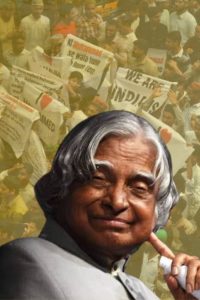
Published in 2006 during A. P. J. Abdul Kalam’s presidency in Vol. 25, Issue No. 24 (16/12/2006), this article is less a profile of Kalam than a reflection on the politics of minority representation. V.T. Rajshekhar asks why some members of historically oppressed groups come to be celebrated by dominant political establishments while others remain excluded or viewed with suspicion. These ideas remain urgent over the last decade with a Dalit and an Adivasi president from the Hindu nationalist party occupying the post.

The article is reproduced here in full. Read today, it can also be situated within a wider discussion about the distinction often drawn between the “good” and the “bad” Muslim—a distinction that is used globally as a liberal strategy to tame minority political power.

The complete, unabridged article is available in the Dalit Voice archives: https://dalitvoice.net/why-upper-castes-are-all-praise-for-abdul-kalam-as-a-good-man/


Why Upper Castes Are All Praise For Abdul Kalam As “A Good Man”? 

President Abdul Kalam, the dark-looking, vegetarian Tamil bachelor who is never invited by any Muslim organisation anywhere in India, is called a “good man” by our Brahminical rulers. Maybe he is called good because he has been good to them.

We were all praise for Kalam when he was a scientist in the Defence Department. We then called him “India’s only scientist”. All other upper-caste “scientists” had no achievement to their credit. Collectively, they did a lot of harm to the poor Kalam. Despite all the pinpricks, Kalam went up by his sheer “merit and efficiency”, which no other Brahmin scientist possessed.


MEDIOCRITY GLORIFIED

We have not made any comment on him after he became the President of India. Because, no. 1, we had never heard him speaking face to face. No. 2, out of respect for a Muslim.

But we have read a lot of his speeches, which made no sense. We asked many people their opinion. They gave the same opinion.

Mediocrity is always glorified in this vast intellectual desert called India.

For the first time, we heard him at the Tehelka “Summit of the Powerless”, which he inaugurated in Delhi on Nov. 20, 2006. As usual, the speech made no sense to us or any comrades with us.


HELPED FIGHT PAKISTAN?

His days as a scientist (he was no doubt brilliant) were fully exploited by the upper castes to manufacture rockets, in which he was an expert. Do rockets feed India’s hungry millions? If not, why was he praised and paraded by the fellow scientists, all from the upper castes? Because rockets helped threaten the enemy. Who is India’s enemy? Of course, Pakistan, which is a Muslim country. Did Muslim Kalam help fight Muslims? Was he praised for this?

In other words, the hungry millions did not get any relief from Kalam’s scientific experiments. He catered to the interests of the Brahminical rulers, who considered Pakistan (read Muslim) as their enemy.

In his speech at the Tehelka function, he praised the cock-and-bull story called the Ramayana (Read Dr. Ambedkar’s book Riddle of Rama & Krishna. DSA, 1995) and the Tamil Brahmin religious leader Ramanujacharya. These are music to Brahminical ears.


WHY ALL HIS GRAND “PLANS” IGNORED?

Kalam, as the President, had visited several places and delivered scores of speeches presenting his grand “plans to reduce poverty in 10 years”. The upper castes cheered him but did not implement a single “plan”.

Why did his “plans” always fall on deaf ears? Because these were all economic in content, while the over 85% of India suffered from a disease that was essentially social and cultural in content. That is why Kalam was simply ignored. His most publicised plan was the “PURA Project”. Did anybody implement his project? We have no information.

Brahmins praised him but silently laughed at him. They are not bloody fools to select him as President unless they have made sure that he would serve their interests.

Prime Minister Vajpayee, heading the sworn anti-Muslim party of BJP, wanted an obedient, harmless Muslim as head of state to decorate the Rashtrapati Bhavan.


PRAISE FOR GANDHI KILLERS

How big a simpleton he is could be made out from his profuse praise for a top RSS terrorist leader, Nanaji Deshmukh. He said he had visited Nanaji’s project in MP and was much impressed by the socio-cultural changes it brought about.

How could the RSS be interested in socio-cultural revolution? Maybe Nanaji’s multi-million-rupee experiment converting the MP tribals into good “Hindus”, meaning slaves, impressed him. RSS is doing such socio-cultural experiments in all tribal belts.

Nanaji is senior to Vaidik Vajpayee. He resigned as Union Cabinet Minister to go into the MP forest to continue his “socio-cultural experiment” of enslaving the tribals. How selfless and dedicated he must be. RSS has hundreds of such leaders and workers.

Kalam has been praised for such work. That means even such a brilliant scientist can be taken for a ride by the Brahminical people.

As he was going out after his speech, we caught hold of his hand and questioned his praise of a Hindu terrorist leader.

His answer was: “What if he is an RSS man? He is doing good work.” We said: “RSS killed Gandhi, whom you praised many times in your speech.” He simply walked away without answering.

Brahminical India gets the President it deserves and the Prime Minister it deserves.

Thirty Atrocity Cases, One Larger Question: What India’s Caste Violence Data Still Doesn’t Capture

A complaint submitted to the National Commission for Scheduled Castats (NCSC) has brought together 30 reported cases of violence against Dalits from nine states, once again exposing the gap between constitutional safeguards and their enforcement on the ground.

Filed under Article 338(5) of the Constitution, the complaint by the Citizens for Justice and Peace (CJP) asks the Commission to investigate incidents reported between April and June 2025 in Uttar Pradesh, Bihar, Madhya Pradesh, Rajasthan, Gujarat, Andhra Pradesh, Himachal Pradesh, Karnataka and Maharashtra. The cases include rape, murder, assault, public humiliation, denial of access to temples and cremation grounds, and attacks on Dalit wedding processions. It also seeks action against public officials accused of failing to discharge their duties under the Scheduled Castes and Scheduled Tribes (Prevention of Atrocities) Act, 1989.

None of these forms of violence are unfamiliar. They have appeared repeatedly in atrocity reports, court records and fact-finding exercises for decades. What changes are the names of the victims and the districts in which the crimes occur.

The complaint cites cases such as the alleged rape of a deaf and mute Dalit girl in Rampur, the murder of a 10-year-old Dalit boy in Etah, and the assault of a Dalit groom in Agra who was allegedly forced off his horse because dominant-caste residents objected to the procession. Other incidents involve denial of cremation rights, restrictions on temple entry and caste-based abuse in public.

The incidents span states governed by different political parties. That is significant because it points to a problem that survives electoral change. The SC/ST (Prevention of Atrocities) Act has been in force for more than three decades, yet its implementation continues to depend on the willingness of local police, district administrations and prosecutors to invoke it properly. Delays in registering FIRs, omission of relevant provisions of the Act, weak investigations and failures to prosecute public officials who neglect their statutory duties remain recurring complaints in atrocity cases.

The need to strengthen implementation has also found expression outside courtrooms. At a recent community vigilance training programme organised by the Dalit Bahujan Shramik Union in Andhra Pradesh, government officials, lawyers and activists stressed that awareness of the SC/ST (Prevention of Atrocities) Act remains inadequate even as untouchability, social discrimination and caste violence continue. Advocate P. Chittibabu called for quicker filing of charge sheets so that cases under the Act do not languish in the courts, while participants highlighted the continuing vulnerability of Dalit women and children. The discussion reflected a familiar reality: India has a strong legal framework on paper, but access to justice continues to depend on how consistently that framework is implemented.

Official crime statistics capture only part of this picture. The complaint refers to National Crime Records Bureau data showing tens of thousands of pending investigations and more than 2.6 lakh pending trials involving atrocities against Scheduled Castes, with conviction rates remaining below 40 percent. Those figures indicate that access to justice remains slow even after a case enters the criminal justice system.

They do not, however, capture the full scale of caste violence. The SC/ST (Prevention of Atrocities) Act applies to members of Scheduled Castes recognised under the Constitution. Dalits who have converted to Christianity or Islam are excluded from the Scheduled Caste category under the Constitution (Scheduled Castes) Order, 1950, and therefore cannot invoke the Act. Where caste motivates violence against Dalit Christians or Dalit Muslims, such cases are generally prosecuted under ordinary criminal law. As a result, violence rooted in caste often disappears from official atrocity statistics despite the caste motive remaining central to the offence.

The question of implementation has acquired another dimension in recent years. Several incidents involving the custodial torture or death of Dalits have drawn attention to the difficulty of enforcing the PoA Act when the alleged perpetrators are police personnel themselves. In such cases, the institutions responsible for registering offences and conducting investigations are also the institutions facing allegations of abuse. The recent Tamil Nadu trial court judgment sentencing nine police personnel to death for the custodial torture and deaths of P. Jayaraj and J. Benicks during the COVID-19 lockdown is a rare instance of accountability. Yet such outcomes remain exceptional and do little to address the institutional conditions that allow custodial violence to persist.

At the same time, the Supreme Court has reiterated that the SC/ST (Prevention of Atrocities) Act cannot be invoked mechanically. In Keshaw Mahto @ Keshaw Kumar Mahto v. State of Bihar (2026), the Court held that merely abusing or threatening a person who belongs to a Scheduled Caste does not automatically attract Sections 3(1)(r) or 3(1)(s) of the Act. The prosecution must establish that the insult or intimidation was intentionally directed at humiliating the complainant because of their caste. The ruling, which builds on the Court’s earlier decision in Shajan Skaria v. State of Kerala, emphasises that caste identity alone cannot substitute for proof that the alleged conduct was motivated by caste.

Read alongside the complaint before the NCSC, the Keshaw Mahto ruling highlights a different challenge. While the Supreme Court has reiterated that the PoA Act cannot be invoked mechanically without establishing the statutory ingredients of a caste offence, rights groups continue to document delays in registering FIRs, omission of relevant provisions of the Act and weak investigations even in cases where caste is central to the violence. The issue, therefore, is not simply one of implementation, but of whether the law and its interpretation are adequately equipped to capture the varied and often indirect ways in which caste operates today. If caste discrimination increasingly manifests through readily provable intent, the question is whether the existing legal architecture is sufficient to respond to these evolving forms of caste power.

The complaint asks the NCSC to direct state governments to ensure prompt registration of FIRs, monitor investigations, initiate disciplinary proceedings against officials who neglect their duties, secure compensation and rehabilitation for survivors, and identify atrocity-prone areas requiring sustained monitoring.

Whether the Commission acts on these requests remains to be seen. Similar demands have accompanied previous compilations of caste atrocities, while concerns over delayed investigations, weak prosecutions and official inaction have continued.

The 30 incidents documented in the complaint are spread across different regions and involve different forms of violence. They also expose the limits of how caste violence is officially recorded and addressed. Until implementation of the SC/ST (Prevention of Atrocities) Act becomes more consistent—and until caste violence against Dalit Christians, Dalit Muslims and victims of custodial abuse is recognised within the wider conversation on caste justice—official numbers will continue to tell only part of the story.


Mangesh is a law student from Mumbai, Maharashtra.

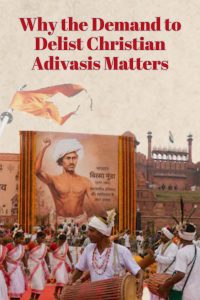
Why the Demand to Delist Christian Adivasis Matters

The demand to remove Christian Adivasis from the Scheduled Tribe list has moved from the margins of Hindutva advocacy toward the centre of national politics. On May 24, around 50,000 tribal persons gathered at Delhi’s Red Fort for a rally organised by the RSS-linked Janjati Suraksha Manch (JSM), where speakers called for the de-listing of Christian Adivasis from the Scheduled Tribe category. The presence of Union Home Minister Amit Shah transformed the event from an organisational mobilisation into a signal of political endorsement.

What was presented as a defence of tribal culture carries wider political implications. The campaign serves two connected functions. It assists the incorporation of tribal populations into a Hindutva political framework by constructing Christianity as a threat to tribal identity. At the same time, it weakens forms of Adivasi politics that have historically centred on land, forests, resources, self-governance and autonomy. The controversy over de-listing therefore reaches far beyond reservations. It concerns who gets to define Adivasi identity and what kinds of political claims can be made in its name.

This is not a new conflict. For decades, organisations associated with the Sangh Parivar have attempted to reshape the political vocabulary through which tribal communities are understood. The preference for the term “Vanvasi” over “Adivasi” is part of that project. Naming is never a neutral exercise. The term “Adivasi” became associated with political movements that understood tribal communities as possessing distinct histories, social formations and relationships to territory that cannot be reduced to the categories of the postcolonial Indian state. It also came to be linked with struggles over land, autonomy, self-representation and cultural rights. “Vanvasi,” by contrast, has been promoted by RSS-affiliated organisations as part of an effort to situate tribal communities within a broader Hindu civilisational framework. The dispute over terminology concerns who has the authority to define tribal identity and whether tribal politics will be articulated through its own historical experiences and political demands or incorporated into a larger majoritarian narrative.

The de-listing campaign emerges from this history. It seeks to make religious affiliation increasingly central to the way tribal identity is understood and recognised. Its supporters argue that conversion to Christianity severs individuals from tribal traditions and therefore undermines the basis on which constitutional protections were granted. Yet once religious affiliation becomes the basis for determining who is a legitimate member of the political community, the implications extend well beyond Christianity.

Across central and eastern India, the strongest currents within Adivasi politics have historically developed around struggles over land, displacement, mining, forests and self-governance. Whether in Jharkhand, Chhattisgarh, Odisha or Maharashtra, tribal movements have repeatedly confronted state institutions, extractive industries and dominant social groups over control of territory and resources. Opposition to mining projects and industrial land acquisition, struggles over the implementation of the Forest Rights Act and PESA, demands for a separate Sarna religious code, and movements against displacement have all shaped contemporary Adivasi politics. These mobilisations have generally been organised around questions of land, governance, cultural recognition and collective rights. The Fifth Schedule, PESA, forest rights legislation and movements against displacement emerged from these material struggles. They did not emerge from divisions between Christian and non-Christian Adivasis.

That is precisely what makes the current campaign politically consequential. It redirects attention away from conflicts over land, extraction and governance and toward conflicts within Adivasi communities themselves. Christian Adivasis become a separate political category whose claims can be isolated from those of the wider community. Such divisions weaken collective mobilisation against displacement, mining expansion, land alienation and other forms of dispossession. They also benefit those who have long sought a more fragmented and manageable Adivasi politics, whether in the service of electoral consolidation or the continued extraction of resources from tribal regions.

These concerns have been repeatedly voiced by Adivasi organisations across Jharkhand. More than one hundred tribal leaders, academics, activists and community organisations called for a boycott of the Delhi conclave before it took place. Their objections reflected a broader pattern. Campaigns around de-listing receive substantial organisational energy and political support, while struggles over land alienation, mining expansion, displacement and forest rights rarely attract comparable urgency from the same actors. That contrast raises an obvious question: why are religious differences within Adivasi communities relevant at all while ongoing conflicts over land, forests and resources are not?

The campaign also seeks to alter the constitutional terms through which tribal identity is recognised. Scheduled Tribe recognition was never designed as a reward for adherence to a particular religion. Article 342 contains no religious qualification, and Adivasi status does not disappear because an individual changes faith.

The constitutional histories of Scheduled Castes and Scheduled Tribes are different, but neither category was originally conceived as contingent on religious affiliation. Dalit Christians and Dalit Muslims continue to challenge their exclusion from Scheduled Caste status on the grounds that caste oppression survives conversion. Rather than correcting that injustice, the demand to de-list Christian Adivasis seeks to extend a similar logic of religious exclusion into a constitutional category where it has historically had no place. Recent judicial and political developments have made such efforts appear increasingly plausible, contributing to a broader perception that protections available to historically oppressed communities are open to reinterpretation through the language of religious belonging.

The de-listing campaign also reveals the conditions under which Hindutva is prepared to recognise tribal distinctiveness. Organisations associated with the Sangh Parivar have long sought to incorporate Adivasi communities into a broader Hindu civilisational framework while simultaneously acknowledging them as culturally distinct. The demand to remove Christian Adivasis from the Scheduled Tribe list narrows the space for that distinctiveness. Tribal identity remains legitimate so long as it can be accommodated within a majoritarian political project; conversion is treated as a point at which recognition becomes conditional.

Christianity has undoubtedly transformed many tribal societies over the past century, as have education, migration, urbanisation and countless other social processes. Those transformations do not erase histories of marginalisation, nor do they justify making religious affiliation the basis of constitutional recognition.

At stake in the controversy is more than the status of Christian Adivasis alone. The demand seeks to normalise the idea that constitutional protections can be conditioned by religious affiliation and that communities historically recognised because of marginalisation can be reorganised through the language of religious belonging. The immediate target may be Christian Adivasis, but the wider effect is the weakening of political traditions organised around land, resources, self-governance and collective rights. In regions where Adivasi communities continue to confront displacement, mining expansion and the erosion of democratic control over local resources, such fragmentation serves interests far more powerful than the communities being asked to embrace it.


Paresh Hate is a Bahujan queer researcher, writer, documenter and activist and the Lead Content Manager at Dalit Voice.

The Politics of the Historically Oppressed Communities and Emerging Transformations in Kerala

Introduction

The recent election campaigns and electoral outcomes in Kerala reveal an important shift in the political economy of the state. Historically oppressed communities, particularly Dalits, Adivasis, Queer people, coastal communities and plantation labour populations, are increasingly reshaping democratic discourse through political responses to unequal development, land alienation, labour precarity, ecological vulnerability and exclusion from institutional power. Kerala’s development model has long been celebrated for its welfare system, literacy and public health achievements. Yet beneath this progressive image, structural inequalities around caste, land ownership, labour relations and representation persisted. The recent elections indicate that the historically oppressed communities are no longer willing to remain silent participants within larger ideological coalitions and are instead asserting independent political agency. A key feature of this shift is the emergence of intersectional solidarity linking caste, labour, ecology, gender, climate vulnerability and democratic representation. The growing assertion of Dalit and Adivasi leadership is therefore not merely symbolic identity politics, but also rooted in struggles over land, labour, rehabilitation, environmental governance and access to state power.


Decline of the Left in Kerala and the Crisis of the “Casteless” Narrative

One of the most significant political developments in Kerala is the visible decline of the CPM and the broader Left among sections of historically oppressed communities. The Left historically built legitimacy through class politics, labour struggles, land reforms and welfare governance. However, many Dalit and Adivasi intellectuals increasingly argue that Left politics failed to adequately confront the persistence of caste within Kerala society. The long-standing “casteless Kerala” narrative often invisibilized continuing inequalities in land ownership, institutional representation, educational access and social dignity. The political posturing around “castelessness,” including within universal welfare and “zero poverty” narratives, was increasingly criticized for masking structural caste inequalities rather than confronting them. This critique intensified further with the Left government’s endorsement of Economically Weaker Sections (EWS) reservation in Kerala. Many Dalit and Adivasi activists viewed this as an ideological shift that diluted the structural basis of caste-based reservation by reframing affirmative action through economic criteria.

Within Dalit intellectual circles, this was interpreted as evidence that the Left was increasingly accommodating upper-caste anxieties and middle-class aspirations rather than deepening anti-caste politics. The implications were both political and ideological. Historically oppressed communities increasingly expect political frameworks that directly address caste, land inequality, ecological injustice and democratic representation instead of subsuming them entirely within class-based narratives. The decline of older ideological certainties has also accelerated the emergence of intersectional solidarities among communities confronting different forms of structural exclusion.


Open Political Assertion by Dalit and Adivasi Leadership

A defining feature of the current political moment is that Dalit and Adivasi leadership in Kerala has increasingly begun to openly assert political positions in the public sphere. Discussions around leaders such as Sunny M. Kapicadu, C. K. Janu, and Manikuttan as potential or symbolic candidates in Kerala elections reflected an important democratic shift. The significance of these discussions lay not only in electoral arithmetic, but also in the broader recognition that historically oppressed communities now expect direct political participation and negotiated representation. Similarly, public declarations of support for the UDF by intellectuals and activists representing 52 organisations and networks, including the press conferences of Geethanandan and Ambujakshan, reflected a new political culture. This demonstrated that the leaders representing the historically oppressed communities were increasingly willing to negotiate alliances publicly.

This marks a departure from older political expectations, where historically oppressed communities were often expected to remain within broader secular or class-based coalitions without independently articulating political positions. Increasingly, intersectional solidarity is becoming the basis for new political alliances and democratic negotiations in Kerala.


Intellectual Assertion and Intersectional Solidarity

The recent transformations in Kerala cannot be understood only through elections. The state has also witnessed the rise of a strong generation of Dalit and Adivasi intellectuals, writers, filmmakers, journalists and public scholars who have reshaped democratic discourse. Intellectuals such as Sunny M. Kapicadu have consistently challenged caste invisibilization within Kerala’s progressive discourse while raising questions of constitutional morality, burial rights, land inequality and dignity. C. K. Janu’s long-standing struggles around Adivasi land rights and displacement continue to shape debates on indigenous justice.

Public intellectuals and scholars, including Dinu Veyil, Dhanya Raman, Rekha Raj, Vinil Paul, Syamkumar, Malavika Binny and many others, have contributed through academic research, anti-caste writing, feminist critique and public engagement. Mainstream media interventions by Rejimon Kuttappan, literary contributions by Dalit and Adivasi poets and writers, including Vedan and cinematic interventions by Dr. Biju, Mrudula Devi, Vinayakan and Leela Santhosh and many more, show how questions of caste, labour, ecological vulnerability and democratic exclusion are increasingly entering Kerala’s public sphere through multiple platforms. One important political framework emerging from these interventions is intersectional solidarity.

More than a slogan, intersectional solidarity is increasingly becoming a political formation through which historically oppressed communities are building collective democratic assertion across caste, labour, gender, ecological and livelihood struggles. Dalit, Adivasi, coastal, feminist, labour and climate-vulnerable communities are increasingly recognizing shared experiences of exclusion while also acknowledging the specificity of caste oppression. Grassroots women leaders such as Gomathi Akka, representing plantation labour women from Idukki; Maglin Philomina, from the fishing community in Thiruvananthapuram; and Ammini K, Adivasi women leader from Wayanad reflect this transformation. Their experiences reveal the intersection of caste, labour exploitation, gender inequality, climate vulnerability and livelihood insecurity. Similarly, the 266-day protest by ASHA workers in Kerala reflected growing anger over low wages and the contradictions within the state’s celebrated public health model, helping build solidarities that extended beyond conventional political and social camps.

The emergence of intersectional solidarity has also been shaped by institutional struggles and public resistance against caste oppression within Kerala’s educational and cultural spaces. Protests and mobilizations around caste discrimination at the K. R. Narayanan National Institute of Visual Science and Arts, caste exclusion within campuses and universities, atrocities against historically oppressed communities and allegations of extrajudicial aggression have contributed to a broader political consciousness among youth and social movements. Historically oppressed communities increasingly responded through protests, demonstrations, public campaigns and collective resistance. These struggles helped make caste violence, institutional discrimination and state accountability central concerns within Kerala’s democratic discourse.


Elections, Representation and the Future of Kerala Politics

The recent elections also revealed a deeper crisis within Kerala’s traditional bipolar political structure. The BJP’s growing vote share, reportedly reaching around 15.18% in certain contexts, reflects not only ideological polarization but also the fragmentation of older welfare-based political coalitions. Economic insecurity, youth unemployment, migration anxieties, agrarian distress and dissatisfaction with established political structures have created conditions for alternative political mobilizations. Historically oppressed communities are no longer electorally peripheral; they are becoming strategically central to Kerala’s political future.

These shifts have also complicated the UDF’s traditional social base, historically associated with sections of upper-caste and Christian communities. As the BJP attempts to expand its influence within these constituencies, the UDF is increasingly being positioned as a broader anti-BJP coalition at the state level, particularly because of the continued presence of the Muslim League within the alliance. For many supporters, this regional electoral arithmetic is also tied to a larger national calculation that strengthening the Congress-led opposition within state legislatures remains necessary to counter the BJP nationally.

At the same time, questions of representation have become increasingly important in the context of the formation of the UDF ministry. The inclusion of three Dalit MLAs as ministers is viewed by many as politically significant because it reflects growing pressure from historically oppressed communities for meaningful participation in governance and institutional power. It also suggests that mainstream political formations increasingly recognize the electoral and political importance of Dalit assertion within Kerala’s changing democratic landscape. However, the continued absence of Adivasi representation within the ministry remains deeply disappointing. In a state where Adivasi communities continue to face land insecurity, displacement, ecological vulnerability and inadequate rehabilitation, the lack of ministerial representation reinforces the long-standing invisibilization of indigenous communities within institutional power.

This contradiction reveals a deeper political economy reality within Kerala society. As historically oppressed communities increasingly build intersectional solidarities and engage more directly with questions of governance, development, representation and resource distribution, dominant social and political interests increasingly perceive this emerging unity as a challenge to existing power structures. The growing assertion of Dalit, Adivasi, coastal, plantation labour and other historically oppressed communities is therefore not merely an electoral development. It is increasingly shaped through solidarities across communities that were historically treated as separate social and political constituencies. This reflects a deeper democratization of political participation, where historically excluded communities are demanding a role in shaping policy, development priorities and governance itself. The central political question facing Kerala today is whether democratic institutions are capable of moving beyond symbolic inclusion toward structural participation and justice.


Conclusion

The recent electoral shifts in Kerala represent more than temporary political dissatisfaction. They reflect a deeper restructuring of democratic consciousness within the state’s political economy. Historically oppressed communities are engaging with politics through questions of land, labour, ecology, dignity, climate justice, rehabilitation and democratic participation, rather than functioning as permanent vote banks for any political formation. The growing visibility of Dalit and Adivasi intellectuals, grassroots leaders, journalists, filmmakers and activists reflects how historically oppressed communities are producing their own political narratives instead of depending on representation through dominant structures.

The future of Kerala politics may depend on how political parties respond to demands emerging from historically oppressed communities. The consolidation of intersectional solidarity among these communities may become one of the defining political developments shaping Kerala’s democratic future. What is unfolding in Kerala is therefore not simply a shift in voting behaviour. It represents the emergence of a new democratic phase in which historically oppressed communities are actively reshaping the political economy of the state.


Jinu Sam Jacob belongs to the Dalit community and is a social development practitioner with 18 years of experience working on human rights, climate justice, governance, urban poverty within and outside India. He has worked with organizations including Plan International, Save the Children, CRY and IIHS. Currently, he is based out of Bengaluru and working as Consultant for development Organisations, CSRs and Philanthropists. He is co-ordinating Alliance of Climate Frontline Communities and engaging in international advocacy with UNFCCC. He is also an advisor for the South Asian Sanitary Labour Network.