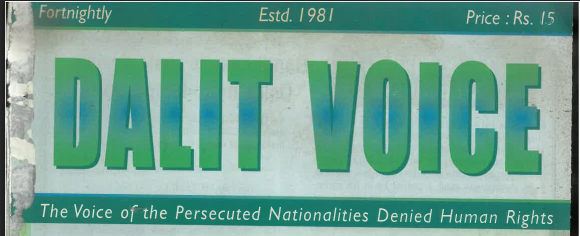
Producer-director Himalaya Tehsin, presently based at 53-Vidhayak Nivas, Lucknow, is noted for short films and documentaries. His father, Rajanikant Verma, a noted Buddhist, is the author of the book, Lumbini to Kushinara. Some ideas of the book are incorporated in the VCD.
The present production, which deals with the most valuable work of Anagarika Dhammapala from Sinhala, gives his early history. To mother Mallika and father Don Corolis, a son, Don David Hewavitarne, was born on Sept.17, 1864 in a noted nobleman family of Hewavitarne in furniture business in Lanka. Though the names were European due to foreign rule, their heart was purely Budhist. Having experienced humiliating treatment to Budhist processions, David was removed by his father from Mission School. He joined Theosophical Society, in 1884, and got busy editing their journals. He was brought to Adyar in South India by Madame Blavatsky and here he learned Pal language. He was ultimately converted to Budhism. In 1885, at the age of 21, he expressed his desire to be Anagarika Celibate and Homeless guardian of Dhamma and was renamed Dharmapala. He visited Northern India in 1891 with a Japanese monk and was distressed to see unpreserved and vandalized ruins at Sarnath. He visited Bodh Gaya and was further grieved to see the place of Enlightenment of the Budha in conditions humiliating the Budhist tenets by Pinda-daana etc. by the Brahmin priests. There he decided to devote his life for revival of the glory of Bodh Gaya and made his residence there and gave a call “Bodh Gaya for the Budhists”.
He formed in 1891, “Bodh Gaya Maha Bodhi Society” at Colombo and started a struggle to liberate Bodh Gaya from Brahmins, brought in four Bhikkus to reside at Bodh Gaya, started a school and a pubilication of a journal, opened office of Maha Bodhi Society in Calcutta in 1892 and convened an international conference in 1893. These activities were not liked by the Brahmins and their men attacked the Bhikkus in 1893.
His work in 1893 was remarkable. He attended the Parliament of World Religions at Chicago, and let the world know about the Budha — the “Light of Asia”. It was he who motivated Swami Vivekananda to attend the Chicago Conference and gave time to Vivekananda to speak from within the time allotted to him. Unfortunately, nobody mentions this fact and even this is not mentioned in the VCD also.
After his return from America, he installed a Japanese idol at Bodh Gaya temple in 1895. Brahmin agents attacked and threw away the idol, and Anagarika and Col. Olcott had to fight a legal battle up to the Calcutta High Court, in the famous ‘Bodh Gaya Temple Case”. Anagarika was supported by people like Rabindranath Tagore, and Vivekanand and in spite of opposition by Brahmins and by the British Commissioner of Patna, Anagarika did not leave Bodh Gaya. After six years of toil, Anagarika succeeded in touching Vajrasana, by fighting the Brahminical Social Order, by establishing that it was the place of enlightenment of the Budha, by establishing that the teachings of the Budha were opposed to Brahminism, and by liberating temple of Bodh Gaya, by including Budhists in the Management of the Bodh Gaya Temple. But he had to forgo the claim of footsteps and other archeological remains of the Budha, which are still neglected under the custody of the Brahmins.
Even the Maha Bodhi Society, established by Anagarika, admitted Brahmins and at one time Hindu terrorists like Shyama Prasad Mukherji were at the helm of affairs. And even now it is under the custody of Brahmins. It is mentioned that it is out of fear of Hindutvawadis. The fear is real, as Mahant Sudarshan Giri threatens, on camera, to convert the issue like that of Ayodhya.
In spite of such Brahmin opposition, Anagarika, the non-violent warrior of Budha, Dhamma and Sangha, worked hard to establish vihars and temples, and start publications, start organizations even in London, and established trusts donating his own inheritance. He took the issue of Bodh Gaya tempie even to Gandhi and Congress but without success. Organizations of Anagarika have flourished all around the world and carrying on excellent benevolent activities mostly in the fields of education.
But in spite of all efforts by present-day Budhists, the Bodh Gaya Temple could not be completely freed from the Brahmin control: This is a challenge to the present- day Budhists.
Only deficiency: Along with the history of Budha’s Dhamma Chakka Pavattana at Sarnath, the film deals with His attainment of Sambodhi at Bodh Gaya. The film has been beautifully pictured, with live scenes of various Budhists sites. with high grade photography and music with Sri Lankan choir of prayer singing. The important part of the film is the interviews of various dignitaries, including even of the Brahmin priests threatening.
As the film is mainly about Sinhalese contribution ¢ to revival of Buddhism in India, one need not expect it to mention Dr. Ambedkar’s work in the field, but it is rather unfortunate that it omits the work done by Ayothee Thass and P. Laxmi Narasu.
The film stresses that Anagarika never wished the temple would be controlled by Brahmins and wished the Budhists to be the custodians of Bodh Gaya Temple and Brahminic activities therein must stop. Film also stresses the cause of maha-abhi-nishkraman (renouncing the family life) by Siddhartha was on a dispute on water sharing of River Rohini as proclaimed by Dr. Ambedkar, and not seeing an old man, diseased man, funeral and a mendicant, as mentioned in traditional accounts.
On the whole, this film is a piece of treasure for every Budhist to have, and cherish as a valuable fortune.